Indian priest, nun get jail term for defying court order

A court in central India has sentenced a Catholic priest and a nun to two months each in jail for defying a court order to reinstate two students their school expelled two years ago.

The district court in Ujjain town of Madhya Pradesh state also asked Father Sebastian Mullamangalam, the then manager of St. Paul Convent School, and school principal Sister Archana to pay 1 million rupees (US$16,000) compensation to the students.

The court’s Jan. 6 order, made public three days later, also requires them to pay legal compensation to the state of US$3,200. The court, however, has kept its order in abeyance for a month to help the convicts appeal against the order in a higher court, failing which they will have to accept the sentence. Church officials have removed the accused priest and nun from the school and appointed new officials but maintained they committed no offence. The school is accused of illegally terminating three students at the end of academic year 2015, with a remark in their transfer certificate that their parents’ “behaviour was not good.”

Bangladesh cardinal reflects on visit by Pope Francis

Pope Francis’s visit to Bangladesh “was a celebration of our cultural identity, of harmony, of diversity, and peace,” according to the country’s first cardinal.

Card. Patrick D’Rozario, Archbishop of Dhaka, was in neighbouring India this week, on a family visit in Kolkata. During his stay, he spoke to Crux.

D’Rozario was created a cardinal by Francis on November 19, 2016.

“The expectations of the people – of everyone – was fulfilled: The Catholics, people of other denominations and other faiths, and of the government. All were actively involved in the preparation and participation, and God has done, providentially, much more than what we had planned.” The pope visited Bangladesh from Nov. 30-Dec. 2, 2017, following his Nov. 27-30 visit to Myanmar.

Besides sharing a border, the two countries are also intertwined with the ongoing Rohingya crisis. Over 500,000 of Myanmar’s Muslim minori-ty have fled to Bangladesh since August, creating a dire huma-nitarian situation.

There are only about 350,000 Catholics in Bangladesh, about 0.2% of the total population. The country is over 86% Muslim, while another 12% is Hindu. Among the events Francis attended during his visit to the country was an interfaith meeting, where he met with members of the Rohingya community.

“The Christians in particular were very, very happy,” the cardinal said.

“They got to see the pope close up at all of the four big events, and so many could – unexpectedly – touch the pope, and this for them was a blessing and grace-filled moment.”

Dalit assertions threaten Hindu hegemony

Indian Dalits, former-ly known as untouchables, are challenging the supre-macist ideology of hard-line Hindu groups. But rights activists are blaming Hindu fundamenta-lism for a recent attack on Dalits celebrating victory in a 19th century battle against their upper-caste overlords. A series of violent clashes between Dalits and higher-caste Maratha people were reported in several parts of western Maharashtra state in early January.

This follow a Jan. 1 attack on Dalit people marking the centenary of an 1818 battle between local rulers and forces of the British East India company. The battle in Bhima Koregaon village resulted in the British curtailing the dominance of local Maratha ruler Peshwa Bajirao II.

The rout has been celebrated by Dalits ever since.

However, this centenary year it turned violent, with one person killed and hundreds injured.

Media reports suggested that right-wing groups carrying saffron flags pelted Dalits with stones, prompting them to retaliate.

Thousands protest jailing of Christians in Indian state

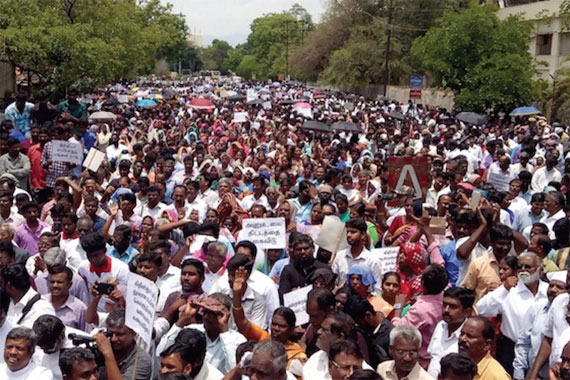
Some 5,000 Christians marched silently through India’s Jharkhand state demanding the release of six Christians jailed last week on complaints of offering money to villagers to attract them to Christianity. The Sept. 25 ecumenical “silent protest” was organized after a local court on Sept. 21 rejected the bail application of six Pentecostals, who were arrested Sept. 15 from Tukupani village in Simdega district.

“We wanted them to be released because they are innocent people who gathered for a prayer,” said Gladson Dungdung, a Catholic leader, who was among those who organized the protest in Tukupani. The court in Simdega district rejected the bail application of five men and a woman “seemingly under pressure from higher ups. But we are appealing to a higher court,” said Dungdung, who works for the rights of indigenous people. Bishop Vincent Barwa of Simdega said an “atmosphere of suspicion” exists after the state’s pro-Hindu government passed an anti-conversion law Aug. 12.

Church group crafts better future for Kashmiri artisans

At the extremity of the village, amid the dim winter weather, a melancholic song coming from a nearby mudhouse made itself heard with singular distinction. The owner of the voice, 24-year-old Uzma Mukhtar, is busy aesthetically carving designs on a woolen rug.

In September, Jammu and Kashmir Catholic Social Service Society, the social service wing of the Catholic Church in the Muslim-dominated state, held an awareness camp in Uzma’s village in Pulwama district.

Three churches bombed ahead of papal visit to Chile

A note said the next bomb would be ‘in your cassock.’ Three Catholic churches in the Chilean capital have been bombed just days before Pope Francis begins his tour of the country. The perpetrators placed incendiary devices in all three churches in Santiago, and in one church left a direct threat to the Pope, saying the next bombs would be “in your cassock”.

Chile’s outgoing president Michelle Bachelet said the events were “very strange, because it is not something that can be identified with one specific group”.

She added: “What I’ve been told is that, for example, [when the Pope visited] Colombia, there were groups there with a little sign [in protest]. In a democracy, people can express themselves as long as they do so in a peaceful and appropriate way.”

Authorities expect some protests over clerical sexual abuse during the Pope’s visit, however this is the first direct threat of violence.

The message in the church was written in Spanish, but with “x”s replacing all letters that signify grammatical gender, a practice typical among activists on the radical left.

The message reads: “We will never submit to the dominion you want to exercise over our bodies, our ideas and actions, because we were born free to chose the path we want to take. Against every monk and nun and against every preacher.Bodies free, impure and wild.” The perpetrators said they would attack the Pope’s “disgusting morals” with the “fire of combat”.Pope Francis is due to visit Chile from 15 to 18 January.

Survey of US Catholics shows refreshed enthusiasm among women

The survey used a nationally representa-tive sample of 1,507 self-identified American Catholics and was administered online by polling firm GfK. The data collection was partly funded by the Louisville Institute, the National Catholic Reporter, and other donors.

Women have been the backbone of the Catholic Church in the U.S. and other Western countries since at least the beginning of the 20th century. Despite disagreeing with various elements of church teaching, they have long maintained a higher degree of participation than men have in the church’s sacramental and communal life, and have also been instrumental in keeping men within the fold.

Our survey was not designed to explore any “Francis effect” on American Catholics – and indeed any study with that intent would be very complex and difficult to execute. But four years into Francis’ papacy, our survey’s replication of questions asked of American Catholics at previous intervals can help pinpoint new trends that may be coincidental with his tenure.

In the case of women’s commitment, the overall story is one of stability, and even slightly increased commitment, rather than further decline. Catholic women’s weekly Mass attendance has stabilized. In 2011, continuing a pattern of sharp decline from the late 1980s, 31% of women went to Mass weekly, and a similar proportion reported weekly Mass in 2017. Today, women are just slightly more likely than men to go to Mass at least weekly.

On two other indicators of commitment, women show more of an uptick since 2011.

An increase in the proportion of women who say that the church is among the most important things in their life, from 35% in 2011 to 39 % today. This finding is a reversal of the steady long-term trend of decline in the church’s importance to women. Until 2011, the church had consistently been less important to men, and its level of importance remains remarkably steady.

Part of the surprise in 2011 was the discovery that for the first time in 25 years, fewer women than men were saying that the church was among the most important parts of their life. With the 2017 data, women are once again more likely than men to regard the church as among the most important parts of their life.

Church attendance drops slightly in Poland

According to the report provided by the Institute for Catholic Church Statistics in Poland for 2016, 36.7% of all Catholics participated in the Sunday Eucharist, while 16% received Holy Communion.

This means that compared to 2015, the rate of dominicantes — that is Catholics participating in the Sunday Masses — fell by 3.1%, and the rate of communi-cantes — that is people receiving Holy Communion — by 1%. The highest rate of dominicantes (66.9%) and communicantes (25.3%) was in the Diocese of Tarnow. At the same time, almost 48,000 Masses were celebrated on every Sunday of 2016. Catholics chose most frequently Masses in the morning between 8 and 11.

The report of the Institute for Catholic Church Statistics in Poland also shows that in 2016, 2,300 seminarians studied in diocesan seminaries. The highest number of seminarians was registered in the Diocese of Tarnow (175), and in the Archdioceses of Warsaw (155) and of Przemysl (98). There were also 25,000 priests in the Polish dioceses, among which the highest number were in the Diocese of Tarnow (1,559), and the Archdioceses of Krakow (1,182) and of Katowice (1,071).

As far as male and female religious orders are concerned, there were in Poland 18,000 nuns and 11,900 friars. In addition, there were 83 contemplative monasteries in Poland, in which pray 1,300 nuns.

There are over more than 10,000 parishes in Poland, in which 35.7 million people live, while 2.4 million people live outside the country. In 2016, Baptism was granted to 374,300 people, about 5,000 more than a year earlier, while 138,300 people received the Sacrament of Marriage, 2,000 more than in 2015.

The Patriarch of Moscow: Russian intervention in Syria saved Christians from “genocide”

Thanks to Russia’s military intervention in the Syrian conflict, the “genocide” of Christians was stopped. And now, the Russian Orthodox Church will take on the task of supporting the reconstruction of Syrian churches, but also of mosques and historical monuments. This was stated by Kirill, Patriarch of Moscow and all the Russias, in the traditional television interview broadcast on Rossija channel 1 on Sunday 7 January, the day when Russian Orthodox Christians celebrated Christmas. In the interview, focusing on the condition and recent trials the Middle Eastern Christian communities have had to face, the Primate of the Russian Orthodox Church also re-proposed personal memories useful to account for the Russian approach regarding the Middle Eastern events of recent years. “In 2013,” said the Russian Patriarch, “the heads of local Orthodox Churches came to Moscow to celebrate the 1025th anniversary of the Baptism of Rus, and when they met Vladimir Putin, one of the strongest messages was the request that Russia should accept to take part in the protection of Christians in the Middle East. I am pleased,” Kirill added, “that this happened, and thanks to Russia’s interven-tion, the genocide of Christians was stopped.” The Head of the Russian Church confirmed the intention of the Patriarchate of Moscow to contribute to the humanitarian aid of Middle Eastern populations, and also to the reconstruction of “places of worship, monasteries, monuments, including Muslim monuments and historical monuments.” Kirill also reread in parallel the recent Syrian events and those related to the fall of the Iraqi regime of Saddam Hussein, emphasizing their impact on the condition of local Christian communities. According to the Russian Patriarch, “already in 2014 it was clear that the conflicts started in Syria were caused by extremist groups that, once they had reached power, they would have eliminated the Christian presence in that Country. This is why Christians actively supported Assad and his government “bearing in mind that with him” the Country had a certain balance of power and, very importantly, people felt safe.”

Catholics ‘fleeing Bosnia-Herzegovina’ over discrimination

‘It is harder for Catholics to defend their basic rights’ in the European country, Cardinal Vinko Puljiæ says.

Up to 10,000 Catholics are leaving Bosnia-Herzegovina every year because of state discrimination against the religious minority, according to the country’s cardinal.

Cardinal VinkoPuljiæ, Archbishop of Vrhbosna, highlighted the alarming exodus of the faithful in an interview with Catholic charity Aid to the Church in Need.

He told ACN that the on-going haemorrhaging was a legacy of the 1992-95 war that caused at least 250,000 of the faithful – around half the country’s Catholics – to become refugees.

The cardinal said: “During the war and in the immediate aftermath of the war most of the Catholics were expelled from their homes and there was a great deal of destruction and looting.

“After the war there was neither political nor financial support provided for an ongoing return of the refugees and expelled.”

Official Website

Exit mobile version