The survey used a nationally representa-tive sample of 1,507 self-identified American Catholics and was administered online by polling firm GfK. The data collection was partly funded by the Louisville Institute, the National Catholic Reporter, and other donors.
Women have been the backbone of the Catholic Church in the U.S. and other Western countries since at least the beginning of the 20th century. Despite disagreeing with various elements of church teaching, they have long maintained a higher degree of participation than men have in the church’s sacramental and communal life, and have also been instrumental in keeping men within the fold.
Our survey was not designed to explore any “Francis effect” on American Catholics – and indeed any study with that intent would be very complex and difficult to execute. But four years into Francis’ papacy, our survey’s replication of questions asked of American Catholics at previous intervals can help pinpoint new trends that may be coincidental with his tenure.
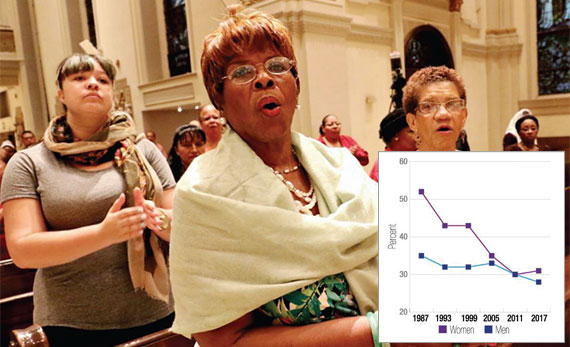
In the case of women’s commitment, the overall story is one of stability, and even slightly increased commitment, rather than further decline. Catholic women’s weekly Mass attendance has stabilized. In 2011, continuing a pattern of sharp decline from the late 1980s, 31% of women went to Mass weekly, and a similar proportion reported weekly Mass in 2017. Today, women are just slightly more likely than men to go to Mass at least weekly.
On two other indicators of commitment, women show more of an uptick since 2011.
An increase in the proportion of women who say that the church is among the most important things in their life, from 35% in 2011 to 39 % today. This finding is a reversal of the steady long-term trend of decline in the church’s importance to women. Until 2011, the church had consistently been less important to men, and its level of importance remains remarkably steady.
Part of the surprise in 2011 was the discovery that for the first time in 25 years, fewer women than men were saying that the church was among the most important parts of their life. With the 2017 data, women are once again more likely than men to regard the church as among the most important parts of their life.