
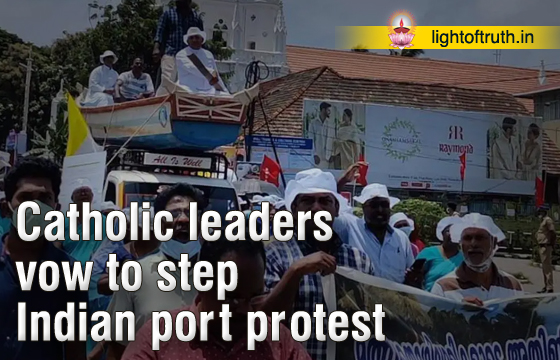
The protest by Catholic fishing communities seeking compensation from a multi-billion-dollar port project has entered its second month with their arch-bishop threatening to move his “stay and prayer” action to the protest venue in southern India.
“My stay and prayer will be moved to the protest venue from the archbishop’s house if required,” Archbishop Thomas Netto of Trivandrum said while addressing protesters in Kerala’s state capital on Aug. 23, as the protest entered its 34th day.
Thousands of fisherfolk under the leadership of archdiocesan bishops and priests have been protesting since July 20 against the multi-billion-dollar Adani Ports and Special Economic Zone on the coast of Vizhinjam.
They say the port endangers the livelihoods of fisher families, has displaced thousands of people and adversely affected the environment and caused coastal erosion.
The state government has ignored their demands which include suspending the project to study its environmental and social impact, rehabilitation of displaced people and employment for those who lost their livelihood and compensation for all who suffered damage.
“Fishermen and the Christian community believe Christ and the cross as everything in their lives. We know Christ died at the age of 33. His death brought liberation for humanity. We fight for justice trusting in Christ. We have nothing to lose,” said Arch-bishop Netto, a key figure in the protest who hails from a local parish.
“We are only asking the government to rehabilitate those who lost their houses.”
He announced the decision to intensify the agitation until the government accepts their demands. “I am ready to sacrifice my life for my people,” the arch-bishop said amid thunderous applause.

Film about Mother Teresa to hit theaters in October
A film presenting the life of St. Teresa of Calcutta, commonly referred to as Mother Teresa, will be premiering in theaters for two days in October.
In theaters Oct. 3-4, “Mother Teresa: No Greater Love” is airing in more than 960 locations across the United States. The film was produced by the Knights of Columbus, the world’s largest Catholic fraternal organization.
The film displays the life of the 20th-century saint and the impact both she and her Missionaries of Charity have had on the people they have served throughout the world. The Missionaries of Charity are a religious community dedicated to serving the poorest in society.
“The Missionaries of Charity are not publicity seekers,” David Naglieri, director of the film, told. “So, to have the opportunity to highlight the incredible work they do and the way that they live the Gospel, I think this story can positively impact people’s lives and draw them closer to their faith.”
Filmed on five continents, the documentary features “incredible access” to the apostolates run by the Missionaries of Charity, Naglieri said.
One of his favourite parts of the film includes footage in Kenya, where the Missionaries of Charity are caring for children with deformities and serious developmental disabilities.
The scene includes a Missionary of Charity sister feeding a baby with hydrocephalus, a condition in which fluid builds up in the brain.
“To see these children … and just the love and the care for that child was just something that deeply moved me,” he said.
“I think what sets this film apart is the fact that it comes 25 years after her death,” Naglieri said. “So it’s the first film that has had the chance to completely soak in her life, her legacy, and also deal with some of the information and revelations of Mother Teresa that came later.”
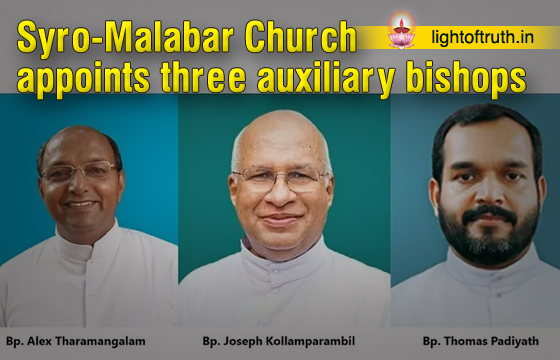
Syro-Malabar Church appoints three auxiliary bishops
The Syro-Malabar Church on August 25 announced the appointment of three auxiliary bishops for the larger of the two Oriental Catholic rites in India.
It also accepted the resignation of Auxiliary Bishop Jacob Muricken of Palai, who wants to lead an ascetic life.
Cardinal George Alencherry, who heads the Church as its Major Archbishop, appoint-ed Father Alex Tharamangalam as the auxiliary bishop of the eparchy of Mananthavady and Fathers Joseph Kollamparambil and Thomas Padiyath as auxiliaries of the eparchy of Shamshabad.
The announcement was made during the closing ceremony of second session of the Church’s 30th Synod of Bishops, after obtaining the assent of Pope Francis through the Apostolic Nuncio.
Since Tharamangalam is in Germany, he could not be present on the occasion. The other two were given the insignia by Cardinal Alencherry together with Bishop Raphael Thattil Shamshabad.
With the three new prelates, the Church has a total of 65 bishops, retired as well as active.
Bishop-designate Tharamangalam, a priest of the archdiocese of Thalassery, was born in 1958. He began his priestly forma-tion in the minor Seminary at Thalassery in 1973 and was ordained a priest on January 1, 1983. He holds a doctorate in philosophy from the Gregorian University, Rome.
Bishop-elect Kollamparambil, who was born in 1955, began his priestly training at the minor seminary of Palai diocese. He was ordained a priest on December 18, 198. He has served in several parishes of Palai diocese. Having secured a Master’s from St. Thomas College, Palai, he served as a lecturer, bursar and warden of the college hostel.
Bishop-elect Padiyath, a priest from the archdiocese of Changanacherry, was born in 1969. He entered the minor seminary in 1984 and was ordained a priest on December 29, 1994. He started his priestly ministry as the assistant vicar in Athirampuzha parish and secretary to Archbishop Joseph Powathil of Changnacherry. He has a doctorate in philosophy and a Master’s in theology from the University of Leuven, Belgium. He served as a professor at Good Shepherd Major Se-minary, Kunnoth in Kannur district. He has taught in several major seminaries and In-stitutions. He is currently serving as Syncellus in the Archeparchy of Changanacherry.

Japan’s blind probe against Unification Church must stop
Support for Prime Minister Fumio Kishida’s government in Japan has dropped to its lowest level since his election amid a quest to investigate lawmakers suspected of entertaining “connections” to the Unification Church.
Kishida’s support has fallen to 36% from 52% a month ago, according to a survey. As much as 87% of the survey participants said the Unification Church was either an “extreme problem” or “somewhat a problem” for the ruling Liberal Democratic Party.
It’s easy to figure out why. The Unification Church’s name has been essentially rendered synonymous with a religious scam following an unrelenting media campaign.
Thousands of Unification Church followers rallied in the South Korean capital Seoul last week protesting the negative Japanese media coverage of their religion. The protesters, mostly Japanese believers who moved to South Korea, say the Japanese media, in its improbable attempt to rationalize Shinzo Abe’s assassination, has unduly targeted their church.
Church members fear that the social persecution, on top of family pressure, will force them to recant their faith.
However, the social pressure could have nothing to do with the actual belief as the church in question is a sort of esoteric cult whose main surreptitious undertaking is to convince their faithful into donating all their savings to the organization.
“The mere suspicion of being in the wrong is already a sentence in East Asian countries”
What is important, particularly in East Asian culture, is the shame family members feel on being seen as relatives of someone who is part of a group whose public image is forever tarnished. That is what matters.
The mere suspicion of being in the wrong is already a sentence in East Asian countries. The substance of the claim doesn’t matter when evaluating reputation.
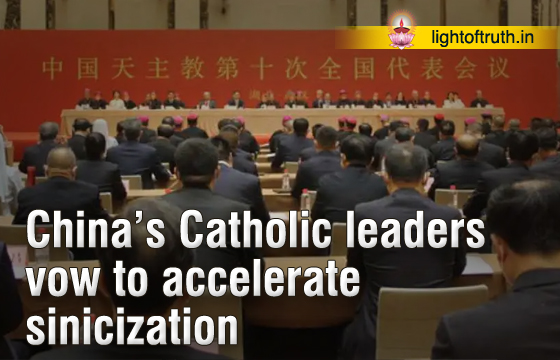
China’s Catholic leaders vow to accelerate sinicization
Two state-sponsored Church bodies in China have elected new leaders during a five-yearly national conference who promised to invigorate the Catholic faithful pastorally in line with the socialist principles of the Chinese Communist Party (CCP).
The three-day 10th National Congress of Catholicism in China ended in Wuhan, the capital of Hebei province in central China, on Aug. 20. Senior officials from the CCP also attended the gathering and delivered speeches.
The meeting attended by some 345 Catholic bishops, clergy, and religious from across China ended with the election of new leaders of the Chinese Catholic Patriotic Association (CCPA) and the Bishops’ Conference of the Catholic Church in China (BCCCC), says a report on the BCCCC website.
Archbishop Joseph Li Shan of Beijing was elected chairman of the CCPA and Bishop Joseph Shen Bin of Haimen was voted in as the new BCCCC chairman.
The delegates also unanimously accepted the Work Report of the 9th Standing Committee on Church efforts and activities in the promotion of patriotism, socialism, and sinicization in the Catholic Church as outlined by President Xi Jinping.
The new leaders have issued a statement to commit themselves to engaging priests, religious, and laypeople including elders across the country for pastoral evangelization and further promotion of sinicization for “truth, pragmatism and inspiration” to move ahead toward a “bright future.”
“It is important to adhere to the direction of sinicization of Catholicism in China”
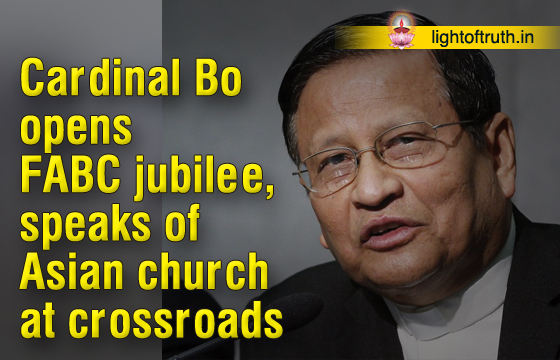
Cardinal Bo opens FABC jubilee, speaks of Asian church at crossroads
The Catholic Church in Asia stands at the crossroads of history amid poverty, climate change, political conflicts, disagreements and economic collapse, said a leading Asian church leader.
Cardinal Charles Bo of Myanmar, president of the Federation of Asian Bishops’ Conferences, made the comments during his address at the opening of the federation’s golden jubilee celebrations August 22. The jubilee programs will conclude Oct. 30, with a two-week FABC gathering in Bangkok.
“We gather amidst suffocating clouds of conflict and displacements, the collapse of the economy, frightening climate change, pandemic and starvation of millions. Secularism is on the ascendency in the traditionally Christian world,” said Bo.
Authoritarian leadership is also becoming the norm in too many countries, he added.
“Democracy faces stiff challenges. Fundamentalism and religious violence threaten global peace. We are called upon to examine ourselves as to what could be the role of Asian churches in these challenging moments,” the cardinal said.
“Asia is a virtual mosaic of cultures; the church reflected that diversity,” Bo said.
He said Asian Christianity is in the process of shedding its alien baggage and becoming truly indigenous to the region.
“The incorporation of the cultural and the religious is what theologians refer to as inculturation,” he said.
Cardinal said much had been achieved in the past 50 years, and he thanked the theologians and others who provided the intellectual identity to the FABC.
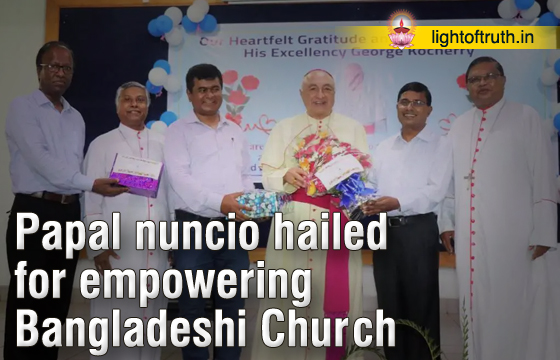
Papal nuncio hailed for empowering Bangladeshi Church
Catholics in Bangladesh have thanked the outgoing apostolic nuncio, Archbishop George Kocherry, for empowering the local Church and strengthening Church-state ties during his nearly ten years in the country.
“Today, all Catholic bishops express our heartfelt gratitude to you for your presence, accompaniment, and dedicated service. You are an experienced diplomat and pastor who built a very strong relationship between the government and the Church. Through your presence, the Catholic Church became more visible in Bangladesh,” said Oblate Archbishop Bejoy N. D’Cruze of Dhaka, president of the Catholic Bishops’ Conference of Bangladesh (CBCB)
Archbishop D’Cruze made the remark during a thanksgiving ceremony for Archbishop Kocherry arranged by the bishops at the CBCB centre in the capital Dhaka on Aug. 22.
Some 180 guests, including two arch-bishops, five bishops, vicar-generals, major superiors, and heads of Church-run organizations attended the event.
Archbishop D’Cruze also hailed the 77-year-old diplomat, who is scheduled to retire at the end of August, for his seminal efforts in realizing Pope Francis’s visit to Bangladesh in 2017 and guiding Catholic charity Caritas in supporting Rohingya refugees.
“During your time, the Church and Caritas Bangladesh came to the forefront. Especially, during the visit of Pope Francis and your loving care to the Rohingya, it is an extraordinary effort you have shown, a great sense of solidarity to Rohingya refugees,” the prelate added.
“He knew well how to maintain good relations with the government and people.”
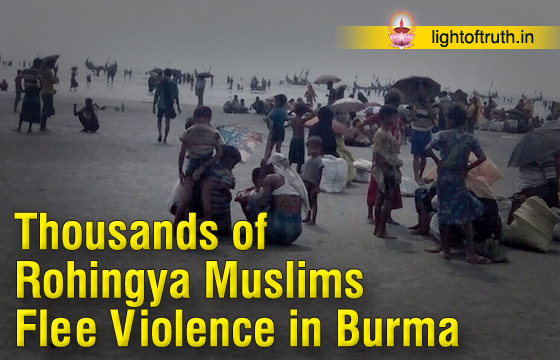
Thousands of Rohingya Muslims Flee Violence in Burma
The United Nations Refugee Agency reports that 123,000 people—mostly Rohingya Muslims—have fled into Bangladesh since August 25, escaping a new round of violence in Burma’s western Rakhine state. The refugees have walked for days, after a series of Rohingya insurgent attacks on Burmese police were met with a strong government response and the burning of thousands of homes. The Rohingya are a stateless Muslim minority living in parts of a hostile and overwhelmingly Buddhist Burma. U.N. officials say their relief camps are reaching full capacity as thousands of refugees continue to cross into Bangladesh.
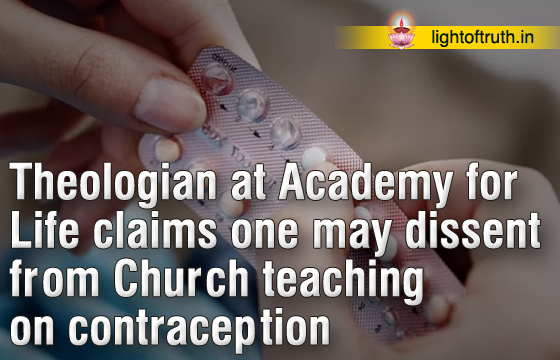
Theologian at Academy for Life claims one may dissent from Church teaching on contraception
The Pontifical Academy for Life has published an interview with a theologian who says Catholic teaching on contraception is open for “theological discussion, within the Church, and even the possibility of dissent.”
The interview with Father Maurizio Chiodi, a member of the Pontifical Academy for Life since 2017, was published in Italian and English and shared on the pontifical academy’s Twitter page. It was conducted by Fabrizio Mastrofini, the communications and social media manager of the Pontifical Academy for Life.
The Pontifical Academy for Life present-ed the interview with Chiodi as a clarification of the work of a 2021 seminar on ethics in which theologians debated a “basic text.”
One of the drafters of the Basic Text and participant in the conference, Fr. Maurizio Chiodi, answered some questions to clarify the meaning of the work done.
A Vatican-published book synthesizing the three-day conference recently came under fire for suggesting that the Catholic Church’s constant opposition to the use of contraception in marriage — clarified in the encyclical Humanae vitae — could change.
Father Chiodi in 2017 publicly argued that some circumstances in marriage could “require contraception” as a matter of responsibility.
In the Aug. 19 article, Chiodi said, “Humanae Vitae, like any encyclical, including Veritatis Splendor, is an authoritative document, but with no claim to infallibility.”
“When it comes to Humanae Vitae, and the earlier stance contained in Casti connubii — which was even stronger — we are in the realm of doctrina reformabilis (‘reformable doctrine’),” he said.
“This,” Chiodi added, “does not legitimize hastily substituting one’s own idea with the teaching of the magisterium, claiming for oneself an infallibility denied to the magisterium, but it does open up theological discussion, within the Church, and even the possibility of dissent, both for the individual believer and the theologian.”
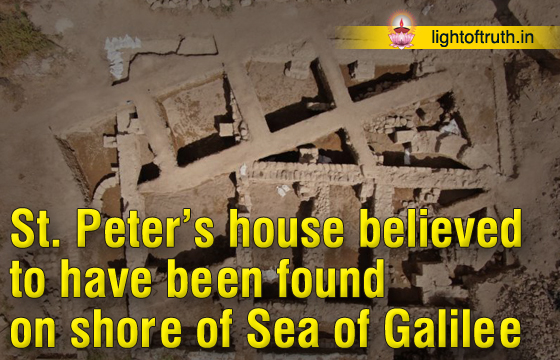
St. Peter’s house believed to have been found on shore of Sea of Galilee
A team of archaeologists’ uncovered evidence this month that may be the “smoking gun” con-firming the location of the house of St. Peter.
While excavating a fifth-sixth century Byzantine basilica at the el Araj archaeological site located on the shores of the Sea of Galilee in Israel, the team discovered a large Greek mosaic that seems to bolster the theory that the church was built over the home of Ss. Peter and Andrew.
Steven Notley, the academic director at the excavation of what is being called “The Church of the Apostles,” is a professor of the New Testament and Christian Origins at Nyack University. He told in a phone interview that the basilica’s mosaic is the “most definitive archaeological connection [we have] with [St.] Peter.”
The mosaic is inscribed with a petition that asks for the inter-cession of St. Peter, who is referred to as “the chief and commander of the heavenly apostles.”
Byzantine Christian writers commonly referred to the Apostle Peter by this title.
The inscription also mentions a donor named Constantine, “a servant of Christ,” and is framed in a round medallion with two strands of black tesserae, or glass mosaic pieces, that are part of a larger mosaic on the floor of the basilica’s sacristy.
The mosaic is inscribed with a petition that asks for the inter-cession of St. Peter, who is referred to as “the chief and commander of the heavenly apostles.” Steven Notley.