- Dr. Riju Veliyil
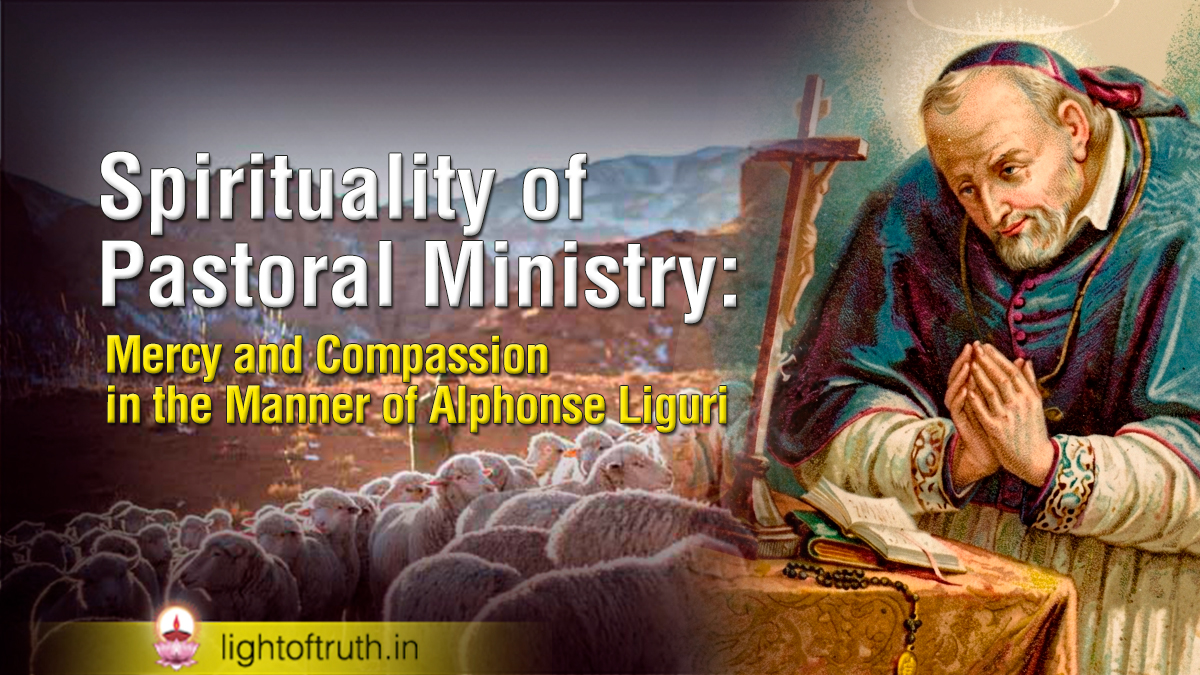
 On 1st August 2012, on the feast day of St. Alphonse Liguri Pope Benedict XVI spoke about the pastoral zeal of him. He said, “Alphonsus was one of the most popular saints of the 18th century because of his simple, immediate style and his teaching on the sacrament of Penance. Alphonsus was one of the greatest pastors and a doctor of the Catholic Church. In a period of great rigorism, he recommended that confessors shall express the joyful embrace and mercy of God the Father. In his personal life he was the object of the superabundant gift of God’s mercy. He became a missionary of mercy following Jesus who represented the God of mercy. Alphonsus lived like the good shepherd of the Gospel, who leaves the ninety-nine sheep to look for the one who is lost or misplaced. The ‘Mercy of God in calling sinners to repentance’ was the principal message of Alphonsian teaching. The Alphonsian narration of mercy was purely pastoral.
The Core of Alphonsian Outlook: Love and Mercy
The core of Alphonsus’ preaching and his writing was ‘Return love for love’. He said: “let us allow ourselves to be utterly captivated by the ‘crazy’ depth of God’s love for us, and to seek with our whole being to return love for love”. Commenting on this S. Devitt writes: “he spoke on the love of God shown to us in the Crib, on the Cross, in the Eucharist, and in the gift of Mary as the Mother of God who is also our Mother”. Love is the eye – opener and driving force for a praxis and culture of Mercy. God’s tender loving mercy is His response to human misery. The greater the misery is, the more abounding is the mercy.

God wants all saints and sinners, each one in his own state, the religious as a religious, the secular as secular, the priest as priest, the husband as husband, the merchant as merchant, and the soldier as soldier.

The Apostolic Exhortation Evangelii Gaudium of Pope Francis affirmed the centrality of mercy. The document says, “The salvation which God offers us is the work of his mercy. No human efforts, however good they may be, can enable us to merit so great a gift. God, by his sheer grace, draws us to himself and makes us one with him” (EG, no. 112).
Alphonsus never identified the sinner with sin. Sin is an absolute evil, but the sinner is essentially good. In keeping with the merciful kenosis of Christ, moral principles, without losing its mandatory character, reveals and give medicine to the wounded man to love God. Here Alphonsus says that the admonitions of the confessor are more effective than the sermons from the pulpit, since, the preacher does not know the circumstances, but the confessor knows; who therefore can make much better corrections and apply remedies to evil. He points out that a sincere commitment to continuous evangelization accompanied by pastoral dedication to mercy, not only simply interpreting sin as guilt, but first as a disease to be cured.
The complexity of our society and the rapidity of the changes increases practical conflicts between values and duties. According to Alphonsus accepting the merciful incarnation of the Truth is the basis to solve the perplexities of conscience. The depth and extent of Christ’s merciful love for us is through His incarnate life and the cross. Catholic Priests are the visible sign of the infinite mercy of God, “who pardons and illuminates the minds and hearts of sinners that they might convert and change their lives. The conscience that decides in favour of the law or of freedom must be confirmed by the dynamism of grace and charity, which is the life of Christ in us. The core of catholic morality according to Alphonsus Liguori, is Paul’s ‘Hymns to Charity’.
‘Mercy’ In the Life of Alphonsus Maria Liguori
The concept of mercy in the life of Alphonsus start from his personal experience with the abandoned and poor people or from the historical context in which he lived. The experience of mercy originates from his juridical, intellectual, social and theological formation. His juridical studies encouraged the completeness and typical interdisciplinary nature of a humanistic ideal from an early age, on the path of universal knowledge. Liguori’s life was a continuous exodus in search of himself and of the most fragile and spiritually abandoned. He begins to read the Gospel in the light of human history, marked by profound fragility. From the Gospel ideals, he began to understand the value of the love and justice of God. God doesn’t want to condemn man but to love. In the gospels, Jesus shows no tolerance for sin but is completely merciful to the sinner. Gospel narratives present Jesus as the one who welcomes sinners. Alphonsus never identified the sinner with sin. Sin is an absolute evil, but the sinner is basically good. He said: “We do not see Christ driving away the black sheep, but rather bringing the lost sheep back on his shoulders. According to the gospel, mercy is always the last word. At his time this was quite revolutionary.
Love also has a dynamism of its own: it does not know how to be idle and never says enough, it opens our eyes on the essential and enduring values of recovery, of the grace and goodness of God. Love fills man’s life, makes him happy with God, and makes him happy with everyone. Love is a total gift of self to God, it is an indissoluble bond, a need for completeness, a treasure to be purchased at great cost.
The self-offering of Christ is the highest manifestation of love and the resurrection is the concrete sign of redemption which gives humanity new hope. Sin certainly destroys the face of God, but sin has not erased the image of God from any person. God’s project of love has not changed. The mercy of God restores dignity and renews humanity through his Son. Christ died for everyone” (2 Cor 5, 14- 15), even for those who as free individuals wilfully refused their redemption. The one who is attracted by the love of Christ is capable of returning to God, and ‘perfection lies in the act of loving God wholeheartedly.
Mercy is the thorough re-establishment of communion between God and man. What David wrote comes true: Mercy and truth meet together, justice and peace will kiss each other (Ps 85, 10). When Justice and peace encountered restoration of relationship with God by the merits of Jesus Christ become easier. Aphonsus Liguori is an example of a zealous pastor. His life was combined with a course of action marked by a gentle and meek goodness. His service with orphans and those condemned to death was the first contact with misery as a young man. He said: ‘they are unhappy, but they are fortunate. Christ also wants to embrace these lost sheep’. He had a sense of great mercy towards these existential peripheries. In the presence of the poor and the suffering the rigorist tendency of that time seemed anti-evangelical. His own personal experiences and the love for the little ones formed him a practical human person.
A Merciful Pastoral Approcha
Pope Benedict XVI said: “The Church owes a debt of gratitude to the towering figure of St. Alphonsus Maria of Liguori, a model of missionary action which can also inspire us today for a new evangelization, especially among the poorest, and for building a more just, fraternal and united human coexistence”. St. Alphonsus became the promoter of a Merciful pastoral approach. It was the result of a lifelong process in him. During his seminary days the training given at the seminary was not exclusively bookish. It included participation in pastoral activities, either in the parishes of Naples through catechisms and visiting the sick especially the incurables. From 1724, Alphonse took part in popular missions preached by the society of Missioni Apostoliche. He was thus initiated into the practical exercises of the missions and into a converting and solid preaching. The magnificent pastoral reforms Alphonsus made were in the pulpit and confessional by replacing the pompous oratory of the time with the simplicity and kindness and mercy.
Alphonse brought no methodological novelty to the literary genre. His merit is in the solutions he gave respecting the requirements of the Gospel and of the human person. He also tried to reconcile the requirements of truth, while respecting the rights of conscience and the privileges of human freedom. Thus maintaining a blissful medium, by avoiding abstract principles for the compassionate pastoral action. Bernard Häring summarized very precisely that the strength of Alphonsus does in a pastoral outlook that creates a new synthesis between the casuistic and the call to Christian perfection. With this pastoral outlook Alphonsus wrote more than one hundred works on spirituality and theology.
Pastoral Care as Merciful Love
Once Pope Pius IX recollected on the uniqueness of Alphonsus Liguori’s writing saying, ‘the books of that man written with extraordinary feelings of tender mercy, transmit a singular love for Jesus Christ, trust in His mercy and merits, and arouse an immense veneration towards the Virgin Mother of God and the Saints. M. Teresi, Liguri’s biographer writs: ‘he was a priest with God’s own heart, a truly apostolic man, a sound dogmatic Doctor, a great father of many children, a bishop according to the sign of God’. He experienced the love of Jesus and those who came in to contact with him, saw in him the face of Jesus Christ.
Alphonsus never identified the sinner with sin. Sin is an absolute evil, but the sinner is essentially good. In keeping with the merciful kenosis of Christ, moral principles, without losing its mandatory character, reveals and give medicine to the wounded man to love God.
Alphonsus with personal experience and conviction asserted that lasting conversions takes place only through the attraction of love. Terrorizing souls with the fear of punishment generates only guilt feelings. This, in the long run turns into frustration that causes sinners to turn away from the source of salvation. In order to reach the abandoned and announce to them the certainty of God’s merciful pardon, Alphonsus used the ‘popular mission’ as a tool. He was convinced that God wants all saints and sinners, each one in his own state, the religious as a religious, the secular as secular, the priest as priest, the husband as husband, the merchant as merchant, and the soldier as soldier. In his time, preachers used to terrify sinners with homilies on hell and the eternal punishment. Alphonsus however was convinced that conversion takes place out of love and not out of terror and “God wishes all to be saved; eternal damnation is reserved only for the obstinate”. In order to carry out this every Christian, in fidelity to Christ, should always follow the path of mercy through the means of sharing, acceptance and accompaniment.
Love is the greatest of all gifts Alphonsus said. It is fire that flames, light that lights, water that fills, fertile dew that recreates the dormant, virtue that give strength, lace that tightens, treasure of all good things. Love also has a dynamism of its own: it does not know how to be idle and never says enough, it opens our eyes on the essential and enduring values of recovery, of the grace and goodness of God. Love fills man’s life, makes him happy with God, and makes him happy with everyone. Love is a total gift of self to God, it is an indissoluble bond, a need for completeness, a treasure to be purchased at great cost.
He instructs that there should always be five reflections for an effective merciful encounter during the missionary preaching. 1. Love for Jesus crucified; 2. Devotion to the Divine Mother; 3. The importance of the prayer; 4. Running away from sinful inclinations; 5. Souls who refuse themselves to confess their sins which ruin their existence. The sacrament of reconciliation is a living experience of merciful forgiveness in which God embraces with love his children who had turned away from him. In short, Alphonsus’ pastoral trust and his own personal experience moved him to say that it is necessary to love Jesus Christ, choose Mary as a model of perseverance, and dedicate in prayer for strength and receive the sacrament of confession to escape sinful occasions.