
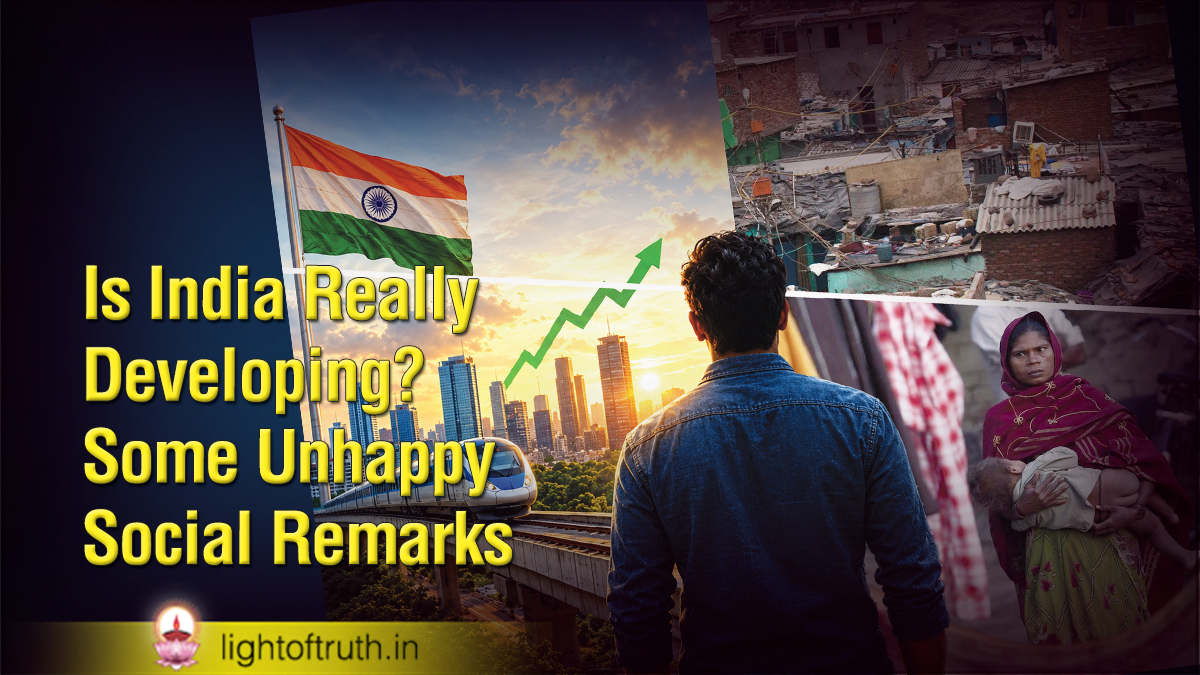
Everyone knows that development is not restricted to economic growth only. Therefore, the term development is defined in multiple ways. Amartya Sen defines development as “a process of expanding the real freedoms that people enjoy.” It creates an environment for a healthy and creative life in its fullness. Social development improves the wellbeing of every individual and their journey towards their dreams with confidence and dignity in society to attain their full potential. Social development is an attempt to change the structure and framework of society qualitatively. It is an investment to reduce poverty and to improve the quality of human relationships. Political will, ideology, and cooperation are the three requirements for any social development. Regarding India, the present social status has yet to empower the country’s people.
In the nutritional status India’s position remains worse than any other countries. India does not have a need-based strategy in healthcare thus far. Considering the diversified needs of people in rural, urban, and suburban areas, India requires a new strategy. Serious efforts should be made to utilize traditional skills in addition to the technology of modern science.
Considering the Social set up of India unemployment, underdeveloped education system, distressed healthcare, constraints on women, religious fundamentalism, mob lynching, and moral policing are some of the areas which need more concentration. Exploitation, oppression, male chauvinism, and patriarchal dominance are still predominant in the country. Hindu fundamentalist groups try hard to eliminate minority religious groups. Mob lynching has become one of the new forms of collective violence. Moral policing is yet another social deviation. India faces a political dilemma that hampers integral and sustainable development. The corrupt administrative system, deviations from constitutional provisions, the threat of corporatism, and populism are significant factors contributing to this political dilemma. The Indian administrative system is corrupt with utopian ethical-religious and political tentacles. A corrupt network engages in activities such as human trafficking, narcotic drug trade, illegal mining, encroachment of public land, and production of spurious drugs. The government needs to pay more attention to safeguard constitutional secularism.
Education is one of the keystones of development as it extends to the integration of people. Education is not only about the transmission of information, but also about experiences, skills, and the change of attitudes, as well as the inculcation of customs and beliefs. Character Formation and acquisition of knowledge are two essential elements of education. Training the students in moral values like tolerance, sincerity, honesty, and self-control are important. Besides, students must be able to earn their livelihood from the training they receive at schools and colleges.
In India education facilities are distributed unequally. Even now, backward castes are discriminated. Upper castes have a monopoly on sending children to schools and colleges. The development of rural areas depends on the education of rural children. Education of the rural population is not promoted wilfully. According to a UN Report, over one-third of children in India drop out before completing the elementary education. Many children from marginalized groups are denied indirectly from even elementary education. Approximately 20 million children from the poorest families and rural areas do not attend preschool education. Only about half of the children in India attain the stipulated level of reading and arithmetic calculation. The root cause of this shortfall in learning is the familial background of the children. The parents of these children have very little education and are unable to provide academic support. Teachers, parents and the governmental machineries practically not give much care for the process of education. Children of the low cast are not supposed to be educated.
Sustainable development relies on inclusive decision-making and strong ethical standards. Achieving national goals requires responsible resource management and the involvement of all groups-youth, families, women, leaders, and activists. Promoting peace depends on empowering civil society. Ethical government policies are vital for meeting basic needs.
A higher education system with better quality alone can provide skilled and qualified labourers. There are more than 18,000 higher education institutions in the country, but these institutions have yet to succeed in providing quality education. The government is not concerned about public educational institutions. Only a few government-funded higher educational institutions provide high-quality education. Unfortunately, in India, only one-fourth of the graduates from higher educational institutions are employable. While reviewing the growth of educational institutions in India over the last two decades, one understands that private educational institutions have grown exponentially.
India had a good history of primary health care, which dates back to the Vedic period. The health care concept included physical, mental, social, and spiritual wellbeing. In the early civilization, a daily routine called dina charya for all included personal hygiene and habits, dietary practices, food sanitation, codes of conduct and self-discipline. Healthy people are an indicator of a country’s growth. With an increase in the number of older people due to lower mortality rates the age distribution in the world population has changed drastically. Now in India older adults are more than 12.7% of the total population.
In the nutritional status India’s position remains worse than any other countries. India does not have a need-based strategy in healthcare thus far. Considering the diversified needs of people in rural, urban, and suburban areas, India requires a new strategy. Serious efforts should be made to utilize traditional skills in addition to the technology of modern science.
Too much privatization of the health sector is an unhealthy sign in a country like India because it shows the inability of the public health sector. Almost 70% of India’s population lives in rural areas. Poor people in northern and north-eastern India do not get sufficient health services. The real victims of this unregulated private sector are the poor people. Widespread corruption in the pharmaceutical industry, bribing doctors to prescribe particular drugs are common. Even the Governments led by the political parties make use of the healthcare sector for their vested interests than justice to be done to the poor people.
Section 15 of the Indian Medical Council Act, prohibits a person from practicing medicine without proper eligibility. There needs to be a more profound balance between the number of patients and doctors in India. According to WHO benchmarks, the ideal ratio is one doctor for 1000 people. It is estimated that India needs 4.3 lakh doctors more to the existing pool to reach the WHO standard. The northern states like Bihar, Chhattisgarh, Jharkhand, and Uttar Pradesh do not have the required ratio at all.
Practically, in India healthcare is virtually absent from public debate and democratic politics. Healthcare reform in India needs a political refocus. Equity must be essential for reform to achieve health security for all. ‘Quality health facility for all’ policy needs to be implemented in every district of the country. A proper healthcare financing policy for the unemployed, women, children, the elderly and those who are mentally challenged are necessary. There needs to be more public awareness about immunization and vaccination of children, especially among rural people.
- Constraints of Women in India
Ancient literary works like Patanjali and Katyayana indicate that women were educated in the early Vedic period. However, in the later periods, i.e., around 500 B.C., the status of women began to decline with the influence of Manusmriti. Child marriage, sati, and a ban on remarriage of women became part of Indian society. Women were even sexually exploited with the devadasi system in Hindu temples. Hindu Kshatriya rulers also practised polygamy. Despite these social barriers, some women engaged themselves in politics, literature, education, and religion.
Although traditions like sati, jauhar, child marriage, and devadasi have been banned, there are certain areas in India where these practices still exist. Although child marriage was banned in India in 1860, it is still practised in many areas of the country. The National Family Health Survey 2015-16 (NFHS-4) shows that 11.9% of girls aged 15-19 in India married before the legal age. It is reported that the devadasi system is still prevalent in Andra Pradesh, Karnataka and Tamil Nadu. In 2018, a census by the Karnataka State Woman Development Corporation reported that there are 9,733 devadasis in the state.
Exploitation, oppression, male chauvinism, and patriarchal dominance are still deeply rooted in the culture of India. Specifically, women are discriminated in areas such as healthcare, education, job opportunities, social equality, and justice. Women receive lesser health care than men, and they have deplorable working conditions and life protection. Very often, girls are not given adequate education. Women work longer hours than men, and their work is often not recognized. As the patriarchal system still prevails in India, women do not receive equality even though the Constitution guarantees it.
In the northern part of India, especially in Chhattisgarh, West Bengal, and Jharkhand, the Adivasi women are often threatened with rape by religious fundamentalists and mafia groups. Adivasis and Dalits are the worst victims of physical violence. Human trafficking is another threat against women in India. Minor girls are deployed as domestic helpers in big cities, no government want to address the issue. There are roughly around 14 lakh girls who are trafficked from different states across India and engaged in domestic work in Delhi. Unfortunately, the majority of trafficked girls remain unwed, and a large number of them become mothers. As alcoholism is often associated with violence and harassment against women.
The Constitution of India guarantees equality for all women (Article 14), no discrimination by the State (Article 15(1)), equal pay for equal work (Article 39(d)), and equality of opportunity (Article 16). Moreover, the Constitution provides provisions for women to have secure, just, and humane conditions for their work. Catholic voluntary associations and religious sisters who work in these ambient to uplift their conditions are often threatened by the big groups having political background. However, even in the 80th year of Independence, women are still trampled upon, due to the feeble implementation of the laws.
Fundamentalists are radical reactionaries, who try to grab power and throw societies into the dark ages of intolerance, oppression, and patriarchy. The idea of ‘Hindu Rashtra’ that emerged from Hindu religious fundamentalism is not only a threat to the unity, communal harmony, and progress of the country, but it also disintegrates the lives of people. The communal temperature was pushed up by the fundamentalist groups cherished the long-term agenda of creating a ‘Hindu Rashtra.’ The government pursues the ideological agenda of communalization of education. They try to put divisive and sectarian views to students by changing the syllabus of textbooks. Historians and a broad section of the Indian intelligentsia have voiced concern against this nefarious move. It is a fact that the Hindu-Muslim communal crisis and the conflict between the high castes and low castes persists in India. To date, it remains a challenge for the formation of an integrated society and an egalitarian polity. The latest outbreak of violence due to fundamentalism is in Manipur. Many people have been murdered, and more than 6000 FIRs have been registered since the ethnic violence broke out on May 3, 2023, between two groups. The polarization of different religious groups in India, primarily by the politicians, has created many riots and massacres in independent India. It has been kept alive by the present ruling regime for electoral gains and to remain in power.
When we evaluate the present circumstances of India as regards fundamentalism, it is pathetic to observe that the whole political scenario of India is opened up to fundamentalist politics. India has lost its communal harmony. In the multi-religious context of India, any development of the country is only possible with religious harmony. Unless and until India reiterates its harmony among people, the welfare of the people will be impossible.
- Mob Lynching and Moral Policing
Collective violence in India appears in four primary forms: lynching, rioting, vigilantism, and terrorism. It is a form of deviant behaviour. It is a form of mass hysteria and dictatorial domination of one group over another. Currently, mob lynching has become one of the new forms of collective violence against Dalits and minorities. Dalits have been discriminated against by dominant casts and have been bonded labourers for generations. When they began to protest against discrimination and injustice, they were hunted down, tortured, and even killed. In many instances, these poor people are lynched under the label of thieves and robbers. Unfortunately, as dominant Hindu groups receive protection from political leaders and police officials, there are hardly any legal actions taken against the perpetrators of such cruelties.
Another social deviation is the moral policing of the public. These acts are carried out by people who call themselves guardians of society. Sometimes, girls are humiliated and harassed publicly, and their dignity is violated. These self-proclaimed guardians of society assert that they uphold moral principles to sustain society.
In this scenario, public policy should enhance individual capabilities and uphold five key freedoms: political, economic, social, transparency, and security. Justice must guide sustainable development. Incorporating cultural values and fostering moral and social conscience with political and ecological awareness are vital for bridging the gap between current realities and aspirations. Sustainable development relies on inclusive decision-making and strong ethical standards. Achieving national goals requires responsible resource management and the involvement of all groups youth, families, women, leaders, and activists. Promoting peace depends on empowering civil society. Ethical government policies are vital for meeting basic needs.
It is our conviction that India’s progress should be oriented towards the wellbeing of its people. This entails the conceptualisation and actualisation of freedom, justice, and development, which are the essential components of overall wellbeing. To achieve this, India needs concrete public policies that reflect its culture, humankind’s deepest assumptions and beliefs, and life goals. We strongly advocate for a zero-tolerance approach towards corruption. We recommend that our leaders cultivate vision, self-awareness, relationship-management skills, and charisma to build bridges across disciplinary boundaries. In short, India must adopt a democratic socialistic pattern for sustainable and inclusive development, with a human face, based on equity reflected in justice, equal opportunity, prosperity, and security.





Leave a Comment