- Dr. Reena Rosy Nelson Anthikat
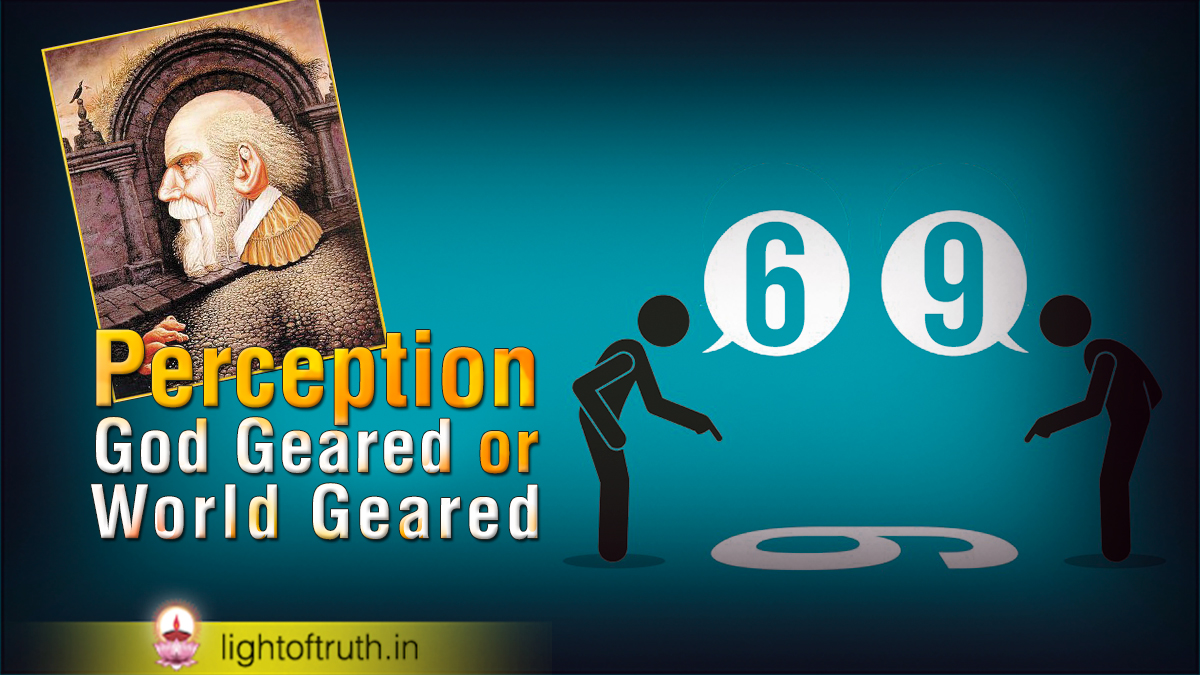
 We live in a postmodern world. Artificial Intelligence, robotic assistance, multi-faceted humanoids and many other factors are slowly starting to overpower human persons, his thinking patterns and behavior. Human values, interpretation and observance of such values are now at stake. Universality is now changing into individualistic patterns and group interests. Universal and Holistic approaches are diminishing…We are living in a world where ‘circumstances in which objective facts are less influential than appeals to emotions and personal belief in shaping public opinion’. The main element that geared this factor is the ‘perception’ of the person and society towards the day to day occurrences of life and the world; or one could say it is the result of an attitude toward the sum total of the common happenings in the present day.
What is perception?
Various studies and experiments are done and still going on to understand what ‘perception’ is. Because this is a decisive factor in the understanding of anything in this world. The objective realty, the subjective evaluation and understanding, all these depend on the perception of the person. So let us view some of the theories on perception. One of the theories is ‘Bottom-Up Processing’ and ‘Top-Down Processing.’ In the ‘Bottom-Up Processing’ perception starts with raw sensory data and builds up to complex interpretations and in ‘Top-Down Processing’ perception is influenced by prior knowledge and expectations.
Another is called ‘Gestalt Theory’. This theory depends on the emphases that “the whole is greater than the sum of its parts.” The human brain naturally organizes sensory input into meaningful patterns. The significant principles include: distinguishing an object (figure) from its background (Figure-Ground); grouping similar elements together (Similarity); grouping elements that are close to each other (Proximity); filling in missing information to perceive a complete image (Closure); seeing elements in continuous lines or patterns (Continuity). There are other theories also. These theories are mentioned in order to make clear that how the ‘perception’ in a person works out.

One’s thoughts, attitudes, and actions are crucial for cultivating a mind-set that can shape his/her perceptions. So if the mind-set is in line with God’s will it can produce positive perceptions. Through exploring the biblical perspectives on perception, one can learn how to see oneself, others, and the world around through the eyes of faith and love.

In association with the above observations on perception one could do an analysis in the ambient of human nature and spirituality and how these factors affect in the formation of ‘perception’. There is a book written by Subham Kumar Singh ‘You become what you think” concerning to the power of the human mind. Studies shows that one’s perceptions are not natural, it becomes natural or spontaneous through one’s repeated or constant activities and ambient in which one frequents. One’s thinking patterns, circumstances, the type of background in which the person is formed, the context at present one lives and the people in constant contact with, forms your perceptions and things becomes facts and real for him/her in accordance with the perception.
Perception: a Process
‘Perception’ is the process through which we interpret sensory information received, from environment, situations and incidents happening in each one and in others allowing us to make sense of the world around us. It’s more than just seeing, hearing, or feeling…scientifically speaking it’s about how our brain organizes and interprets these signals to form a coherent understanding of reality.
The process of ‘perception’ involves five key stages. The main aspect is the ‘stimulation’ received from the environment. These aspects received from the environment becomes sensory inputs. Anything that enters from the environment could become stimuli. ‘Organization’ is the second aspect. It is the process of grouping and structuring of the sensory data. This process lead to the third aspect ‘interpretation’. In this the organized sensory data is assigned and reach to a meaning. Then, this formulated new meaning is compared to previous experiences and this process is named ‘association’. The last in this process is the reactions based on the perceived information and it is called ‘action or response’. Thus analysis of the process of perception gives us the input that perception seems automatic, and it is deeply influenced by factors like past experiences, expectations, emotions, and culture.
One’s thoughts, attitudes, and actions are crucial for cultivating a mind-set that can shape his/her perceptions. So if the mind-set is in line with God’s will it can produce positive perceptions. Through exploring the biblical perspectives on perception, one can learn how to see oneself, others, and the world around through the eyes of faith and love. This formation is a journey of discovering the transformative power of perceiving life through a biblical lens. The Bible has much to say about perception, which refers how to interpret and understand the world around us. Each person’s perception depends and determines how one sees himself/herself, others, and even God. It can be influenced by thoughts, beliefs, experiences, and emotions.
Importance of the Word of God
The Bible offers unending wisdom on the importance of having a healthy and righteous perception. ‘Perception’ is often related to how individuals understand and interpret the teachings and messages. It involves the spiritual discernment and insight one gains from the Scriptures. It enables to see beyond the literal words and comprehend deeper meanings and truths. The Bible speaks about the importance of having an open heart and mind to perceive God’s will and guidance, as well as the ability to recognize spiritual truths and apply them to one’s life. Ultimately, perception according to the Bible is about gaining wisdom and understanding through faith and divine revelation.

In the context of the Bible, spiritual perception refers to the ability to discern and understand spiritual truths, insights, or realities through the guidance of the Holy Spirit. It involves seeing beyond the physical realm and gaining a deeper understanding of God’s will, His word, and His presence in lives.

Proverbs 23:7 says “For as he thinks in his heart, so is he.” This verse highlights the importance of thoughts and beliefs in shaping perception. In the same way Proverbs 4: 23 also says: “Above all else, guard your heart, for everything you do flows from it.” Perception is closely tied to the heart, so it is decisive to protect and nurture the heart to maintain healthy perceptions. St. Paul says: “Finally, brothers and sisters, whatever is true, whatever is noble, whatever is right, whatever is pure, whatever is lovely, whatever is admirable-if anything is excellent or praiseworthy-think about such things” (Philippians 4:8). These verses encourages us to focus on positive uplifting thoughts, as they influence our perception. Similarly 1 Corinthians 13:12 says: “For now we see only a reflection as in a mirror; then we shall see face to face. Now I know in part; then I shall know fully, even as I am fully known.” This reminds us that this current perception is limited and imperfect, but one day we will see things clearly as God sees them. In Matthew 7:1-2 it is said: “Do not judge, or you too will be judged. For in the same way you judge others, you will be judged, and with the measure you use, it will be measured to you.” This passage reminds us to be careful in our perception of others, as it will reflect back on us.
Spiritual perception is often associated with wisdom, discernment, and an intimacy to God that allows individuals to interpret and apply biblical teachings in a meaningful way. It is believed to be a gift from God that enables believers to see the world from a spiritual perspective and live according to His divine principles. In the context of the Bible, spiritual perception refers to the ability to discern and understand spiritual truths, insights, or realities through the guidance of the Holy Spirit. It involves seeing beyond the physical realm and gaining a deeper understanding of God’s will, His word, and His presence in lives.
Life in the presence of God
In order to have clarity in perception the first and basic aspect is the understanding of the Supreme. This factor is clear in Psalm 139:14, which says, “I praise you because I am fearfully and wonderfully made; your works are wonderful, I know that full well.” This verse highlights the idea that human being is charmingly created by God and is unique. Ephesians 2:10 says, “For we are God’s handiwork, created in Christ Jesus to do good works, which God prepared in advance for us to do.” It underscores the notion that each individual has a specific purpose and role in God’s plan, and should recognize one’s value and significance in His eyes.
All these verses and reflections brings to our mind that one needs formation based on God’s Love and providence. He is the true hope. In order to cultivate positive perceptions one needs the positivity of mind and senses as the Proverbs 2:3-5 says, “indeed, if you call out for insight and cry aloud for understanding, and if you look for it as for silver and search for it as for hidden treasure, then you will understand the fear of the Lord and find the knowledge of God.” Therefore, seeking wisdom and understanding with a humble and reverent heart, recognizing the importance of spiritual discernment in walking according to God’s ways are the necessary factors for a clear perception. The Bible emphasizes the importance of having a righteous and godly perception, rooted in truth, love, and wisdom. By aligning our perceptions with God’s perspective, we can route the complexities of life with clarity and purpose.
Wisdom and Knowledge
In relation with the above said, it is important to have an understanding of wisdom and knowledge for positive perception. Wisdom is acquired in three ways. Through age, experience and through the gifs of the Holy Spirit. Knowledge is possessing the facts. Wisdom is the ability to achieve the best ends with the facts. Wisdom is the ability to make good decisions based on the knowledge available. The wisest human may choose wrongly, if he do not possess all the facts. In the same way with the knowledge of everything one may go wrong if he evaluates unwisely. In God resides perfect knowledge and fullness of wisdom. There is nothing to add in God to increase his wisdom or Knowledge. Wisdom is desirable among humans because, in choosing the best outcomes, we look to serve the greater good.

to have positive perceptions one must be God geared. For that the best way is living in the presence of God. To live in the presence of God one needs interiority. Invest in the Bible reading attentively and pondering reflectively will give energy to have good perception. The enlightenment comes from investment in living according to the word of God

Here the words of St. James helps us to distinguish the worldly wisdom and Godly wisdom. It shall help one to cultivate good perceptions. St. James in his writings asks: “who is wise and understanding among you? By his good conduct let him show his works in the meekness of wisdom. But if you have bitter jealousy and selfish ambition in your hearts, it is earthly, unspiritual, and demonic. For where jealousy and selfish ambition exist, there will be disorder and every vile practice. But the wisdom from above is first pure, then peaceable, gentle, open to reason, full of mercy and compassion, impartial and sincere (James 3:13–18).
For a correct perception one must have the capacity to distinguish what is worldly wisdom and what is Godly wisdom. Worldly wisdom self-promotes. Godly wisdom elevates others. Worldly wisdom seeks the highest place. Godly wisdom seeks the lowest place. Worldly wisdom avoids the mirror of the Word. Godly wisdom submits to the mirror of the Word. Worldly wisdom trusts in earthly possessions. Godly wisdom trusts in treasures in heaven. Worldly wisdom boasts. Godly wisdom is slow to speak. Worldly wisdom says trials will crush you. Godly wisdom says trials will mature you. Worldly wisdom says temptation is no big deal. Godly wisdom says temptation indulged leads to death. Worldly wisdom says, “Seeing is believing.” Godly wisdom says, “Blessed are those who have not seen and yet have believed” (John 20:29).
Conclusion
So to have positive perceptions one must be God geared. For that the best way is living in the presence of God. To live in the presence of God one needs interiority. Investing in Bible reading attentively and pondering reflectively will give energy to have a good perception. The enlightenment comes from investment in living according to the Word of God…the Holy Scripture. Pay a genuine attention to striking a right balance between living a Word based life and exercise reasoning in order not to be geared by the world. Thus good perception needs formation. Formation of the integral person shall reveal the exactness of truth and reality.