
- Dr. Abraham Oliapurath
Normally, the aim of education is to get into a job that can guarantee a decent life. This gradually moved to the direction of clubbing education with business. And thus, it fell into the hand of corporates who provided job-oriented courses. Although education is not primarily aimed at procuring a job, the fact that it can be a facilitator for it cannot be overlooked. Because we are destined to earn our bread by the sweat of our brow, that dimension of education also deserves attention.
At present the field of education has been captured by powerful corporates. Thus, education has become an industry for which students are the raw material. Educational institutions could more aptly be called ‘education factories’. Some categories of education are publicized as status symbols that have a higher value. So, people are graded by the type of education they have received and the profession they are in. Consequently, there is a mad rush for institutions that provide engineering, medicine, MBA, BDS and MSW courses. In India, especially in the southern state of Kerala, quite a number of boys and girls prefer to have a nursing certificate that can land them a job in Europe or the Gulf countries, despite having the intellectual prowess and economic wherewithal to study weightier courses. Another concerning development is the shortage of students interested in the arts and humanities. They would rather choose hotel management, cookery etc. In the long run. it will adversely affect the culture and civilization of the country.
Life Oriented Education
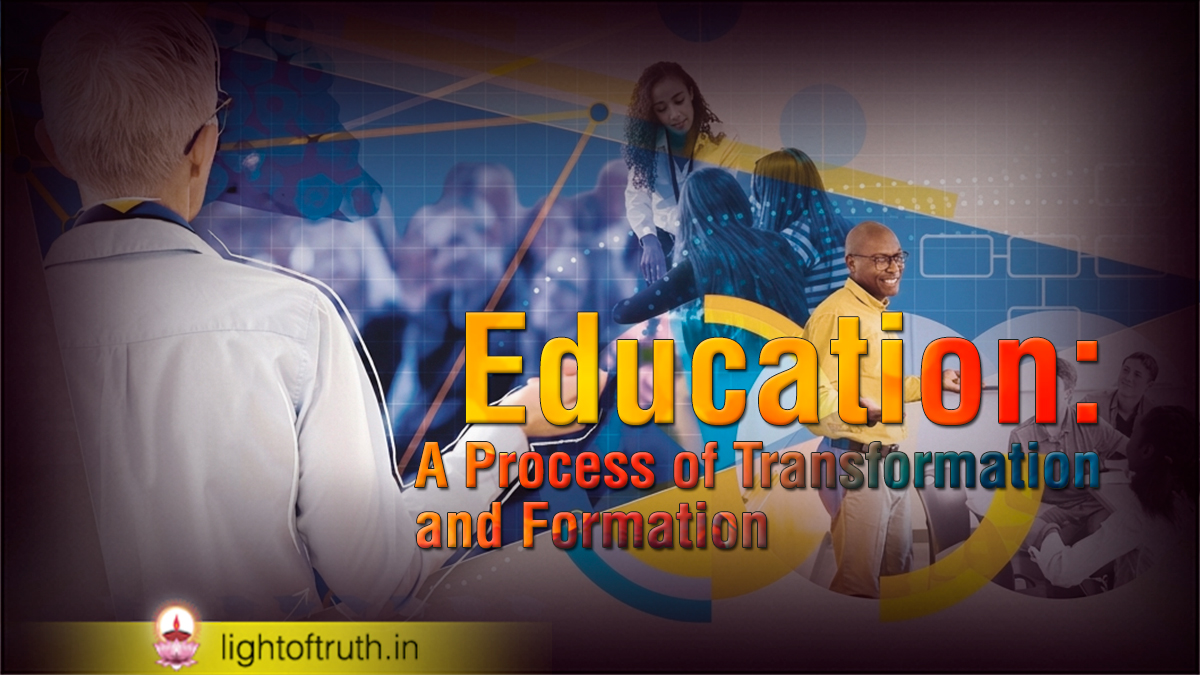
Judged by its core value, education is a process that helps a person in his/her integral growth. The most important aim of every hue of education is to promote one’s social and spiritual growth, which will assist a student to become a true and mature personality who can make valuable contributions to society and the world at large. Every genuine education encompasses information and transformation. All that the teacher conveys systematically to the students is information. It can be done through the medium of books, media, nature etc. Good education grooms a boy or a girl into strong and independent personalities. This process is also called integral growth, because it, along with information, moulds his/her intellectual, mental, emotional, artistic, spiritual, cultural, social and interpersonal capacities. This is what formation is all about. When a boy/girl gradually changes with age, not only physically but also in vision and outlook about himself/herself, the society and the world, education becomes transformative.

The most important aim of every hue of education is to promote one’s social and spiritual growth, which will assist a student to become a true and mature personality who can make valuable contributions to society and the world at large. Every genuine education encompasses information and transformation.

Life oriented education is not a job-oriented pursuit, it instead helps in the formation of an individual of integrity who is other-oriented and is capable of assimilating knowledge and wisdom. Devoid of this factor, education gets reduced to a tool to work with. It can’t impart ideals and principles to individuals or to society. Therefore, cultivation of humanness, mutual understanding, compassion, selflessness and tolerance should go hand in hand with education. That is not to discount the importance of the technical, informative and linguistic knowledge that students should acquire.
A child or youngster needs growth in knowledge and in wisdom. The Bible says that ‘fear of the Lord is the origin of wisdom’. So, to grow in wisdom’ training is also needed in religiosity for the child to grow in the fear of God. It should not get confined to ritualistic practices, but must also embrace the development of interiority and transcendence. Integral human growth depends also on the formation of interiority.
Teachers as the Corner Stone
In the discussion on the process of proper education, especially ‘education for integral growth’ or leading a mind from the darkness to light, from tabula rasa to clarity of mind, the all-important factor is the teacher. If teaching is considered only as a profession or only as a job than a service for the building up of the society, the teacher will not have the basic sincerity to build up good character in the students.
From the very beginning of the life of a child – from three years onwards – it is in the hands of the teacher, almost every day minimum 5 to 7 hours. It extends for more than 13 to 15 years. Practically, during its growth the child learns less from books than from the teachers it comes into contact with. The mannerisms, way of life, actions and attitudes of the child are imbibed from teachers. So, over and above the professional requirements of the job, teachers must possess humanness, compassion, discipline in life, mental stability, cheerfulness, positivity, fear of God, knowledge, intelligence and wisdom, which are the marks of a sterling personality. They must possess communicative skills. Actually, a teacher is imparting his/her personality and character to the child or student along with information and knowledge. So, their behavior, lifestyle, way of speaking, all shall be of a standard that suits a mentor. The teacher is a model and leader for his/her student. In that sense, who else can we think of as a better teacher than Jesus?
Jesus was a rabbi – the great teacher. He taught every one with love, with an aim that was targeted at the transformation of all whom he met. He used parables and life experiences to teach his audience, rendering his teaching simple and light. So He said: My yoke is easy to carry, and my burden is light. His miracles were intended only to convince people; it had nothing to do with vanity or self-esteem. Jesus was also an exceptionally good counsellor. A teacher also must be a good counsellor like him. Children are the budding generation. So, they must be treated accordingly. A good teacher must be a good consoler also. Their personality, qualities and abilities should be the sole criteria for choosing them.
Guru Nithyachythannya Yathi, a renowned Indian writer, addressing the teachers said: ‘dear teachers, please realize that the students (boys and girls) before you are like your own children; then begin to teach them. If you are unable to see them as your children please stop teaching.’ Those words of Yathi have far-reaching implications. If teachers see students as their children, they will totally dedicate themselves to their grooming. Nothing else will matter to them more. Just as no parent would ever want his/her children to go astray or fail in their studies, it should also pain teachers when one of their students becomes wayward. One could say every parent is a teacher and every teacher is a parent. It is better to send children to schools or educational institutions where the parents are working as teachers. Understanding teaching as a vocation rather than a profession is a great revelation. When considered as a vocation, education becomes a duty entrusted by the Supreme teacher or the Teacher of all teachers.
Higher education processes
Plainly speaking, higher education should be programmed to suit the taste, intellectual capacity, skills, and the social background of the students. In developed countries, education systems are monitored and promoted by the government. In India, we still stick to the old system, which provides certificates that are of little use. Very few get into institutions that provide quality education. Actually, the right thing would be to leave higher education to the choice of children. Parents and guardians should only support and guide them to select the best option that suits them. They should not be coerced into selecting the course or stream that parents, family, friends, religious leaders or even the teachers would want.
Good education will also teach the value and dignity of all kinds of jobs that provide service to society. It will also provide sufficient knowledge on various types of jobs that are suitable to student’s personal orientations, capacities and interests. If not, it will jeopardize the future of our youth. To avoid that, parents, teachers, and the society will have to work with one mind and heart to impart proper education.
Creative criticisms are always important for the healthy growth of the students, teachers and the institution. Teachers and the management must show tolerance for criticism. Sometimes the educational institutions run by the Christian community have to face unbearable criticisms. Most of the time the criticisms expose the expectations of the society. People wish to see Christian educational institutions as genuine, truthful, service-minded and standing with the poor and marginalized. So, when they deviate even a bit from them, people will criticize and suggest corrective measures. They can be of great help to keep abreast with changing times. Before starting an educational institution, Christian communities should think twice whether it will serve the promotion of Christian values. Will it be helpful for the poor and the marginalized? Will it be a counter witness rather than something that proclaims the glory of God?
A discussion on educational institutions will be incomplete without a reference to campus politics. Generally speaking, in a democratic system, educational institutions should provide a scope for practical politics. Along with knowledge, civic sense, freedom of expression, social commitment, cooperative efforts and the like, mature politics should also be cultivated in higher educational institutions. Campus politics can be of great help for it. In schools as well as higher educational institutions, healthy discussions, tolerance of difference of opinions and freedom of expression need to be promoted. From a very young age, students should be taught to distinguish between arguments and the people who make them. That is essential to prevent arguments from becoming a cause of enmity. Maturity of mind and emotions are very important in life. Students shall be given opportunities to learn all these aspects in their life. It will help transform campus politics and the participation in it into a useful form of art. Campus politics is a natural way of learning how to become a good collaborator, how to serve the people, and how delve into the burning issues of the state or the country. Man by nature is sociable. This nature leads him to associate or enter into various activities of a group. Educational institutions must positively cultivate this aspect among the students. The only danger that campus politics poses is misuse of youngsters as tools for political violence.
When educational institutions and teachers work in collaboration with dedication and without selfishness, there shall emerge an atmosphere of integral and balanced growth in the personality of the students. They will thus become valuable citizens of the country who are equipped with well-honed talents and skills.