
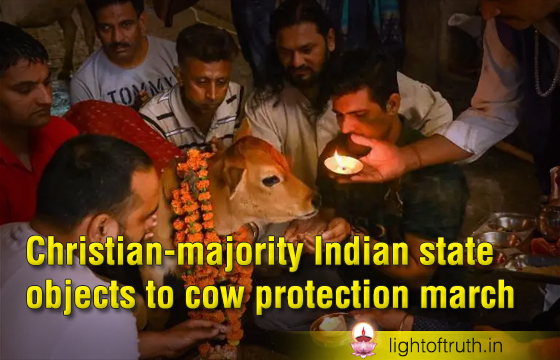
A Hindu group’s plan to campaign against cow slaughter in India’s Christian-majority Nagaland has invited criticism from several quarters, including the state’s ruling alliance. National-level Hindu leaders, such as Shankaracharya Avimukteshwaranand Maharaj of Jyotirmath, are scheduled to arrive for the Gau Dhwaj Yatra (cow protection march) set for Sept. 28. However, the state’s political parties say such a march would go against the sentiments of the 1.97 million people in the state, where the majority—88 percent—are Christians. A statement from the Nationalist Democratic Progressive Party (NDPP), which leads the state’s ruling alliance, said the “event would go against the sentiment of the majority of people.” m The march could disrupt the socio-religious harmony in the state, the statement added. Alliance partner, the pro-Hindu Bharatiya Janata Party (BJP) of Prime Minister Narendra Modi, urged the organisers “to reconsider the proposal.” The cow is a revered animal under Hinduism, and 20 of 28 Indian states have laws banning or regulating cow slaughter. The NDPP statement said the Nagaland legislature had already decided not to ban cow slaughter. The party observed that Nagaland became a state in 1963 under constitutional provisions safeguarding the social practices of its people, called the Nagas. In a statement, BJP Nagaland president Benjamin Yepthomi said the government of Nagaland should uphold the special provisions of the constitution. Two state legislators belonging to the Baptist Church also opposed the proposed event. Kuzholuzo Azo Nienu of the Nagaland People’s Front (NPF) expressed “shock” at the announcement of such an event in Nagaland, where beef is a staple for most Naga people. The march would be “tantamount to infringement on freedom of individual rights to choice of food.” In 2017, the NPF organised a “beef festival” in the state capital, Kohima, to protest the move to ban cow slaughter. Lawmaker Imkong L. Imchen from the BJP said the proposed march will not aid the cause of the right-wing party in Nagaland. “Beef is the most delicious food for the Nagas,” he told UCA News. As many as 20 Indian states have laws regulating the act of slaughtering cows. Leaders of religious minorities, such as Christians and Muslims, say cow vigilante groups have stepped up violence since Modi came to power in 2014.
All posts by Light of Truth

Indian diocese foils bid to install Hindu deity idol in college
An Indian prelate says his diocese has foiled an attempt by the student wing of the country’s ruling party to install a Hindu deity’s statue in a church-run college with police help. Members of the Akhil Bharatiya Vidyarthi Parishad (All India Students’ Council), affiliated to the pro-Hindu Bharatiya Janata Party (BJP) of Prime Minister Narendra Modi, insisted on installing Lord Ganesh’s statue at St. Mary’s P.G. College in Sagar diocese, in Madhya Pradesh state, on Sept. 7 the birthday of the elephant-headed deity. “It is true right-wing activists wanted to install the statue of Lord Ganesh, but we did not permit it because it is not our practice,” Bishop James Athikalam of Sagar told UCA News on Sept. 9. It is wrong on the part of right-wing Hindu groups and students “to force their religious practices on minority education institutions,” said Bishop Athikalam, citing India’s constitution. “We function as per the provisions of the law,” Athikalam added. Along with Muslims, Buddhists, Jains, Sikhs, and Parsees, Christians are grouped as a minority, and the constitution gives them freedom to practice and propagate their religion in their educational institutions. “We are not bound to follow religious practices of other religions on our campus,” Athikalam said. “It does not mean that we are against other religions.” We summoned the police against “a totally illegal act on our campus,” and they discouraged the students, the prelate said. As a compromise, the students were allowed to install the statue outside the campus. Hindus believe worshipping Lord Ganesh will help them overcome obstacles. The student wing of the BJP insisted on installing the statue in the more than two-decade-old Catholic college as the majority of students are Hindus. Its leader, Shalini Verma, told the media that “close to 90 percent of the students in the college are Hindus, and it is wrong to hurt their religious sentiments by denying permission to install the idol of Lord Ganesh.” We are grateful to the police for their support, the prelate said, adding we don’t “disrespect any religion.” Church-run educational institutions have been facing harassment from the ruling BJP in Madhya Pradesh, which has enacted a sweeping anti-conversion law, according to church leaders. On July 27, members of the All India Students’ Council forced their way into St. Peter Higher Secondary School in Jhabua diocese and demanded the removal of statues of St. Peter and Mother Mary and wanted portraits of Goddess Saraswati in their places. The ruling party’s student wing also created problems at St. Thomas Higher Secondary School in Mansuar district in the same diocese on June 27. A few days before, they entered the premises of Vandana Convent School under the Sagar diocese and sought action against the nun principal for allegedly hurting religious sentiments. Christians make up a mere 0.27 percent of 72 million people in Madhya Pradesh, most of them Hindus. Most Christians are from indigenous and lower-caste communities, which make up about 30 percent of the population of Madhya Pradesh.
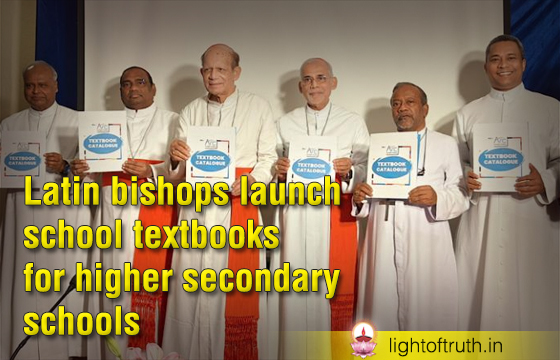
Latin bishops launch school textbooks for higher secondary schools
The Conference of Catholic Bishops of India (CCBI) on September 10 launched a set of 115 textbooks for schools under the Central Board of Secondary Education and the Indian Certificate of Secondary Education. CCBI president Cardinal Filipe Neri Ferrao, Archbishop of Goa and Daman, unveiled the textbooks at an event held at St. John’s National Academy of Health Sciences, Bengaluru.Present on the occasion were 40 bishops, including Cardinals Oswald Gracias and Anthony Poola, attending the CCBI Executive Committee meeting, along with educationists, major superiors, secretaries of the CCBI Commissions, and other dignitaries. “Education is a primary mission of the Church in India. With numerous schools across the country, we are committed to providing quality education to future generations. This new series of textbooks will further strengthen our education,” said Cardinal Ferrão. Cardinal Gracias, Archbishop of Bombay, congratulated those involved in publishing the textbook series for Catholic schools. Archbishop Peter Machado of Bangalore stressed the church’s responsibility in shaping future citizens who uphold both human and constitutional values. He also referred to the CCBI’s value education textbooks, launched in 2022, as an essential tool in this mission. The textbooks were published by Arclight Global, the CCBI’s publishing arm, established in 2022.The launch marks a significant step forward in the Church’s efforts to enhance educational resources in its schools across India, says Father Alathara.
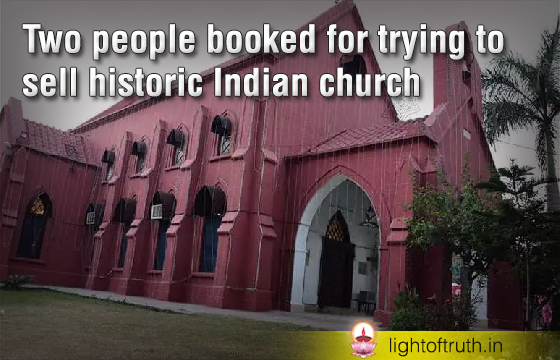
Two people booked for trying to sell historic Indian church
Police in a northern Indian state have booked two people for allegedly trying to sell off a more than a century-old Protestant church by posing as its office bearers. Police said Jordan Masih and Mary Wilson were arrested after they tried to sell the 129-year-old Golaknath Memorial Church in Punjab state’s Jalandhar city, posing as the treasurer and member of the church.Sanwar Bhatti, president of the United Church of Northern India Trust Association, which claims to hold a power of attorney for the church, told UCA News on Sept. 10 that they learnt about the fraud last week and complained to the police. Jalandhar police said the duo struck a deal with a prospective buyer and collected a token amount of 500,000 rupees (some $5,000) in June. “The duo is absconding, and police are trying to trace them,” Bhatti said. Pastor Nanook Bhatti, a Jalandhar-based Christian leader, told UCA News that media reports of the incident have shocked the local Christian community. “It is a very unfortunate thing to happen. But it is also a lesson to all Christians that they must be very alert about their church properties,” he said. Church sources said the church, located in the Mission Compound in Jalandhar city, is spread over 0.5 hectares of land and is valued at 1.5 billion Indian rupees (some US$19 million). The church also has historic significance as it is named after Golaknath Chatterjee, a Bengali Hindu convert to Christianity who renounced his home and became the first Indian missionary in the Punjab around 1830. Before him, the region was served by foreign missionaries. Pastor Amit Prakash, secretary of the Chandigarh diocese of the Church of North India (CNI), thanked the police for timely action as Masih was trying to register the deal at the land records office. Jordan Masih “is not a member of the CNI Church. He has a history of fraudulently selling church properties,” Prakash said. He said several people, like Masih, are targeting the properties owned by the CNI. “They pretend to be members and try to forge documents to make fraudulent deals,” the pastor added. Punjab is a Sikh-majority state where the rate of conversion to Christianity has been on the rise in recent decades, causing concern among the state’s Sikhs. Sikh preachers allege that Christians now constitute 10 percent of the northern state’s 28 million people.
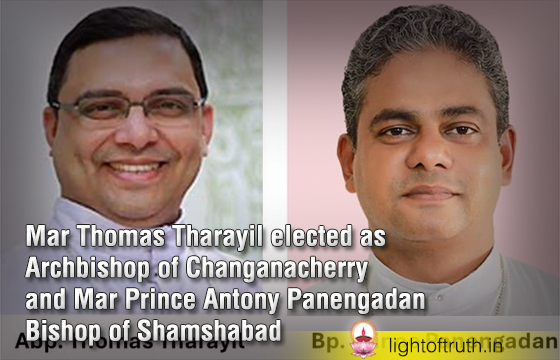
Mar Thomas Tharayil elected as Archbishop of Changanacherry and Mar Prince Antony Panengadan Bishop of Shamshabad
The Synod of the Syro-Malabar Major Archiepiscopal Church, gathered at Mount St. Thomas, Kerala, having received prior papal assent according to CCEO can. 184, canonically elected to the office of Archbishop of the Archeparchy of Changanacherry, Mar Thomas Tharayil (52), until present Auxiliary of the Archeparchy of Changanacherry, and Mar Prince Antony Panengadan (48), until present Bishop of the Eparchy of Adilabad. Both elections were made public on August 30, 2024. Archbishop Thomas Tharayil was born on February 2, 1972, in Changnacherry. He was ordained a priest on January 1, 2000, after completing his theological studies at St. Thomas Apostolic Seminary, Vadavathoor. He holds a doctorate in psychology from the Gregorian University in Rome and has served as Director of Danahalaya, an Institute of Formation in Alappuzha. Known for his expertise in psychology and as a retreat preacher, he was ordained as a bishop on April 23, 2017, and now assumes the role of Archbishop of Changanacherry.Bishop Prince Antony Panengadan was born on March 13, 1976, in Arimpur, Archdiocese of Trichur. He was ordained a priest on April 25, 2007, after completing his theological studies at Ruhalay Seminary, Ujjain. He later obtained a Doctorate in Biblical Theology from Urbaniana University, Rome. Bishop Panengadan has served as Assistant Parish Priest and priest-in-charge of mission stations in the Eparchy of Adilabad. He was ordained a bishop on October 29, 2015, and is now appointed as the Bishop of the Eparchy of Shamshabad.
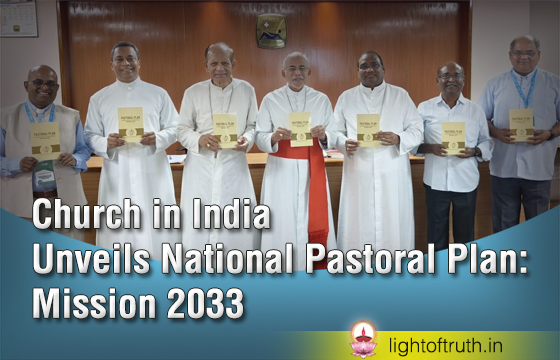
Church in India Unveils National Pastoral Plan: Mission 2033
The Conference of Catholic Bishops of India (CCBI) has launched its new National Pastoral Plan, titled “Journeying towards a Synodal Church: Mission 2033.” The plan was officially released by Cardinal Filipe Neri Ferrão, President of the CCBI, during a meeting at St. John’s National Institute of Health Sciences, Bangalore, on September 11, 2024. The event saw the presence of 40 bishops, along with 27 secretaries of CCBI Commissions and regional deputy secretaries from 14 regions of the CCBI. This initiative follows a year-long process involving over 5,000 members of the Latin Catholic Church in India, including bishops, clergy, religious leaders, men, women and youth. The focus is on answering a crucial question: “Where is God calling the Church to be by 2033?” “It is the fruit of conversations in the Spirit,” Cardinal Ferrão said. He emphasized that the plan is a collective project and called on every individual to contribute to its realization at parish, diocesan, regional and national levels. A committee, led by Bishop Gerald Isaac Lobo of Udupi, has been formed to oversee the implementation of the plan, which will be rolled out through the Commissions, Departments and Apostolates of the CCBI at the national, regional and diocesan levels.
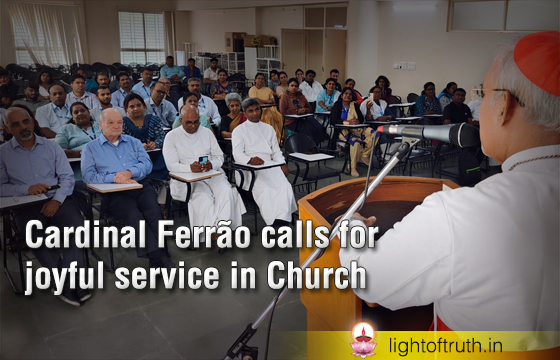
Cardinal Ferrão calls for joyful service in Church
Cardinal Filipe Neri Ferrão, president of the Conference of Catholic Bishops of India (CCBI), has urged people working for the conference to serve the Church with joy and dedication. The cardinal was addressing the staff of various CCBI secretariats on September 9 at Paalanaa Bhavana in the southern Indian city of Bengaluru, a press release issued by conference deputy secretary general Father Stephen Alathara.In his address, Cardinal Ferrão reminded the clergy, the religious, and the laity that a joyful heart is essential in carrying out their mission within the Church. He encouraged them to draw strength and inspiration through prayer and family life. He also urged them to reflect the love of Christ in all aspects of their service. He thanked them for their dedication.The program was attended by more than 52 staff members, including priests, religious, and laity, representing various offices such as the CCBI general secretariat, Pontifical Mission Organisations, Catholic Connect and Arclight Global.The CCBI’s Catholic Connect mobile app, launched in January, offers access to a wide range of spiritual resources, relevant news, and practical services, including health insurance, education, job opportunities and emergency assistance. Arclight Global, the publishing arm of the CCBI in collaboration with Asian Trade Cooperation, produces value education books and school textbooks.
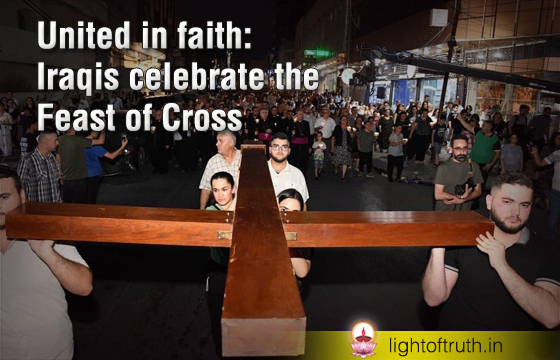
United in faith: Iraqis celebrate the Feast of Cross
A historic moment in Erbil, northern Iraq. In Ankawa, a suburb of the capital city of Iraqi Kurdistan located in the north of the country, hundreds of Christians are participating in the Feast of the Cross, which began on Monday 9 September and will continue until Friday. The joyous event is marked by high hopes given that the Christians of various traditions are coming together for the celebration – Catholic, Orthodox and Assyrian – the first time united together in celebrating the memory of the finding of the Holy Cross on which our Lord died for the redemption of all.
The focus of the celebrations underscores the faith that unites Christians. They are praying every day in a different church and participating in the various cultural meetings organised in the streets of the suburb, made festive with special lights and colours. All the events are part of the preparations for the liturgical Feast of the Exaltation of the Holy Cross, which will take place on 14 September for churches following the Gregorian calendar or 27 September for those following the Julian calendar.
At the opening of the festivities on Monday 9 September, a large cross was carried in procession to the Assyrian Church of the East of St. John the Baptist. The solemnity of the celebration was reflected in the hymns sung by the clergy and faithful holding large lit candles, a sign not only of praise and adoration but also of sharing and peace. “Churches used to celebrate this commemoration separately every year. But this year is wonderfully different,” underscored Monsignor Bashar Matti Warda, arch-parish priest of the Chaldean Catholic Diocese of Erbil, who organised the event with the blessing of Mar Awa III, Patriarch of the Assyrian Church of the East, and the Bishops of the Syro-Catholic and Syro-Orthodox Churches.
In his address during the festival, Patriarch Mar Awa III explained how “the celebration of the Feast of the Finding of the Cross of our Lord Jesus Christ represents an important milestone in the divine plan in the Church of the East. When we look at the cross, we remember the sufferings of Christ, but also his glorious resurrection from the dead. And when we make the sign of the cross over ourselves, we proclaim our expectation of his Second Advent and our faith in eternal life.”
The celebrations of the Feast of the Holy Cross represent a further and concrete step in ecumenism to which the Catholic Church attaches great importance, as Pope Francis affirmed in his Apostolic Exhortation Evangelii Gaudium: “commitment to ecumenism responds to the prayer of the Lord Jesus that ‘they may all be one.’”
The events also represent a positive sign for the future of Iraqi Christians: over time, wars, political instability and the rise of the Islamic State have driven thousands of Christians of all denominations out of the country. Just some time ago, Monsignor Bashar Matti Warda himself, in the absence of official statistics, declared that “in all of Iraq there are around 300,000 Christians remaining.” But hope remains alive despite the reduced numbers of this flock, as the Ankawa festival is proving.
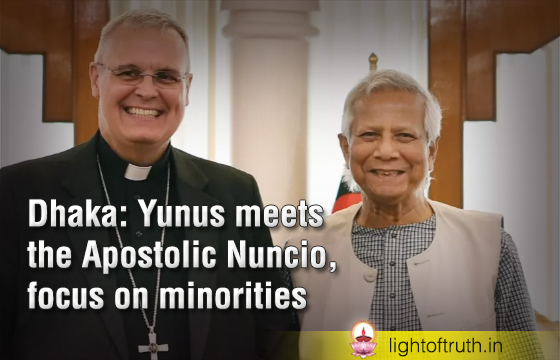
Dhaka: Yunus meets the Apostolic Nuncio, focus on minorities
On 9 September the Apostolic Nuncio to Bangladesh, Msgr Kevin S. Randall, met with Muhammad Yunus, Chief Advisor to the interim government created after former Prime Minister Sheikh Hasina fled to India.
At the Rashtriya Guest House Jamuna in Dhaka, the two discussed various issues, including the protection of religious minorities in the country. The nuncio proposed the creation of an institution for interreligious dialogue between the Vatican Delegation for Interreligious Dialogue and Bangladeshi scholars of Islam.
He went on to emphasise the need to increase humanitarian assistance for over one million Rohingya refugees living in camps in Cox’s Bazar. To which the Chief Advisor responded by asking for the Vatican’s support. After the meeting, Msgr Randall told AsiaNews he shared with Yunus ‘that Pope Francis is always concerned about the plight of the displaced people. The Church in Bangladesh, through Caritas, has been helping the Rohingya since 2017’.
On the other hand, Yunus, who won the Nobel Peace Prize in 2006 for fostering the development of microcredit in Bangladesh, emphasised that the interim government’s main goal is to improve security after last month’s protests (strikes and demonstrations are still ongoing in some outlying areas) and to implement major reform programmes.
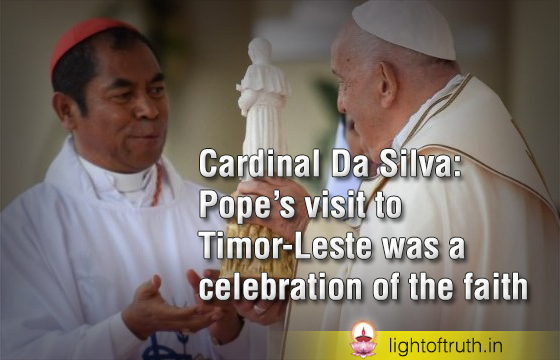
Cardinal Da Silva: Pope’s visit to Timor-Leste was a celebration of the faith
“It was a historical event, a celebration for the people of Timor, a celebration of the faith of the Catholic Church in Timor, years after the first visit of St. Pope John Paul II, and the first visit to our homeland as a sovereign nation.” In an interview with Vatican News’ Fr. Bernardo Suate, Cardinal Virgilio do Carma da Silva, Archbishop of Dili, described Pope Francis’ just-concluded Apostolic Visit to the nation, calling it “successful” thanks to all who made the Journey possible.
“The Pope’s visit,” Cardinal Da Silva observed, “affirmed and confirmed our identity, saying to the Timorese: ‘Even though we are small as a country, we have something unique, and that is our Catholic faith.'” “We are not Indonesians, nor are we Australians, but we are Timorese,” he said, noting that, as such, “we have our own unique Timorese and Catholic identity.” The fruits that “will be reaped from Pope Francis’ presence, for the Church, country, and society,” he insisted, are “reinforcing the faith” and “bringing peace to the young people of Timor.”
Even though Pope John Paul II visited the country when “we were still a colony under Indonesia, in a state of desperation,” the Cardinal highlighted that the former Pope’s message was “one of hope, namely to ‘Be firm in your faith, continue to be salt and light to the world.'” “After two decades of independence, the visit of Pope John Paul II, followed by Pope Francis’ visit, during these two decades of transition in the process of building a nation and a new identity,” Cardinal Da Silva expressed, “there was a new birth in this corner of the world.”
The Holy Father’s stay in the overwhelmingly Catholic-majority island nation, he noted, “was an opportunity to share with the world the reality of the Timorese people,” especially “the faith of the Timorese people, living the Catholic faith in this corner of the world.”
The Cardinal also recalled the “strong messages” the Holy Father left the nation’s young people, namely to be joyful and exuberant, and secondly, “to respect their elders, their parents, and the children.”
“When all young people and children continue to cultivate in their hearts this attitude of respect for others,” Cardinal Da Silva argued, “it will be a big step for us and will make a difference, especially after the Pope’s visit.”