
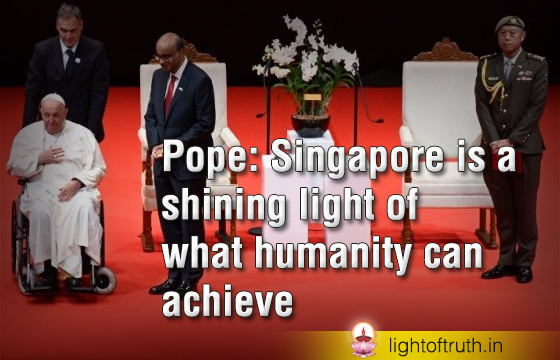
Addressing Authorities, Representatives of Civil Society, and members of the Diplomatic Corps at the National University of Singapore (NUS) , Pope Francis expressed his gratitude for the warm reception extended by the Singaporean authorities. He then opened his reflections by highlighting Singapore’s unique role in the world today as “a commercial crossroads of primary importance and a place where different peoples meet”.
The Pope emphasised the city-state’s transformation from its “humble origins” and commended its “unwavering commitment to carry out projects and initiatives” that have helped it develop. He noted that this progress was not achieved by chance, but through “rational decisions” and careful planning. Recalling, then, Lee Kuan Yew, Singapore’s first Prime Minister, the Pope noted his legacy, highlighting how his vision and leadership laid the foundation for the country’s rapid growth and transformation.
Pope Francis then went on to note that Singapore’s dedication is not only to economic growth but also to social justice and the common good. He acknowledged the country’s efforts in ensuring that all citizens benefit from progress, through policies that provide public housing, high-quality education, and an efficient healthcare system and he expressed his hope that these efforts will continue, “until all Singaporeans are able to benefit from them fully.”
However, the Pope also warned against the risk of placing “pragmatism or merit above all things,” which, he said, may inadvertently lead to the exclusion of the marginalised. In this regard, he stressed, as he often does, the importance of remembering the poor and the elderly, and of protecting the dignity of migrant workers. “These migrants contribute a great deal to society and should be guaranteed a fair wage”, he said.
The Pope then took some time to underscore the importance of nurturing authentic human relationships, particularly in the digital age. He urged Singaporeans to use technological advancements to “promote understanding and solidarity” rather than to isolate individuals in a “false and intangible reality.”
He also emphasised Singapore’s “harmonious” coexistence of various ethnicities, cultures, and religions. This inclusivity, said the Pope, is “facilitated by the impartiality of public authorities who engage in constructive dialogue with all,” ensuring that every individual can contribute to the common good. This mutual respect, dialogue, and cooperation, he continued, are essential in “avoiding conflict and chaos,” and in ensuring that development remains balanced and sustainable.
All posts by Light of Truth
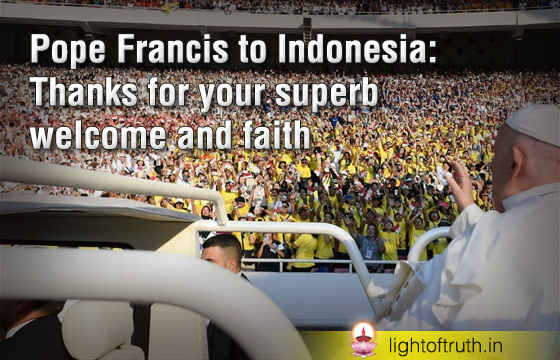
Pope Francis to Indonesia: Thanks for your superb welcome and faith
“May God bless you and make you grow and persevere in peace and fraternal love!”
This was the heartfelt wish Pope Francis offered the Church in the country of Indonesia at the conclusion of the Holy Mass for the faithful on 5 September. Catholics in the country make up about 3 percent of the population, numbering around 8 million. Addressing those gathered in Jakarta’s Gelora Bung Karno Stadium, the Pope thanked Cardinal Ignatius Suharyo Hardjoatmodjo, Archbishop of Jakarta, and the other Bishops of the Church in Indonesia.
He expressed his appreciation for the service of the country’s priests and deacons, who, he said, “serve the holy people of God in this great country.” The Pope also thanked the consecrated men and women, all the volunteers, and, “with great affection, the elderly, sick, and suffering who have been praying for us.” “My visit among you is drawing to an end, and I wish to express my joyful gratitude for the superb welcome that I have received,” he said. Renewing his gratitude to the President of the Republic, civil authorities and security services, the Holy Father expressed his appreciation to the entire Indonesian people. “Dear brothers and sisters,” Pope Francis concluded, “may God bless you and make you grow and persevere in peace and fraternal love!”
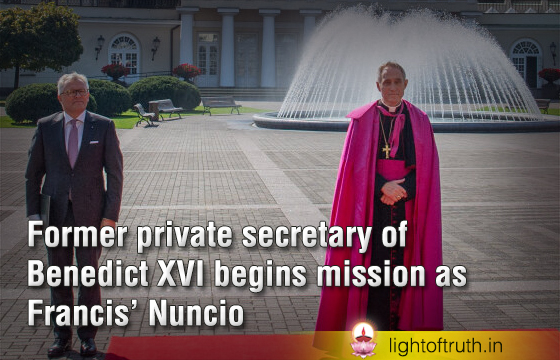
Former private secretary of Benedict XVI begins mission as Francis’ Nuncio
In a significant diplomatic move, Archbishop Georg Gänswein has formally assumed his position as the Vatican’s Apostolic Nuncio to the Baltic nations of Lithuania, Latvia, and Estonia. On Friday 6 September, the German prelate presented his credentials to Lithuanian President Gitanas Nausėda, marking the official start of his new diplomatic mission. Gänswein, once the trusted private secretary to Pope Benedict XVI, now steps into a role that bridges the Vatican’s relationship with a historically Catholic region during a time of heightened geopolitical tension.
Gänswein’s arrival in Vilnius was marked by a ceremonious display, with photographs from the Lithuanian presidential office capturing the archbishop in traditional clerical attire—a black cassock accented with a violet sash and cape—walking along the red carpet to the Presidential Palace. There, he delivered his credentials against the backdrop of the Lithuanian and Vatican flags, symbolizing the enduring diplomatic ties between the Holy See and Lithuania.
Archbishop Gänswein’s appointment to the Baltic region comes after a period of transition in his ecclesiastical career. Following the passing of Pope Benedict XVI, Gänswein was transferred back to his home archdiocese of Freiburg by Pope Francis in 2023 but without any specific role assigned. His new appointment as Apostolic Nuncio to Lithuania, Latvia, and Estonia in June 2024 signals a fresh chapter in his career, moving from his close ties with the late Benedict XVI to a critical diplomatic position in one of Europe’s most geopolitically sensitive regions.
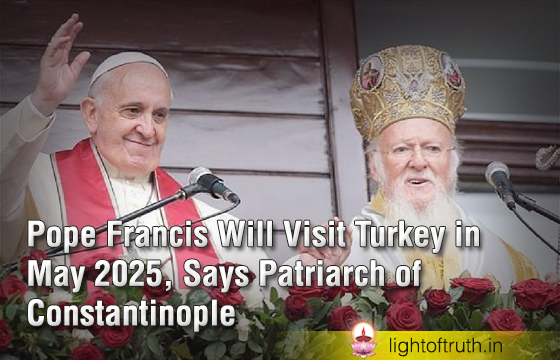
Pope Francis Will Visit Turkey in May 2025, Says Patriarch of Constantinople
Next May, Pope Francis will undertake a significant trip to Turkey, an event that promises to be both ecumenical as well as politically relevant. This journey, announced by the Ecumenical Patriarch of Constantinople Bartholomew I, will commemorate the 1700 years of the first Ecumenical Council of Nicaea, held in 325 in present day Iznik, Turkey. Bartholomew I revealed that both religious leaders have agreed to celebrate this important anniversary at the end of May. Up to now, the Holy Father had mentioned this event as a possibility, but now the Patriarch has confirmed the date. This meeting will not only be a historical celebration, but also an opportunity for the Orthodox and Catholic Churches to discuss the possibility of unifying the date of Easter. At present, these Churches celebrate Easter on different dates, due to the use of the Gregorian (Catholics) and Julian (Orthodox) calendars. Although the Assembly of the Orthodox Bishops of Istanbul has shown its support to a common date, a concrete proposal is yet to be presented. In 2025, Easter will fall on the same day, April 20, for both Christian Traditions.
Pope Francis’ trip will have a broader framework, namely, the 2025 Ordinary Jubilee. Added now, to the more than eighty celebrations foreseen for the Holy Year, is this journey to Turkey, one of the most important ecumenical events in the history of the Church.
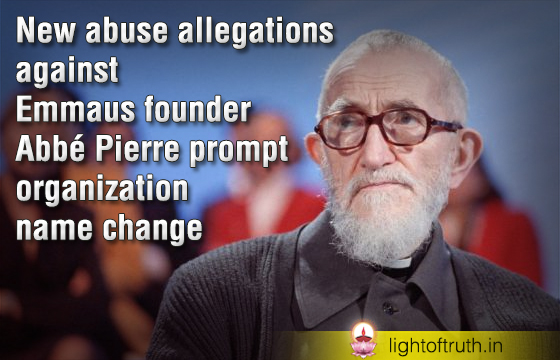
New abuse allegations against Emmaus founder Abbé Pierre prompt organization name change
A foundation that supports a prominent Catholic movement in France is changing its name after revealing nearly 20 fresh abuse allegations against the famed Abbé Pierre, a formerly beloved Capuchin priest who died in 2007.
A Sept. 6 statement released by Emmaus International, a solidarity movement with over 400 member associations that seeks to combat poverty and homelessness worldwide, detailed new allegations of sexual abuse and misconduct by Pierre, who founded the movement in 1949.
A previous July 17 report from Emmaus had detailed allegations involving at least seven victims, including one who was a minor at the time of her alleged assault. Emmaus France said it first received a report from a woman accusing Pierre of sexual assault in 2023.
The group said it commissioned consulting firm Groupe Egaé to set up a system to allow additional alleged victims to come forward. Since then, Groupe Egaé said, at least 17 additional victims have come forward alleging “sexual violence committed by Abbé Pierre against girls and women.”
In light of the allegations against its founder, the Abbé Pierre Foundation, which provided nearly 4 million euros (about $4.4 million) in funding to Emmaus in 2023, has “decided to change its name and has begun the necessary paperwork,” Emmaus International said last week. In addition to the foundation name change, the Emmaus France board will submit a proposal for the removal of “Abbé Pierre, founder” from its logo at an extraordinary general assembly that will take place in December.
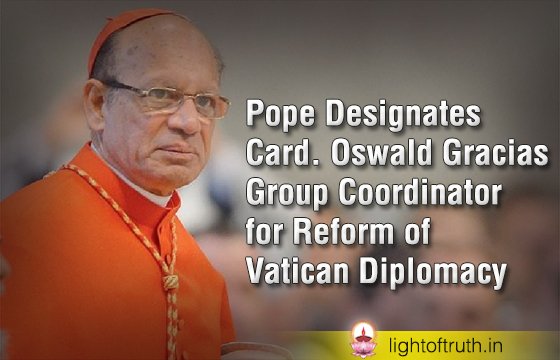
Pope Designates Card. Oswald Gracias Group Coordinator for Reform of Vatican Diplomacy
In a significant step towards the renewal of Vatican Diplomacy, Pope Francis designated Cardinal Oswald Gracias, Archbishop of Mumbai, one of the Pontiff’s principal advisers, Coordinator of a study group that will assess the role of Papal Representatives throughout the world. This move, promoted by the Pope’s reformist vision, seek that the Apostolic Nunciatures and other Holy See bodies operate in a more missionary and synodal way, in tune with the changes gestating in the Catholic Church.
The Nunciatures, which act as Embassies of the Vatican in the different countries, play a crucial role in the communication between the Pope and the local Churches, as well as in the representation of the Holy See to the Governments. Under the leadership of Cardinal Gracias, the study will focus on improving the functioning of these key institutions, guaranteeing that their work is not limited to a merely diplomatic role, but that it be more aligned with the pastoral and evangelizing mission of the Church.
Cardinal Gracias will not be alone in his task. Important figures such as Cardinal Mario Grech, Secretary General for the Synod of Bishops , and Monsignor Luciano Russo, Secretary of the Papal Representatives, will be at his side and contribute to the study that, according to Pope Francis’ expectations must be ready before June 2025.
This effort arises as part of a series of identified points by the Pope during the first session of the Synodal Assembly in October 2023. One of those issues is the need to redefine the relationship between the Papal Representations and the local Churches, ensuring that there is greater closeness and synergy between them. The final aim is that the Nunciatures be true bridges that foster understanding and cooperation on pastoral and ecclesial subject.
Although this topic will not be addressed directly in the next Synod session, planned for October 2024, it will offer participants a preliminary report, with the objective of detailing work plans and receiving feedback on the study’s progress.
On several occasions, Pope Francis has highlighted the importance of making the Church a more synodal institution, namely, that she listen and respond to the needs of the local communities. In this context, not only must the Nunciatures function as diplomatic delegations but also as vehicles that promote a spirit of collaboration and mission. This structural renewal is in consonance with the Pope’s pastoral focus, who has called the Church to come out of her traditional structures and be more active in evangelization and social commitment.
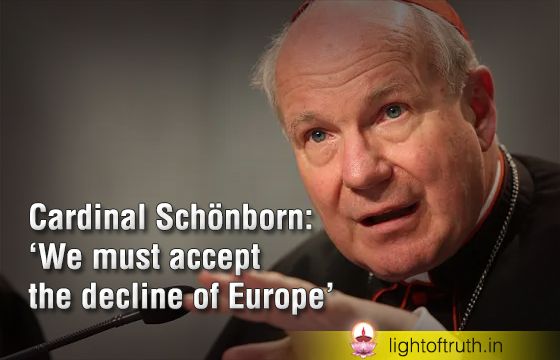
Cardinal Schönborn: ‘We must accept the decline of Europe’
Cardinal Christoph Schönborn, OP, archbishop of Vienna, said in a recent interview with a French Catholic magazine that in the face of rising secularization and the growth of Islam in many historically Christian nations, Catholics should “trust in the work of grace” and remember that the Church is “an expert in humanity.”
“The Church is alive and will always be, albeit under different circumstances. We must accept the decline of Europe. We tend to gaze at our ecclesiastical navel, but it is an undeniable continental movement,” Schönborn said, speaking to Famille Chrétienne.
“In 20 years, the European population will not be the same as it is today, and it is already not the same as it was 50 years ago. This is inevitable, above all due to the decline in the birth rate in Europe but also due to immigration and the increasing presence of Islam. This poses new challenges for us Christians. We must also not forget that the Lord is at work in his Church! Just think of the 12,000 baptisms of adults and young people in France this year.”
The Austrian cardinal, who helped to produce the Catechism of the Catholic Church, said that despite the decline of the Church’s influence in Europe, he is convinced that the Church “has not yet breathed its last.” “Despite secularization, the great questions of men and women remain the same as before: birth, growth, education, illness, economic worries. And then there is the family, marriage, and death,” Schönborn noted. “There is a lot of talk about change, but too little attention is paid to the constants of society. The Church must remember that it is an expert in humanity, as Paul VI said.”
The cardinal called the idea that France and Europe are “no longer Christian” because of Islam’s influence “absurd,” but he firmly stressed that “Catholics should return to the Church.”
If Catholics have left the Church, we should not be surprised that they are in the minority,” he continued, calling for a “fraternal rapprochement” with Islam, echoing the words of Pope Francis, noting that Christians “do not take up arms but trust in the work of grace.”
“Both our religions have an absolute appeal. For Muslims, God has demanded that the whole world be subjected to him and the Koran. As for Christ, he has entrusted us with a universal mission: ‘Make disciples of all nations.’ Neither of them can therefore renounce their mission. But the Christians’ way of acting is not that of the Koran but the following of Christ in all dimensions of our lives,” he said.
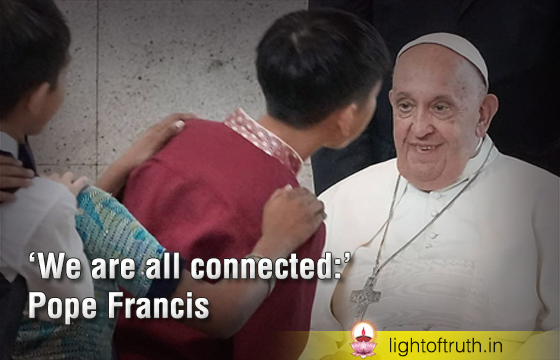
‘We are all connected:’ Pope Francis
“Be builders of hope,” Pope Francis told the over 100,000 Indonesian faithful gathered on Thursday afternoon to join him at Holy Mass in Jakarta’s main stadium, as his three-day visit to their nation came to an end.
“Guided by the word of the Lord,” he said during his homily, “I encourage you to sow seeds of love, confidently tread the path of dialogue, continue to show your goodness and kindness… and be builders of unity and peace.”
His appeal to foster fraternity in a divided and shattered world resonated loudly in this pluralistic and diverse nation of many islands, languages, and creeds.
It’s an overwhelmingly Muslim nation, proud of its tradition of tolerance and cohabitation, a nation that sought and found a friend and an ally in Pope Francis, who signed a joint declaration with the Grand Imam of Istiqlal Mosque, the largest in Southeast Asia, in which together they called for religious harmony for the sake of humanity and of creation.
The urgent need to foster and nurture Human Fraternity, the main leitmotif of the entire visit, permeated that ceremony in more ways than one when Pope Francis and the Imam stepped into the famous “Tunnel of Friendship“ that connects the Catholic Cathedral and the Mosque, both physically and symbolically.
“We all have a role to play in helping everyone pass through the tunnels of life with our eyes turned toward the light,” he said.
But the most luminous light of the day shone during his visit to a group of disabled persons waiting to welcome him at the nearby offices of the Indonesian Bishops’ Conference.
After listening to Andrew’s story of difficulty and hope, and having learnt of how Andrew has been chosen to participate in the Paralympics, the Pope expressed admiration for the young swimmer, turned to his hosts, and said: “You are all champions of love in the Olympics of life!”
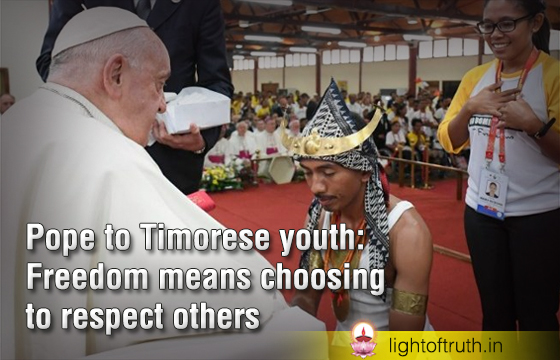
Pope to Timorese youth: Freedom means choosing to respect others
“I have two words of advice for you: make a mess and respect your elders!” Pope Francis offered those words of advice on September 11 as he met with the young people of Timor-Leste in the capital, Dili.
The encounter was held at the Congress Centre and was the final public event of the Holy Father’s Apostolic Journey to Timor-Leste. In his address, the Pope noted that young people make up a clear majority of the population of 1.4 million, of whom over 95% are Catholic, praising their enthusiasm in living the faith.
Pope Francis said he would never forget the smiles he found on the faces of the Timorese people. He also invited Timorese youth to recall the sacrifices their forefathers made in laying the foundations of the nation, and took the opportunity to urge them to respect their elders.
A society, he noted, has two treasures: young people and the elderly. “The children and the elderly,” said the Pope. “A society that has so many children like you must take care of them. And one that has so many elderly, who are the memory, must respect and care for them.”
Pope Francis spoke briefly about the three values of “freedom, commitment, and fraternity.”
He recalled a saying in the Tetum language of Timor-Leste—“ukun rasik-an” which means “everyone is able to govern themselves.” The Pope said young people should recall the true meaning and purpose of freedom. “To be free does not mean doing what we want,” he said, noting that freedom means respecting others and caring for our common home. He also recalled the value of “fraternity” and the importance of reconciliation. “You, in this smiling country, have a wonderful history of heroism, faith, martyrdom, and above all, faith and reconciliation,” he said. Pope Francis concluded his meeting with young Timorese by urging them to recall the example that Jesus gave in forgiveness and reconciliation.
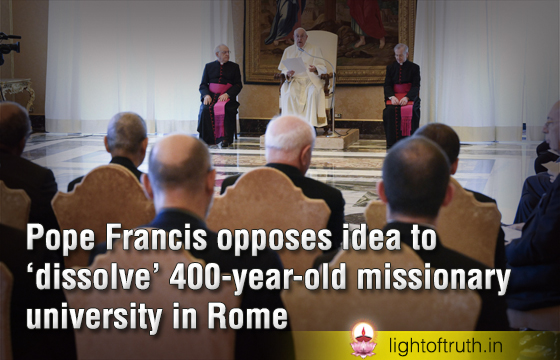
Pope Francis opposes idea to ‘dissolve’ 400-year-old missionary university in Rome
Pope Francis expressed disagreement with a proposal to absorb a 400-year-old missionary-focused university in Rome into other pontifical universities. Members of the Dicastery for Evangelization were meeting in an extraordinary plenary assembly Aug. 29–30 to discuss the future of the Pontifical Urban University, which educates priests and religious from the Catholic Church’s mission territories. “There is some plan to ‘dissolve’ [the university] with the other universities: No, this will not do,” Francis said in his address Aug. 30 to the cardinals, bishops, priests, and religious gathered for the plenary.
According to Agenzia Fides, a missionary-focused news age-ncy under the Dicastery for Evangelization, the Rome assembly is an intermediate step in discussions about “the present and future” of the Pontifical Urban University. Also known as the “Urbaniana,” the missionary university was founded as the Urban College in 1627 by Pope Urban VIII, part of the educa-tional aspect of the then-Sacred Congregation of Propaganda Fide. In 1962, it was elevated to a pontifical university. Its mission is to train and educate the priests, religious, and laypeople who help spread the Gospel in places with-out a strong Christian presence or where the Church has few financial resources.
In his speech on Friday, Pope Francis thanked the dicastery’s members for traveling to Rome “to reflect on the identity, mission, expectations, and future of the Pontifical Urbaniana University.” “I, too, would like to offer some thoughts on this,” he added, underlining that the Urbaniana “has its own identity.”
The pope reflected on the still-relevant missionary vocation of the Urban University and the need to balance that identity with the issues faced by the Church and world today.
He also said the need to raise the quality of educational and research offerings must be balanced with a necessary rationing of human and economic resources. ”Making good use of resources,” Francis said, “means unifying equal paths, sharing faculty from the six [pontifical] institutions, eliminating waste, planning activities wisely, and abandoning outdated practices and projects.” “In the specific case of the Urbaniana, it is important that, in the quality of the educational offerings, its missionary and intercultural specificity emerges even more, so that those who are being trained are able to mediate with originality the Christian message in the relationship with other cultures and religions,” he said.