
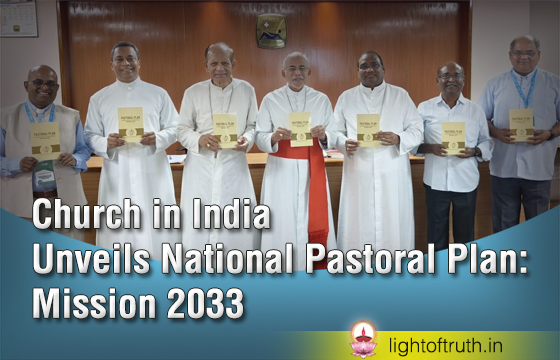
The Conference of Catholic Bishops of India (CCBI) has launched its new National Pastoral Plan, titled “Journeying towards a Synodal Church: Mission 2033.” The plan was officially released by Cardinal Filipe Neri Ferrão, President of the CCBI, during a meeting at St. John’s National Institute of Health Sciences, Bangalore, on September 11, 2024. The event saw the presence of 40 bishops, along with 27 secretaries of CCBI Commissions and regional deputy secretaries from 14 regions of the CCBI. This initiative follows a year-long process involving over 5,000 members of the Latin Catholic Church in India, including bishops, clergy, religious leaders, men, women and youth. The focus is on answering a crucial question: “Where is God calling the Church to be by 2033?” “It is the fruit of conversations in the Spirit,” Cardinal Ferrão said. He emphasized that the plan is a collective project and called on every individual to contribute to its realization at parish, diocesan, regional and national levels. A committee, led by Bishop Gerald Isaac Lobo of Udupi, has been formed to oversee the implementation of the plan, which will be rolled out through the Commissions, Departments and Apostolates of the CCBI at the national, regional and diocesan levels.
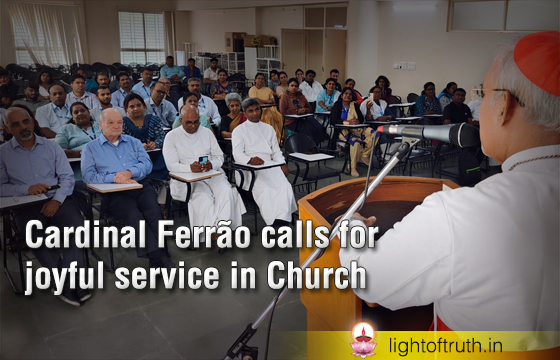
Cardinal Ferrão calls for joyful service in Church
Cardinal Filipe Neri Ferrão, president of the Conference of Catholic Bishops of India (CCBI), has urged people working for the conference to serve the Church with joy and dedication. The cardinal was addressing the staff of various CCBI secretariats on September 9 at Paalanaa Bhavana in the southern Indian city of Bengaluru, a press release issued by conference deputy secretary general Father Stephen Alathara.In his address, Cardinal Ferrão reminded the clergy, the religious, and the laity that a joyful heart is essential in carrying out their mission within the Church. He encouraged them to draw strength and inspiration through prayer and family life. He also urged them to reflect the love of Christ in all aspects of their service. He thanked them for their dedication.The program was attended by more than 52 staff members, including priests, religious, and laity, representing various offices such as the CCBI general secretariat, Pontifical Mission Organisations, Catholic Connect and Arclight Global.The CCBI’s Catholic Connect mobile app, launched in January, offers access to a wide range of spiritual resources, relevant news, and practical services, including health insurance, education, job opportunities and emergency assistance. Arclight Global, the publishing arm of the CCBI in collaboration with Asian Trade Cooperation, produces value education books and school textbooks.
United in faith: Iraqis celebrate the Feast of Cross
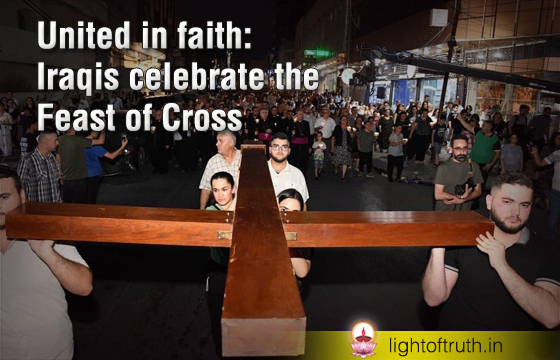
A historic moment in Erbil, northern Iraq. In Ankawa, a suburb of the capital city of Iraqi Kurdistan located in the north of the country, hundreds of Christians are participating in the Feast of the Cross, which began on Monday 9 September and will continue until Friday. The joyous event is marked by high hopes given that the Christians of various traditions are coming together for the celebration – Catholic, Orthodox and Assyrian – the first time united together in celebrating the memory of the finding of the Holy Cross on which our Lord died for the redemption of all.
The focus of the celebrations underscores the faith that unites Christians. They are praying every day in a different church and participating in the various cultural meetings organised in the streets of the suburb, made festive with special lights and colours. All the events are part of the preparations for the liturgical Feast of the Exaltation of the Holy Cross, which will take place on 14 September for churches following the Gregorian calendar or 27 September for those following the Julian calendar.
At the opening of the festivities on Monday 9 September, a large cross was carried in procession to the Assyrian Church of the East of St. John the Baptist. The solemnity of the celebration was reflected in the hymns sung by the clergy and faithful holding large lit candles, a sign not only of praise and adoration but also of sharing and peace. “Churches used to celebrate this commemoration separately every year. But this year is wonderfully different,” underscored Monsignor Bashar Matti Warda, arch-parish priest of the Chaldean Catholic Diocese of Erbil, who organised the event with the blessing of Mar Awa III, Patriarch of the Assyrian Church of the East, and the Bishops of the Syro-Catholic and Syro-Orthodox Churches.
In his address during the festival, Patriarch Mar Awa III explained how “the celebration of the Feast of the Finding of the Cross of our Lord Jesus Christ represents an important milestone in the divine plan in the Church of the East. When we look at the cross, we remember the sufferings of Christ, but also his glorious resurrection from the dead. And when we make the sign of the cross over ourselves, we proclaim our expectation of his Second Advent and our faith in eternal life.”
The celebrations of the Feast of the Holy Cross represent a further and concrete step in ecumenism to which the Catholic Church attaches great importance, as Pope Francis affirmed in his Apostolic Exhortation Evangelii Gaudium: “commitment to ecumenism responds to the prayer of the Lord Jesus that ‘they may all be one.’”
The events also represent a positive sign for the future of Iraqi Christians: over time, wars, political instability and the rise of the Islamic State have driven thousands of Christians of all denominations out of the country. Just some time ago, Monsignor Bashar Matti Warda himself, in the absence of official statistics, declared that “in all of Iraq there are around 300,000 Christians remaining.” But hope remains alive despite the reduced numbers of this flock, as the Ankawa festival is proving.
Dhaka: Yunus meets the Apostolic Nuncio, focus on minorities
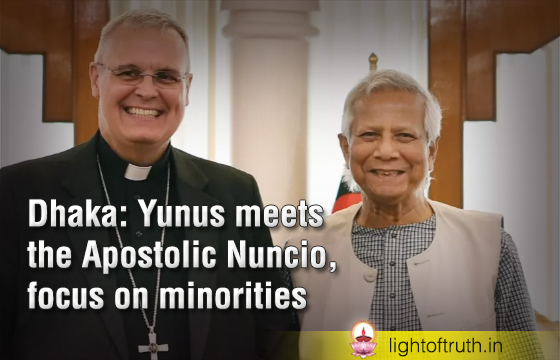
On 9 September the Apostolic Nuncio to Bangladesh, Msgr Kevin S. Randall, met with Muhammad Yunus, Chief Advisor to the interim government created after former Prime Minister Sheikh Hasina fled to India.
At the Rashtriya Guest House Jamuna in Dhaka, the two discussed various issues, including the protection of religious minorities in the country. The nuncio proposed the creation of an institution for interreligious dialogue between the Vatican Delegation for Interreligious Dialogue and Bangladeshi scholars of Islam.
He went on to emphasise the need to increase humanitarian assistance for over one million Rohingya refugees living in camps in Cox’s Bazar. To which the Chief Advisor responded by asking for the Vatican’s support. After the meeting, Msgr Randall told AsiaNews he shared with Yunus ‘that Pope Francis is always concerned about the plight of the displaced people. The Church in Bangladesh, through Caritas, has been helping the Rohingya since 2017’.
On the other hand, Yunus, who won the Nobel Peace Prize in 2006 for fostering the development of microcredit in Bangladesh, emphasised that the interim government’s main goal is to improve security after last month’s protests (strikes and demonstrations are still ongoing in some outlying areas) and to implement major reform programmes.
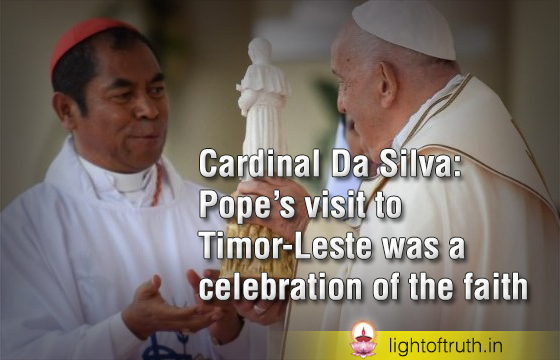
Cardinal Da Silva: Pope’s visit to Timor-Leste was a celebration of the faith
“It was a historical event, a celebration for the people of Timor, a celebration of the faith of the Catholic Church in Timor, years after the first visit of St. Pope John Paul II, and the first visit to our homeland as a sovereign nation.” In an interview with Vatican News’ Fr. Bernardo Suate, Cardinal Virgilio do Carma da Silva, Archbishop of Dili, described Pope Francis’ just-concluded Apostolic Visit to the nation, calling it “successful” thanks to all who made the Journey possible.
“The Pope’s visit,” Cardinal Da Silva observed, “affirmed and confirmed our identity, saying to the Timorese: ‘Even though we are small as a country, we have something unique, and that is our Catholic faith.'” “We are not Indonesians, nor are we Australians, but we are Timorese,” he said, noting that, as such, “we have our own unique Timorese and Catholic identity.” The fruits that “will be reaped from Pope Francis’ presence, for the Church, country, and society,” he insisted, are “reinforcing the faith” and “bringing peace to the young people of Timor.”
Even though Pope John Paul II visited the country when “we were still a colony under Indonesia, in a state of desperation,” the Cardinal highlighted that the former Pope’s message was “one of hope, namely to ‘Be firm in your faith, continue to be salt and light to the world.'” “After two decades of independence, the visit of Pope John Paul II, followed by Pope Francis’ visit, during these two decades of transition in the process of building a nation and a new identity,” Cardinal Da Silva expressed, “there was a new birth in this corner of the world.”
The Holy Father’s stay in the overwhelmingly Catholic-majority island nation, he noted, “was an opportunity to share with the world the reality of the Timorese people,” especially “the faith of the Timorese people, living the Catholic faith in this corner of the world.”
The Cardinal also recalled the “strong messages” the Holy Father left the nation’s young people, namely to be joyful and exuberant, and secondly, “to respect their elders, their parents, and the children.”
“When all young people and children continue to cultivate in their hearts this attitude of respect for others,” Cardinal Da Silva argued, “it will be a big step for us and will make a difference, especially after the Pope’s visit.”
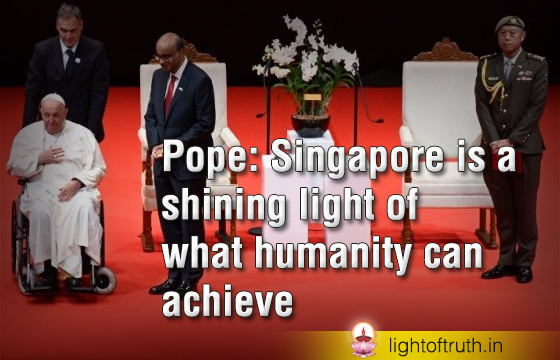
Pope: Singapore is a shining light of what humanity can achieve
Addressing Authorities, Representatives of Civil Society, and members of the Diplomatic Corps at the National University of Singapore (NUS) , Pope Francis expressed his gratitude for the warm reception extended by the Singaporean authorities. He then opened his reflections by highlighting Singapore’s unique role in the world today as “a commercial crossroads of primary importance and a place where different peoples meet”.
The Pope emphasised the city-state’s transformation from its “humble origins” and commended its “unwavering commitment to carry out projects and initiatives” that have helped it develop. He noted that this progress was not achieved by chance, but through “rational decisions” and careful planning. Recalling, then, Lee Kuan Yew, Singapore’s first Prime Minister, the Pope noted his legacy, highlighting how his vision and leadership laid the foundation for the country’s rapid growth and transformation.
Pope Francis then went on to note that Singapore’s dedication is not only to economic growth but also to social justice and the common good. He acknowledged the country’s efforts in ensuring that all citizens benefit from progress, through policies that provide public housing, high-quality education, and an efficient healthcare system and he expressed his hope that these efforts will continue, “until all Singaporeans are able to benefit from them fully.”
However, the Pope also warned against the risk of placing “pragmatism or merit above all things,” which, he said, may inadvertently lead to the exclusion of the marginalised. In this regard, he stressed, as he often does, the importance of remembering the poor and the elderly, and of protecting the dignity of migrant workers. “These migrants contribute a great deal to society and should be guaranteed a fair wage”, he said.
The Pope then took some time to underscore the importance of nurturing authentic human relationships, particularly in the digital age. He urged Singaporeans to use technological advancements to “promote understanding and solidarity” rather than to isolate individuals in a “false and intangible reality.”
He also emphasised Singapore’s “harmonious” coexistence of various ethnicities, cultures, and religions. This inclusivity, said the Pope, is “facilitated by the impartiality of public authorities who engage in constructive dialogue with all,” ensuring that every individual can contribute to the common good. This mutual respect, dialogue, and cooperation, he continued, are essential in “avoiding conflict and chaos,” and in ensuring that development remains balanced and sustainable.
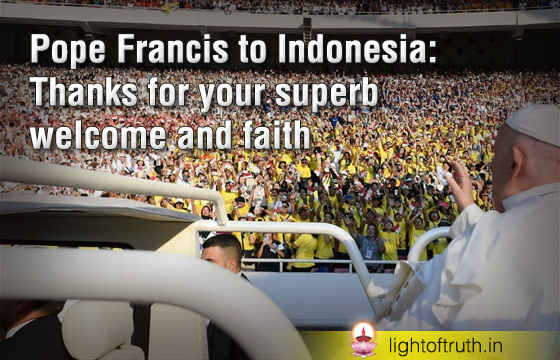
Pope Francis to Indonesia: Thanks for your superb welcome and faith
“May God bless you and make you grow and persevere in peace and fraternal love!”
This was the heartfelt wish Pope Francis offered the Church in the country of Indonesia at the conclusion of the Holy Mass for the faithful on 5 September. Catholics in the country make up about 3 percent of the population, numbering around 8 million. Addressing those gathered in Jakarta’s Gelora Bung Karno Stadium, the Pope thanked Cardinal Ignatius Suharyo Hardjoatmodjo, Archbishop of Jakarta, and the other Bishops of the Church in Indonesia.
He expressed his appreciation for the service of the country’s priests and deacons, who, he said, “serve the holy people of God in this great country.” The Pope also thanked the consecrated men and women, all the volunteers, and, “with great affection, the elderly, sick, and suffering who have been praying for us.” “My visit among you is drawing to an end, and I wish to express my joyful gratitude for the superb welcome that I have received,” he said. Renewing his gratitude to the President of the Republic, civil authorities and security services, the Holy Father expressed his appreciation to the entire Indonesian people. “Dear brothers and sisters,” Pope Francis concluded, “may God bless you and make you grow and persevere in peace and fraternal love!”
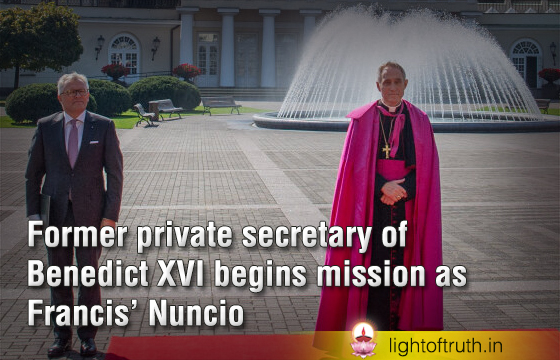
Former private secretary of Benedict XVI begins mission as Francis’ Nuncio
In a significant diplomatic move, Archbishop Georg Gänswein has formally assumed his position as the Vatican’s Apostolic Nuncio to the Baltic nations of Lithuania, Latvia, and Estonia. On Friday 6 September, the German prelate presented his credentials to Lithuanian President Gitanas Nausėda, marking the official start of his new diplomatic mission. Gänswein, once the trusted private secretary to Pope Benedict XVI, now steps into a role that bridges the Vatican’s relationship with a historically Catholic region during a time of heightened geopolitical tension.
Gänswein’s arrival in Vilnius was marked by a ceremonious display, with photographs from the Lithuanian presidential office capturing the archbishop in traditional clerical attire—a black cassock accented with a violet sash and cape—walking along the red carpet to the Presidential Palace. There, he delivered his credentials against the backdrop of the Lithuanian and Vatican flags, symbolizing the enduring diplomatic ties between the Holy See and Lithuania.
Archbishop Gänswein’s appointment to the Baltic region comes after a period of transition in his ecclesiastical career. Following the passing of Pope Benedict XVI, Gänswein was transferred back to his home archdiocese of Freiburg by Pope Francis in 2023 but without any specific role assigned. His new appointment as Apostolic Nuncio to Lithuania, Latvia, and Estonia in June 2024 signals a fresh chapter in his career, moving from his close ties with the late Benedict XVI to a critical diplomatic position in one of Europe’s most geopolitically sensitive regions.
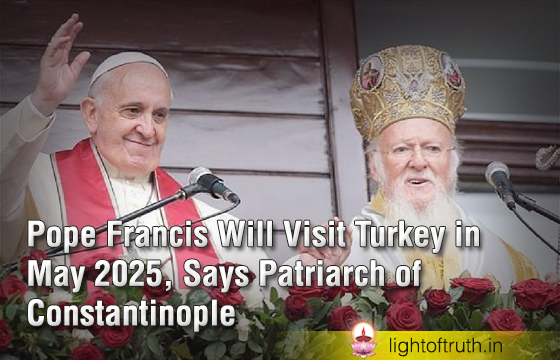
Pope Francis Will Visit Turkey in May 2025, Says Patriarch of Constantinople
Next May, Pope Francis will undertake a significant trip to Turkey, an event that promises to be both ecumenical as well as politically relevant. This journey, announced by the Ecumenical Patriarch of Constantinople Bartholomew I, will commemorate the 1700 years of the first Ecumenical Council of Nicaea, held in 325 in present day Iznik, Turkey. Bartholomew I revealed that both religious leaders have agreed to celebrate this important anniversary at the end of May. Up to now, the Holy Father had mentioned this event as a possibility, but now the Patriarch has confirmed the date. This meeting will not only be a historical celebration, but also an opportunity for the Orthodox and Catholic Churches to discuss the possibility of unifying the date of Easter. At present, these Churches celebrate Easter on different dates, due to the use of the Gregorian (Catholics) and Julian (Orthodox) calendars. Although the Assembly of the Orthodox Bishops of Istanbul has shown its support to a common date, a concrete proposal is yet to be presented. In 2025, Easter will fall on the same day, April 20, for both Christian Traditions.
Pope Francis’ trip will have a broader framework, namely, the 2025 Ordinary Jubilee. Added now, to the more than eighty celebrations foreseen for the Holy Year, is this journey to Turkey, one of the most important ecumenical events in the history of the Church.
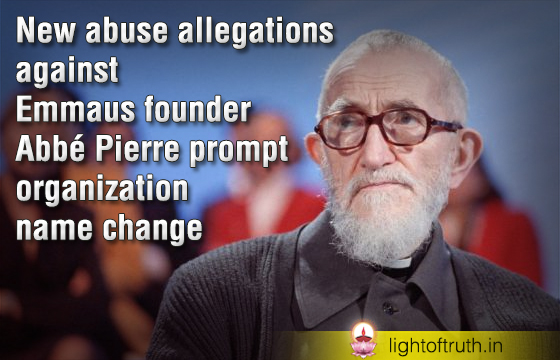
New abuse allegations against Emmaus founder Abbé Pierre prompt organization name change
A foundation that supports a prominent Catholic movement in France is changing its name after revealing nearly 20 fresh abuse allegations against the famed Abbé Pierre, a formerly beloved Capuchin priest who died in 2007.
A Sept. 6 statement released by Emmaus International, a solidarity movement with over 400 member associations that seeks to combat poverty and homelessness worldwide, detailed new allegations of sexual abuse and misconduct by Pierre, who founded the movement in 1949.
A previous July 17 report from Emmaus had detailed allegations involving at least seven victims, including one who was a minor at the time of her alleged assault. Emmaus France said it first received a report from a woman accusing Pierre of sexual assault in 2023.
The group said it commissioned consulting firm Groupe Egaé to set up a system to allow additional alleged victims to come forward. Since then, Groupe Egaé said, at least 17 additional victims have come forward alleging “sexual violence committed by Abbé Pierre against girls and women.”
In light of the allegations against its founder, the Abbé Pierre Foundation, which provided nearly 4 million euros (about $4.4 million) in funding to Emmaus in 2023, has “decided to change its name and has begun the necessary paperwork,” Emmaus International said last week. In addition to the foundation name change, the Emmaus France board will submit a proposal for the removal of “Abbé Pierre, founder” from its logo at an extraordinary general assembly that will take place in December.