Pope Francis sides with Benedict, says Christ shed his blood ‘for many’

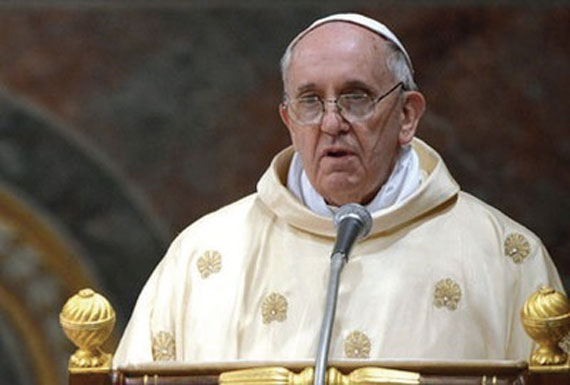
Pope Francis on November 3 appeared to wade into one of the most contentious liturgical debates in Catholicism in recent years, siding with his predecessor Pope emeritus Benedict XVI by insisting that Christ died “for many,” instead of using the phrase “for all.”

“The ‘many’ who will rise for eternal life are to be understood as the ‘many’ for whom the blood of Christ was shed,” Francis said. “They are the multitude that, thanks to the goodness and mercy of God, can experience the life that does not pass away, the complete victory over death brought by the resurrection.” The quotation marks around the word “many” were used by the Vatican when distributing the text.

Francis argued that “for many” better captures the sense that human beings have to make a choice during this life, either for or against God.

“Awakening from death isn’t, in itself, a return to life,” the Pope said. “Some in fact will awake to eternal life, others for eternal shame.”

“Death renders definitive the ‘crossroads’ which, already here in this world, stands before us: The way of life, that is, the one that leads us to communion with God, or the path of death, that is, the one that leads us away from Him,” the Pontiff said.

The phrase “for many,” used both in the Gospel of Mark (14:24) and Matthew (26:28), has been debated repeatedly over the past two decades by liturgists, theologians, and others. Used in the Roman Mass during the Eucharist prayer with reference to the blood of Christ, its Latin original is “pro multis.”

An ‘ecumenical Mass’ is impossible, says German cardinal

Cardinal Woelki said there is ‘no basis’ for such a service as Catholics and Protestants do not agree on the Eucharist.

Catholics and Protestants do not have enough in common to celebrate a so-called ‘ecumenical Mass,’ a German cardinal has said. Card. Rainer Maria Woelki of Cologne said there is “no basis” for such a service because the denominations “do not agree on the central issues” around the Eucharist. The cardinal explained in the Kölner Express that for Catholics, the Eucharist is not just a common meal; it is the true Body and Blood of Christ in the transubstantiated gifts of bread and wine. Protestants do not have this understanding. The Real Presence is an “incontrovertible certainty” for Catholics, he said. As long as these differences exist, there can be no “common supper.”

The Catholic world is about to be turned upside down

By 2050, the leading Catholic nations will be in Africa, Asia and Latin America. This will change everything. The Catholic Church worldwide is passing through an era of historical transformation, a decisive shift in numbers towards the Global South – to Asia, Africa and Latin America. Many are aware of this trend as an abstract fact, but we are scarcely coming to terms with the implications for Church life, for the composition of Church leadership, and for its future policies. A southward-looking Church may be a vibrant and flourishing body, but it might pose some challenges for Catholics of the older Euro-American world.

The fact of that geogra-phical shift is clear enough. A century ago, the European continent accounted for almost two thirds of the world’s Catholics. By 2050, that proportion will fall to perhaps a sixth. In that not-too-far future year, the Church’s greatest bastions will be in Latin America (perhaps 40%), in Africa (25%) and Asia (12%). Actually, those numbers understate the southern predominance, because a sizeable number of Catholics living in Europe or North America will themselves be of migrant stock – Nigerians or Congolese in Europe, Mexicans in the United States. A Church born long ago on the soil of Asia and Africa is returning home.

Priest resigns as consultant on doctrine after letter to pope

After publication of his letter to Pope Francis questioning the pontiff’s teachings, Father Thomas Weinandy has resigned from his position as consultant to the U.S. Conference of Catholic Bishops’ Committee on Doctrine. The Capuchin Fran-ciscan priest is former executive director of the U.S. bishops’ Secretariat of Doctrine and Canonical Affairs, serving in the post from 2005 until 2013. He expressed loyalty to the pope but at the same time told the pope that “a chronic confusion seems to mark your pontificate.” He released his letter to several Catholic and other media outlets November 1, including Crux. The priest told Crux, a Catholic news outlet, he did not write the letter in an “official capacity,” and he was alone responsible for it.

French priest receives human rights award for genocide research

An Oct. 26 ceremony on Capitol Hill honoured French priest Father Patrick Desbois for his work for nearly two decades in researching and telling the story of genocides past and present.
But the event also challenged the audience to be vigilant and to take more responsibility for the world around them.

“We have an obligation to follow the path of Father Desbois,” said Rep. Jamie Raskin, D-Maryland, noting that the French priest continuously proved every human life matters and that everyone should speak up for human rights.

“We need people like you,” Rep. Randy Hultgren, R-Illinois, told the priest after urging the audience to always be vigilant because “so much evil is still present.”

Mumbai church among seven Indian sites awarded by UNESCO

With seven out of 16 awards, India bagged the highest number of awards among all the participant nations in the United Nations Educational, Scientific and Cultural Organization (UNESCO) Asia Pacific Award for Cultural Heritage Conservation for 2017. While the award for merit was given to three Indian historical sites, the others four sites were given honourable mentions in the UNESCO awards, announced on November 1. Four of the awards winning structures are in Mumbai. The 16 winners of the UNESCO award are from six countries: Australia, China, India, Iran, New Zealand and Singapore.

Colombo cardinal wants govt to ban tutorial classes on Sundays

Cardinal Malcolm Ranjith of Colombo has called on the Sri Lankan government to ban tutorial classes on Sundays.

“I wrote to the president to ban tuition classes from 6.00 a.m. to 2.00 p.m. on Sundays,” said Cardinal Ranjith addressing a Catholic Teachers Day program at St. Joseph’s College Colombo on Nov. 3. He said Christian children need also to attend Sunday school. “Children do not have time to play or enjoy their childhood today because they run to tuition classes,” he said.

The cardinal said Buddhist children also fail to go to the temple on Buddhist holy days due to tutorial classes. A Buddhist teacher, Ananda Rashown, who fights to ban tutorial classes said all religious leaders should pressure authorities to stop such classes on Sundays and Buddhist holy days.

“Anyone who conducts classes on Sundays should be punished,” he said. Tutorial classes on Sundays have come in for strong criticism from teachers and some parents claiming it has an adverse effect on children.

However, others argue that a ban on tutorial classes takes away the right of people to work on Sundays and that the government has no right to enforce such a ban.

The pope bans sale of tobacco in Vatican

Pope Francis has personally decided that markets inside the Vatican will no longer sell cigarettes as of January 1, 2018. The Vatican spokesman, Greg Burke, explained that “the Holy See cannot contribute to an activity that clearly damages the health of people.” Indeed, according to the World Health Organization, every year smoking is the cause of more than seven million deaths throughout the world. Cigarettes were a source of revenue for Vatican markets, as they sell products tax-free, at a price much lower than Italy’s. However, the Pope said “no profit can be legitimate if it puts lives at risk.”

Don’t decorate graves with plastic: Goa Church official

In view of Nov. 2 All Souls Day, Catholic Church officials in Goa have advised not to use plastic and other toxic items to decorate graves to beat pollution and to safeguard environment.

The Church’s social welfare wing Caritas, in a letter to all parish priests and chaplains in the state, said these items should be shunned particularly on the occasion of All Souls Day, when Catholics visit and decorate their ancestors’ graves and pray for the departed souls.

Lay Catholic dedicates his life to Kashmir’s abandoned

Inside a two-story building within the crowded Bakshi Nagar area of Jammu and Kash-mir state, 35-year-old Emma-nuel Appan is preparing break-fast for aged and abandoned charity home residents in his care. Wearing a T-shirt and with a rosary around his neck, the young Catholic layman hands out cups of tea. It has been more than a year since Appan volunteered to work at the Little Teresa Home for the elderly and destitute managed by a charity called “Friends of Birds of the Air.” This charity movement, began operating some 25 years ago in southern Kerala state and has since spread to most other states. The Little Teresa Home opened three years ago. It provides food, shelter and medical care as well as emotional support to residents, who are mostly aged between 70-80.

“I choose this life for me and I am in love with it.” “God has made me a multi-tasked person,” he says light-heartedly. Fr Boby John of Jammu-Srina-gar Diocese, who heads the Little Teresa Home, praised the selfless efforts of volunteers such as Appan.

Official Website

Exit mobile version