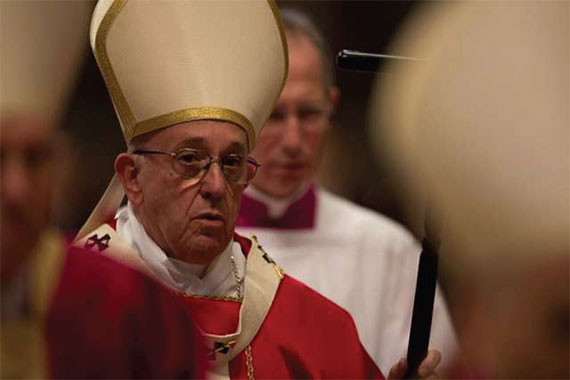
Pope Francis on November 3 appeared to wade into one of the most contentious liturgical debates in Catholicism in recent years, siding with his predecessor Pope emeritus Benedict XVI by insisting that Christ died “for many,” instead of using the phrase “for all.”
“The ‘many’ who will rise for eternal life are to be understood as the ‘many’ for whom the blood of Christ was shed,” Francis said. “They are the multitude that, thanks to the goodness and mercy of God, can experience the life that does not pass away, the complete victory over death brought by the resurrection.” The quotation marks around the word “many” were used by the Vatican when distributing the text.
Francis argued that “for many” better captures the sense that human beings have to make a choice during this life, either for or against God.
“Awakening from death isn’t, in itself, a return to life,” the Pope said. “Some in fact will awake to eternal life, others for eternal shame.”
“Death renders definitive the ‘crossroads’ which, already here in this world, stands before us: The way of life, that is, the one that leads us to communion with God, or the path of death, that is, the one that leads us away from Him,” the Pontiff said.
The phrase “for many,” used both in the Gospel of Mark (14:24) and Matthew (26:28), has been debated repeatedly over the past two decades by liturgists, theologians, and others. Used in the Roman Mass during the Eucharist prayer with reference to the blood of Christ, its Latin original is “pro multis.”