

Catholic Church faces tremendous challenges posed by hardening of borders across the world coupled with suspicion, exclusion, politics and fear which could be overcome only with love, said Cardinal Luis Antonio Tagle, pro-prefect of Vatican’s Dicastery for Evangelization. “Even within the same parish and the diocese, the Christian universal love is forgotten,” Tagle said. The Philippine cardinal made the remarks during an address to about 200 delegates at the biennial Meeting of the International Societies of Apostolic Life (MISAL) in the western Indian state of Goa on Dec. 2. The Dec. 2-6 event is hosted by the Society of Pillar, an indigenous missionary religious society founded by Father Benito Martins in 1887. Delegates from 22 religious congregations from across the world joined the gathering, themed “Journeying Together: Encountering Frontiers.” Tagle said conflict within the Church is a cause of concern nowadays.
The gathering coincides with the 18th Exposition of the Sacred Relics of St. Francis Xavier at Old Goa, the Patron of the Missions. In his keynote speech, Tagle said Christian love goes beyond all frontiers to witness Jesus through their mission. He emphasized the importance of understanding “frontiers” in the context of walking together for evangelization and offered a threefold explanation of the term. “A frontier is a border between two territories, encompassing civil, historical, cultural, and ethnic dimen-sions,” he said, adding that understanding these borders aids in describing local churches and facilitates inculturation. He pointed to Jesus’ example of moving across territories to foster appreciation and to disentangle Christianity from being identified with one culture. Highlighting the need for attentive-ness to frontiers, Tagle stressed the import-ance of redefining cultural elements for better understanding. “While respecting the first frontiers of borders, we fail to give testimony to the universal frontiers of Christian love,” he remarked.

Pope elevates Cardinal Gracias’ ‘successor’ in Bombay Archdiocese
Bishop John Rodrigues of Poona has been elevated to coadjutor bishop of Bombay archdiocese, paving the way for him to succeed Cardinal Oswald Gracias in India’s largest diocese. Cardinal Gracias, who turns 80 on Dec 20, is likely to step down as archbishop of Bombay, a diocese with more than half a million followers in western Maharashtra state. ”Pope Francis has appointed Bishop John Rodrigus as the coadjutor bishop of the Archdiocese of Bombay,” Cardinal Gracias said in a video message on Nov. 30. “Bishop John will come to Mumbai on Jan. 25 and reside at the Archbishop’s House” to ensure a seamless succession in one of India’s oldest dioceses in the nation’s financial and commercial hub, Gracias further said. Bishop Rodrigues, 57, had served as Bombay’s auxiliary bishop for 10 years before becoming the bishop of Poona in 2023. “John has always been a brilliant person,” his elder brother, Father Luke Rodrigues, told the media. Bishop Rodrigues was born in Mumbai on Aug. 21, 1967, and taught dogmatic theology in many seminaries in the country. The son of a widow, the prelate’s two elder brothers are priests. Luke is a Jesuit priest, while Father Savio Rodrigues in the archdiocese.
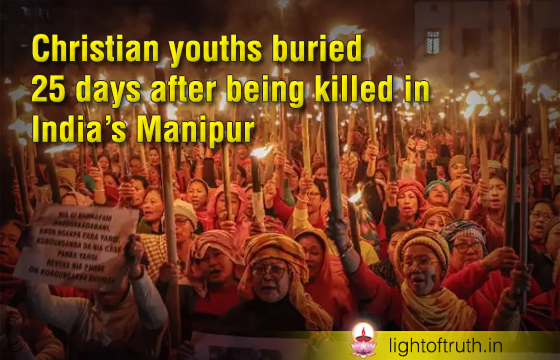
Christian youths buried 25 days after being killed in India’s Manipur
The bodies of 12 indigenous Christian youths were laid to rest 25 days after they were killed in India’s sectarian strife-torn Manipur state. Many people turned up on Dec. 5 for a special prayer meeting organized at the Peace Ground at Tuibuong in Churachandpur district, a tribal Christian stronghold in the northeastern state, bordering civil war-hit Myanmar. The mourners observed a one-minute silence before the bodies with gunshot wounds were buried in the Martyrs’ Cemetery. Speakers at the meeting called them “martyrs” who laid down their lives while protecting their tribal community which is fighting with the majority Hindus in the hilly state. A total shutdown was observed in Tuibuong and thousands of people joined the funeral procession. Among the 12 youths, 10 were killed in an alleged encounter with the Central Reserve Police Force in Jiribam district on Nov. 11. Two others were allegedly killed by Meitei groups. However, the pro-Hindu government in the state has called the youths “militants.” Their burial was delayed as the Indigenous Tribal Leaders’ Forum (ITLF), repre-senting Kuki-Zo tribal Christians in Manipur, insisted on their postmortem reports. The youths, aged between 19 and 35, accord-ing to the postmortem report, were shot from behind.
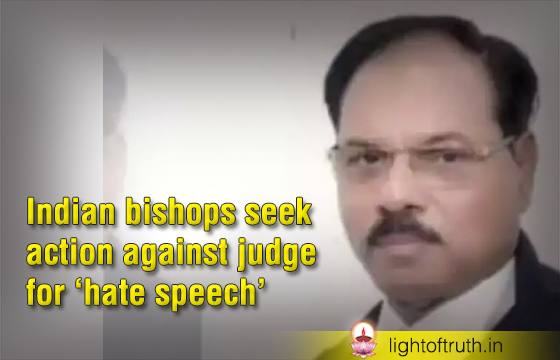
Indian bishops seek action against judge for ‘hate speech’
Catholic bishops have urged India’s lawmakers to act against a high court judge who said the country should be ruled by the wishes of the “majority” Hindus. Justice Shekhar Kumar Yadav reportedly delivered the controversial remarks on Dec. 8 at an event organized by the Vishwa Hindu Parishad (VHP or World Hindu Council) at the Allahabad High Court in northern Uttar Pradesh state. Yadav endorsed the extremist agenda of the clandestine outfit Rashtriya Swayamsevak Sangh (RSS), the parent body of the VHP and the ruling Bharatiya Janata Party. “The law works according to the majority. Be it in the context of the family or society. Only what benefits the welfare and happiness of the majority will be accepted,” Yadav said at the function held inside the high court’s library hall. Yadav even used the controversial term kathmullah to refer to fanatic or excessively devout Muslims during his speech. A majoritarian rule is “the opposite of everything that is intended by Article 14 and the constitution of India,” the Catholic Bishops’ Conference of India (CBCI) noted in a statement. Article 14 guarantees the equality of all persons before the law. “The comments were made during a function organized by an outfit “that was reportedly responsible for communal violence in the past,” the bishops said in the statement on Dec. 11. The judiciary is entrusted with the duty to guard the constitution and judges are sworn in to uphold the constitution, the prelates noted. Persons who do not have “faith in our constitution and its morality should have nothing to do with the judiciary, much less be a judge,” the statement further said. The government should take action against the judge under Articles 124 and 217 of the constitution, which allow parliament to impeach high court judges. If the government fails, the opposition lawmakers should step in, the prelates demanded. The CBCI asked all parlia-mentarians to rise to the occasion to take action against Yadav. Lawyers and civil rights groups have asked India’s Chief Justice Sanjiv Khanna to initiate disciplinary action against Yadav and send him packing.
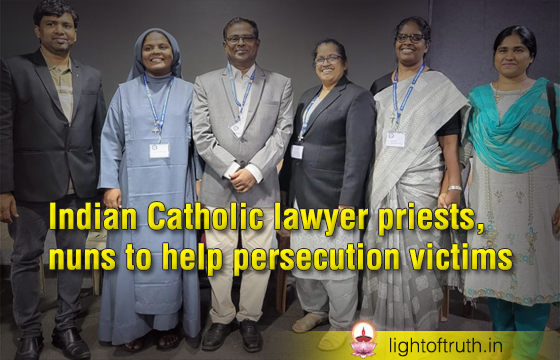
Indian Catholic lawyer priests, nuns to help persecution victims
The legal cell of Catholic lawyer-priests and nuns has vowed to extend help to Indian minorities, including Christians, as persecution against them increases in India. “We have decided to provide legal help to the victims of atrocities and discrimination from the minority communities, especially Christians, irrespective of their denominational differences,” said Father Bondala Sleeva Raju, Telegu regional convener of the National Lawyers’ Forum of Religious and Priests (NLFRP). The regional forum is based in the southern Telugu region, covering India’s two Telugu-speaking states, Andhra Pradesh and Telangana. Our teams will extend the help “free of cost” as our primary objective is to protect the rights of the country’s minorities, Raju told on Dec. 9 after a three-day convention of the NLFRP concluded in Eluru in Andhra Pradesh on Dec. 8. We are concerned about Christians amid rising persecution against them over alleged charges of religious conversion, the priest attached to Vijayawada diocese in Andhra Pradesh added. Eleven states, most of them ruled by Bharatiya Janata Party governments, have enacted a draconian anti-conversion law that curbs the citizen’s right to change religion without prior approval from government officials. These laws often target Christians and Muslims, the NLFRP meeting noted.
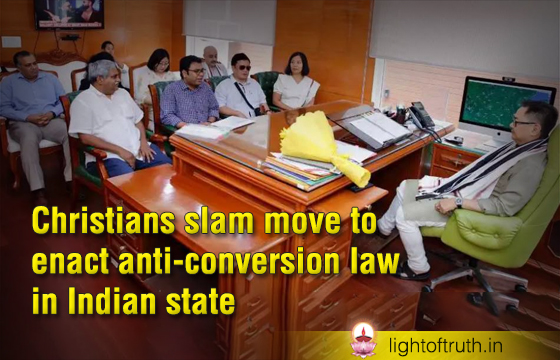
Christians slam move to enact anti-conversion law in Indian state
Church leaders and activists have criticized a state government’s decision to enact an anti-conversion law in the northern Indian state of Rajasthan, calling it “politically motivated.” The Bharatiya Janta Party (BJP)-run government in the state approved the draft for a tough new law to prevent so-called “forced religious conversions” in the state. The draft bill, containing stringent provisions, will be tabled for a vote at the upcoming session of the state assembly, Parliamentary Affairs Minister Jogaram Patel told media people on Nov. 30. The bill, which was approved in a Cabinet meeting chaired by Chief Minister Bajanlal Sharma, proposes a jail term of up to 10 years for proven cases of forced conversion, according to media reports. The bill stipulates that individuals wishing to convert to another religion must apply to the district magistrate at least 60 days in advance. “The district magistrate will examine whether or not it is a forceful conversion,” Patel said. The minister said that special focus is being given to addressing the issue of conversions in tribal areas, where such activities are reportedly prevalent. If the bill is passed by the state legislature, Rajasthan will become the 12th state in India to promulgate an anti-conversion law. Currently, 11 Indian states, most of them ruled by the BJP, have the repressive law in place. “It is too early to comment on the subject as it is a sensitive issue,” Bishop Joseph Kallarackal of Jaipur, the state capital of Rajasthan told UCA News on Dec. 3. He said prelates in the state will have to discuss the bill with legal experts and leaders from the community. “We will examine in detail the likely impact of the proposed law,” Kallarackal added. Christian activist Minakshi Singh condemned the decision to enact the repressive law. “Under article 25 of the Indian constitution, people are free to profess, practice and propagate any religion of their choice,” she said.

India’s top court tells warring church factions to share properties
India’s top court has told the warring factions in the Oriental Syrian Orthodox Church of Antioch to share all public amenities at disputed Church properties in a southern state until a solution to the row can be found. The government in Kerala is finding it difficult to implement a 2017 apex court order that awarded disputed churches to the Orthodox faction due to stiff opposition from the Jacobite camp, a breakaway faction of the Da-mascus-based Church. While hearing a contempt petition against the communist-led state government and the Jacobite faction, a division bench of Justices Surya Kant and Ujjal Bhuyan of the Supreme Court on Dec. 3 told the warring fa-ctions to share among them-selves all public amenities in the disputed church compounds without discrimination. The current stalemate concerns six disputed churches located in the state’s Ernakulam and Pa-lakkad districts. These chur-ches are under the control of the Jacobite faction of the Oriental Church, which has nearly 2 million followers in Kerala. “All public facilities like burial grounds, schools, hospitals, etc. on church premises shall continue to be availed by everyone, including Catholics,” the judges said in the order. Though it is an interim order, “it is significant as the court wanted to see both sides come together,” as shar-ing the amenities was not there in the 2017 order,” observed Biju Oommen, secretary of the Orthodox Church Association. He said they would consult their lawyers before sharing the amenities.
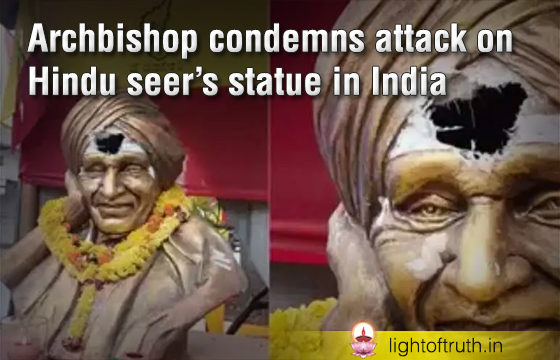
Archbishop condemns attack on Hindu seer’s statue in India
An archbishop has conde-mned an attack on a revered Hindu seer’s statue in a south-ern Indian state. “We have learned through media reports of the unfortunate and deeply disturbing incident of the defacement and vandalization of the statue of the late Shivakumara Swamiji in Girinagar in Banga-lore,” Archbishop Peter Ma-chado of Bangalore said in a statement on Dec. 5. The act, which has rightfully outraged people, “has no place in our society,” the prelate said, urg-ing the public not to be pro-voked by such incidents. Police arrested a 37-year-old delivery executive for damaging the statue on Dec. 4. The bronze-colored statue of the Lingayat seer was vandalized in the early hours of Nov. 30. “We arrested him under Section 324 of the Bharatiya Nyaya Sanhita (the new Indian penal code),” police told the media. Shiv Krishna hails from neighboring Andhra Pradesh state. During questioning, he claimed he was “inspir-ed” to deface the statue by a vision of Jesus Christ in a dream. “The claim of the alleged culprit is baseless,” the prelate observed. He said such statements can “sow discord and create communal tension.” The statue was installed five years ago and local residents staged a protest, demanding stiff punishment for the accus-ed. “The Swamiji has been an inspiration to countless indi-viduals,” Archbishop Machado said. His legacy promotes har-mony, and this act of disrespect toward him is a “violation of the very principles he upheld,” he noted. The prelate has urged the police to conduct an impartial investigation.
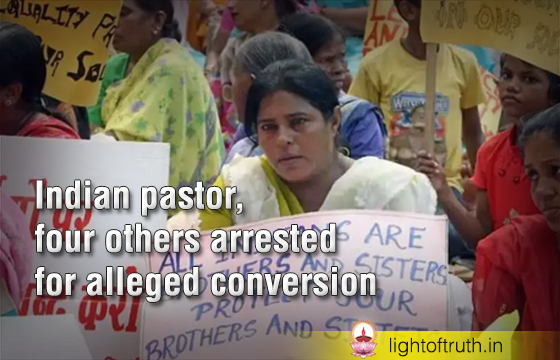
Indian pastor, four others arrested for alleged conversion
Five Christians, including a pastor, have been arrested in a northern Indian state under a sweeping anti-conversion law after hardline Hindu activists objected to their holding a Sunday prayer meeting. Police in Uttar Pradesh on Dec. 8 arrested Pastor Vineet, his wife Payal, who were both identified by a single name, and three others, who were not named, in Kherki Mujkkipur village in Meerut district. The pastor was holding a prayer meeting and a medical camp at his house. The police recovered religious books, registers, bank details, and other materials from the house, the local Hindi newspaper Jagaran reported on Dec. 9. Vineet embraced Christianity a decade ago and converted around 250 people, according to the police. He purchased the house six months ago and organized Sunday prayer meetings there under the banner of the Kingdom of God Ministries Trust. The Dec. 8 meeting was attended by 50 people when a mob from the Hindu Raksha Dal (Hindu Protection Army) reached the spot and objected to it. The Dal’s state president Gaurav Parashar alleged people were being converted at the prayer meeting and informed the police.
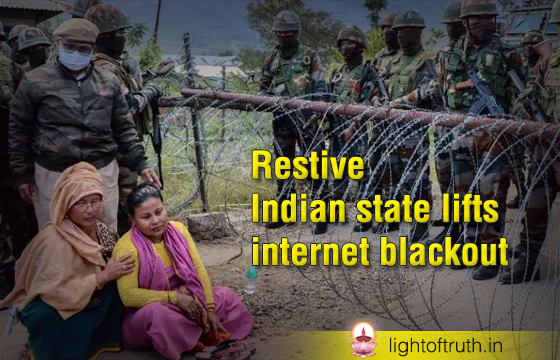
Restive Indian state lifts internet blackout
Internet was restored in India’s conflict-torn northeastern state of Manipur on Dec. 9, weeks after a blackout was ordered to contain deadly ethnic violence and clashes between protesters and police. Ethnic clashes broke out in Manipur last year between the predominantly Hindu Meitei majority and the mainly Christian Kuki community, killing more than 250 people. Since then, communities have splintered into rival groups across swaths of the northeastern state, which borders war-torn Myanmar. Fresh clashes that killed at least 17 people last month in a part of Manipur previously spared from the violence prompted the latest of several internet shutdowns imposed in the state. That order came after protesters, outraged by the killings, tried to storm the homes of politicians in state capital Imphal, vandalising some of the properties. The local government on Dec. 9 ordered the lifting of “all forms of temporary suspension of internet and data services” imposed on November 19. Internet services were shut down for months in Manipur last year during the initial outbreak of violence, which displaced around 60,000 people from their homes according to government figures. Thousands of the state’s residents are still unable to return home owing to ongoing tensions. Long-standing tensions between the Meitei and Kuki communities revolve around competition for land and public jobs. Rights activists have accused local leaders of exacerbating ethnic divisions for political gain. Manipur is ruled by Bharatiya Janata Party and Human Rights Watch has accused the government of facilitating the conflict with “divisive policies that promote Hindu majorita-rianism.”