- Dr. Benny Nalkara CMI
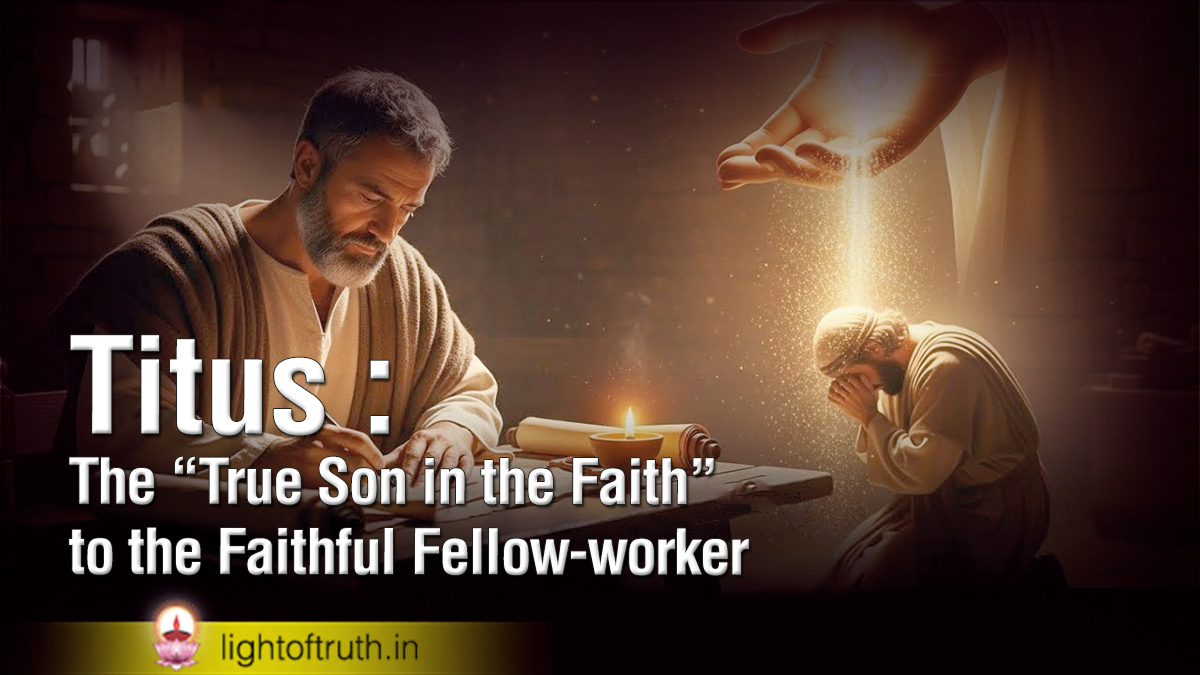
 Titus, one of Paul’s most trusted and valuable co-workers, stands as a model of faithful discipleship, courageous collaboration, capable administration, conflict resolution, and mature Christian leadership. Paul calls him his “true son in our common faith” (Titus 1:4), using the Greek expression gnesios teknon, meaning “genuine,” “legitimate,” or “true child.” The expression indicates a spiritual rather than biological relationship. The phrase kata koinen pistin – “according to our common faith”- emphasizes their participation in the same saving faith. The father-son imagery therefore expresses spiritual formation and affection while affirming their common standing before God.
Titus accompanied Paul in difficult circumstances, including the sensitive visit to Jerusalem (Gal 2:1), and was entrusted with challenging missions at Corinth and with organizing the collection for the poor in Jerusalem (2 Cor 8:6, 10, 16). Paul refers to him as a “brother” and “fellow worker,” demonstrating the depth of trust between them. Titus was not merely a disciple who followed Paul; he became a mature co-worker capable of carrying out difficult responsibilities independently and according to Paul’s pastoral vision.
Titus was most probably a Gentile convert to Christianity and an important member of Paul’s missionary team. Although Scripture does not describe his conversion, Paul’s relationship with him reveals a process of accompaniment, formation, trust, and empowerment. Paul formed Titus through experience and gradually entrusted him with increasingly demanding responsibilities. His life therefore illustrates the importance of mentorship in developing mature Christian leaders.
One of Titus’s earliest significant roles emerged during the controversy over circumcision. Paul brought Titus, a Greek and uncircumcised Gentile Christian, to Jerusalem as evidence that faith in Christ did not require the adoption of Jewish ritual practices. When some attempted to compel him to be circumcised, Paul refused (Gal 2:5). Titus thus became a living testimony to the freedom and universality of the Gospel. His presence demonstrated that salvation is received through faith and grace rather than through external ritual requirements. He symbolized the Church’s call to transcend cultural barriers while remaining faithful to the Gospel.
Titus became particularly important in Paul’s ministry at Corinth. The Corinthian community was troubled by divisions, moral problems, abuses connected with the Lord’s Supper, and resistance to Paul’s authority. After Paul’s efforts to correct these problems, Titus was entrusted with the delicate task of helping the community respond positively. He entered a tense situation as a peacemaker, requiring courage, patience, sensitivity, and pastoral wisdom. Titus did not simply deliver Paul’s message; he developed genuine concern for the Corinthians and worked for their spiritual restoration. When he returned to Paul in Macedonia with news of their repentance and reconciliation, Paul was greatly encouraged. Titus demonstrated that authentic conflict resolution requires both truth and affection: firmness in confronting problems and compassion toward persons.
Titus also proved his integrity in handling financial matters. Paul entrusted him with an important role in organizing the collection for poor Christians in Jerusalem. Such responsibility required transparency, accountability, organizational competence, and trustworthiness. Titus shows that Christian leadership extends beyond preaching and pastoral ministry. The responsible administration of money and material resources is also a spiritual responsibility. Leaders entrusted with institutional resources must act honestly and transparently, placing the mission and the welfare of people above personal interests.
Another important stage of Titus’s ministry was his work in Crete. Paul left him there to “set in order the things that are lacking” (Titus 1:5). The Christian communities faced moral disorder, false teaching, and inadequate leadership. Titus was therefore asked to appoint elders in different cities and ensure that they possessed appropriate character and doctrinal soundness. His task involved establishing order, strengthening communities, safeguarding sound doctrine, and preparing others for pastoral responsibility. His mission reveals an essential dimension of Christian leadership: the Church needs not only inspired preaching but also competent administration, formation, accountability, and wise governance.
Paul’s later reference to Titus in Dalmatia (2 Tim 4:10) suggests that he continued his missionary activity. Though the details are unknown, the reference reflects Paul’s continuing confidence in him. Titus had developed from a disciple who accompanied Paul into a mature co-worker entrusted with significant responsibilities. His development demonstrates that leadership grows through formation, experience, responsibility, and faithful service.
Titus combined gentleness with firmness, courage with sensitivity, and competence with compassion. He did not exploit his position for personal advantage but demonstrated genuine concern for people and their spiritual growth. His leadership was not based on self-promotion or charisma but on reliability, integrity, maturity, and service.
The example of Titus has profound relevance for Christian leadership today. Leaders must recognize their gifts and employ them for building up the community rather than seeking personal recognition. They must confront problems honestly while maintaining patience, gentleness, and respect for persons. Difficult situations should be approached with the goal of reconciliation and restoration. They must also exercise transparency in the management of resources, form other leaders, preserve the integrity of the Gospel, and adapt to different cultural and pastoral contexts.
The journey of Titus-from Paul’s “true son in the faith” to a trusted “partner and fellow worker”-is ultimately a story of faithful discipleship becoming mature leadership. He defended the freedom of the Gospel, crossed cultural boundaries, mediated conflicts, administered resources responsibly, established order in troubled communities, formed leaders, and continued the missionary task. Titus reminds the Church that effective Christian leadership rests not merely on authority or charisma but on faith, integrity, maturity, competence, compassion, and a willingness to serve. He remains an enduring model of the Christian leader as a trustworthy co-worker, builder of community, and agent of reconciliation.