- Prof. Andrea Grillo
 Introduction
Very often we are overly conditioned by the words we use. We must not allow inadequate ways of thinking about the Eucharist to impose the wrong words upon us. At the root of the misunderstanding that is now tearing apart the experience of the Syro-Malabar Church – and also that of other Churches facing the same problem, though less dramatically – lies a rather ambiguous language: it expresses a truth, but not the whole truth. In this reflection, I would like to sketch its history briefly, from which we can learn how to address present-day questions as well.
1. A History of Orientation in the Eucharistic Celebration
For many centuries, we distinguished between the “Mass without the people” and the “Mass with the people,” assigning greater value to the former. The former was called “Low Mass” and was very frequent, while the latter was called “Solemn Mass” and was much rarer. The rediscovery, after the Second Vatican Council, of the centrality of the “Mass with the people” required a profound rethinking of the space of celebration and a recovery of the altar’s central position. The change in “orientation” depends on a change in understanding: the Mass is an act of the “priestly community.” Thus, the “side altars” lose their importance and the high altar changes its form. To understand this transition, we must go back many centuries and consider a text that proved decisive.
2. Charles Borromeo’s “Instructions” for the Building of Churches
In his work of 1577, the Archbishop of Milan, Charles Borromeo, identifies several criteria for the construction of churches, including detailed provisions concerning orientation. On the one hand, he prescribes the church’s orientation ad orientem, though with appropriate exceptions. Of the greatest interest, however, is the fact that from that text onward, and in an extraordinarily widespread manner, Catholic churches would have the tabernacle placed upon the altar. This structural element, positioned above the high altar, inevitably determines an orientation “toward the Lord,” represented precisely by this modern structural arrangement. Arising from the reaction against Protestant positions on the Real Presence and sacrifice, the tabernacle assumes a predominantly apologetic role. It also profoundly influences the way in which we orient ourselves in celebration. Let us consider this feature of our churches briefly.
3. The Tabernacle
An interesting starting point is the biblical origin of the term “tabernacle,” by which we now identify the place where the Eucharist is reserved and kept. The word comes from the Latin Vulgate, which uses it 473 times: 449 times in the Old Testament and only 24 times in the New Testament. Its primary meaning is “tent.” Its use becomes especially frequent in the Torah, between the Book of Exodus and the Book of Deuteronomy (258 occurrences), precisely when the “dwelling of God” among his people takes the form of a tent or temple. For this reason, the term also occurs widely in the narratives of David and Solomon, in close connection with the building of the temple. It is also used extensively by the prophets, especially Ezekiel, as well as in the Psalms and Wisdom literature. In the New Testament, its use is limited to three major areas of meaning: a tent in the strict sense (for example, in the Synoptic accounts of the Transfiguration); a metaphor for life as pilgrimage (in Paul and Peter); and, finally, reference to the “temple/tabernacle” of the First Testament, especially in Hebrews and Revelation.
3.1. The Presence of God and the Paschal Form
The central question concerns where the presence of God is revealed. Israel’s tent/temple as a language of presence led medieval theology, in writings De tabernaculo, to make the allegorical interpretation of the Torah a central theme. This is attested for a millennium, from Bede (seventh–eighth century) to Théophile Raynaud (seventeenth century). The identification of God’s dwelling in the Old Testament with the body of Christ – together with the reading of the temple as Christ’s body and the body as the temple of the Spirit – allowed the theme of the tabernacle to develop over the centuries. It became both a temple of flesh and a heavenly temple, but it also came to assume a location within the domus ecclesiae, almost as a new sancta sanctorum.
In its disciplinary and architectural dimensions, this development tends to leave the Eucharistic rite in the background, treating the “presence of God” solely as the “permanent sacred product of consecration.” It is clear that the modern, Tridentine recovery of the “centrality of the tabernacle” (understood as the “little temple” in which the consecrated bread is reserved in the church), deliberately made a central architectural feature and even placed above the high altar, raises a theological question for us concerning the Eucharistic rite. The progressive separation between the “sacramental Body of Christ” and the “ecclesial Body of Christ” – rather than their being manifested as the inner fabric of the ritual sequence of the Eucharistic celebration – is replaced by “faith in the sacramental body,” which generates devotion and a relationship with the virtues of unity and charity. This leads to concentrating all attention on the “truth of the sacramental body,” while neglecting the ecclesial dimension of the Body of Christ, which cannot be “localized.”
3.2. Before the Council: Pius XII
It is very instructive to consider the inertia of the Tridentine model, constructed in the sixteenth century around the central position of the Eucharistic reservation. This model profoundly influences both celebration and Eucharistic theology, which in turn can also be understood as causes and justifications of the central tabernacle. One of the documents closest in time to the Second Vatican Council, and apologetically connected with the liturgical rethinking then taking shape, is the address that Pope Pius XII sent to the International Congress of Liturgy in 1956.
Many observations could be made about this text. I shall limit myself to three:
- a) The distinction between “altar” and “tabernacle” gains no new perspective from consideration of the ritual action. It is 1956, and a rethinking of the liturgy has begun (we should remember that Pius XII had already promoted the reform of the Easter Vigil and Holy Week). Yet it is evident that recognition of the altar’s primacy over the tabernacle remains entirely extrinsic and does not prevent the tabernacle from being regarded as the place of the “permanent presence,” which therefore not only may, but “must,” remain above the altar.
- b) It is recognized as paradoxical to celebrate the Eucharist “in front of the permanent sacrament,” but there is no departure from a theological notion of the “Body of Christ” that identifies the sacrament only with the reality effected by consecration, rather than with the dynamic of communion. This would become clear only almost a decade later, although even today, seventy years afterward, it remains rather obscure.
- c) Finally, it is interesting that only three years before this address, in 1953, Pope Pius XII had modified the rules of the Eucharistic fast. What might appear to be merely disciplinary had a decisive effect on the recovery of the meaning of the Eucharistic celebration and its theological value. By changing the rule of fasting “from midnight,” evening Masses became possible. This applied both to ministers and to the faithful. It made possible a transformation in the relationship to the rite of Communion, which, also because of these new disciplinary conditions, could become not an individual act of worship but an ecclesial act that builds up the Body of Christ. When Communion becomes the fulfilment of the celebration, it is no longer difficult to understand that the Mass is “toward the people”: it is brought to completion in the act by which all become the Body of Christ.
4. The Understanding of the Eucharist Presupposed by that Arrangement and Orientation
With a view to renewing Eucharistic theology and the devotion that ritual action can accompany and inspire, these considerations are far from secondary. They show how deeply the one-sided reading of Eucharistic experience, still imposed upon our hearts and bodies by medieval and modern thought, has taken root. An internal rupture within the ritual action can lead one to hold that the breaking of the bread is destined not for consumption in Communion, so as to build up the ecclesial Body of Christ, but for permanence in the tabernacle, so as to preserve the sacramental Body of Christ. To symbolize the Eucharistic reservation as a “tabernacle” (as temple and dwelling) is to replace ecclesial communion with adoration of the sacrament. To recover the tabernacle’s character as simply the place of Eucharistic reservation means, instead, recognizing that consecration is ordered toward consumption, not preservation, and that the rite of Communion should not normally draw from the reserved sacrament, but should always and only proceed from the altar. An excessive symbolization that goes so far as to negate the tabernacle’s function of serving Communion is a matter of no small importance for Eucharistic theology and devotion.
5. The Transition to the Renewed Model (of Space, Orientation, and Eucharistic Theology)
Let us consider the expression that opened the new phase in 1964 and that remains our point of reference today:
Altare exstruatur a pariete seiunctum, ut facile circumiri et in eo celebratio versus populum peragi possit.
“The altar should be built apart from the wall, so that it can easily be walked around and celebration facing the people can take place upon it.”
The expression used immediately after the Council, which we still repeat today, indicates a “tendency” that was then beginning. It uses the words that could best be understood at the time. Yet the phrase “so that celebration toward the people may take place upon it” is an expression that today deserves decisive further reflection.
It is evident that, according to the intention of the text, the missa versus populum and the missa versus altare cannot be regarded as opposing interpretations. Certainly, in post-conciliar debate they acquired symbolic value and became a way of identifying – sometimes in forced terms – two worlds and two forms of celebration and ecclesial life. Here, however, I would like to point out an element that might suggest an “intrinsic” mediation between the two traditions. On closer examination, the language of versus is not at all exclusive, except in the case of the altar. To say versus altare is to exclude versus populum. The reverse is not true. When one says versus populum, one also includes versus altare, because the altar stands “between” the one who presides and the people.
It therefore seems to me that the objections to versus populum – accused of “closing the Church in upon itself” rather than opening it to the transcendence of God (which, it is claimed, would instead be guaranteed by versus altare) – are based on a very weak argument. They overlook the “inclusive” value guaranteed only by versus populum and not by versus altare. Those who face the altar with their backs to the people are obliged to turn around from time to time. Those who face the altar, with the people standing beyond it, experience the reality of the circumstantes: they are simultaneously versus altare and versus populum.
We might therefore say that, theologically, we must move beyond the alternative between two possibilities that was introduced almost surreptitiously through language that was still approximate. The post-conciliar rediscovery of the missa versus populum does not come at the expense of the altar; rather, it recovers the need to unite, in a single act, the twofold but non-contradictory orientation toward the altar and toward the people. If the altar can be “surrounded” by the act of worship, orientation toward the altar and orientation toward the people can occur in the same act. By contrast, when the minister and the entire assembly are oriented “toward an altar that is not detached from the wall,” a different situation arises, continually introducing the need for an intermittent “reorientation versus populum.”
This linguistic difficulty calls for a new way of speaking and thinking.
6. A Theological Clarification and a Change of Language
- a) As we have seen, the tension between versus populum and versus altare arises from a polarization external to the intentions of the texts of 1964 and 2002. The real question is this: if the altar is truly the centre, then it may make sense to ask whether one stands “before” or “around” the altar. If the altar’s position is central, as the norms prescribe, everyone is oriented “toward the altar” – both the one who presides and the people. The alternative is not versus populum or versus altare, but different ways of understanding versus altare. If the altar is central, everyone will be “toward the altar,” because everyone will be circumstantes and circumeuntes: all stand and move around the altar.
- b) The history of the Church knows difficult transitions, from which one does not emerge through artificial solutions. Just as it was not possible for the Roman Church to resolve the tensions caused by liturgical reform by permitting both the reformed Roman Rite and the earlier, unreformed rite to be celebrated in the same parish, so too it is not possible to find a genuine “spatial peace” within the same Mass by celebrating one part “toward the people” and another “toward the altar.” The solution of dividing the orientation between the Liturgy of the Word and the Liturgy of the Eucharist is a fiction without historical foundation and, indeed, without an object. It would be strange to think that the Liturgy of the Word were “toward the altar,” when institutionally it is conceived in relation to the ambo, not the altar. The Liturgy of the Word in itself is never versus altare. It is right, however, to point out that the two liturgies – of the Word and of the Eucharist – have different orientations. But this is in re: it does not derive from a synodal decision, but from the very reality of the Eucharist. In the Liturgy of the Word, we stand “around the ambo”; in the Liturgy of the Eucharist, we stand “around the altar.” This is the language that can also unify the Syro-Malabar celebrative tradition.
- c) Let me clarify my thought further. We should not reason with prepositions such as “facing,” “in front of,” or “toward” (unfortunately used even in the synodal text), but with expressions such as “around,” “standing around,” and “moving around.” This is the right perspective, capable of overcoming the logic of an unfounded opposition. To recover the meaning of “liturgical reform,” and to remain within the logic of a common journey, the conditions for communion must be created not through a compromise at the lowest level, but through a deepening of that common journey. Then, with a logic of mercy, “toward the altar” will not be opposed to “toward the people.” Since liturgical action is the action “of all the baptized,” it requires that throughout the Eucharistic celebration all stand first “around the ambo” and then “around the altar.” The people are the subject of this twofold “standing around.” No one ever turns their back on anyone, and it cannot be accepted that one part should be “toward the people” and another “toward the altar.” Rather, we must seek to bring about a deeper communion, enabling all bishops, priests, religious, and baptized faithful, in their Qurbana, to gather first around the ambo and then around the altar. The Word and the Sacrament are the centre of orientation. There is no need either to turn eastward or to raise one’s gaze to the cross: the Lord speaks from the ambo and the Lord acts from the altar. He is the Crucified and Risen One; the Lord who is present and the Lord who is to come; the Lord whom we adore as present and the Lord whom we await as future. Through his Word the assembly lives in communion; through his Body and Blood it proclaims his death and awaits him at the end of time.
- d) A major change in language allows us to move beyond oppositions and to journey together along the path opened by the Second Vatican Council, which tends toward an ever greater openness to the actuosa participatio of the whole People of God in the ritual action of the Eucharist. It will then be possible to show mercy toward one another – not by “splitting in half” the one common rite, but by patiently accepting that some celebrate the same liturgy (with the same texts) through partially different actions. This should not take the form of an artificial “fifty-fifty” arrangement that does not conform to liturgical logic. Rather, where the altar has not yet been detached from the wall, it may remain in place and necessarily entail a versus altare that cannot also include versus populum. Patience amid this diversity is the virtue to be cultivated. In my judgment, altering the rite and the reform journey of everyone in order to create an artificial and fictitious communion is an ineffective path that produces only disorientation.
What is the central point of the Eucharistic celebration?
To answer this question, it is not helpful to create a polarization between altar and people. It is not helpful to create a tension between sacrament and Church. It is not helpful to create a tension between consecration and Communion.
Here, then, is the central point of our question:
- The Lord as cosmic eschatology, as “East,” and as the final Parousia is the criterion for the construction of the church building.
- The Lord as altar is the centre of the celebration; but the Lord is also the sacrament of the Real Presence of the Body of Christ, giving rise to orientation toward the tabernacle.
- The Lord as people – that is, as the ecclesial Body of Christ – is the goal of the celebration: the rite of Communion, which is the ritual fulfilment of the Eucharistic Prayer.
The “people,” toward whom the celebration is oriented, are not a distraction from the sacrament, but the fulfilment of the mystery, the destination of the Paschal event. Every Mass is fulfilled in the movement from East, to Altar, to People. There can therefore be no contradiction: one may begin facing East; one must honour the altar; one must listen to the Word while facing the ambo; and one stands as the circumstantes around the altar. Thus, toward the altar and toward the people are one and the same, precisely because the Body of Christ – as sacrament and as Church – is one and the same.
Dividing the Mass into a part toward the people and a part toward the altar is a serious distortion. Although it seeks to find a point of mediation, it risks creating a stalemate and preventing the Church’s consciousness from maturing. This is all the more true because the movement cannot be “from the people to the altar,” but, if anything, “from the altar to the people.” “Toward the people” concerns not primarily the proclamation of the Word, but the rite of Communion.
The ultimate meaning of the Eucharist is the ecclesial Body of Christ. We must not only think of the Eucharist as oriented “toward the people”; we must also recognize the “assembled people,” who acknowledge themselves as the Body of the Risen One, as Eucharist.
In the end, using the beautiful words of St Augustine from a Pentecost homily, we may say: Estote quod videtis, accipite quod estis – “Be what you see; receive what you are.” If this is the truth of the Eucharistic rite, the bitter disputes over orientation appear increasingly to be forms of resistance to the Second Vatican Council and questions that are essentially “rearguard” concerns.
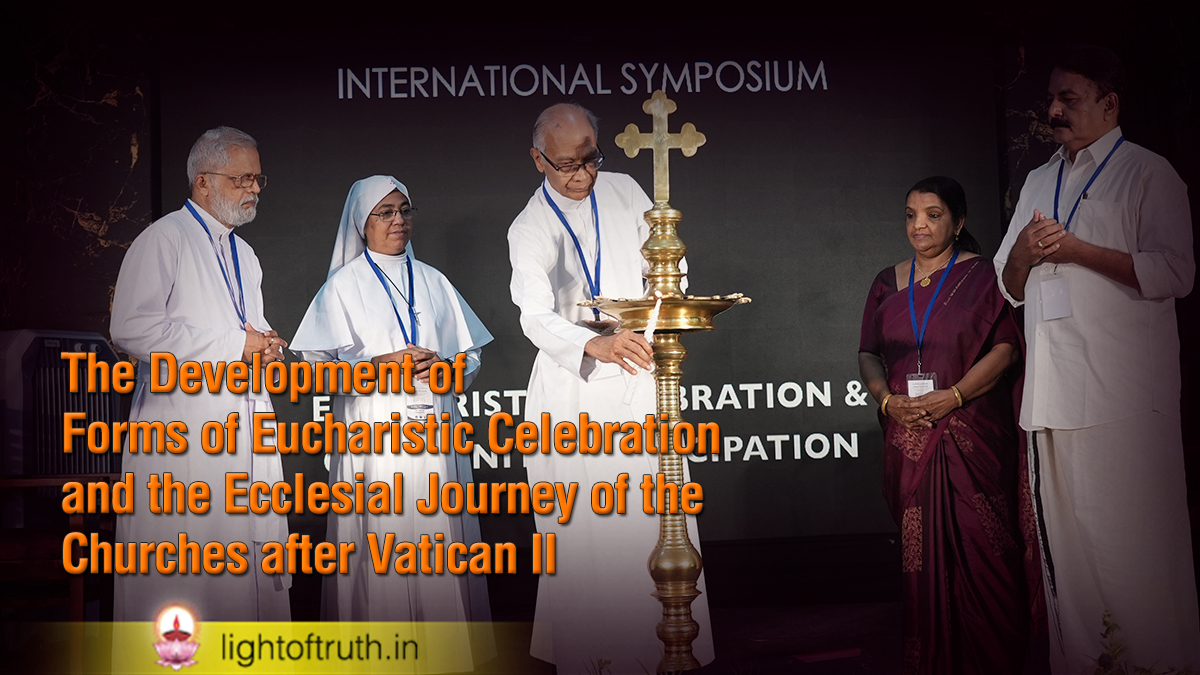
[1] Professor of Sacramental Theology at the Faculty of Theology of the Pontifical Athenum of St. Anselm in Rome. This is a shorter version of a paper presented at the International Symposium on Eucharistic Celebration and Community Participation held at Niveditha, Aluva 0n 24-25 July 2026