
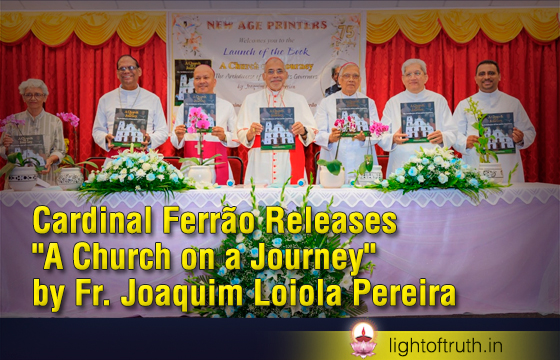
Cardinal Filipe Neri Ferrão presented the book, “A Church on a Journey: The Archdiocese of Goa and its Governors” by Fr. Joaquim Loiola Pereira on 13 October, at St Joseph Vaz Spiritual Renewal Centre, Old Goa. Published by New Age Printers, the book chronicles five centuries of the Archdiocese’s history. The launch featured reflections, hymns, and a call to preserve the Church’s legacy. Cardinal Ferrão actively praised the book, stating, “a labour of love” and “a narrative of faith, leadership, and community that has journeyed for over five centuries.” He commended Fr. Pereira’s “discretion, grace, and quiet faithfulness” over three decades, noting that the book captures “the spirit of the times and the character of the bishops who shepherded the faithful through peace, growth, and transformation.” He highlighted their roles as builders, reformers, and visionaries.
Daily Archives: October 14, 2025
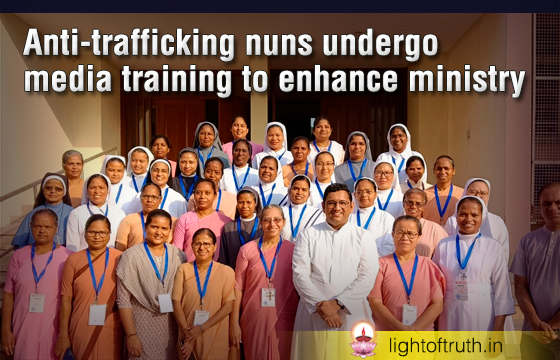
Anti-trafficking nuns undergo media training to enhance ministry
Around 40 nuns engaged in fighting human trafficking in India spent three days at a Church media institute learning various forms of media that they could use in their mission. The October 3-5 workshop aimed to equip the AMRAT (Asian Movement of Women Religious against Human Trafficking) members with media knowledge so that they can report crimes against women and children, including trafficking, to the authorities, said Holy Cross Sister Regina Rozario, the project coordinator in the movement’s national team.
The AMRAT is part of “Talitha Kum” (“Little girl, I say to you, get up”), the international network of consecrated life against trafficking in persons. The October 3-5 training that focused on digital storytelling and cyber safety was conducted at the Media College of NISCORT (National Institute of Social Communication, Research and Training) managed by the Catholic Bishops’ Conference of India, at Vaishali, on the Delhi-Uttar Pradesh border. The participants came from various women congregations that serve in the regions of Bihar, Delhi, Jharkhand, Madhya Pradesh, Maharashtra, North East, Punjab, Rajasthan, Uttar Pradesh, and West Bengal.
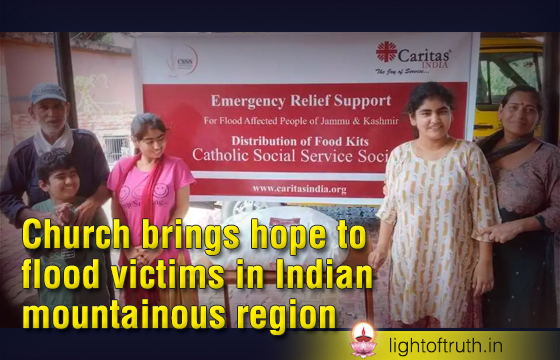
Church brings hope to flood victims in Indian mountainous region
In the last week of August, floodwaters swept through parts of India’s mountainous Jammu and Kashmir region with unprecedented, unimaginable force. In Hindu-majority Jammu, villages like Mandal, Akalpur, Akhnoor, Bari Brahmana, and Samba, families watched helplessly as homes were damaged, food stocks ruined, and entire neighbourhoods submerged.
Within hours, hundreds of people were forced to abandon everything and take shelter wherever they could find space. By the time the waters began to recede, at least 165 families had lost their homes and belongings. Hunger and fear gripped the survivors.
The difficulties faced by flood-affected people prompted the Catholic Social Service Society (CSSS) of Jammu to step forward. With the support of Caritas India, the Church agency launched emergency relief efforts on Aug. 31, barely three days after the floods struck. The team was led by Father Senoj Thomas and included a small group of staff and a dozen volunteers who quickly mobilized to reach families before conditions worsened. Food was the most urgent need for victims as many spent days with little food. Food ration kits came to them as a lifeline.
Each family received rice, wheat flour, cooking oil, salt, sugar, pulses, spices, biscuits, and even a packet of Nutri, a nutritional supplement that many mothers use to prepare meals for children. These kits contained enough items for families to live on for two weeks, giving them enough time to recover and rebuild some stability after the chaos of the floods. The CSSS carefully reached out to the affected family and ensured they were treated with dignity throughout the process. Lists were prepared in advance, names were called, and distribution happened in an orderly way.
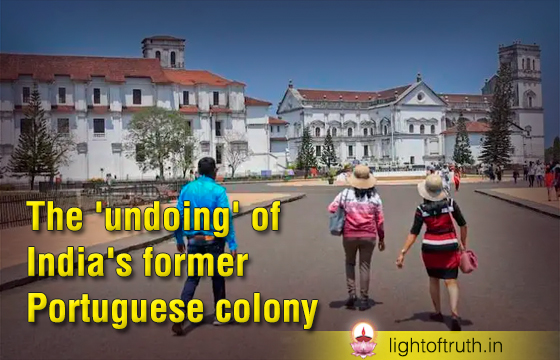
The ‘undoing’ of India’s former Portuguese colony
At the start of the Hindu holy month of Shravan in late July this year, banners appeared in parts of Goa declaring that “Goa bans beef” for the entire month. The order issued by a Hindu group had no official sanction, yet it carried weight.
Shravan, dedicated to Lord Shiva, is traditionally a period of fasting and abstinence for devout Hindus. Many refrain from meat altogether, and beef — considered taboo by orthodox Hindus — is especially sensitive. This time, the observance took on a sharper edge. The self-styled “gau rakshaks,” or cow protectors, began conducting extrajudicial checks on cattle and beef transporters. Their vigilance led to a sudden shortage of beef across the state.
Since 2022, when the pro-Hindu Bharatiya Janata Party (BJP) returned to power with a coalition government, such shortages have become more frequent. In December 2024, ahead of Christmas, beef traders went on strike after repeated attacks by cow vigilantes. Chief Minister Pramod Sawant, a loyalist of the Hindu nationalist Rashtriya Swayamsevak Sangh (RSS or National Volunteers Corps), has been outspoken in his endorsement of right-wing Hindu groups.
“Earlier, people used to come to Goa for the sun, sand, and sea,” he said at an event organized by the Goa-based Sanatan Sanstha, which backs the BJP’s idea of a Hindu Rashtra. “Now they visit Goa’s beautiful temples, culture, and villages. This is Goa’s culture.” Sawant added that the state should not remain a “bhoga bhoomi (land of enjoyment)” but become a “yoga bhoomi (land of yoga).”
Beneath Goa’s postcard-perfect beaches, a deeper contest is unfolding — but that is not about whether Goa should retain any Christian identity.
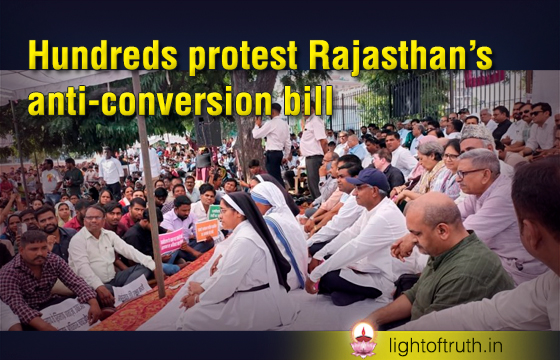
Hundreds protest Rajasthan’s anti-conversion bill
More than 2,000 people have protested against the recently passed Rajasthan Religious Conversion Bill, 2025. The protesters, who gathered at Shaheed Smarak (Martyr Memorial) Park in the state capital of Jaipur on October 5, urged the governor not to sign the bill the Rajasthan assembly passed on September 9.
They also asked the chief minister to stop criminalizing prayer meetings and to take action against hate campaigns targeting Christians, indiatomorrow.net reported October 6. The bill reportedly aims to prevent religious conversions using force, fraud, allurement or coercion, punishable with steep penalties, including life imprisonment. Those returning to their “ancestral religion” have been exempted from the law.
The protesters came together under the banner of the Coordination Against the Religious Conversion Bill, 2025. More than 20 organizations, including the Jaipur Christian Fellowship and Rajasthan Christian Alliance, participated. They resolved that minority communities would continue their state-wide protest until the bill is withdrawn. The central slogan of the gathering was: “Honourable Governor, please refuse to sign this unconstitutional bill and refer it to the President!”
Plans were announced for state-wide rallies, meetings, and signature campaigns in every district of the northwestern Indian state against the bill. Hundreds also signed a memorandum submitted to the governor. Another memorandum was presented to the chief minister. The memorandum documented 13 attacks in seven states in the past 20 days. Protesters demanded protection of fundamental religious rights for Christians, Muslims, Buddhists, Sikhs, and others. Police were urged to stop declaring Christian Sunday prayer meetings as “crimes,” a move that has caused panic in the community. The protesters condemned repeated attacks on prayer meetings by Vishwa Hindu Parishad (World Hindu Council) and Bajrang Dal members. They criticized the state police for registering cases against clergy and devotees instead of protecting them.
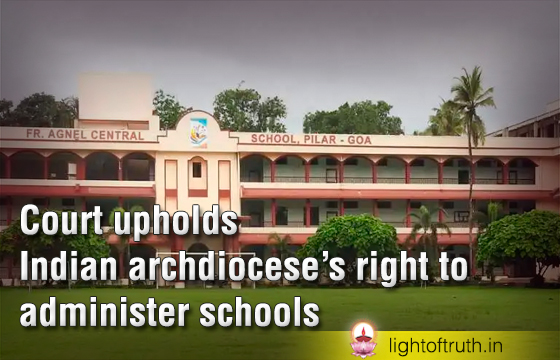
Court upholds Indian archdiocese’s right to administer schools
A top court in the western Indian state of Goa has upheld the right of the Archdiocese of Goa and Daman to administer its schools, as guaranteed by the rights enshrined in the Indian Constitution. The Goa bench of the Mumbai High Court delivered the order on Oct. 3, made public on Oct. 8, while hearing a petition filed by the Diocesan Society of Education (DSE), the educational arm of the Archdiocese.
The DSE had challenged directives issued in 2024 by the Goa Directorate of Education, which required that staff appointment orders in diocesan schools be authorized by the government agency, rather than the DSE chairman. The DSE, being a minority, “is not bound to follow the procedure prescribed” in the directives, the bench of Justices Bharati Dangre and Nivedita Mehta stated.
The Indian Constitution guarantees the rights of religious and linguistic minorities to manage and administer institutions for the benefit of their people. That right “imposes no such limits or restraints, except to ensure quality education,” the court said. The Archdiocese of Goa and Daman, which operates 138 primary to higher secondary schools, contested the directive, arguing that it curtails the archdiocese’s autonomy in managing its schools. The court quashed the education department’s directive and revived DSE’s autonomy to make appointments, initiate disciplinary proceedings, and exercise administrative control over its schools. The state holds the power to prescribe teacher qualifications and maintain educational standards. The DSE had also challenged specific rules of the education department, which it said curtailed its autonomy in running the schools.
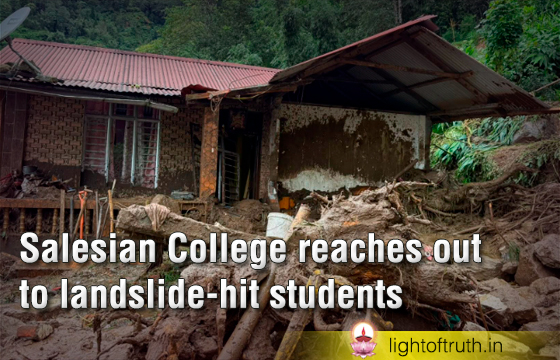
Salesian College reaches out to landslide-hit students
Salesian College (Autonomous), with campuses in Sonada and Siliguri, has extended its support to students, faculty, and families affected by the recent landslides that have ravaged the Darjeeling hills and surrounding regions.
The landslides—triggered by relentless rainfall—have disrupted life across Darjeeling, Mirik, Kurseong, and nearby areas, leaving many displaced and distressed. The college leadership has assured its community that no student will be left behind in this time of crisis.
“Our prayers and thoughts are with all those enduring the difficulties caused by these landslides,” said principal Father Babu Joseph in his message. “Salesian College stands united with our students and staff from the affected regions. We understand the distress many are facing and assure every possible support—academic, financial, and emotional—during this recovery period.”
The college has activated its Office of Student Affairs and departmental heads to reach out to students from impacted areas. Measures include flexible attendance policies, extended submission deadlines, and rescheduled examinations. Counselling and pastoral care teams are also on standby to offer emotional and spiritual support. Father Joseph emphasized that the institution’s mission goes beyond academics. “We are a community rooted in faith and fraternity. In moments like these, our commitment to accompaniment becomes our most vital offering.” The college has urged students and families in need of assistance—academic, administrative, or personal—to contact the college office or their department coordinators without hesitation.
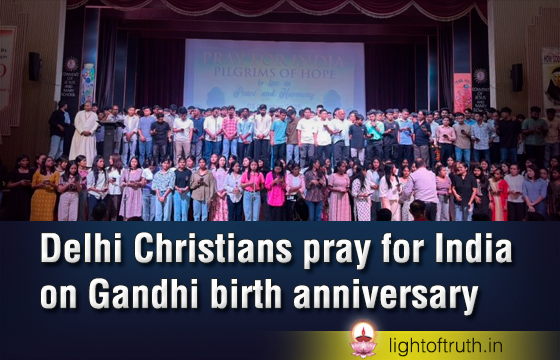
Delhi Christians pray for India on Gandhi birth anniversary
Around 700 Christians from across the National Capital Region observed the birth anniversary of Mahatma Gandhi on October 2 praying for India. The ecumenical event – “Pray for India – Pilgrims of Hope” – at the downtown Convent of Jesus and Mary was part of the Jubilee Year 2025 celebrations of Jesus Christ. The Delhi Commission for Ecumenism organized the event that highlighted the Catholic Church’s commitment to fostering peace, unity, and dialogue in a diverse society.
Archbishop Anil J.T. Couto of Delhi, who inaugurated the event with a prayer, recalled Mahatma Gandhi’s vision of non-violence, social justice, and care for the marginalized. He encouraged participants to translate prayer into concrete acts of compassion, saying, “We keep alive the Father of the Nation’s dream by coming together to pray for India.” His words set the tone for a day of reflection, unity, and spiritual renewal.
Archbishop Kuriakose Bharanikulangara of the Syro-Malabar Eparchy of Faridabad prayed for unity, harmony, and reconciliation, while Auxiliary Bishop Deepak Valerian Tauro of Delhi prayed for Christian institutions schools, colleges, and hospitals invoking God’s blessings so they may continue to serve as centres of learning, healing, and service.
Leaders from Orthodox, Protestant, and Evangelical Churches reinforced the spirit of Christian fraternity, reflecting the day’s ecumenical essence. The highlight of the program was the chanting of the Nicene Creed in Syriac by Father Afilash of the Malankara Orthodox Syrian Church, commemorating 1,700 years of the historic symbol of Christian unity.
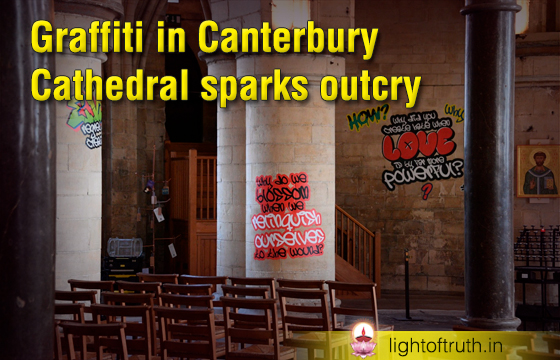
Graffiti in Canterbury Cathedral sparks outcry
Visitors to Canterbury Cathedral this week have been taken aback to find its medieval interior covered in graffiti-style slogans, part of a new art installation that has drawn serious criticism. The work, titled “Hear Us”, transforms the pillars and walls of the nation’s mother church with brightly coloured lettering and stencil designs asking questions such as, “Are you there?”, “Why all the suffering?” and “Where does love come from?”
The images resembling spray-painted graffiti in a mix of street styles – which are removable – have led some to comment that the cathedral now looks more like “an underground car park in Peckham” than one of Christendom’s most venerated shrines, reports The Times. The Rev Marcus Walker, a London clergyman, expressed astonishment at the cathedral’s approach, posting on X: “There is something deeply bizarre about the way in which the Dean and Chapter of Canterbury delight in desecrating their sacred space. It feels almost Freudian.”
His remarks have been widely shared and have come to symbolise the disquiet felt by many about the treatment of such an important building and national shrine. The display has split public opinion. While some visitors have described the work as fresh and engaging, others have been appalled by its intrusion into a sacred space.
A statement from the cathedral admitted that the exhibition had provoked “visceral reactions”, with some finding the experience “discomforting” and even “sacrilegious”. The cathedral noted that the graphics though strikingly realistic are in fact temporary stickers that have been “expertly and sensitively applied” and will be removed before the enthronement of the Right Rev Sarah Mullally as the Church of England’s new Archbishop of Canterbury early next year.
Canterbury Cathedral, founded by St Augustine in 597 AD, has long stood at the centre of English Christianity. It has witnessed royal coronations, the martyrdom of St Thomas Becket, the turbulence of the Reformation and the destruction of war.
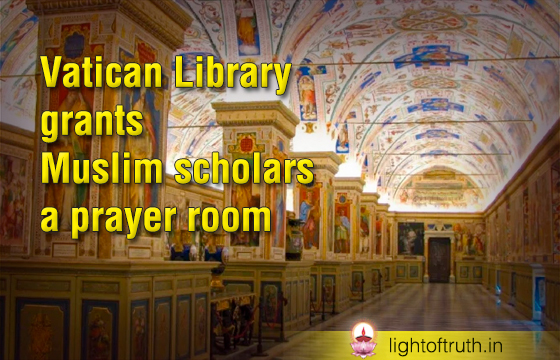
Vatican Library grants Muslim scholars a prayer room
Muslim scholars visiting the Vatican Apostolic Library are being accommodated with prayer spaces, its Vice Prefect has confirmed.
Fr Giacomo Cardinali, Vice Prefect, said in an interview with the Italian newspaper La Repubblica that Muslim academics had requested a small area in which to pray, and the library had agreed. “Some Muslim scholars have asked us for a room with a carpet for praying and we have given it to them,” he said.
The Vatican Library, founded in the mid-15th century and often regarded as the intellectual heart of the Catholic Church, houses a vast array of manuscripts and texts from across the world’s religions and cultures.
Fr Cardinali said its collections include “incredibly old Qurans” alongside Hebrew, Ethiopian, Arabic, and Chinese works. “We are a universal library,” he explained.
The Vice Prefect also drew attention to some of the more unusual items in the collection, such as what is believed to be the oldest medieval Japanese archive outside Japan. The archive was preserved thanks to a Salesian missionary, Father Mario Marega, who lived in Japan during the 1920s.
According to Fr Cardinali, the missionary discovered the documents when he noticed children playing with a ball of paper made from old manuscripts. Realising their significance, he rescued them from a ruined castle, thus saving them decades later from the devastation of the atomic bomb. “It was either a sensational stroke of luck or an inspiration from above,” Fr Cardinali said.
Today, the Vatican Library is estimated to contain some 80,000 manuscripts, 50,000 archival items, nearly two million printed books, and more than 100,000 engravings, prints, coins, and medals. New discoveries continue to emerge, including a rare manuscript of Spinoza’s Ethics unearthed in recent years.