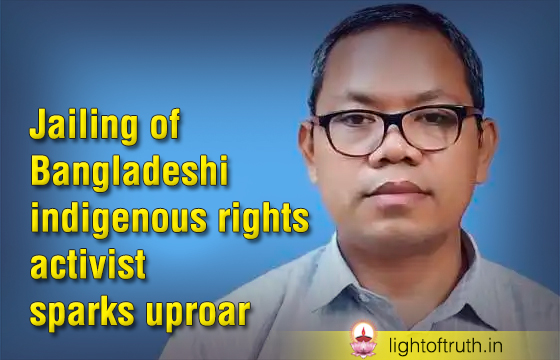
Jailing of Bangladeshi indigenous rights activist sparks uproar

A Bangladeshi court jailed an ethnic tribal leader for eight years for an alleged charge of extortion, about a year after he was released from nearly five years in secret detention.

A court in Rangamati district of Chattogram Hill Tracts (CHT) region in southeast Bangladesh sentenced Michael Chakma and two others to eight years rigorous imprisonment on Oct. 8. The case was filed in 2007 during the tenure of the military-backed caretaker government.

Chakma, 46, an ethnic Chakma and Buddhist, is a leader of the CHT-based political organization, the United People’s Democratic Front (UPDF), which seeks autonomy for the hilly, forested, and restive region.

He disappeared while visiting the national capital, Dhaka, in 2019. Chakma told the media that the state forces kept him in secret locations until he was dropped off at the door of his home on Aug. 7, 2024, two days after former Prime Minister Sheikh Hasina fled to India following a massive student-led public uprising.

He is among about 700 victims of enforced disappearance during the 15-year authoritarian regime of Hasina’s Awami League government.

The interim government led by Nobel Peace Prize winner Professor Muhammad Yunus, which replaced the ousted regime, formed the Commission of Inquiry on Enforced Disappearances to probe into hundreds of people who were either killed or secretly detained. Chakma was convicted in absentia in 2023 for alleged illegal possession of arms, which he termed “yet another false case.”

Pakistan slammed for delay in forming Minorities Commission

Leaders from Christian and Hindu communities have criticized Pakistani authorities for their failure to form a commission to protect the rights of religious minorities despite nearly five months after the parliament passed a related law. Pakistan’s parliament passed the National Commission for Minorities’ Rights Bill 2025 on May 12. The law was hailed as a landmark move to safeguard the rights of minorities in a country criticized for violations of religious freedom.

The criticism came as media reports suggest the bill has been in limbo after being returned by President Asif Ali Zardari to the Ministry of Human Rights for review. In a report released on Oct. 10, the Catholic bishops’ National Commission for Justice and Peace (NCJP) expressed disappointment over the limbo.

The report titled “Thousands of Slips Stand Guard” cited administrative hurdles and political apathy as major causes for the delay in forming the proposed 30-member minorities commission. The NCJP urged the government to ensure the commission enjoys independence.

It further urged the government to re-table the bill, ensure amendments comply with the Paris Principles, the standards for the credibility and effectiveness of National Human Rights Institutions adopted by the UN General Assembly in 1993.

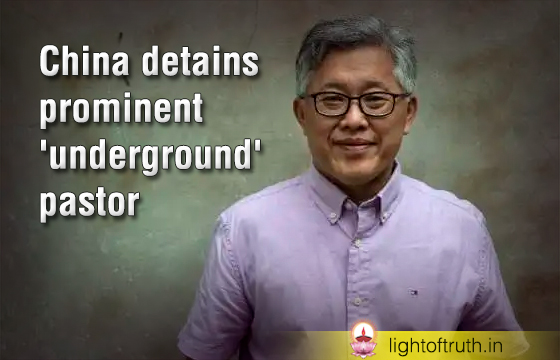
China detains prominent ‘underground’ pastor

The founder of a prominent Chinese underground church has been detained along with more than 20 of its members in a sweeping national crackdown, according to his daughter and one of its pastors. Police arrested Jin Mingri, who founded the unregistered Zion Church, at his home in the southern region of Guangxi on Oct. 10, along with several pastors in other cities, including Beijing, who were taken into custody overnight.

Jin was detained on “suspicion of the illegal use of information networks,” a detention notice stated. At least seven pastors, including Jin, who also goes by the name Ezra, may face criminal charges for “illegal dissemination of religious information via the internet,” according to a church statement.

Police searched their homes and confiscated their computers and cell phones. “It is just a blatant attack on religious freedom,” Jin’s daughter Grace said. Since Oct. 9, police have apprehended church leaders and members in Shanghai, Beijing, Zhejiang, Guangxi, Shandong, Sichuan and Henan, according to a list compiled by church members.

Four people have since been released following interrogation. Police barred lawyers from meeting detained church members in the Guangxi city of Beihai on Oct. 13 morning, according to Grace.

It was not immediately clear if those detained have been able to speak with lawyers since then. “We are not criminals, we are just Christians,” said Sean Long, a Zion pastor based in the United States who has been in touch with family members of those detained in China. “We pray for the best, but we have to prepare for the worst.”

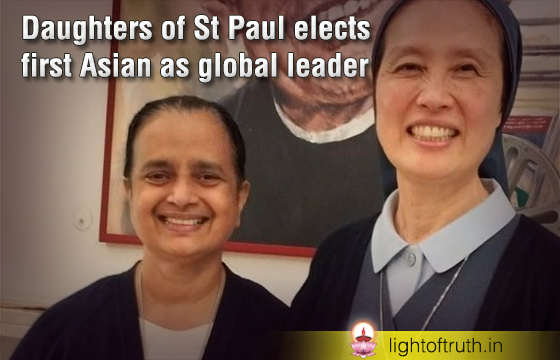
Daughters of St Paul elects first Asian as global leader

The Daughters of St Paul, a member of the Pauline Family, on October 1 elected Sister Mari Lucia Kim as their superior general during their 12th general chapter in Rome. Sister Kim is the first Asian to head the 110-year-old congregation founded by Blessed James Alberione along with Mother Thecla Merlo. She is the eighth successor of Mother Merlo.

The Korean nun, who will turn 60 on November 1, has been a member of the congregation since 1995. She is currently the Korean provincial. She had served as a member of the general council during 2013-2019. Sister Kim replaces Sister Anna Caiazza, who led the congregation for the past six years. She will head the congregation until 2031.

The Daughters of St Paul, who entered South Korea in 1960, are known as the “Media Nuns” in the Southeast Asian nation. The sisters spread the Gospel through various forms of media and literature, supporting Catholic culture among young people.

The sisters operate 15 bookshops throughout Korea and manage 12 communities. In 2020, they opened a new apostolic centre in Seoul called Hyehwa Namu, which includes a bookstore, snack bar, event spaces, and a small theatre. Their primary focus is on forming young people through new media and establishing a website for their mission in Asia. They are involved in training and motivational programs for young people in schools and universities. The Daughters of St Paul has 1,815 members in 11 provinces and 14 delegations. As many as five houses are directly under the generalate.

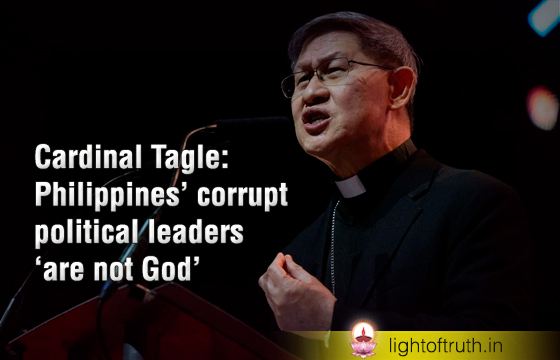
Cardinal Tagle: Philippines’ corrupt political leaders ‘are not God’

Cardinal Luis Antonio Tagle said politicians in the Philippines must remember that they are “not God” following a major corruption scandal. “Please, you are human beings. You are created in God’s image. Can you please look at yourself and, with humility, say, ‘I am not God. I should not pretend to be God. I am a creature with many other creatures, and so my responsibility is to take care of what God has given to us for the good of all,’” Cardinal Tagle told the ABS-CBN News Channel.

Tagle, pro-prefect at the Dicastery for Evangelisation, was the Archbishop of Manila from 2011 to 2019. The 68-year-old theologian, who finished his doctorate at the Catholic University of America in Washington, DC, remains an influential voice in the Filipino Church.

Speaking in an interview published on 4 October, Tagle expressed disbelief at the corruption controversy involving billions of pesos for flood control projects. He said it demonstrates “the mystery of the capacity of human beings to destroy each other through corruption”.

Acknowledging that this was partly a failure of formation by the Church, the cardinal challenged Filipinos to go beyond the massive protests that have rocked the country in recent weeks. “After the rallies, we should now look for lasting change, because we cannot effect change simply by expressing our anger,” he said.

Other Church leaders have condemned the corruption scandal, even joining protests in different parts of the country. A Church-led protest on 21 September drew thousands of people, and a bigger one is being prepared for 30 November, a public holiday in honour of the nineteenth-century Filipino revolutionary Andres Bonifacio. The Bishop of Kidapawan Jose Colin Bagaforo, 71, said a group of clergy had joined a new movement to fight the “systemic corruption” and “excessive greed” that have led to poverty in the country. Their “Trillion Peso March Movement” is named after the successful “Trillion Peso March” protest on 21 September.

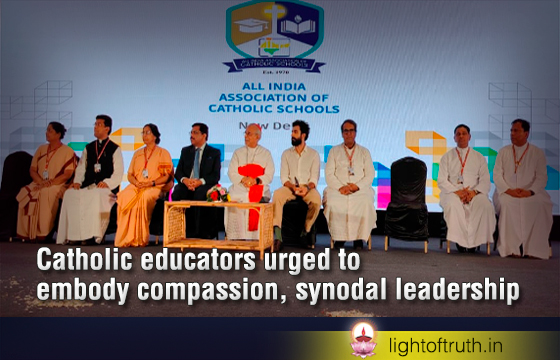
Catholic educators urged to embody compassion, synodal leadership

The national convention and general body of the All India Association of Catholic Schools (AINACS) opened with a call from Cardinal Filipe Neri Ferrão urging Catholic educators to be “rooted in Christ and be messengers of hope.”

Addressing more than 1,050 delegates gathered at the Park Regis Convention Centre in Arpora, Goa, the archbishop of Goa and Daman drew inspiration from the Gospel and Pope Francis to invite educators to embody compassion, wisdom, and synodal leadership in their ministry.

Reflecting on the healing encounter between Jesus and the leper, Cardinal Ferrão illustrated the transformative power of loving care. He reminded the assembly that Jesus approached the leper, touched him, healed him, and became a witness of hope. In the same spirit, Catholic educational institutions are called to radiate hope through attitudes of mercy and understanding, the cardinal added.

In his keynote address, Cardinal Ferrão expanded this vision through the lens of synodality, describing Catholic educational leadership as a journey of communion, participation, and mission. He called on leaders to cultivate open hearts, to encourage dialogue, and to respect diverse perspectives. Leadership, he said, must move beyond rigid bureaucracies and embrace relationships built on trust and shared responsibility.

He emphasised that discernment is central to synodal leadership. Drawing from the Gospel, he described it as a patient, prayerful approach, attentive to God’s will rather than personal ambition. True discernment, he noted, allows educators to respond effectively to the evolving needs of their communities, making decisions that nurture growth, understanding, and holistic development.

The cardinal also framed leadership as stewardship, reminding educators that students are gifts entrusted to them, deserving care, guidance, and love. Quoting the Gospel of Luke, he described stewardship as a vocation of service, compassion, and patience, one that prioritises the integral development of each student.

Vatican greets Hindus ahead of Diwali, urges dialogue for peace

The Vatican has extended greetings to Hindus worldwide ahead of their Diwali festival, calling it an occasion to promote peace, dialogue, and reconciliation in a divided world. In an Oct. 10 message, the Dicastery for Interreligious Dialogue said the festival of lights — celebrated on Oct. 20 this year — symbolizes “the victory of truth over falsehood, light over darkness, life over death, and good over evil.” The three-day celebration marks the beginning of a new year, family reunions, and the worship of God, the dicastery noted.

This year’s Diwali message coincides with the 60th anniversary of Nostra Aetate — the Second Vatican Council’s landmark declaration on the Church’s relations with non-Christian religions, promulgated on Oct. 28, 1965. The dicastery’s prefect, Cardinal George J. Koovakad, and secretary, Monsignor Indunil Janakaratne, signed the message on the theme: Hindus and Christians: Building world peace through dialogue and reconciliation in the spirit of Nostra Aetate. The dicastery recalled that Nostra Aetate urged believers to “recognize, preserve, and promote the good things, spiritual and moral, as well as the socio-cultural values” present in other faith traditions for the sake of peace. The Vatican urged Christians, Hindus, and all people of goodwill to strengthen shared efforts for peace “through dialogue and collaboration in the spirit of Nostra Aetate,” emphasizing unity and fraternity across religions and nations. It also reaffirmed the Church’s teaching to reject “nothing that is true and holy” in other religions, and to honour teachings and practices that “reflect a ray of that Truth which enlightens all people.”

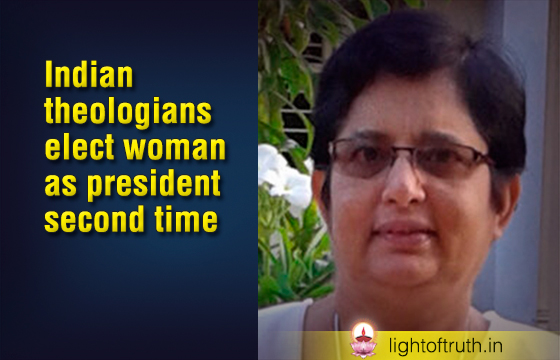
Indian theologians elect woman as president second time

The Indian Theological Association (ITA) has elected Sister Evelyn Monteiro, a member of the Sisters of the Cross of Chavanod, as its president, the second woman to head the 49-year-old association. The election took place during the association’s 47th annual meeting at Ishvani Kendra in Pune, western India. Sister Monteiro was the association’s vice president during the past three years. The first woman president of the association was Presentation Sister Shalini Mulackal.

The meeting also elected Jesuit Fathers Thomas Kuriackose as the ITA vice-president and Joseph Victor Edwin, the secretary. The new executive members are Astrid Lobo Gajiwala, a lay woman theologian from Mumbai, Father Jacob Parapally MSFS, Father Jacob Naluparayil MCBS, and  Father Xavier Francis Tharamel SJ.

Sister Monteiro, who has a doctorate in systematic theology from the Centre Sèvres, Facultés jésuites de Paris, France, teaches the same subject in a number of theoretical institutions in India and overseas. She is the co-founder of Ecclesia of Women in Asia (EWA), an association of Catholic women theologians in Asia.

In 2004, she authored the “Church and Culture: Communion in Pluralism,” besides editing several books and publishing a number of articles in national and international theological journals. Her research addresses ecclesiology, particularly in situating the conciliar and post-conciliar understanding of the Church in the pluri-religious and socio-cultural context of Asia and India, and contextual and liberation theologies.

The September 26-28 gathering explored Lumen Gentium and Gaudium et Spes, two key documents from the Second Vatican Council. The meeting reaffirmed the vocation of theologians in India is to be deeply rooted and dialogical. An Indian theologian is called to be grounded in the Catholic tradition while engaging in dialogue with the diverse religious and cultural landscape of India.

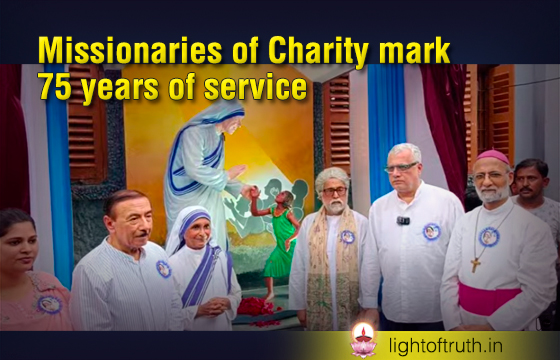
Missionaries of Charity mark 75 years of service

The Mother House of the Missionaries of Charity in Kolkata stood bathed in reverence and quiet joy on October 7 as the congregation founded by Saint Teresa of Calcutta celebrated its 75th Foundation Day. At the platinum jubilee, the international congregation recommitted to their charism of “wholehearted free service to the poorest of the poor.”

The day’s commemorations began with Mass in the tomb chapel, attended by sisters, volunteers, and friends of the congregation. Prayers were offered for peace, interfaith harmony, and the suffering poor across the globe. A short documentary on the congregation’s global outreach was screened, followed by testimonies from long-time collaborators.

Sister Mary Joseph, the congregation’s superior general, in her address, said: “We do not celebrate ourselves today, but the grace of God that has sustained this mission for 75 years. Mother taught us that holiness is not a luxury—it is a simple duty of love. We renew that duty today.”

A highlight of the celebration was the unveiling of a newly installed statue of Mother Teresa, mounted on the side wall of the Mother House facing AJC Bose Road. The statue depicts Mother Teresa bending forward with open arms to receive a girl child running toward her—a tableau of welcome, humility, and maternal love. The composition captures the essence of Mother’s mission: to embrace the abandoned and unloved with the heart of Christ.

The function was attended by civic and religious dignitaries. Many onlookers paused in prayer to witness the roadside event. O’Brien hailed the Missionaries of Charity Sisters calling them “our champion women” – 5,766 of them along with 390 Brothers and several hundreds of collaborators and volunteers spread out in 138 countries. “For 75 years, they have served not just the poor, but the conscience of our city. Mother Teresa’s legacy is not just in homes and hospices—it’s in every act of quiet compassion that this city has learned to offer,” he said.

Vatican official urges religious leaders in India to promote peace

A Senior Vatican official has called on religious leaders to promote reconciliation and peace amid growing violence and intolerance worldwide, as he addressed a meeting in India. Cardinal George Jacob Koovakad, prefect of the Vatican Dicastery for Interreligious Dialogue, made the appeal while addressing an interreligious gathering for peace in Mumbai on Oct. 4.

The meeting, organized by the Interreligious Dialogue Commission of the Archdiocese of Bombay as part of the Church’s Jubilee Year 2025 celebrations, brought together leaders from Hindu, Buddhist, Sikh, Zoroastrian, Jewish, and Islamic traditions, along with civic representatives, scholars, and peace activists.

Linking the gathering to the feast of Saint Francis of Assisi, Cardinal Koovakad described the saint as “the saint of fraternal love, simplicity, and joy” and “a pioneer of interreligious dialogue who sowed seeds of peace.” Quoting Pope Leo XIII, he said religion “is not a source of conflict but a wellspring of healing and reconciliation.” Interreligious dialogue, he added, enables believers to “bear witness to the truth that faith unites more than it divides” and strengthens “our hope for a more just world.” Reflecting on the 60th anniversary of Nostra Aetate, the Second Vatican Council’s landmark document on interreligious relations, Koovakad said its principles continue to inspire “fraternity, friendship, unity, and solidarity for the good of humanity.”