Venezuelan opposition leader receives 2025 Nobel Peace Prize

Venezuelan opposition leader María Corina Machado was awarded the 2025 Nobel Peace Prize on October 10 in recognition of “her tireless work in promoting the democratic rights of the Venezuelan people and for her struggle to achieve a just and peaceful transition from dictatorship to democracy,” according to the Nobel Committee. This year’s prize is awarded to a “courageous and committed advocate for peace,” a woman who has kept “the flame of democracy burning amid growing darkness,” according to the announcement posted on the Nobel Prize website.

With a political career spanning more than 20 years, Machado is the founder and national coordinator of the Vente Venezuela political party. Since October 2023, she has been the undisputed leader of the opposition after obtaining an overwhelming majority of votes in primary elections. Machado toured the country during the campaign for the presidential elections of July 28, 2024, and was welcomed by thousands of people at her rallies.

President Nicolás Maduro’s government disqualified her from holding public office, so the opposition coalition ended up registering Edmundo González Urrutia as a candidate to challenge Chavismo in the electoral contest. Maduro claimed a much-disputed victory that allowed him to begin a new six-year presidential term. Meanwhile, the opposition to Maduro, led by Machado, called for a series of protests and activities across the country to confront the alleged fraud. These protests resulted in dozens of deaths by government security agencies, hundreds of arrests — according to the organization Foro Penal — and Machado herself remaining in hiding to this day.
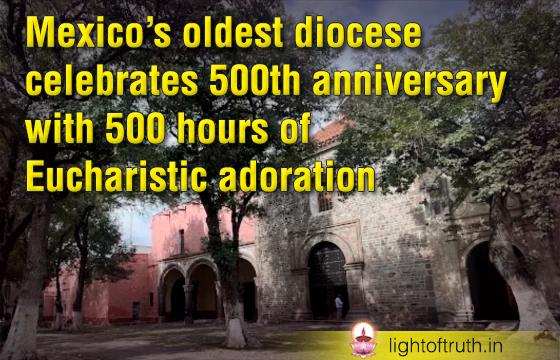
Mexico’s oldest diocese celebrates 500th anniversary with 500 hours of Eucharistic adoration

The Diocese of Tlaxcala, the oldest in Mexico, is commemorating the quincentennial of its canonical establishment with a 500-hour period of continuous Eucharistic adoration before the Blessed Sacrament as an expression of gratitude and renewal of faith.

The initiative began on Sept. 12 and will conclude on Oct. 3, with the hours being distributed among the 93 churches that make up the seven deaneries of the diocese. Each deanery is responsible for 50 hours of adoration.

A statement noted that the objective of the activity is to spiritually prepare for the celebration of the jubilee of the 500th anniversary “as a form of thanksgiving and renewal of faith.” Parish priests, vicars, and community leaders are also invited to promote the initiative during Sunday Masses and encourage families, parish groups, and the faithful in general “to join in this moment of unity around Christ.”

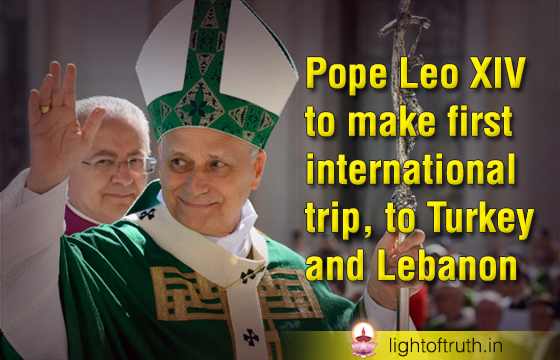
Pope Leo XIV to make first international trip, to Turkey and Lebanon

Pope Leo XIV will visit Turkey and Lebanon in the first apostolic journey of his pontificate, to take place from Nov. 27 to Dec. 2, the Vatican announced on Oct. 7. Holy See Press Office Director Matteo Bruni said the pope accepted the invitations of the “Head of State and Ecclesiastical Authorities” of both countries in an Oct. 7 statement released by the Vatican.

During the six-day papal trip, the Holy Father will visit the Turkish city of Iznek to mark the 1,700th anniversary of the Council of Nicaea, an ecumenical milestone in Church history that led to the formulation of the Nicene Creed.

According to a media release published by the Ecumenical Patriarchate, Pope Leo will undertake a joint pilgrimage with Orthodox Patriarch Bartholomew I of Constantinople to Nicaea on Nov. 28 before spending two days in the Phanar, the headquarters of the Ecumenical Patriarchate in Istanbul, where he and Bartholomew will celebrate the feast day of St. Andrew the Apostle on Nov. 30.

The Assembly of the Catholic Patriarchs and Bishops in Lebanon issued a statement expressing their gratitude to Pope Leo for his “fatherly love and special concern” for the Lebanese people. “We receive this historic event with great joy and renewed hope, praying this apostolic visit may bring Lebanon peace and stability, and that it may be a sign of unity for all Lebanese Christians and Muslims alike, in this delicate phase of our nation’s history,” the statement read.

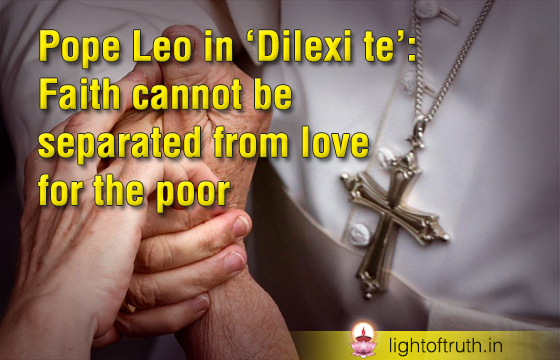
Pope Leo in ‘Dilexi te’: Faith cannot be separated from love for the poor

Pope Leo XIV’s first Apostolic Exhortation sees the love of Christ incarnated in love for the poor, in caring for the sick, opposing slavery, defending women who experience exclusion and violence, making education available to all, accompanying migrants, charitable giving, working for equality and more.

Dilexi te (“I have loved you”, from Rev 3:9) unfolds in 121 numbered paragraphs spread throughout five chapters, and flows directly from the Gospel of the Son of God, Who in the very act of entering into our world through the Incarnation became poor for our sakes. At the same time, it reproposes the Church’s social teaching, especially that of the past 150 years, as “a veritable treasury of significant teachings” concerning the poor.

With this document, signed on 4 October, the feast of Saint Francis of Assis, Pope Leo situates himself firmly on the path laid out by his predecessors, including Saint John XXIII, with his appeal, in Mater et Magistra, to wealthier countries not to remain indifferent to nations oppressed by hunger and extreme poverty (83).

Saint Paul VI added his own voice with Populorum progressio and his appearance at the United Nations as an “advocate of the poor”; as did Saint John Paul II, who consolidated the doctrinal foundations of the Church’s “preferential option for the poor”.

More recently, Benedict XVI, in Caritas in veritate, offered a more markedly political take on the crises of the Third Millenium; while Francis made care for the poor and solidarity with the poor one of the key themes of his pontificate.

Like Francis, who completed the work of Benedict XVI on the encyclical Lumen Fidei, Pope Leo XIV took up the text of his immediate predecessor for his first major Magisterial document. Dilexi te builds on the teaching of Francis’ final encyclical – Dilexit nos, on the Sacred Heart of Jesus – highlighting the “close connection” between the love of God and love for the poor. “In the poor”, writes Pope Leo, God “continues to speak to us” (5). The Holy Father likewise recalls the theme of the Church’s “preferential option… for the poor”, an expression that arose in the context of Latin America (16). Pope Leo explains that this “‘preference’ never indicates exclusivity or discrimination towards other groups” but instead emphasizes “God’s actions, which are moved by compassion toward the poverty and weakness of all humanity” (16).

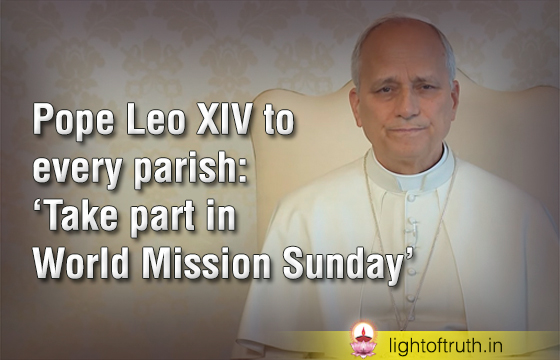
Pope Leo XIV to every parish: ‘Take part in World Mission Sunday’

“I urge every Catholic parish in the world to take part in World Mission Sunday,” insisted Pope Leo XIV in a video message for the occasion of World Mission Sunday.

World Mission Sunday is held every year on the second-to-last Sunday of October. This year it will take place on 19 October with the theme of “Missionaries of Hope among the peoples.”

The video begins with the Holy Father recalling that on World Mission Sunday every year, the whole Church prays, united, particularly for missionaries and the fruitfulness of their apostolic labours. “When I served as a missionary priest and Bishop in Peru,” Pope Leo illustrated, “I saw first-hand how the faith, the prayer and the generosity shown on World Mission Sunday can transform entire communities.” Hence, he gave all Catholic parishes some concrete homework. “I urge every Catholic parish in the world to take part in World Mission Sunday,” Pope Leo said, underscoring, “Your prayers, your support will help spread the Gospel, provide for pastoral and catechetical programs, help to build new churches, and care for the health and educational needs of our brothers and sisters in mission territories.”

“This October 19th, as we reflect together on our baptismal call to be ‘missionaries of hope among the peoples,'” the Pope encouraged, “let us commit ourselves anew to the sweet and joyful task of bringing Christ Jesus our Hope to the ends of the earth.” The Holy Father concluded by thanking parishes worldwide for everything they do to help him to help missionaries throughout the world and imparting his Apostolic Blessing.

Immigration is a ‘Gospel issue’ before a ‘political issue,’ U.S. bishop says

Bishop Mark Seitz of El Paso, Texas, said immigration is a “Gospel issue” before it is a “political issue” in the United States.  In an exclusive interview with EWTN News reporter Valentina Di Donato, Seitz said the Church has a responsibility to reaffirm Catholic social teaching regarding the preferential option for the poor. “It’s always the role of the bishop to speak the Gospel, to reflect on that Gospel and its implications for our daily lives,” the prelate told EWTN News. 

“We have a task to form people based on that teaching of love and mercy and compassion that applies not just in exceptional cases, not just to certain people, but in a special way to the poor and the vulnerable, and that includes immigrants,” he said. 

Speaking about the “inalienable rights” every person is endowed with by God, the bishop said the rights of immigrants should not only be a concern of the Church but should also be “respected in law.” “While we are not politicians — it’s not our task to develop rules and laws — we are responsible to help form consciences and bring people back to the basic underlying principles, which, by the way, are principles upon which our country was built,” he said.

According to the bishop, U.S. asylum law is not being respected “right now,” as several migrant families living in the El Paso Diocese, located near the U.S.-Mexico border, no longer feel protected and fear deportation. “We should practice that [respect for] human dignity when we are dealing with a person who simply fled here because they had no other option,” he told EWTN News.

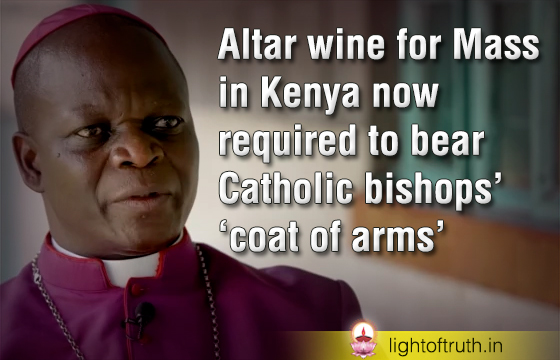
Altar wine for Mass in Kenya now required to bear Catholic bishops’ ‘coat of arms’

Wine for Mass in Kenya must now bear the “coat of arms” of the country’s bishops, the chairman of the Kenya Conference of Catholic Bishops (KCCB) announced Oct. 4.  Speaking at the 2025 National Prayer Day at the Subukia National Marian Shrine in Kenya’s Nakuru Diocese on the feast of St. Francis, KCCB chairman Archbishop Maurice Muhatia Makumba announced that bottles containing the altar wine must bear the coat of arms of the bishops, as well as an official signature, to certify their authenticity. 

The Catholic faithful have welcomed the news as many believe the wine previously used “had lost its sanctity due to its widespread use outside the Church,” according to a BBC report. 

The wine formerly used is reportedly widely sold in liquor stores, bars, and supermarkets. After exploring options, the bishops in Kenya chose a South African vintage for the newly approved Mass wine. “Vigilance on the quality and standards of the wine and hosts used in the Mass is given to the Catholic bishops of the country. This is reviewed from time to time,” the archbishop added. The new wine was officially introduced to worshippers during the National Prayer Day. Muhatia has directed that local Catholic communities and Catholic institutions abide by the directives and sourcing for the new altar wine.“It is important that you acquaint yourself with your diocese and know what has been established as the outlets for this wine because different dioceses have different ways of distributing this wine,” he said at the National Prayer Day. “Some dioceses allow only specific persons to buy this wine for Mass; others allow everybody. Depending on your diocese, please be aware of the regulations.”

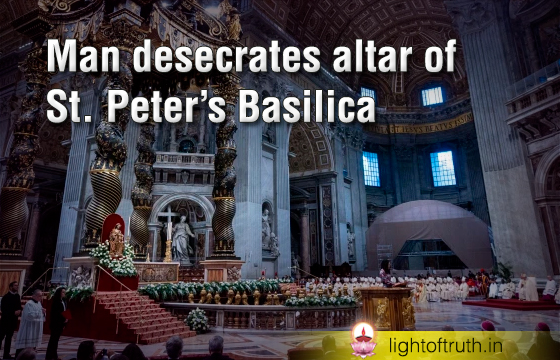
Man desecrates altar of St. Peter’s Basilica

A man urinated on the Altar of Confession of St. Peter’s Basilica on Oct. 10 before being taken away by security officers in the famous basilica, according to news reports. The man climbed the altar and “urinated under the stunned gaze of hundreds of tourists,” according to the newspaper Corriere della Sera’s Rome edition. Video of the desecration was widely shared on social media.

Il Tempo reported that the man “was promptly reached by plainclothes police officers present in the basilica” and was escorted out of the church.

The latter newspaper claimed Pope Leo XIV was “shocked to learn of the news,” though the Holy See Press Office had not released a statement about the incident as of Oct. 11.

This is not the first time this year that a vandal has attacked the altar from which the pope says Mass.In February, a man desecrated the altar by climbing on top of it and throwing six candelabras that were on the altar to the ground. In June 2023, meanwhile, a Polish man approached the high altar as the basilica was about to close, undressed, and climbed onto the altar. Photos posted online showed the words “Save children of Ukraine” written in marker on his back. The Vatican performed a penitential rite after that act of desecration.