
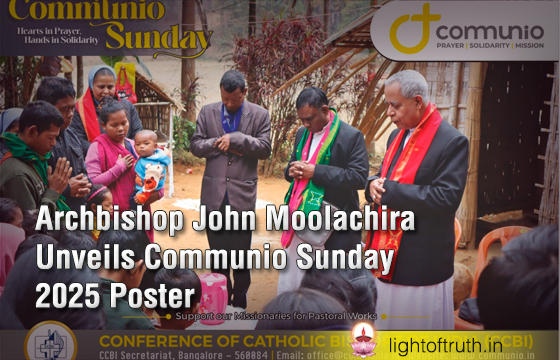
Archbishop John Moolachira of Guwahati officially unveiled the poster for Communio Sunday 2025 at the Archbishop’s House, Guwahati. This year, Communio Sunday will be observed across India on 30 November 2025, the first Sunday of Advent. In his message, Archbishop John Moolachira underlined the heart of the Church’s vocation: “Mission is the very life and identity of the Church. Every baptized person is called to live and witness Christ in the world, carrying His light to those in the peripheries. Through Communio, we are reminded that mission is not optional but essential to our Christian life.” The projects supported by Communio are strengthening parishes, communities, and especially the marginalized, enabling the Church to remain a beacon of hope.” Observed annually, Communio Sunday invites the faithful to renew their missionary zeal through prayer, solidarity, and contributions. It is a reminder that every Catholic is a missionary disciple, called to live out communion and share the Good News in daily life. The release of the Communio Sunday 2025 poster in Guwahati marks the beginning of this year’s celebrations and reaffirms the Church’s commitment to being a Communion in Mission. With the blessing of Archbishop John Moolachira and the leadership of Communio, the faithful are encouraged to embrace this call and actively participate in the evangelizing mission of the Church in India.
Daily Archives: September 30, 2025
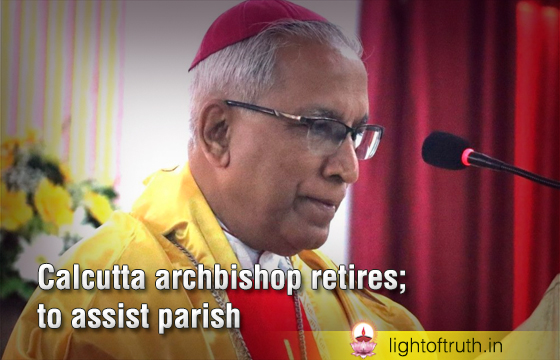
Calcutta archbishop retires; to assist parish
Pope Leo XIV has accepted the resignation of Archbishop Thomas D’Souza from the pastoral governance of the Archdiocese of Calcutta, effective September 20. With this, Coadjutor Archbishop Elias Frank has automatically succeeded him as the tenth archbishop of the archdiocese, based in Kolkata, the capital city of West Bengal state. He is the sixth Indian prelate of the archdiocese.
In a message, Archbishop D’Souza thanked the archdiocese’s priests, religious and laity for their support during his tenure that began on February 23, 2012. He also shared that he would assist in Our Lady of Lourdes Parish, Barasat, from September 29. “I will reside in the parish presbytery,” he added. The parish is in North 24 Parganas district, some 25 km northeast of Kolkata.
Pope prays for victims of typhoon in Asia
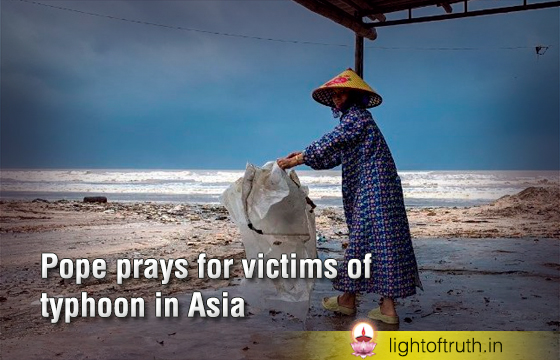
Towards the end of the Mass for the Jubilee of Catechists, and before reciting the noonday Angelus prayer on 28 September, Pope Leo addressed the faithful gathered in St Peter’s Square. His thoughts turned in particular to Asia, where, he said, “a very powerful typhoon” has struck several regions, “in particular the Philippines, the island of Taiwan, the city of Hong Kong, the Guangdong region and Vietnam”
“I assure the affected populations,” the Pope continued, “especially the poorest, of my closeness and my prayers for the victims, the missing, the many displaced families, the countless people who have suffered hardship, as well as the rescue workers and civil authorities.” “I invite everyone to put their trust in God and to show solidarity with others. May the Lord give strength and courage to overcome every adversity.” Typhoon Ragasa, which said to be the strongest so far this year, has forced the evacuation of over two million people in Guangdong alone. In addition to extensive damage, flooding, power outages and landslides, it has caused at least 25 deaths in the Philippines and 14 in Taiwan.

Asian Bishops gather to deepen synodality ahead of 2026 FABC Plenary in Bali
The FABC Bishops Seminar on Synodality, held at Baan Phuwan, opened with Mass on September 23 presided over by Archbishop Anthony Weradet Chaiseri, vice president of the Catholic Bishops’ Conference of Thailand, ahead of the 2026 Federation of Asian Bishops’ Conferences (FABC) Plenary Assembly in Bali. “The purpose was to study and understand the Final Document of the Synod together, reflect on our dioceses, and consider how the Church in Asia can put it into practice,” Archbishop Chaiseri told LiCAS News. The prelate also noted that the gathering revisited the Bangkok Document, issued during the FABC’s 50th anniversary in 2022, which is deeply connected to the global synodal process.
Participants used a process modeled after the Synod of Bishops in Rome—combining lectures, prayerful reflection, and small-group sharing.
Nine group discussions focused on three themes: the link between the Synod’s Final Document and the FABC’s Bangkok Document of 2022; the reception of the synodal pathway across Asia; and the need for transparency and accountability in a synodal Church.
Archbishop Chaiseri noted that Asia’s contemplative approach to discernment—marked by silence, listening, and consensus—aligns closely with the global synodal method of Conversation in the Spirit. The seminar comes as the global Church enters the implementation phase of the Synod, following the release of the Final Document in November 2024 and a framework introduced by Cardinal Mario Grech in March 2025.
Running until 2028, the process calls for bishops to set clear goals and timelines while ensuring broad participation across all sectors of the Church. This includes not only clergy and parishioners but also young people, marginalized communities, and those sceptical of the synodal process. Catholic schools, hospitals, prisons, and digital platforms are also expected to play a role, alongside religious communities and lay movements.
“These meetings reflect the growing desire among Churches in Asia to deepen synodality, strengthen communion, embrace the path of synodality within the Church, and walk in closer unity with the Universal Church under the guidance of Pope Leo XIV,” Archbishop Chaiseri said.
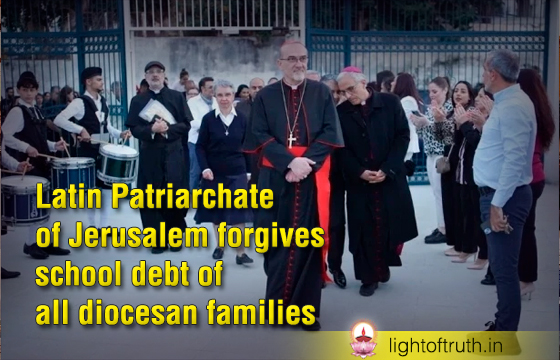
Latin Patriarchate of Jerusalem forgives school debt of all diocesan families
The Latin Patriarchate of Jerusalem has decided to forgive the school debts of all families in the diocese for the school years prior to the Jubilee of Hope as a gesture “to promote and demand justice, equity, and, above all, solidarity.” The patriarchate is the Latin-rite Catholic diocese based in Jerusalem, reestablished in 1847 by Pope Pius IX. Its ecclesiastical jurisdiction encompasses Israel, Palestine, Jordan, and Cyprus, serving the Latin Catholic communities present in the Holy Land and these regions of the Middle East.
In a statement, Cardinal Pierbattista Pizzaballa, Latin patriarch of Jerusalem, said the jubilee year “has taken place in a context of violence and war,” which “seems to be increasing evermore.” The cardinal explained that under the motto “Hope Does Not Disappoint,” Catholics are called “to a special conversion of heart. We are called to return to God, to rediscover our Christian roots and the beauty of our faith.” They are also called to “heal the relationships we have wounded” and to “rediscover the joy of encountering Christ.”
Despite the perilous situation in the region, one that has had “serious consequences for the lives of all our families and institutions,” Pizzaballa said he sees it as an opportunity not to get lost “in petty and short-sighted considerations but to focus on the essentials of life in our relationship with God and in the life of the world.”
Thus in order to give expression to “this desire for change, for renewal, for a return to God and to our brothers and sisters,” the patriarchate has decided to forgive “all debts of all the families to the schools of the Latin Patriarchate for the years prior to the jubilee, that is, up to and excluding the 2024-2025 school year.”
“This was not an easy decision to make because of the costs involved. As you can imagine, the various administrative offices did not fail to raise their legitimate concerns. Nevertheless, we feel it is necessary to make this gesture and to once again trust and rely on God and his providence,” the patriarch wrote. “We hope that this gesture will make life easier for many of our families in need and help them to regain confidence and hope,” the statement added.
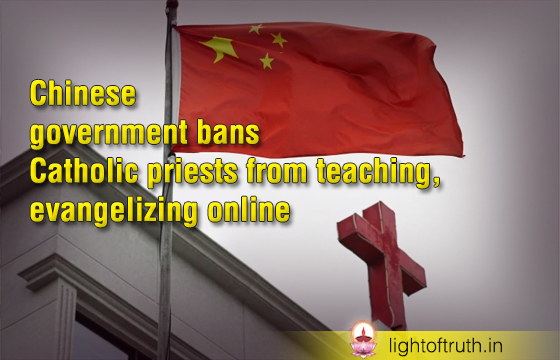
Chinese government bans Catholic priests from teaching, evangelizing online
New regulations from the State Administration for Religious Affairs in China have enacted a ban on several major forms of online evangelization for religious clergy of all religions, including Catholic priests. The new Code of Conduct for Religious Clergy on the Internet comprises 18 articles. Among stipulations that religious clergy must “love the motherland” and support Chinese leadership of the Communist Party of China and its socialist system, faith leaders are banned from preaching and performing other religious rituals through live broadcasts, short videos, or online meetings.
Priests may only do so on “websites, applications, forums, etc. legally established by religious groups, religious schools, temples, monasteries, and churches” with approval from the Chinese government. Furthermore, whenever using social media accounts or messaging apps to send out information, religious clergy must provide “certificate of membership as registered religious clergy” to their internet service providers. Clergy are banned under the code from both the evangelization and education of minors on the internet, and from organizing educational opportunities, such as seasonal camps for minors on the internet. They are also banned from making money online and from raising money to build religious places or for holding religious activities.
“If a religious clergy violates this standard, the religious affairs department shall order them to make corrections within a time limit,” the code of conduct states, adding: “If they refuse to make corrections, the religious affairs department shall … punish them in accordance with the provisions of relevant laws and administrative regulations.” For “serious” offenders, the code recommends religious institutions suspend their teaching activities or revoke their religious status. “Religious teachers and officials who carry out online activities through overseas websites and platforms shall abide by this standard,” the code states.
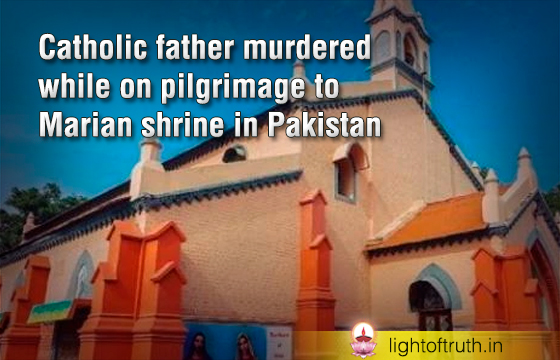
Catholic father murdered while on pilgrimage to Marian shrine in Pakistan
Men on motorcycles murdered a father and injured a 16-year-old boy while they were taking part in a pilgrimage to the national Marian shrine of the Virgin Mary in Mariamabad in Pakistan, an incident that has shocked Christians in the Muslim-majority country. According to the Vatican news agency Fides on Sept. 12, Afzal Masih, a married father of four, was murdered on Sept. 7 while he was on a pilgrimage to the shrine located in the Archdiocese of Lahore.
“We are deeply saddened by the murder of Afzal Masih. He was a devout Catholic who was participating in a Marian pilgrimage to venerate and pray to the Virgin Mary. Today, we express our deepest condolences to his family,” Father Tariq George, rector of the shrine, told Fides. The murder occurred while Afzal Masih was traveling with 15 other members of the faithful and several young men on motorcycles approached the minibus and began to provoke the group. When the pilgrims stopped at a gas station 19 miles from the shrine, a man identified as Muhammad Waqas opened fire with a rifle, killing Afzal Masih with a shot to the neck and wounding his 16-year-old cousin, Harris Masih, in the arm. Afzal Masih was taken to the hospital but died. After his arrest, Waqas told police that he “had no intention of killing.” Christians in Pakistan are calling for an investigation into the case and for justice to be done.

Pope at Jubilee Audience: Faith of simple people guides the Church
Pope Leo XIV held a special Jubilee Audience in St. Peter’s Square on September 27, as thousands of catechists attend the Jubilee of Catechists on September 26-28. In his catechesis, the Pope reflected at length on the sensus fidei, which he said is like a “sixth sense of simple people for the things of God.” “God is simple and reveals Himself to the simple,” he said. “For this reason, there is an infallibility of the People of God in believing, of which the infallibility of the Pope is an expression and a service.”
Pope Leo turned to the 4th century St. Ambrose, who was serving as governor of the city of Milan during a time of great conflict in the Church. As a civil authority, he intervened at a crucial point in the election of a new Bishop of Milan, employing his great ability for listening and mediation to bring calm among the faithful. Tradition recounts that a child cried out “Ambrose bishop!” and the whole people joined him in acclamation. “Ambrose was not even baptized; he was only a catechumen, that is, preparing for Baptism,” he said. “Yet the people perceived something profound in this man and elected him. Thus the Church had one of its greatest bishops, and a Doctor of the Church.”
Ambrose, said Pope Leo, at first refused and even fled the city, before understanding that this was a call from God, thus allowing himself to be baptized and ordained bishop. The Pope marvelled at the great gift that “the little ones” gave to the Church. “Even today this is a grace to ask for: to become Christians while living out the vocation we have received!” he said. As parents, entrepreneurs, workers, teachers, priests, or religious, every person is called to be a Christian through their chosen path, noted the Pope, adding that people can “sense” whether we are truly becoming Christians or not.
After accepting his vocation, St. Ambrose lifted up the faith of his people, even creating new ways of singing psalms and hymns, of celebrating the liturgy and preaching.
St. Ambrose’s preaching even converted St. Augustine, who himself became a bishop and Doctor of the Church. “He himself knew how to perceive, and in this way hope multiplied,” he said. “To perceive, to intuit, is a way of hoping—let us not forget this!”
In conclusion, Pope Leo XIV said God moves His Church forward and shows her new paths through the sensus fidei, the faith of the people of God. “To perceive, to intuit, is the instinct of the little ones for the Kingdom that is coming,” he said. “May the Jubilee help us to become little ones according to the Gospel, so as to perceive and serve God’s dreams!”
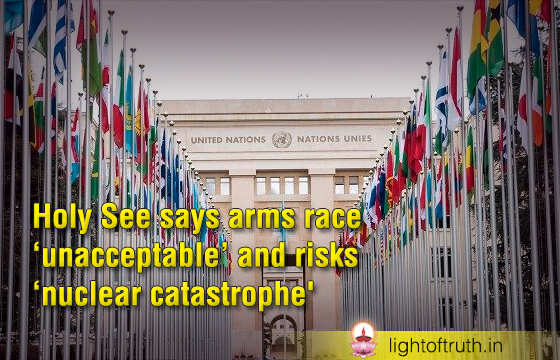
Holy See says arms race ‘unacceptable’ and risks ‘nuclear catastrophe’
An urgent and necessary step to avoid nuclear catastrophe”. That’s how Archbishop Paul Richard Gallagher, Secretary for Relations with States and International Organisations, has described the Comprehensive Nuclear Test Ban Treaty. The Archbishop was speaking on 26 September, at the fourteenth UN conference on the entry into force of the treaty, which was signed by the Holy See 29 years ago.
The Archbishop stressed that the failure to ensure the treaty’s entry into force “undermines global efforts against nuclear testing”, and raises questions regarding “ethical responsibility”.
“Peace cannot be secured through mutual fear or the logic of deterrence,” said Archbishop Gallagher, pointing out that nuclear testing has had catastrophic humanitarian and environmental consequences. “Regrettably, the continuous expansion and modernization of nuclear arsenals, accompanied by increasingly belligerent rhetoric and threats concerning their deployment, perpetuate the dangerous illusion that security can be achieved through the threat of annihilation,” he added. Speaking at the high-level meeting organised to commemorate the International Day for the Total Elimination of Nuclear Weapons, Archbishop Gallagher recalled the profound suffering caused by the first nuclear test in New Mexico 80 years ago, and the tragic bombings of Hiroshima and Nagasaki that followed. The British Archbishop also emphasised “the ongoing threat that nuclear weapons continue to pose to global peace, to future generations, and to creation”. Gallagher went on to express the Holy See’s “profound concern over the growing trend towards extensive rearmament”. “The continued and massive diversion of resources to armaments, rather than to efforts that promote integral human development and lasting peace,” he said, “is unacceptable and calls for renewed international responsibility”.
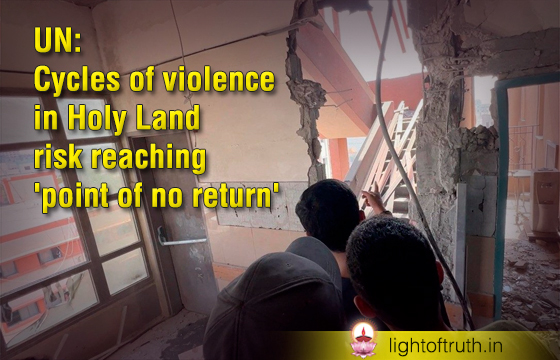
UN: Cycles of violence in Holy Land risk reaching ‘point of no return’
The U.N. Secretary-General Antonio Guterres has warned that the cycles of deadly violence in the Holy Land risk reaching ‘point of no return.’ He also suggested that the two-state solution to the Israeli-Palestinian conflict is nearing collapse, citing expanding Israeli settlements, forced displacement and de facto annexation. Guterres said the cycles of violence, including attacks by extremist settlers, have entrenched an unlawful Israeli occupation and pushed the region “perilously close to a point of no return.” He condemned Israel’s approval of construction in the E1 area, warning it would sever the West Bank and destroy the territorial continuity of a future Palestinian state. “Israeli settlements are not just a political issue. They are a flagrant violation of international law,” he said.
Guterres praised France and Saudi Arabia for reviving a high-level conference on the two-state solution and welcomed recent recognitions of Palestinian statehood. He urged nations to build on the momentum. On Gaza’s future, he called for a framework rooted in international law, rejecting ethnic cleansing and ensuring a clear path to statehood. He demanded an end to settler violence and annexation threats, and urged Israel to comply with International Court of Justice rulings. “A just and lasting peace will never be built through more violence,” Guterres said. “It demands a collective commitment—to diplomacy, to international law, to the dignity of all people.”
Meanwhile, Gaza’s health authorities warned that hospital departments are on the verge of collapse due to a fuel shortage, placing patients and the wounded at “risk of certain death.” Efforts to ration generator power have failed, prompting an urgent appeal for fuel deliveries. The warning came a day after Israeli strikes forced Al-Rantisi Children’s Hospital and Nasser Eye Hospital to shut down. The Nasser facility was Gaza’s only public ophthalmology hospital. Health officials said both were rendered non-functional “following repeated shelling.”