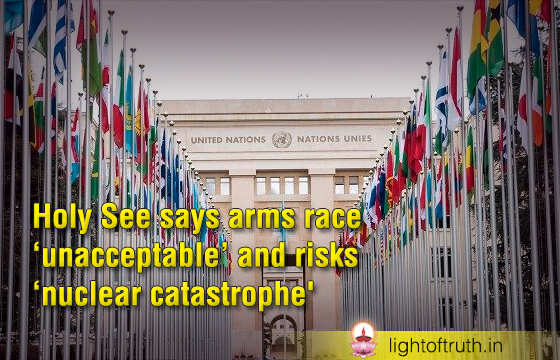
An urgent and necessary step to avoid nuclear catastrophe”. That’s how Archbishop Paul Richard Gallagher, Secretary for Relations with States and International Organisations, has described the Comprehensive Nuclear Test Ban Treaty. The Archbishop was speaking on 26 September, at the fourteenth UN conference on the entry into force of the treaty, which was signed by the Holy See 29 years ago.
The Archbishop stressed that the failure to ensure the treaty’s entry into force “undermines global efforts against nuclear testing”, and raises questions regarding “ethical responsibility”.
“Peace cannot be secured through mutual fear or the logic of deterrence,” said Archbishop Gallagher, pointing out that nuclear testing has had catastrophic humanitarian and environmental consequences. “Regrettably, the continuous expansion and modernization of nuclear arsenals, accompanied by increasingly belligerent rhetoric and threats concerning their deployment, perpetuate the dangerous illusion that security can be achieved through the threat of annihilation,” he added. Speaking at the high-level meeting organised to commemorate the International Day for the Total Elimination of Nuclear Weapons, Archbishop Gallagher recalled the profound suffering caused by the first nuclear test in New Mexico 80 years ago, and the tragic bombings of Hiroshima and Nagasaki that followed. The British Archbishop also emphasised “the ongoing threat that nuclear weapons continue to pose to global peace, to future generations, and to creation”. Gallagher went on to express the Holy See’s “profound concern over the growing trend towards extensive rearmament”. “The continued and massive diversion of resources to armaments, rather than to efforts that promote integral human development and lasting peace,” he said, “is unacceptable and calls for renewed international responsibility”.