
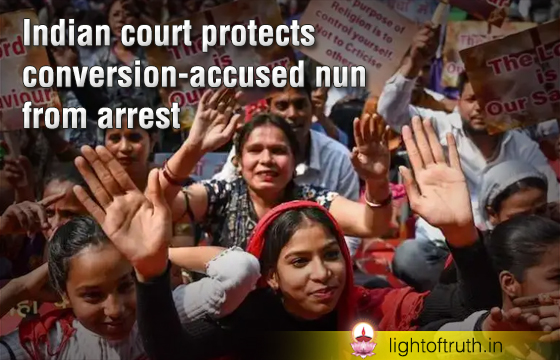
A state court in central Indian Chhattisgarh state has issued a pre-arrest bail to a Catholic nun after police began investigating a complaint that the nun attempted to convert a Hindu student at her nursing college. The move of the Bilaspur High Court, the highest court in the state, saves Sister Bincy Joseph from immediate arrest. The nun is the principal of Holy Cross Nursing College, located in Kunkuri town in the predominantly tribal Jashpur district. “We are relieved and happy,” said Abhinandan Xalxo, president of the Jashpur Catholic Sabha (church), who has been assisting the nun in the case. Xalxo told on April 25 that the court granted anticipatory bail to Joseph on April 24. Police are investigating an April 6 complaint of a student that the nun “attempted to forcibly convert” her. The complaint was sent to the district collector, the top civil official in a district, and the Superintendent of Police, the district’s top police official.
Daily Archives: May 2, 2025
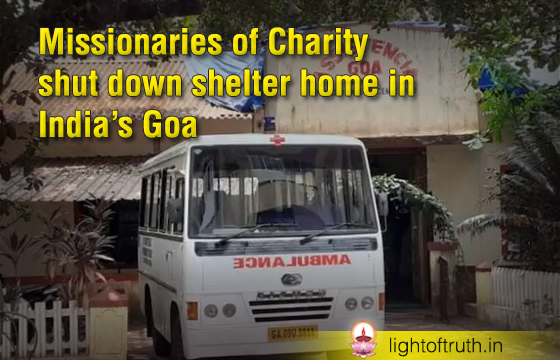
Missionaries of Charity shut down shelter home in India’s Goa
The Missionaries of Charity, founded by St. Mother Teresa of Kolkata, has closed their home for the destitute in Goa, western India, on April 28 amid fears that their landlords pushed them out to reclaim the land. Sister Rosario, the superior of the seven-member community in state capital Panaji, told they have handed over the place to the original owners, Assistência de Goa, a charity organization. “We have received an order from our Kolkata headquarters to leave and go to another place,” she said. The Missionaries of Charity nuns worked in the house for 49 years after Mother Teresa started the home on a 5,000 square meter premises at the invitation of Assistencia de Goa, in a prime location in the state capital.

Students Inspire Tangra Locals with Earth Day Celebrations
Students of Don Bosco Tuition Centre Nitika in Tangra, Kolkata extended their Earth Day 2025 celebrations beyond their institution, transforming Radhanath Chowdhury Road, Seal Lane and Tangra into a hub of environmental awareness. This student-led initiative aimed to inspire the local community and spotlight the urgent need for sustainable practices. Earth Day, observed globally on April 22 since 1970, serves as a call to action for preserving the planet. This year too, Don Bosco Nitika students brought this call directly to passersby, engaging them through dances, speeches, slogans, and skits that highlighted pressing issues like pollution, global warming, and water scarcity.
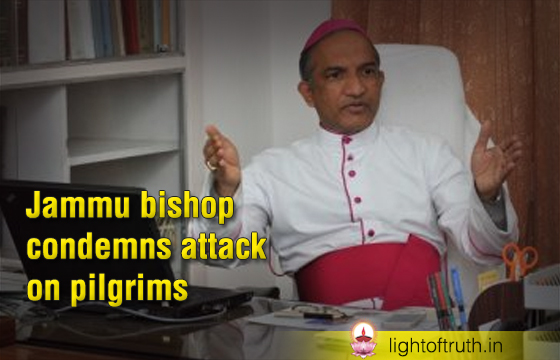
Jammu bishop condemns attack on pilgrims
Bishop Ivan Pereira of Jammu-Srinagar on April 23 expressed deep anguish and unequivocal condemnation of what he called horrific terrorist attack on innocent tourists in Kashmir state. Suspected rebels on April 22 killed 27 people in the picturesque tourist resort of Pahalgam. The attack in Kashmir’s southern district of Anantnag came amid the peak tourist season as thousands of tourists were holidaying in the region. Bishop Pereira said the “act of senseless violence” has “cast a dark shadow over our collective conscience.”

Canadian bishops: Protect life, freedom, and vulnerable in upcoming election
In a statement released ahead of the April 28 federal election, Canada’s bishops are calling on Catholics to vote with a renewed spirit of hope, guided by conscience and rooted in faith — with particular concern for the right to life, care for the vulnerable, and protection of religious freedom.
Framed within the Church’s Jubilee Year of Hope, the pastoral letter from the Permanent Council of the Canadian Conference of Catholic Bishops encourages the faithful to reflect prayerfully on the challenges facing the country “with a spirit of hope and a vision for a better future.”
“In a free and democratic society, all those eligible to vote have not only a right but also a responsibility to engage with local candidates and political parties,” the bishops write. “We are called to discern which policies best serve the common good — that which the Church defines as ‘the sum of those conditions of … social life whereby people, families, and associations more adequately and readily may attain their own perfection’” (Gaudium et Spes, 74).
Among the many issues Catholics are called to consider, the bishops place particular emphasis on the right to life, stating: “This right is being undermined by the lack of legal protection for the unborn, the ongoing expansion of eligibility for medical assistance in dying (MAID), and the insufficient access to quality palliative care for those who are suffering at the end of life.”
The bishops call on Catholics to advocate for society’s most vulnerable members: “those living in poverty, victims of human trafficking, individuals suffering from mental illness and addiction, the homeless, and immigrants,” each of whom is described as “deserving of both social and legal support.”
The bishops also warn of “growing intolerance toward religious communities in Canada,” including “threats to remove charitable tax status simply for upholding values rooted in faith that diverge from prevailing secular ideologies.”

Divine Mercy Sunday: Pope Francis was an ‘instrument of mercy for humanity,’ Parolin says
Vatican Secretary of State Cardinal Pietro Parolin presided over the solemn Mass for Divine Mercy Sunday held in St. Peter’s Square, highlighting the need for the Church to follow in Pope Francis’ footsteps as “instruments of mercy for humanity” in the world today. ”Only mercy heals and creates a new world, putting out the fires of distrust, hatred, and violence: This is the great teaching of Pope Francis,” Parolin said in his Sunday homily.
“Pope Francis was a shining witness of a Church that bends down with tenderness toward those who are wounded and heals with the balm of mercy,” he added. Approximately 200,000 people participated in the outdoor Mass offered for the late pontiff on the second day of the Church’s “Novendiales” mourning period, the Holy See Press Office reported.
“Brothers and sisters, preci-sely on Divine Mercy Sunday we remember our beloved Pope Francis with affection,” Parolin said. “It is precisely the Father’s mercy, which is greater than our limitations and calculations, that characterized the magisterium of Pope Francis and his intense apostolic activity.”
Insisting that people’s affections for the late pope “must not remain a mere emotion of the moment,” Parolin said “the Church must welcome his legacy” by “opening ourselves to God’s mercy and also being merciful to one another.”
Addressing the throngs of teenagers present in the square Parolin encouraged them to be close to Jesus Christ and to show his “merciful face” to all those they encounter in life. “I address a special greeting to you, with the desire to make you feel the embrace of the Church and the affection of Pope Francis, who would have liked to meet you, to look into your eyes, and to pass among you to greet you,” Parolin said to applause from those gathered in the square.
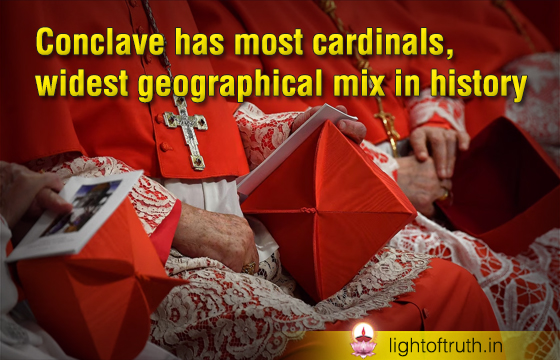
Conclave has most cardinals, widest geographical mix in history
There are 135 cardinals under the age of 80 and eligible to vote in a papal election. By contrast, 115 cardinals took part in the conclaves in 2005 and 2013. The cardinals represent 72 different countries if one counts the nations where they are serving and not just where they were born.
The cardinals’ average age on April 28 was 70 years and 5 months. That is slightly younger than the average age of electors who participated in the last conclave in 2013, which was 71.8. According Universi Dominici Gregis, the document giving rules for the election of a new pope, cardinals who celebrate their 80th birthday before the day the Apostolic See becomes vacant – that is, with a papal death or resignation – do not take part in the election.
The oldest among current voters is Cardinal Carlos Osoro Sierra, the retired archbishop of Madrid, who turns 80 May 16. The youngest member of the conclave is 45-year-old Ukrainian-born Cardinal Mykola Bychok of the Ukrainian Eparchy of Sts Peter and Paul of Melbourne, Australia. He is one of 17 Gen X cardinals, those born between 1965 and 1980.
Only five of the cardinals eligible to enter the conclave were created cardinals by St John Paul II and 22 were created by Pope Benedict XVI. That means 27 of them took part in the conclave that elected Pope Francis, and five of those also participated in the 2005 conclave that elected Pope Benedict. But that also means voting in a conclave will be a brand new experience for 108 of the electors.
While the geographical breakdown of conclave voters has become more diverse since 1978, Europeans are still the largest block with 52 electors. However, Asia is more represented now than ever before with 24 electors. There are 23 cardinal-electors representing Latin America, followed by Africa with 18 electors. North America has 14 electors and Oceania has four voting-age cardinals.

Conclave to elect new Pope to begin on May 7th
The conclave to elect the 267th Pope will begin on May 7th, following the conclusion of the Novemdiales Masses to pray for the eternal repose of the late Pope Francis. The Cardinals present in Rome have agreed to begin the conclave on May 7th, 2025. The date was set on Monday morning by the approximately 180 cardinals present (just over a hundred of whom are electors) gathered for the fifth General Congregation in the Vatican. The conclave will take place in the Vatican’s Sistine Chapel, which will remain closed to visitors during those days.
The conclave will be preceded by a solemn Eucharistic celebration with the votive Mass Pro Eligendo Papa, attended by the Cardinal electors. In the afternoon, the Cardinal electors proceed in a solemn procession to the Sistine Chapel, where the Conclave begins to elect the new Pope. At the end of the procession inside the Sistine Chapel, each Cardinal elector takes the oath as prescribed in paragraph 53 of Universi Dominici Gregis. Through this oath, they commit, if elected, to faithfully fulfill the Munus Petrinum as Pastor of the Universal Church. They also pledge to maintain absolute secrecy regarding everything related to the election of the Roman Pontiff and to refrain from supporting any attempts of external interference in the election. At this point, the Master of Pontifical Liturgical Celebrations proclaims extra omnes, meaning that all individuals who are not part of the Conclave must leave the Sistine Chapel. Only the Master himself and the ecclesiastic designated to deliver the second meditation remain.
This meditation focuses on the grave responsibility that rests upon the electors and the necessity of acting with pure intentions for the good of the Universal Church, keeping only God before their eyes. Once the meditation is delivered, both the ecclesiastic and the Master of Pontifical Liturgical Celebrations leave.
The Cardinal electors then recite prayers according to the Ordo Sacrorum Rituum Conclavis and listen to the Cardinal Dean, who asks whether they are ready to proceed with voting or if any clarifications regarding the rules and procedures.
All election procedures take place exclusively in the Sistine Chapel within the Vatican Apostolic Palace, which remains completely sealed off until the election is concluded.
Throughout the election process, the Cardinal electors must refrain from sending letters or engaging in conversations, including phone calls, except in cases of extreme urgency.
They are not allowed to send or receive messages of any kind, receive newspapers or magazines of any nature, or follow radio or television broadcasts.
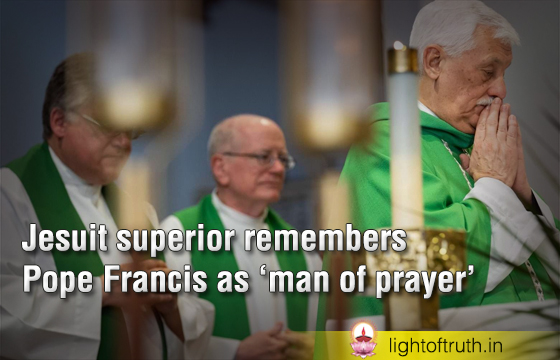
Jesuit superior remembers Pope Francis as ‘man of prayer’
The superior general of the Society of Jesus, said Pope Francis “did not seek to please everyone” or to measure him-self by a popularity index. “Once he chose to be a disciple of Jesus, his deep motivation in life was to put God’s will into practice,” Fr Arturo Sosa SJ told reporters, calling the late Pope “a man of prayer, who asked for prayers to make decisions according to the will of God.” The Jesuit superior defended Francis against claims he caused controversy – like with Fiducia Supplicans, the Vatican’s document on blessings for “irregular” couples – or fell short in some areas, saying he was not the source of problems in the Church but inherited problems that were already there. “Pope Francis helped put the difference of positions on the table” and provoked dialogue, Sosa said, emphasising that the late Pope wanted to listen to everyone.
“I don’t think of Pope Francis as a reformer,” Sosa said. “I think of him as someone who continued the reform that the Church has always carried out.”
Regarding his record on abuse, Sosa said Pope Francis “always acknowledged his limitations, his mistakes, and his slowness” to respond to cases.
“This is not about giving Pope Francis a medal or giving him a grade but about learning about potential criticism and mistakes,” he said. “With regard to abuse cases, I think the Church is not in the same place when Pope Francis was elected. That’s without a doubt. It hasn’t been a straight line … but the Church has advanced in that direction,” he added. Sosa said Pope Francis’ most urgent legacy for today will be his calls for peace: “I think Pope Francis has shouted in every moment, on every occasion, about peace.”
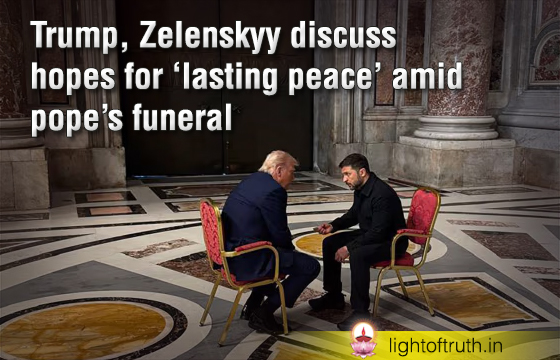
Trump, Zelenskyy discuss hopes for ‘lasting peace’ amid pope’s funeral
U.S. President Donald Trump and Ukrainian President Volodymyr Zelenskyy on Saturday held a brief discussion in the soaring halls of St. Peter’s Basilica amid the funeral of Pope Francis, speaking “one-on-one” about possible peace overtures in the Russia-Ukraine war.
“[It was a] good meeting. We discussed a lot one-on-one,” Zelenskyy said in a post on X. “Hoping for results on everything we covered.” The Ukrainian leader hailed the informal mini-summit as “very symbolic.” The talk took place while the leaders were at the Vatican for the funeral of Pope Francis, who for the last few years of his pontificate was a tireless advocate for peace in the Russia-Ukraine war.
The two heads of state discussed “protecting [the] lives of our people,” a “full and unconditional ceasefire,” and “reliable and lasting peace that will prevent another war from breaking out,” Zelenskyy said. The discussion “has potential to become historic, if we achieve joint results,” he said.
White House Deputy Chief of Staff Dan Scavino also shared footage of the meeting, including Vatican officials arranging the ornate chairs for the two leaders to sit in. Pope Francis regularly used his public addresses, especially his Angelus prayers, to call for peace between Ukraine and Russia. The Holy Father repeatedly urged the two countries to work toward a peaceful resolution of the conflict. In some cases he even sent material goods to Ukraine, dispatching multiple ambulances to help save lives in war zones there.