
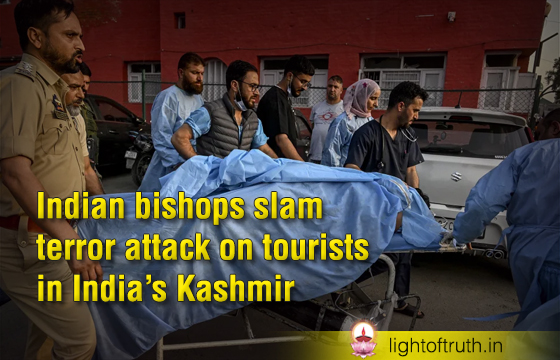
The Catholic Bishops’ Conference of India (CBCI) has condemned the terrorist attack on tourists in India’s Kashmir that killed 26 people and injured 17 others, expressing pain for families who lost their loved ones. Terrorists opened fire on tourists on April 22 in the famed Baisaran meadow, about 5 kilometers from the resort town of Pahalgam in Kashmir’s Anantnag district. The victims include two foreigners – from the UAE and Nepal – and two local people. Indian authorities described the attack as one of the deadliest in recent times, according to media reports. The bishops’ conference’s April 23 statement said: “We strongly condemn this heinous crime against humanity, which has targeted innocent lives, causing immense pain and suffering to families and loved ones.” The bishops’ body called it “a brutal act” and “a grave affront to human dignity and values,” while demanding that those responsible “be brought to justice.” It further appealed to those involved in violence to lay down their arms and embrace the path of peace. “Violence only breeds more violence, and it is high time for us to choose the path of love, compassion, and understanding,” it added. The bishops urged the Christian community across India to pray fervently for the repose of the souls of those who have lost their lives and for the speedy recovery of those injured in the attack. Indian Prime Minister Narendra Modi cut short an official visit to Saudi Arabia after the attack and returned to New Delhi. He decried the “heinous act” and pledged that the attackers “will be brought to justice.” The deadly attack on tourists coincided with the April 21-24 visit of US Vice President JD Vance. He called it a “devastating terrorist attack.” US President Donald Trump, Russian President Vladimir Putin and Italian Prime Minister Giorgia Meloni, among other world leaders, condemned the attack and expressed solidarity with India. UN Secretary General Antonio Guterres strongly condemned the “armed attack,” stressing that attacks against civilians are unacceptable under any circumstances.
Daily Archives: May 2, 2025

No action taken against police who assaulted Catholic priests in India
Three weeks after police assaulted two Catholic priests and tribal women in a village in eastern Odisha, Church leaders say the Hindu-leaning state government has not taken any action against the attackers. Father Joshi George, parish priest in Juba village of Gajapati dis-trict, told on April 15 that they have “not heard from the police or any government officials” about any action taken regarding the March 22 incident. Police assaulted George, his assistant Father Dayanand Nayak, and several women cleaning the parish church in what was described as a targeted attack on Christians. George said a police team led by woman police officer Joshna Roy “singularly targeted Christians in the villages whereas the Hindus were let off.” The priest said the state’s inaction, even after three weeks, supports the argument that it was a targeted move. “Police have filed a false case of selling marijuana against a Catholic teacher of a government-run school in a neighboring village. He has been now suspended from his job, while a Hindu teacher detained by the police has been let off,” George said. Police used a lathi – a long, heavy bamboo stick – to beat up people “and molested women belonging to a tribal community as they barged into” the church premises said a fact-finding team in an April 13 report titled “Police turned from Protectors to Perpetrators.” “There is a palpable sense of fear, insecurity, and disbelief among the children, women, and two Catholic priests. This does not bode well for the administration,” the report stated. “This is the first time in the recorded history of the state” that police targeted, beat, and paraded Catholic priests, the report said.
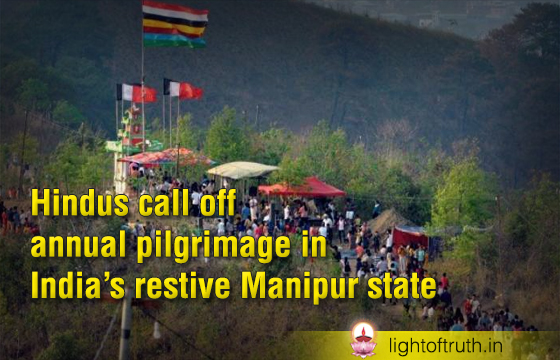
Hindus call off annual pilgrimage in India’s restive Manipur state
The Hindu-majority Meitei community in northeast India’s restive Manipur state have called off an annual religious pilgrimage to sacred hills following an alleged threat from predominantly Christian tribals in the area, according to sources. The Meitei people scrapped their pilgrimage to the Thangjing Hills in tribal-dominated Churachandpur district on April 14 after the tribal community vowed to oppose access to the area, the unnamed sources said. Animosity between the state’s Meitei and tribal groups has resulted in sectarian violence since May 2023 that has left more than 260 people dead and about 60,000 displaced. Most victims were tribal Christians. Some Church leaders expressed dismay over the tough stance taken by the tribal groups. “It would have been a good occasion for promoting goodwill and brotherhood,” a Church leader based in the state capital Imphal told on April 15 on condition of anonymity. “We cannot restore peace without dialogue and any act that aggravates hostilities and ill will should be avoided,” added another Christian leader who also wished to remain anonymous. Local sources say young Meitei reached the buffer zone that divides the Imphal Valley where most Meitei live, and hilly areas dominated by tribal people on April 14. But they returned home after security forces and their elders told them to go back following a threat from the tribals. Meitei people consider the Thangjing Hills as being a scared religious site. Every April, during Cheiraobab — the Meitei New Year they trek to the hills to offer prayers to their deity, Lainingthou Sanamahi.

Indian Catholic nun moves closer to sainthood
Indian Catholic nun Eliswa Vakayil, known as a champion of women’s rights, has moved closer to sainthood after Pope Francis published a decree authorizing her and five others to be declared blessed. Francis approved the decree to beatify the 19th-century nun during an audience with Cardinal Marcello Semeraro, prefect of the Dicastery for the Causes of Saints, on April 14, according to Vatican News. As part of the procedure, Francis approved a miracle attributed to Eliswa Vakayil (1831–1913), from Kerala state of southern India, is popularly known as Mother Eliswa of the Blessed Virgin Mary. She founded the first indigenous Carmelite religious order for women known as the Third Order of Discalced Carmelites in 1866. It was later renamed as the Teresian Carmelite Sisters. Vakayil was married at the age of 16 and gave birth to a daughter named Anna before entering religious life. The sudden illness and death of her husband changed the course of her life. Her daughter was just 18 months old then, according to a report by the Vatican’s Fides news agency. She took refuge in silent prayer and service to the needy in the community. She started frequenting the Blessed Sacrament and other forms of spiritual nourishment. In 1862, about 12 years after her husband’s death, she expressed her desire to join religious life to her parish priest. Four years later, she joined the Carmelite congregation, a feat soon followed by her daughter Anna and her younger sister Thresia.
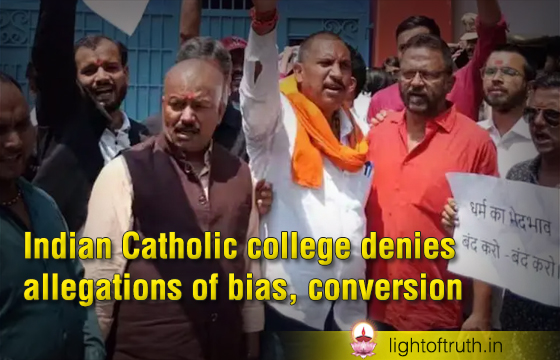
Indian Catholic college denies allegations of bias, conversion
A Church-run college in the northern Indian state of Uttar Pradesh has denied allegations of religious conversion and discrimination against students amid protests by hardline Hindu activists. “The allegations leveled against St. Dominic Savio College in Lucknow are totally false and baseless,” said Father Donald D’Souza, the spokesperson of Lucknow diocese, which manages the institution. Activists of the Hindu Mahasabha, or grand assembly of Hindus, a right-wing organization, protested in front of the college on April 15. They told media the college management had “detained some students on the campus with an ulterior motive to convert them.” They also alleged that Hindu students were not allowed to wear their religious symbols like the sacred thread and tilak, a mark on the forehead to indicate caste or sect status, on the campus. These allegations were also posted on social media, and the Hindu Mahasabha wanted district authorities to take action against the institution. The college, in its April 15 statement, denied the “claims circulating on Facebook that the institution discriminated against students on religious grounds, leading to their detention in Class 11.” The institution, which started 48 years ago in the state capital, said the allegations were “misleading and disturbing.” “The decision to detain certain students was based purely on academic performance,” the statement clarified, adding that the students in question “have consistently underperformed throughout the academic year, showing little to no improvement despite repeated interventions.”

Indian Christians hopeful as govt promises to restore land rights
Leaders representing around 600 families, mostly Catholics, are hopeful about concluding their six-month protest to reclaim their lands after a federal minister visited their southern Indian village and promised to seek an early solution. Kiren Rijiju, federal minister for minorities, visited Munambam coastal village of Kerala’s Ernakulam district on Jan. 15 and addressed the people, who have been on a protest since October 2004. “We are very hopeful of ending the protest after the minister promised to find a solution in three weeks,” said Father Antony Xavier, the parish priest of Valankanny Matha Church, which is part of the disputed land. The 610 families, including some Hindus, began the protest almost two years after officials informed them in January 2022 that approximately 400 acres of land in the village, including the land they had purchased decades ago, did not belong to them. The officials informed them that nearly a century ago, the land was designated as waqf, a Muslim dedication for charity. The State Waqf Board has asserted its ownership of the land, and as a result, the families’ land rights have been suspended. Archbishop Joseph Kalathi-parambil of Verapoly archdiocese, based in Ernakulam district, submitted a memo-randum to the federal minister, who called on him at his residence, on April 15.
“I request you to re-establish the revenue rights of the people of Munambam, which is entangled in the waqf issue in a time-bound manner and give specific directives to the various authorities in the lower appropriate departments for resolving the issue,” the prelate appealed in his memorandum. The land issue became complicated because of a federal law governing waqf properties – the Waqf Act of 2013 – that granted excessive power to Waqf Boards, allowing them to designate any property as waqf land based on their own investigations.

Indian tribal village forces Christian families to abandon faith
Tribal villagers in central India’s Chhattisgarh state forced seven Christian families to abandon their faith, but six other families remain steadfast in their faith despite intense pressure, a local Christian leader said. Pastor Chinnam Wycliff Sagar said that the 13 Christian families in Karigundam, a village in the Maoist-infested Sukma district, were ordered by the local village council to return to their animist tribal religion or get expelled from the village. The village council issued the order on April 12, Palm Sunday, Sagar told UCA News. Six families “stood firmly against the illegal order,” and it “has irked villagers,” Sagar told UCA News on April 17, three days after visiting the families in the village. The village has 136 tribal families, totaling 660 people. Villagers “threw household items belonging to the Christians out of the village” and told them to stay away. However, local officials and police helped them return on April 13, Sagar said. “Now they are back in their homes, but their struggle to maintain their faith will be another challenge as the entire village is hostile to them”, he explained. Sager said the villagers did not allow him to see the families that left the Christian faith. The pastor said no police complaint has been filed as they “were allowed to regain access to their homes.”
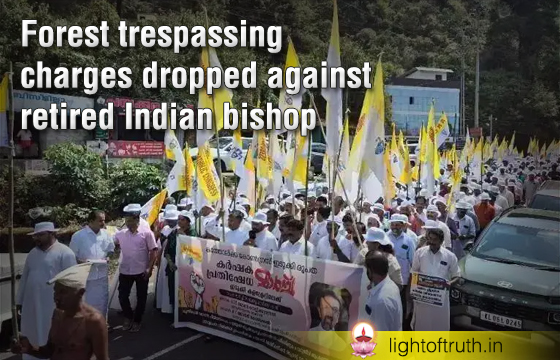
Forest trespassing charges dropped against retired Indian bishop
The Church has welcomed a decision by the communist-led government in India’s southern Kerala state to drop charges against an 88-year-old Catholic bishop and 23 others for entering a restricted forest during a march demanding the reopening of a blocked public road. “We are happy the go-vernment announced dropping of charges against our elderly bishop for joining a public protest,” said Vincent Nedun-gatt, Vicar General of Kotha-mangalam diocese of Eastern Rite Syro-Malabar Church based in Kerala. Retired Bishop George Punnakottil of Kotha-mangalam and others, including elected representatives, were charged with violating forest laws and trespassing on forest land on March 23, along with over 3000 aggrieved local people, mostly farmers. Father Nedungatt told on April 21 that the prelate should not have been charged with violation of the law. “He knew the difficulties and pain of his people, especially farmers, and joined the protest to protect their interests,” he added. People from different walks of life, including Catholics, condemned the Left Democratic Front government and demanded that it withdraw the charges against the bishop and others. The government decided to drop the charges at a high-level meeting attended by Law Minister P. Rajeev, Forest Minister A. K. Saseen-dran and other senior officials on April 16, official sources said.
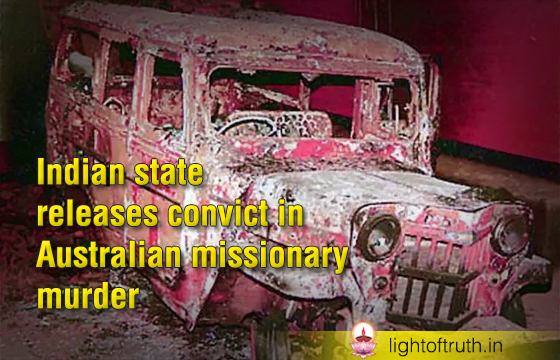
Indian state releases convict in Australian missionary murder
The government in eastern India’s Odisha state has released a man serving a life term for the murder of Australian missionary Graham Staines and his two minor sons, reportedly considering his “good conduct” in jail. The government, led by the Hindu-leaning Bharatiya Janata Party (BJP), released Mahendra Hembram, 51, on April 16 after he had spent 25 years in prison. Keonjhar district prison authorities gave Hembram a cordial farewell and, garlanded him in recognition of his good conduct in jail, reports said. “The Christian community in Odisha is shocked over the news of his pre-mature release,” said Father Ajay Singh, a lawyer and activist belonging the archdiocese of Cuttack–Bhubaneswar in the state. Singh told on April 17 that the release of Hembram, who murdered a missionary and his two sons, “will set a horrible precedent.” Hembram was given life in prison for assisting Dara Singh, the main culprit, who burnt alive Staines and his two minor sons – Philip (aged 10) and Timothy (aged 6) – on Jan. 22, 1999, in the Koenjhar district of eastern Odisha state. The missionary and the children were sleeping inside their vehicle in the remote village.
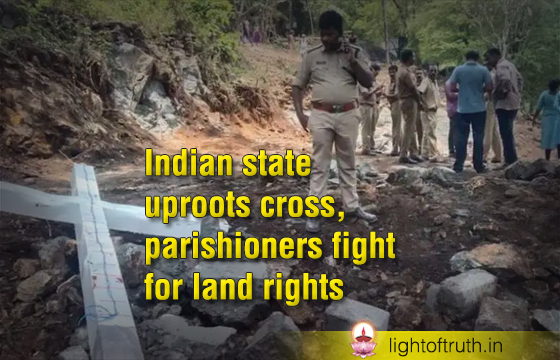
Indian state uproots cross, parishioners fight for land rights
Catholics in a parish in Kerala in southern India have accused the state’s forest department of “terrorizing” them after officials uprooted a cross and registered charges against their priest and leaders for encroaching on forest land. James Aikkaramattam, parish priest of St. Thomas Church in Idukki district, told on April 21 that the cross was on “parish land that a parishioner donated decades ago.” On April 12, Palm Sunday, forest officials used an earthmover to remove the 3-meter concrete cross, claiming it was illegally occupying forest land. The forest department also registered a case against 18 people, including the parish priest, for violating forest laws by trespassing onto forest land and encroaching upon government property. ”The charges against me and others are false, as we did not trespass onto any protected forest. A parishioner built his house on the land and lived there for five decades before donating it to the parish.