
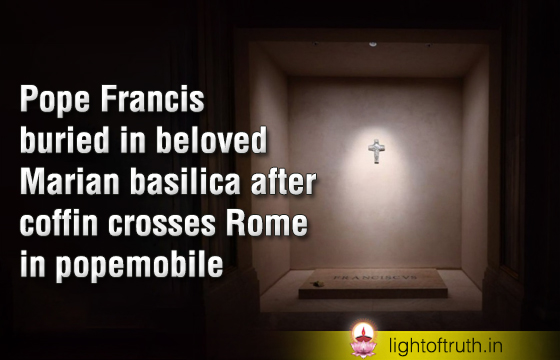
Pope Francis was buried on April 26 Saturday in the Basilica of St. Mary Major after his coffin crossed the centre of Rome, marking the pontiff’s final goodbye to the Eternal City. After the celebration of the funeral Mass in St. Peter’s Square, the pope’s coffin left the Vatican via the Perugino Gate at 12:30 p.m. local time. The simple wooden coffin was transported in a popemobile-style pickup truck and greeted to applause and cheers of “Goodbye, Pope Francis,” and “Good journey, Francis” from a small crowd gathered just outside the Vatican.
The white car carrying the papal coffin winded slowly through Rome, the city of which Pope Francis was bishop, past the white Monument to Victory Emmanuel II, the Roman Forum, and the Colosseum, to arrive at Via Merulana, a wide street leading to the main square of the Basilica of St. Mary Major.
The Vatican and local authorities estimate 150,000 people lined Rome’s streets to wave goodbye to Pope Francis’ coffin. Around 400,000 people attended the funeral Mass. As the bells of the basilica tolled, a group of poor from Rome were on the steps of the basilica to meet the papal funeral procession and to pay their final respects to the pope who loved them so much.
A small procession of cardinals, bishops, priests, and other Vatican officials led the way into the Marian basilica and to the side chapel housing Francis’ favorite icon of Mary, “Salus Populi Romani,” where four young children laid baskets of white roses before the historic image. The pope’s burial site, at his request, is the Basilica of St. Mary Major, one of the four papal basilicas in Rome. He joins seven other popes buried in the basilica, with roots dating back to the fifth century.
Francis’ tomb was prepared earlier this week, a white, Italian marble slab in the ground with his name in Latin, “Franciscus.” His distinctive silver pectoral cross, featuring the Good Shepherd carrying the lost sheep, hangs on the wall above.
Daily Archives: May 2, 2025
Pope Francis’ love for prisoners remained until the end
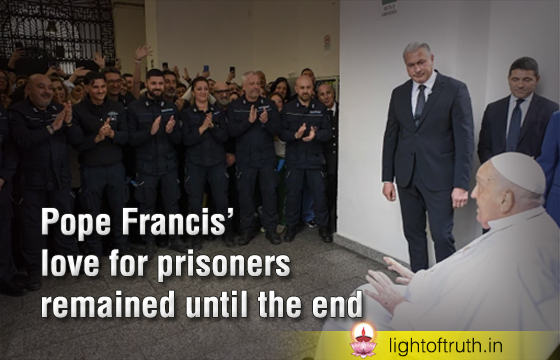
Prisoners always held a special place in Pope Fran-cis’ heart, and he demon-strated his love for them throughout his pontificate. He visited them in the vari-ous countries he traveled to and even, for the Jubilee of Hope, decided to open a Holy Door himself at the Rebibbia prison for the first time in history.
During his first Holy Week after being elected pontiff in 2013, he went to the prison to wash the prisoners’ feet, a gesture he repeated every year until his final Holy Thursday, four days before his death. On April 17, the ailing pontiff visited the prisoners at Regina Coeli (Queen of Heaven) prison near the Vatican, a testament to his tireless defense of human dignity and his predilection for castoffs. Father Raffaele Grimaldi, who oversees the work of Italian prison chaplains, emphasized in an interview with ACI Prensa, CNA’s Spanish-language news partner, that the initiative by the Holy Father is a sign that “his attention to the least and the poor was evident until his very last day.” “When he went to Regina Coeli, a few days before returning to the Father’s House, he wanted to leave us with a great message of ministering to the incarcerated,” he noted.
Pope Francis’ final hours and gratitude for returning to the Square
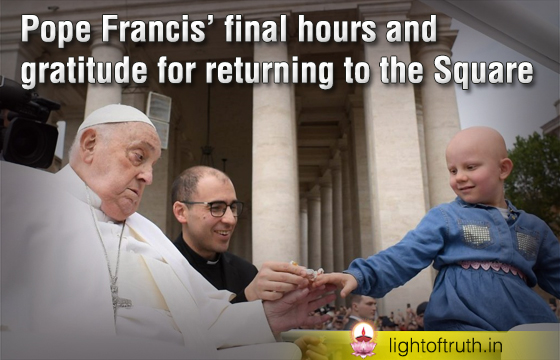
“Thank you for bringing me back to the Square.” This expre-ssion of gratitude was among Pope Francis’s last words to the person who watched over him tirelessly throughout his illness, as well as before. He spoke those words to Massimiliano Strappetti, the nurse who, according to the Pope himself, once saved his life by suggesting colon surgery, and whom the Holy Father later appointed in 2022 as his personal healthcare assistant. Mr. Strappe-tti stayed by the Pope’s side during all 38 days of his hospitalization at Rome’s Gemelli Hospital, and keeping watch round-the-clock during his recovery at the Casa Santa Marta. He was with the Pope on Easter Sunday, during the Urbi et Orbi blessing. The day before, they had gone together to St. Peter’s Basilica to review the “route” he would take the following day when he was to appear on the Central Loggia of St. Peter’s Basilica.
The late Pope wanted to offer one last, meaningful surprise to the 50,000 faithful with a ride in the popemobile on Sunday after the blessing on the balcony of St. Peter’s Basilica façade. However, Pope Francis did hesitate a bit and asked the opinion of Mr. Strappetti, asking him, “Do you think I can manage it?” Once in St. Peter’s Square, he embraced the crowd, especially the children, since this was his first ride after being discharged from Gemelli hospital, as well as the last outing among the faithful of his life. Tired but content, the Pope afterwards thanked his personal healthcare assistant, saying, “Thank you for bringing me back to the Square.” These heartfelt words reveal the deep desire of the Argentine Pope to be among the people of God, enjoying the human connection he made a hallmark of his papacy.
Persecuted and displaced, the Rohingya saw in Pope Francis the love of Christ
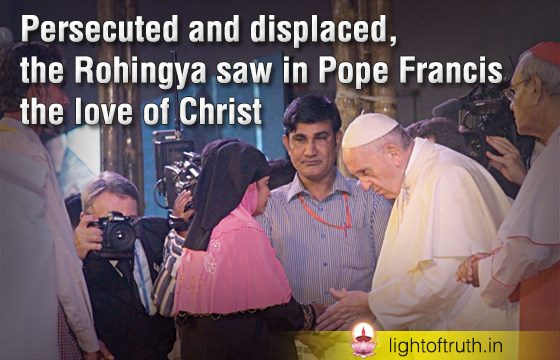
One of the most touching deeds that made Pope Francis go down in history was his 2017 visit to Bangladesh, which included a meeting in Dhaka with a group of Rohingya refugees who had fled violence in Myanmar.
Silent tears and heartfelt words that marked the embrace moved the world and became a symbol of his deep commitment to justice and compassion. On that occasion, Francis prayed with the Rohingya.
Since then, he has often reminded the world of their suffering. More than a million Rohingya live in Bangladesh, forcibly displaced from Myanmar where they are persecuted.
“Even though we are few and often forgotten – dispersed, marginalised, and afflicted – we grieve with the global Church,” said Peter Saiful, a representative of the small Rohingya Catholic community, also displaced in Bangladesh, speaking to AsiaNews.
“Pope Francis was a beacon of hope for the marginalised, a voice for the voiceless, and a man whose humility touched hearts across all boundaries,” Saiful explained. “As members of a persecuted and displaced people, we saw in Pope Francis the living compassion and solidarity of Christ. That encounter during his visit is a deeply moving and unforgettable moment in our community’s history.”
Pope Francis liked to say: “You cannot be a Christian without living like a Christian, and you cannot be a Christian without practising the Beatitudes. And one of the Beatitudes is to welcome the stranger.” Rohingya Christians are grateful to God for the pope’s life and ministry, dedicated to justice, peace and the unity of God’s people.
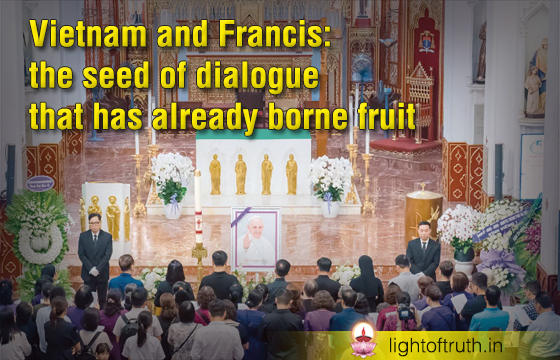
Vietnam and Francis: the seed of dialogue that has already borne fruit
Long queues of faithful are openly and freely honouring Pope Francis in cathedrals. An official paid homage to the late pontiff on behalf of the government by burning incense in front of the pope’s portrait at the headquarters of the Catholic Bishops’ Conference of Vietnam (CBCV). While analysts are trying to read some hidden meaning in the two lines of condolence published in China by the Chinese Catholic Patriotic Association, the pope’s death showed where the seed of dialogue is already bearing much fruit, namely in China’s neighbour Vietnam, which offers a model for the delicate path relations between the Holy See and China could take.
The news of Francis’s death reached Vietnam on April 21 just as the country’s Catholic bishops were gathered for the spring session of their assembly. Quickly, a delegation led by the CBCV president, Archbishop Giuse (Joseph) NguyÅn Nãng of Ho Chi Minh City, left for Rome to take part in the pontiff’s funeral while the websites of the dioceses were filled with news about Pope Francis, stories from Rome, and the condolences from Vietnamese Catholics.
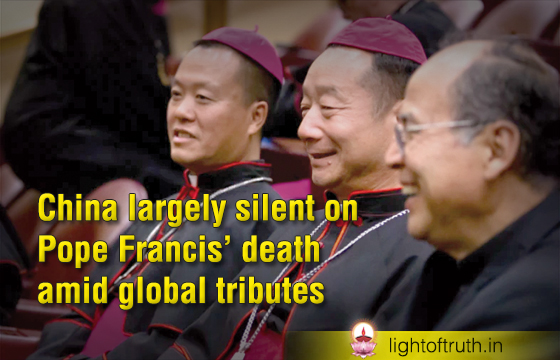
China largely silent on Pope Francis’ death amid global tributes
High-ranking heads of state and Catholic bishops in China have remained notably silent following the death of Pope Francis, while reactions from political and religious leaders across the globe poured out on social media within hours of the pope’s passing on Monday morning.
AsiaNews reported on April 22 that Chinese officials are not permitted to express themselves publicly on Pope Francis’ death due the Chinese Communist Party (CCP)’s control over the Church there. The Chinese government offered a brief statement nearly 24 hours after the Holy Father’s passing, only after reporters asked foreign ministry spokesperson Guo Jiakun about it on April 22.
“China expresses its condo-lences for the death of Pope Francis,” he said, adding that “in recent years, China and the Vati-can have maintained constructive contacts and engaged in useful exchanges. China is ready to work with the Vatican to promote the continuous improvement of China-Vatican relations.”
Notably, the CCP posted a tribute to Pope Benedict XVI after his passing two years ago, stating: “We entrust Benedict XVI to God’s mercy and ask him to grant him eternal rest in heaven.” Several days have passed since Pope Francis’ death with no similar statement from the CCP.
“I mean, it’s really astonishing because they have an agreement with the Vatican,” Hudson Institute Fellow Nina Shea told CNA on Wednesday. ”It’s a refle-ction of their refusal to acknow-ledge the supremacy of the papal authority over the Catholic Church and that they see the pope only in secular terms as a head of state, the Holy See.”
The Vatican-China agreement to allow Chinese-appointed bishops in the Catholic Church was renewed last year and is set to remain intact until October 2028, despite numerous reports of Chinese violations of the deal and continued persecution against Catholic bishops.
“The absence of condolen-ces,” Shea said, “is a sign that they do not see the pope as the religious head of the Catholic Church and they do not want their people to associate the pope, the papacy, with the Catholic Church in China.”
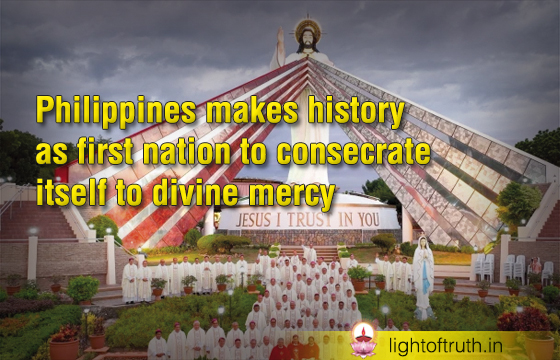
Philippines makes history as first nation to consecrate itself to divine mercy
The Philippines made history this year on April 27, Divine Mercy Sunday, by becoming the first nation in the world to consecrate itself entirely to Jesus through divine mercy.
In 2016 at the Pan-African Congress on Divine Mercy Sunday in Rwanda, bishops in Africa consecrated the continent itself to divine mercy. However, the Philippines is the first singular nation to do so.
“This is remarkable; this is really unprecedented. Never has this been done before in the history of the world – a country consecrating themselves to the divine mercy,” said Father James Cervantes of the Marians of the Immaculate Conception (MIC), a congregation devoted to spreading the message of divine mercy. “I believe the bishops are being inspired by the Holy Spirit to lead our country to holiness.”
The bold initiative began with a single spark – a heartfelt letter from Cervantes to bishops across the country calling for a nationwide consecration to divine mercy. Dioceses responded enthusiastically, and soon the idea spread like wildfire.
The Permanent Council of the Catholic Bishops’ Conference of the Philippines (CBCP) gave its official approval, declaring that a national consecration to divine mercy will take place during all Masses on April 27 as part of the 2025 Jubilee Year celebrations.
Cardinal Pablo Virgilio David, president of the CBCP, issued a statement calling on all dioceses, parishes, religious communities, and Catholic institutions to participate in this landmark spiritual initiative.
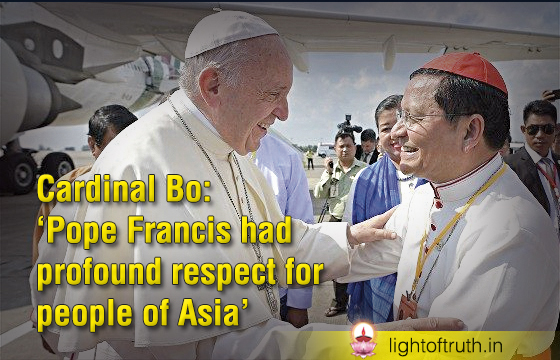
Cardinal Bo: ‘Pope Francis had profound respect for people of Asia’
“Pope Francis related to all, with the broken, the forgotten, and the earth itself. He made room in his heart for those the world pushed aside. And so now, as the world mourns him, we feel the sorrow that always follows great love.”
In a wide-ranging interview with Vatican News, Cardinal Charles Maung Bo, Archbishop of Yangon and President of Myanmar’s Bishops’ Conference, who served two terms as the President of the Federation of Asian Bishops’ Conferences, remembered the late Pope Francis in this way following his return to the Lord on 21 April.
Cardinal Bo had the joy of being named by Pope Francis as the first-ever Cardinal of Myanmar, and of welcoming the Holy Father to his nation in November 2017.
Remembering Pope Francis’ historic Apostolic Journey to his nation, the Cardinal said, “Despite significant pressure from various quarters urging him not to visit our country, and despite the many challenges that loomed large, Pope Francis chose to come. And in doing so, he shone a great light upon the suffering of our people.”
In fact, the Cardinal remembers, “Pope Francis had a profound affection for the people of Asia,” adding, “he fell in love with the people of Myanmar.”
Over the years, the Pope has made constant appeals for Myanmar, for peace and for aid, and even before his passing, not only did he express his condolences for all those affected by the tragic quake, but he also offered sustenance to help the suffering population.
As of April 19, 2025, the death toll from the 7.7-magnitude earthquake that struck Myanmar on March 28 stood at 3,726, with 5,105 injured and 129 still missing. The disaster has compounded Myanmar’s existing humanitarian crisis, with nearly 20 million people in need of aid due to ongoing civil conflict.