
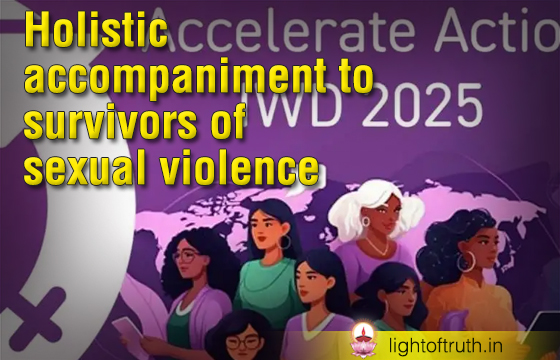
“Accelerate Action” to gua-rantee gender equality and wo-men’s rights, focusing on impa-ctful solutions, inclusivity and intersectionality, is this year’s call for International Women’s Day on March 8. A promising demon-stration of such action is the out-reach by an India-based network of Catholic women called Sisters in Solidarity (SIS), established in 2019 to provide holistic support to a nun survivor of clergy sexual violence (CSV) and to her compa-nions. However, SIS members also respond in other capacities to sexual violence and other gend-er equality issues in the Church and broader society. Pertinent to the SIS response is its combined feminist theological and social science sensibility that undersco-res the commitment to gender equality and women’s rights in the Church and society. Anchored in understanding women’s experi-ence of sexual violence as a first principle, SIS and like-minded support groups assert that the traumatic psychological impacts on women from the onset of vio-lence through to complete healing, range from a swirl of mixed and swinging emotions (especially when the perpetrator is a known authority figure whose responsi-bility is to protect), to serious psychological dysfunctionality and self-harm. Emotional impacts may be worse in contexts that place a high premium on virginity, link sexual purity to women’s bodies, family and community honour, and resort to a range of discriminatory silencing and punitive tactics, in-cluding stigmatization by fami-lies, communities, work, religi-ous, and other institutions. This generates shame, self-blame guilt, fear, anger, feelings of a loss of self-worth, and an overall sense of hopelessness and despair. Sur-vivors of sexual violence, inclu-ding SIS-supported survivors, also find it difficult to access justice.
Daily Archives: March 15, 2025
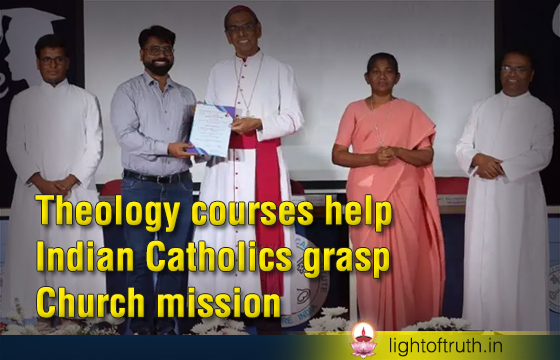
Theology courses help Indian Catholics grasp Church mission
Hubert Praveen grew up thinking that only people of other faiths, namely Hindus and Muslims, can be religious fanatics. The 43-year-old father of two now has a different understanding of life and faith after he completed a course on theology. “We say Hindus and Muslims are fanatics. But we are no less when it comes to our own religion and faith,” Praveen, a resident of the southern Indian city of Bengaluru told. He said his understanding changed after he completed an online theology course on Dialogue and Evangelization with St. Peter’s Pontifical Institute in Bengaluru (Bangalore) in southern India. The seminary trained some 1,000 people in two online courses–one year certificate course and a two-year diploma course since 2024. Praveen said these courses help laypeople like him appreciate faith and lead a life without being judgmental. Praveen was among 142 people–laymen, nuns and religious brothers–who completed the online certificate course and attended years’ convocation on Feb. 23. The two-year online diploma course in theology covers subjects such as Biblical Studies, Systematic Theology, Moral Theology, Canon Law, Liturgy and Missiology. Praveen says the certificate course helped him understand that regular churchgoers are not “holier than thou” than those who may not go and go less frequently. “Before I took this course, I was proud that my faith was the right faith. But now I see people of other faiths as the children of the same God and we all will meet in the same heaven after death,” he said.
The seminary founded 50 years ago offer these courses online and through regular postal mail, describing it as “theology coming to visit you right on your doorstep, to make learning easy. “The seminary also admit lay people and nuns for canonically valid degree and licence courses as regular students, who have to physically attend the classes. Ashok Kumar, a retired banker from Vijayawada diocese in southern Andhra Pradesh state also appreciated the online course. For engaging in Church’s “administrative and mission work, we need qualified people who can preach and teach,” Kumar told.
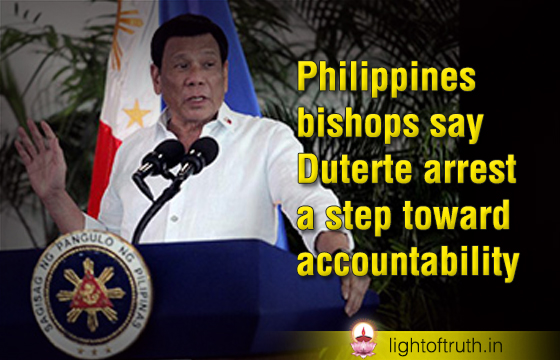
Philippines bishops say Duterte arrest a step toward accountability
Bishop Jose Colin Bagaforo of Kidapawan said Mr Duterte’s arrest is a crucial move toward justice for the thousands killed in his deadly drug war. “True justice … is about accountability, transparency, and the protection of human dignity,” said Bishop Bagaforo, who is also president of Caritas Philippines. “For years, former president Duterte has claimed that he is ready to face the consequences of his actions. Now is the time for him to prove it,” he said. Mr Duterte is in police custody after Interpol served him with an arrest warrant from the International Criminal Court for alleged crimes against humanity upon his arrival at Manila’s international airport. The ICC has been investigating the brutal anti-drugs crackdown that Mr Duterte oversaw while he was in office. According to UCA News, human rights groups and Church organisations estimate that between 12,000 to 30,000 people, mostly poor drug suspects from squalid ghettos and underbellies of the Catholic-majority nation, were killed during Mr Duterte’s regime.
Mr Duterte withdrew the Philippines from the ICC in 2019, but an appeals judge ruled that prosecutors still had jurisdiction over the alleged crimes because they occurred when the country was still a member. Most cases investigated by the ICC took place between 2016 and 2019. The probe also covers alleged crimes committed when Mr Duterte was mayor of Davao.
Bishop Gerardo Alminaza of San Carlos emphasised the need for justice, stating that the victims and their families deserve truth and reparations. “These killings were not random; they were part of a policy that violated the fundamental right to life,” said Bishop Alminaza, who is also vice president of the national Caritas. “The families of the victims deserve truth, reparations, and justice. As a nation, we must ensure that such crimes never happen again,” he said.
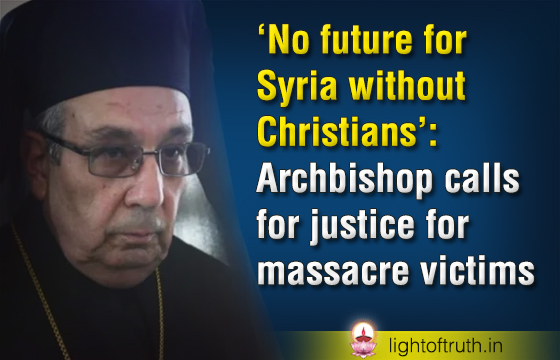
‘No future for Syria without Christians’: Archbishop calls for justice for massacre victims
The Greek-Catholic archbishop of Homs, Jean-Abdo Arbach, condemned the massacres of civilians that occurred in Syria last weekend – which left at least 1,000 dead – and urged Christians to maintain hope for an end to the violence and a return to unity and reconciliation.
Arbach emphasized the importance of the Christian community for the country’s future, telling the pontifical foundation Aid to the Church in Need (ACN) that “without Christians, there can be no future for Syria” and urged the faithful to remain steadfast despite the trying circumstances.
“Christians are the roots of Syria and Syria is the cradle of Christianity. In Damascus we can still find the places where St. Paul converted to Christianity in the first century. We still have first-century churches and monasteries, and we have kept Aramaic, the language Jesus spoke, alive,” the prelate emphasized. Furthermore, the archbishop urged those responsible to stop the hostilities: “We do not want more bloodshed. We call for unity and reconciliation. After 14 years of war, we do not need another conflict.” The attacks, which claimed more than 1,000 lives, have been attributed to militants from the Hay’at Tahrir al-Sham group, a coalition of Sunni Islamist insurgent groups that have seized power in the Middle Eastern country by overthrowing the regime of President Bashar al-Assad.
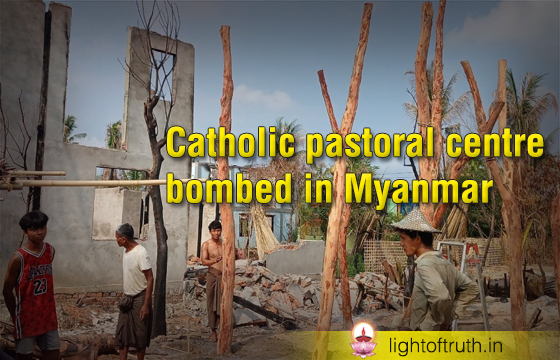
Catholic pastoral centre bombed in Myanmar
Myanmar’s military has bombed a Catholic pastoral centre in the northern Kachin State. According to the Vatican’s Fides news agency, the St. Mi-chael’s Catholic Church pastoral centre in the rural area of Nan Hlaing in the Diocese of Banmaw was struck and destroyed on 3 March by a bombing carried out by the Burmese army. The church has over one hundred years of history.
Jesuit Fr. Wilbert Mireh, who assists the parish priest, told Fides that five shells and two air bombs were fired at their church complex, hitting and causing damage to the structure, but without any casualties. The local Catholic community in Kachin State is enduring a fierce conflict that continues between the regular army and the ethnic Kachin forces, which have taken over positions near the city of Banmaw. The Kachin Independence Army (KIA), which fights for self-determination in the state, is one of the best-organized ethnic militias, active for decades, and has joined the resistance against the ruling military junta.
The war has intensified, and in the past two years, it has affected nine out of the thirteen parishes in the Diocese of Banmaw, increasing the number of refugees. Fr. Mireh explained that to report the incident, he had to travel to a distant location to find a place with electricity and an internet connection. “Electricity, phone service, and utilities,” he explained, “have been completely cut off in our area since July 2024.”
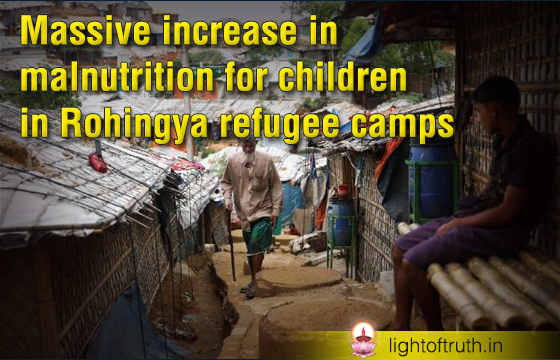
Massive increase in malnutrition for children in Rohingya refugee camps
Severe acute malnutrition in the Rohingya refugee camps in Bangladesh is soaring, the United Nations Children’s Fund has warned, stating it has surged by 27% in February 2025 compared to the same period last year. Recent figures, UNICEF pointed out, show the crisis is worsening. In January 2025, cases of severe acute malnutrition rose by 25% compared to the same month last year, and February saw the even sharper increase at 27%, causing concerns for a dangerous upward trend.
Multiple compounding factors, the organization explained, are contributing to the disturbing escalation. In 2024, there were prolonged monsoon rains that worsened sanitation and triggered spikes in severe diarrhea and outbreaks of cholera and dengue. Also worsening conditions were the impact of intermittent food ration cuts over the previous two years, leading to poor quality diets deteriorating further, as well as a growing number of families fleeing violence and seeking shelter in the camps in recent months.
Moreover, families are facing emergency levels of nutrition in Cox’s Bazar, the world’s largest refugee settlement, home to more than a million Rohingya refugees, including more than 500,000 children. In the camps, more than 15 percent of children are now severely malnourished, marking the highest levels recorded since the mass displacement of Rohingya refugees in 2017.
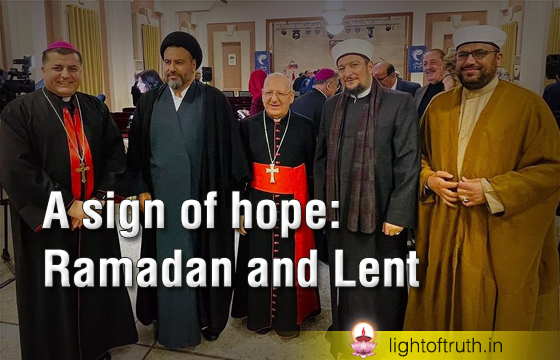
A sign of hope: Ramadan and Lent
This year the month of Ramadan overlaps with the Christian season of Lent. The significance of this coincidence between these two great periods of fasting has not been lost on His Beatitude Louis Raphael Sako, Chaldean Patriarch of Baghdad, who has just announced in an official message to the Muslim and Christian faithful in Iraq that “it is a sign of hope”.
“On this special occasion”, he said, “I extend my warmest congratulations and best wishes to all Muslims in the Holy Month of Ramadan and to all Christians at the beginning of the Great Lent, with hope that God Almighty will include them all in His merciful and loving care, and grant peace and security to our beloved country and to our neighbours in the wider region”.
The patriarch said that both Ramadan and Lent are “times of fasting, prayer, repentance and forgiveness, purification from vices, almsgiving and charity, and a time of quenching one’s thirst at the fountain of divine values, in the spirit of love and tolerance”.
His Beatitude did not refrain from lamenting that today, not only have so many people turned away from God, the God of love and mercy, but that “people have turned away from each other, from tolerance and forgiveness, and from charity and doing good”. He recalled that, during this season of fasting, “all believers need the light of God to illumine their hearts and minds so that they can transform God’s will into an honest and righteous lifestyle.”
In his message, Cardinal Sako extends his gaze to his beloved homeland, saying that, for the sake of lasting stability and security in Iraq, there is no other solution than “to submit to the logic of the State and to cooperate with it, so that Iraq can establish justice, the rule of law, national unity, equal citizenship and avoid sectarianism”. “We will only achieve this by embracing a culture of learning and education that respects all faiths and all peoples in a pluralistic society.”
Vatican Dissolves Miles Christi Religious Institute Amid Ongoing Scandals
The Vatican has officially decreed the dissolution of the religious institute “Miles Christi”, marking the end of its existence as a clerical institute of diocesan right. The decision, formally approved by Pope Francis on February 6, 2025, was announced by the Dicastery for Institutes of Consecrated Life and Societies of Apostolic Life. Bishop Mauricio Landra, Auxiliary Bishop of Mercedes-Luján, has been appointed as the pontifical delegate responsible for overseeing the institute’s closure. His appointment brings an end to the tenure of Archbishop Jorge Ignacio García Cuerva, who had served as the Vatican’s commissioner for “Miles Christi” since late 2022. A Troubled History Leading to Dissolution Founded in 1994 in the Archdiocese of La Plata, Argentina, “Miles Christi” was once regarded as a promising religious institute. However, in recent years, its reputation suffered due to serious allegations against its founder and members. In February 2020, the institute’s founder, Roberto Juan Yannuzzi, was expelled from the clerical state after being found guilty of offenses including sexual misconduct with adults, abuse of authority, and violating the secrecy of confession to absolve a complicit party. This marked the beginning of increased scrutiny of “Miles Christi” and its internal governance.
By December 2022, under the leadership of Archbishop Víctor Manuel Fernández, the Archdiocese of La Plata terminated the institute’s management of San Luis Gonzaga Parish and San Francisco de Asís School, institutions it had overseen for 16 years. These responsibilities were transferred to the archdiocese. Shortly thereafter, additional concerns emerged. A formal complaint of sexual abuse involving a “Miles Christi” priest had reportedly been filed with the religious institute’s leadership in early 2022.
The case was later escalated to the archdiocese, then expanded, and ultimately submitted to civil authorities. By early 2023, Archbishop García Cuerva, in his role as Pontifical Commissioner, announced the closure of «Miles Christi’s San Ignacio Centre in La Plata, further signaling the Vatican’s growing intervention in the institute’s affairs. On March 6, 2025, Bishop Landra issued a statement confirming that Miles Christi had been formally notified of the Vatican’s decision. Acknowledging the complexity of the situation, he expressed hopes that the closure would be carried out with “justice and charity” and entrusted the process to the intercession of Mary, Mother of the Church.
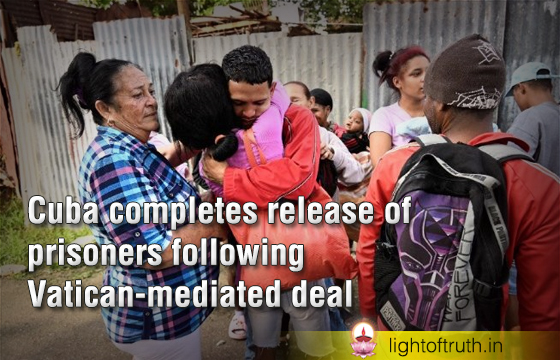
Cuba completes release of prisoners following Vatican-mediated deal
In one of his final official acts, and in the wake of a Vatican-mediated deal with the Cuban government, Joe Biden on January 14 removed Cuba from a US terrorism blacklist in exchange for an agreement by the Cuban government to free 553 prisoners.
The United States, the European Union, the Catholic Church and rights groups have long pushed the island nation to release hundreds of protesters jailed following anti-government protests in July 2021, the largest since Fidel Castro’s 1959 revolution.
In a statement after the deal, Cuban President Miguel Díaz-Canel said, “As part of the close and fluid relations with the Vatican State, I informed Pope Francis of [the decision to free the prisoners] in the spirit of the 2025 Jubilee.”
The deal was overturned by the new US presidency just six days after Donald Trump was sworn in, but prisoners have continued to be sporadically released. In February, the Vatican Secretary of State, Cardinal Pietro Parolin, called the gradual release of the Cuban prisoners “a sign of great hope” at the start of the Holy Year, and he expressed hope for more “gestures of clemency” from governments in the spirit of the Jubilee.
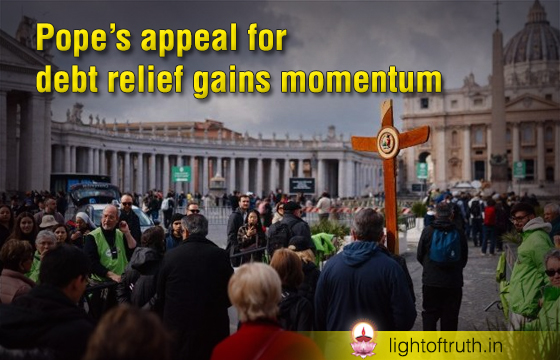
Pope’s appeal for debt relief gains momentum
In more than 160 countries, Pope Francis’ call for debt relief is becoming manifest, says Eric LeCompte, the Executive Dire-ctor of Jubilee USA Network, a development coalition of more than 750 religious groups and organizations around the world, in an interview with Vatican News.
The coalition, which includes Pope Saint John Paul II among its founders, frequently advises the Catholic Church and Bishops’ Conferences around the world on implementing the Church’s vision for the Church on Jubilee, a vision of debt relief, debt cancellation, and building an economy that provides for everyone.
For more than 25 years, LeCompte has led religious groups to win policies that alleviate poverty, address global conflict, and promote human rights. He has also addressed the United Nations General Assembly on needed economic and climate policies to achieve the Sustainable Development Goals.
Amongst other roles and responsibilities, LeCompte, who serves on boards of faith-based development and financial transparency organizations and recently received an honorary doctorate from Catholic Theological Union of Chicago, has advised a UN General Assembly process on global sovereign bankruptcy structures to alleviate poverty and is a member of expert UN working groups.