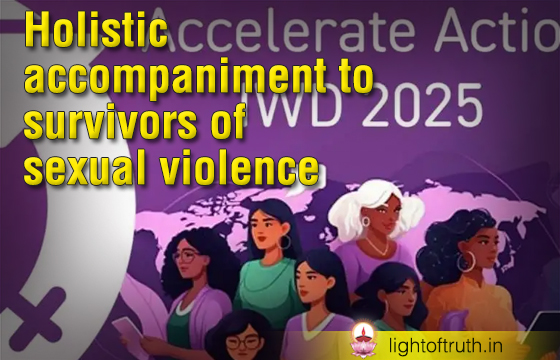
“Accelerate Action” to gua-rantee gender equality and wo-men’s rights, focusing on impa-ctful solutions, inclusivity and intersectionality, is this year’s call for International Women’s Day on March 8. A promising demon-stration of such action is the out-reach by an India-based network of Catholic women called Sisters in Solidarity (SIS), established in 2019 to provide holistic support to a nun survivor of clergy sexual violence (CSV) and to her compa-nions. However, SIS members also respond in other capacities to sexual violence and other gend-er equality issues in the Church and broader society. Pertinent to the SIS response is its combined feminist theological and social science sensibility that undersco-res the commitment to gender equality and women’s rights in the Church and society. Anchored in understanding women’s experi-ence of sexual violence as a first principle, SIS and like-minded support groups assert that the traumatic psychological impacts on women from the onset of vio-lence through to complete healing, range from a swirl of mixed and swinging emotions (especially when the perpetrator is a known authority figure whose responsi-bility is to protect), to serious psychological dysfunctionality and self-harm. Emotional impacts may be worse in contexts that place a high premium on virginity, link sexual purity to women’s bodies, family and community honour, and resort to a range of discriminatory silencing and punitive tactics, in-cluding stigmatization by fami-lies, communities, work, religi-ous, and other institutions. This generates shame, self-blame guilt, fear, anger, feelings of a loss of self-worth, and an overall sense of hopelessness and despair. Sur-vivors of sexual violence, inclu-ding SIS-supported survivors, also find it difficult to access justice.


From a Railway Platform to the Altar: Abandoned Child Becomes a Priest
Twenty-eight years ago, a frightened five-year-old boy was found alone at Shoranur railway station. He had no memory of his parents or a family to