
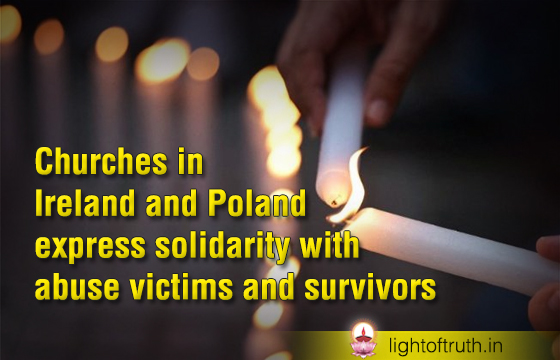
In 2016, the Vatican’s Ponti-fical Commission for the Prote-ction of Minors established a Universal Day of Prayer for Survivors and Victims of Sexual Abuse. In the press release anno-uncing its creation, the Commi-ssion explained that a “survivor of clerical child sexual abuse made the proposal of a Day of Prayer.” In response, Pope Fran-cis requested Bishops’ Confe-rences around the world to choose an appropriate day to mark this prayer initiative. Dioceses in Poland and Ireland mark the Day of Prayer for Survivors and Victims of Abuse on the first Friday of Lent, which this year falls on March 7.
Since 2017, the dioceses in Ireland have commemorated this day of prayer. This year, parishes across the country will light blessed candles as a reminder of the importance of “atonement, repentance, and the light of hope amidst darkness.” These “Candles of Atonement” will be placed in cathedrals and churches throughout Ireland.
The tradition of the Candles of Atonement stems from Pope Francis’ visit to Dublin in 2018 during the 9th World Meeting of Families. During the closing Mass, he entreated God’s mercy for the crimes of abuse and asked for forgiveness on behalf of the Church. The candles are meant to “reflect the commitment to spiritual healing, reconciliation, and peace.”
Churches in Poland become meeting places of hope. In Poland, a line from the Gospel of St. Matthew serves as the motto for the Day of Prayer. The Delegate of the Polish Bishops’ Conference for the Protection of Children and Youth, Archbishop Wojciech Polak, invited everyone to use this day to express their solidarity with victims and survivors.
He explained that there are designated churches where people are encouraged to come together to pray with those affected.
Daily Archives: March 15, 2025
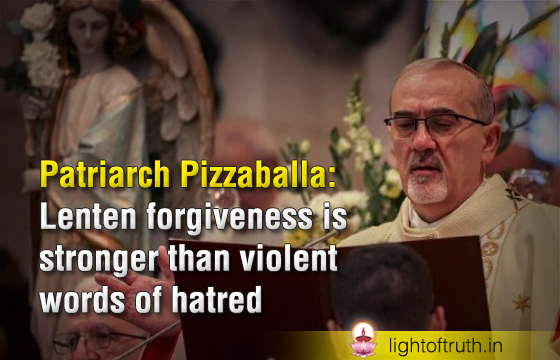
Patriarch Pizzaballa: Lenten forgiveness is stronger than violent words of hatred
As the season of Lent began, Cardinal Pierbattista Pizzaballa, Latin Patriarch of Jerusalem, has urged Christians to look to the Cross of Christ, which represents the heart of Easter and the hope of the world, especially in times of war, selfishness, and violence.
In his Lenten message sent to the faithful of the Holy Land, the Cardinal Patriarch said every believer in Christ must realize that “violent words of rancor and hatred, the presumptuous speeches of conflict and recrimination cannot prevent God from speaking the word of reconciliation in Christ: Ave Crux, spes unica!”
Lent, he said, represents an ever-renewed opportunity to receive the gift of grace and forgiveness, as we experience the desert alongside Jesus. “We need this new word, the word of the Cross, which may seem like foolishness to the powerful and wise of this world and of our time,” said Patriarch Pizzaballa. “It is the only word that can reopen paths of hope and peace, by overturning worldly criteria. The Way of the Cross, along which we learn with difficulty, but with joy, the new logic of gift and forgiveness, calls for men and women, young and old, families and children, who are ready to walk it, by renewing their way of thinking and their attitude. Only in this way can we hope for a future in peace.”
The Cardinal invited Christian commu-nities in the Holy Land to make time to read the Passion narratives and visit the places marked by the Lord’s passage to Calvary and the Sepulcher. He recalled that reconciliation can only become effective by becoming ministry in service toward our brothers and sisters. “The gift is not magical, but must be received, witnessed, lived and shared,” he said. “So, let us all, pastors and lay people, religious men and women, get involved and feel jointly responsible for carrying the word and ministry of reconciliation into the world.”
“When reconciled with God, Christians must deeply feel the call to reconcile among themselves and then extend that reconciliation to all humanity,” said Patriarch Pizzaballa. “Let us not waste this time given to us by the mercy of God,” he concluded. “It is not just another Lent: if we want it to be, it can become a different, a new Lent!
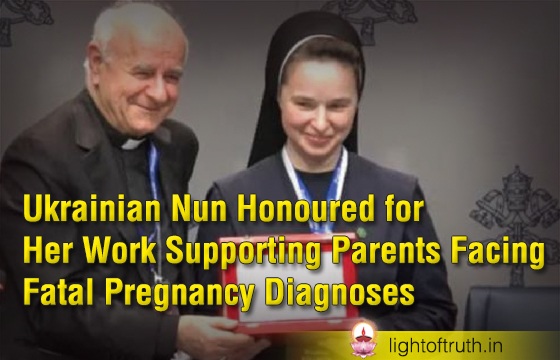
Ukrainian Nun Honoured for Her Work Supporting Parents Facing Fatal Pregnancy Diagnoses
Amid global discussions on the value of life and ethical dilemmas in modern medicine, Ukrainian nun Sister Giustina Holha Holubets has been recognized for her unwavering commitment to parents facing devastating prenatal diagnoses. On March 5, the president of the Pontifical Academy for Life, Archbishop Vincenzo Paglia, presented her with the “Guardian of Life” Award for her work in offering care and guidance to families who, in moments of despair, might consider abortion as their only option. Sister Giustina, a member of the Servants of Mary Immaculate, is not only a clinical psychologist at the Medical Genetics Centre in Lviv but also the founder and president of “Huella de Vida”, a pioneering perinatal hospice established in 2017. The organization, driven by its motto—”I cannot give days to your life, but I can give life to your days”—provides perinatal palliative care to families experiencing the heartbreak of severe and untreatable fetal conditions. During a press conference at the Pontifical Academy for Life’s General Assembly, which explored the theme “The End of the World? Crisis, Responsibilities, Hopes”, Sister Giustina spoke passionately about the urgent need to change societal attitudes toward prenatal loss. She pointed out that prenatal diagnoses often lead to pregnancy termination, which, in turn, skews medical statistics by reducing recorded cases of congenital conditions. Sister Giustina’s message was clear: even when medicine offers no solution, love remains. “In situations where ‘nothing more can be done,’ there is always something left to do: to love—to love until the very end.”
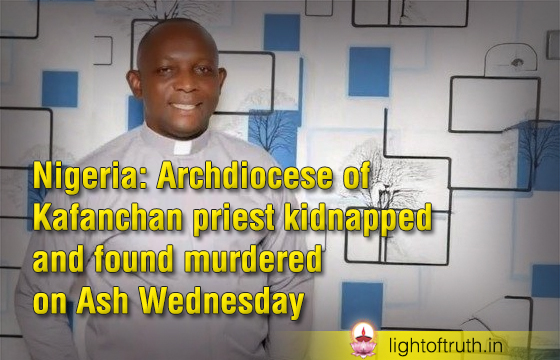
Nigeria: Archdiocese of Kafanchan priest kidnapped and found murdered on Ash Wednesday
The Catholic Archdiocese of Kafanchan has confirmed the tragic killing of Fr. Sylvester Okechukwu, who was abducted from his residence on the night of 4 March 2025. Fr. Sylvester Okechukwu was abducted from his residence at St. Mary’s Catholic Church in Tachira, located in the Kaura Local Government Area, on the evening of 4 March. He was later found murdered in the early hours of Ash Wednesday on 5 March.
“It is with deep sorrow and heavy hearts that we announce the tragic death of our beloved priest, Rev. Fr. Sylvester Okechukwu, who was ordained on 11 February 2021,” Fr. Shanet said. He added, “The untimely and brutal loss has left us heartbroken and devastated. Fr. Sylvester was a dedicated servant of God who worked selflessly in the vineyard of the Lord, spreading the message of peace, love, and hope. He was always available and accessible to his parishioners. His untimely death has left an indelible void within our diocesan family, and we share in the pain of his passing with his family, friends, and all those who knew and loved him,” the Chancellor said. The motive behind the killing is unknown. The Kaduna State Police Command said that they have launched a search for the perpetrators.
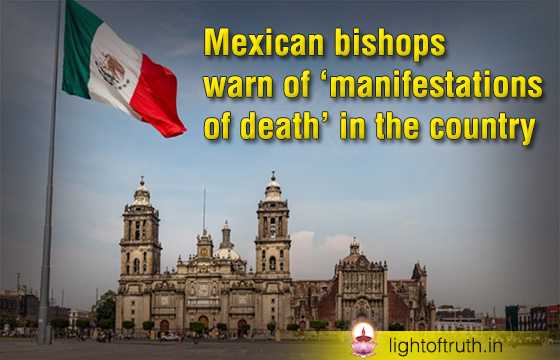
Mexican bishops warn of ‘manifestations of death’ in the country
The Church in Mexico warned about the “manifestations of death that have been taking place in our country,” which, according to the bishops, “threaten human dignity, dehumanize our coexistence, and leave a deep wound in the con-science of our people.”
In a statement issued on March 5, the Mexican Bishops’ Conference specifically pointed out problems such as “the decri-minalization and promotion of abortion, the scourge of uncon-trolled violence, organized cri-me, and the scourge of drug trafficking, which has turned entire regions into war zones.” However, despite this panorama “marked by shadows of death and despair,” the prelates reminded that “life is a sacred gift, which must be welcomed, protected, defended, and promoted with courage.” In this context, the bishops called for a commitment in favour of human dignity, calling for a Week for Life to be held March 24–28.
The prelates called for the formation of a “conscience illuminated by the truth,” emphasizing that “it is essential to educate the conscience in the light of the Gospel and the teaching of the Church to avoid falling into error and moral confusion.” They also insisted on the need to protect people in their most vulnerable stages, especially the unborn and the elderly, and warned that one should not “be silent in the face of unjust laws that violate human dignity.”
The bishops stressed the urgency of “promoting the family and education in values,” emphasizing that the home is the first space for learning and formation. “It is necessary to strengthen marriage, educate in faith and Christian values so that the new generations grow in a culture of respect and solidarity,” they added. They also urged people to “combat violence with the peace of the Gospel,” affirming that “we cannot resign ourselves to violence. Peace begins in the heart of each person and is built with justice.” The bishops further urged people to accompany the victims of violence, recalling that the faithful are “called to be Samaritans who heal the wounds of those who have suffered violence. Mercy is a concrete witness to Christian hope.”
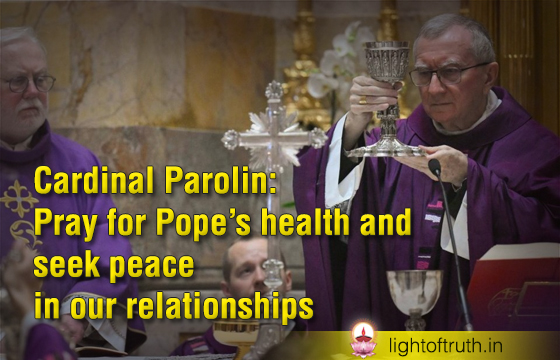
Cardinal Parolin: Pray for Pope’s health and seek peace in our relationships
Ambassadors and members of the diplomatic corps accredited to the Holy See gathered in the Pauline Chapel of the Apostolic Palace on March 14th morning to attend Mass, which they requested in order to pray for Pope Francis. Cardinal Pietro Parolin, Vatican Secretary of State, celebrated the Mass, and thanked those who proposed the idea of praying together as a group.
“We gather in prayer this morning for the intention of the Holy Father’s health, that he may recover and return soon among us,” said the Cardinal in his homily. He also recalled the 12th anniversary of Pope Francis’ election to the papacy, which occurred on March 13 as he recovers from bilateral pneumonia at Rome’s Gemelli hospital. Cardinal Parolin then reflected on the essence and purpose of prayer, saying it is more about opening our hearts to God than about informing him of our desires, which He already knows. Rather, he said, prayer is the key that opens the Lord’s heart, since it opens our own heart to listening to His word.
Turning to the day’s Gospel, which is about the righteousness required to enter the Kingdom of Heaven, Cardinal Parolin noted that Jesus emphasizes the impor-tance of loving our neighbours, even if we disagree. Jesus told His disciples that even those who are angry with someone else will be subject to judgement. “Wars do not start [on the battlefield],” said the Cardinal. “They start here, in the human heart, born from feelings of hatred and hostility that we harbour toward others.”
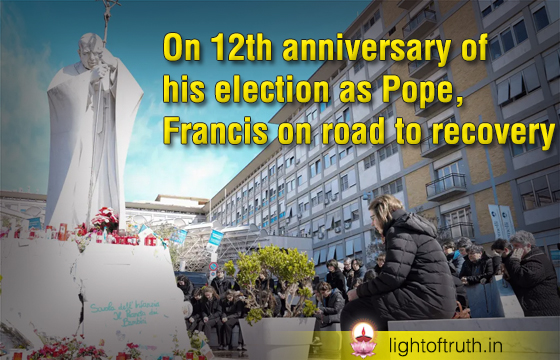
On 12th anniversary of his election as Pope, Francis on road to recovery
On the eve of the 12th anniversary of his election as the 266 Pope of the Catholic Church, the Holy See Press Office reported that “The Holy Father’s clinical condition, despite the complexity of the overall picture, remained stable.” This information confirms a tendency, which now reaches eight days, after the Pontiff’s last crisis in hospital. It was corroborated that “The chest X-ray performed yesterday [Tuesday, March 11] radiologically confirmed the improvements recorded in the previous days.” However, the Pope “continues to receive high-flow oxygen therapy during the day and non-invasive mechanical ventilation at night.”
On Wednesday morning, March 12, after following the Spiritual Exercises via remote connection with Paul VI Hall, the Holy Father “received the Eucharist, dedicated himself to prayer and then to motor physiotherapy. In the afternoon, after following the Curia’s Spiritual Exercises, he continued with prayer, rest and respiratory physiotherapy.” For the first time in 12 years, Pope Francis will spend the anniversary of his election hospitalized. 13th March marks his 28th day in the hospital and the 12th anniversary of his election as Pope.