
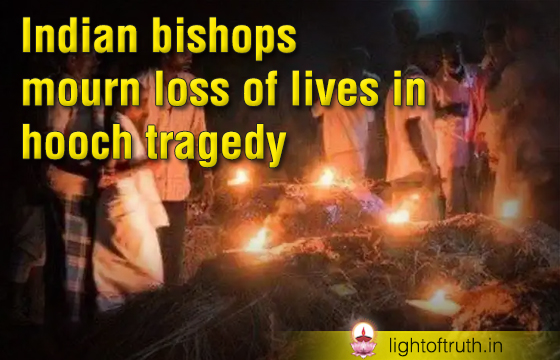
Consumption of spurious liquor led to the death of 57 people, most of them daily wage laborers, and left 150 others battling for life in a hospital in a southern Indian state. The Catholic Bishops’ Conference of India (CBCI) expressed its “profound sorrow and condolences to the families of those who tragically lost their lives after consuming methanol-mixed liquor in Tamil Nadu [state].” Many of those who died were Dalits or formerly untouchables from Kallakuruchi town and its nearby villages who worked as daily labourers. “Our thoughts and prayers are with the victims and their families during this heartbreaking time,” the CBCI said in a June 21 statement. The Catholic bishops also sought action against those involved in the illicit liquor trade that led to the tragedy. The state police’s crime investigation department has arrested seven suspects so far since the tragedy on June 19. The victims, among them two women and a transgender person, consumed the spurious liquor in the evening after a hard day’s work. “Among the dead are a few Protestant Christians,” said a Catholic priest in the Arch-diocese of Pondicherry-Cuddalore which covers the Kallakuruchi town and its surrounding area. However, the exact number of Christians who died or are in serious condition could not be ascertained due to the highly tense situation, he said. “It is still ex-plosive despite heightened security,” the priest who wished to be anonymous told.
Daily Archives: June 28, 2024

Twenty young leaders commit to become lay missionaries
As many as 20 young people from seven Indian states have committed to becoming lay missionaries through the Communio missionary training programme. The commitment ceremony took place on June 23 at St. Francis Assisi Church at Tallur, Udupi diocese, Karnataka. The second batch of the missionary training programme organized by Communio in collaboration with the Youth Commission of the Conference of Catholic Bishops of India was inaugurated by Father Stephen Alathara, Deputy Secretary General, CCBI, and the Director of Communio. Earlier in March 2024, the Youth Commission trained 30 youth for their missionary journey. The Communio Missionary Training Programme that began on June 22 will conclude on June 27 when the trainees take the missionary pledge before Bishop Gerald Isaac Lobo of Udupi. The selected volunteers, chosen for their diverse linguistic, cultural, and environmental backgrounds, are being immersed in the local culture by staying with twenty families from St. Francis Assisi parish.

Churches appeal Indian president to save Manipur Christians
Christian groups in the strife-torn Manipur state in northeast India have jointly appealed to Indian President Droupadi Murmu to stop the violence against a tiny group of Christians who live among native Hindu Meitei people. An estimated 35,000 Meitei Christians face “total cleansing and obliteration” in all the valley districts of the hilly state, according to their memorandum submitted to Murmu on June 26. The All Manipur Christian Organization (AMCO), a forum of all Christian groups in the state cutting across denomi-national differences, said Meitei Christians are facing violence from people of their ethnicity.
The Meitei people make up 53 percent of Manipur’s 3.2 million population. They are mostly Hindus, but some have followed various Christian denominations for decades. How-ever, they became the target of Meitei violence after a riot broke out 14 months ago between Meitei people and predominantly Christian Kuki tribal people, the Church leader told. “Since the mayhem and violence started, more than 360 Christian churches have either been razed to the ground, demo-lished or vandalized, out of which 249 churches belong to the Meitei minority Christian com-munity,” said the memorandum. “What is extremely saddening and heart-wrenching is the fact that all the displaced Meitei Christians are still not allowed to practice Christianity as their faith,” it said.
“The Meitei Christians, who are being threatened and harassed, are not allowed to practice their faith,” the memorandum said. It stressed that freedom of religion is “a guaranteed fundamental right of each citizen of our secular nation.” The Meitei Christians should be given “the necessary protection and assurance by the government of India and state government that they would no longer be disturbed from any angle in practicing the faith they choose,” it said. The memorandum also appealed to Murmu to take immediate action to “rebuild the places of worship, fostering healing and restoring the fabric of unity among the people.” It said that the reconstruction of these churches will serve as a symbol of resilience and reaffirm our commitment to diversity and harmony.
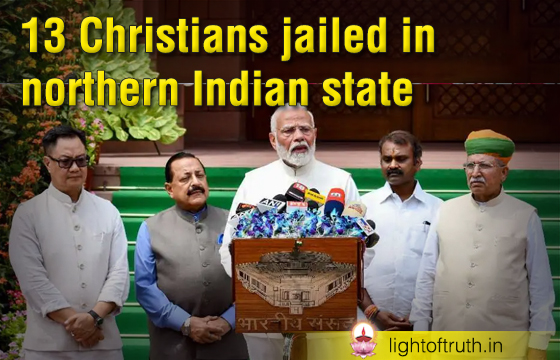
13 Christians jailed in northern Indian state
A Protestant pastor along with his wife, and three other pastors are among 13 Christians jailed in separate incidents in a northern Indian state over allegations of religious conversion. “It is an alarming situation. Within 20 days, 13 people went to prison because of their faith in Jesus Christ,” said a Christian leader who is helping Pastor Sanjay Kumar and his wife, Sunita Devi, to secure bail. The pastor and his wife, who are parents of three children, were arrested in Azamgarh on June 21 by police in Uttar Pradesh. The state, governed by the Bharatiya Janata Party (BJP), has a sweeping anti-conversion law in place. The series of arrests began on June 7 with Abhishek Masih and Anil Masih in Barabanki district. This was followed by the arrest of ` Durgesh Chauhan on June 9 in Ayodhya district.
On June 16, Pastor Paul, who was identified by a single name, and Nandlal Rajbhar were arrested in Ghazipur district followed by the arrests of Ram Chander, Anuj Kumar, Sarvesh Kumar and Hitna, identified by a single name, in Sitapur district on June 19. The latest to be arrested on June 23 were Pastor Sarju Prasad from Ayodhya district and Pastor Naresh Kumar from Hardoi district.The Christian leader said most of them were participating in house prayer meetings when the police arrived after being alerted by local villagers suspecting conversion activities. The police arrested and produced them in local courts seeking they be placed in custody for further investigations. “More than a dozen Christians are being accused of religious conversion even though there isn’t a single person whom they converted,” said a Church leader. He felt the police action may be “the fallout of the general election where Modi and his party lost seats in Uttar Pradesh,” resulting in their reduced majority in parliament.
Uttar Pradesh government is headed by Yogi Adityanath, a Hindu monk-turned-politician. The draconian anti-conversion law was enforced by his government as an ordinance in 2020. It was adopted by the state assembly the following year as the Uttar Pradesh Prohibition of Unlawful Conversion of Religion Act 2021.Since the enactment of this law, Church leaders said close to 450 Christians, including Catholic priests and pastors, have been jailed in the state. Christians make up a mere 0.18 percent of Uttar Pradesh’s more than 200 million people.
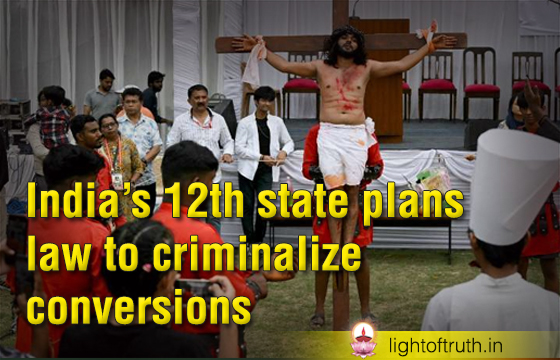
India’s 12th state plans law to criminalize conversions
Yet another Indian state has announced plans to enact a draconian anti-conversion law, which is often used to harass Christians in the country. The Bharatiya Janata Party (BJP) government in the north-we-stern state of Rajasthan dis-closed its intent to curb religious conversions in an affidavit filed before the Supreme Court, the country’s top court, on June 18. The affidavit was filed in response to a public interest litigation by Delhi-based lawyer and BJP Ashwini Kumar Upadhyay seeking stringent steps by federal and state governments to control fraudulent religious conversions, which he called “a nationwide problem.”
The petition alleged the involvement of Christians in fraudulent religious conversion. Eleven Indian states, most of them ruled by the BJP, have enacted the draconian law, ironically named as freedom of religious acts. But Rajasthan “lacks a specific legislation” to curb conversions, according to the affidavit filed by the state government. After defeating the secular Congress party, the BJP formed a government in Rajas-than in December last year. “There is no doubt enactment of an anti-conversion law will make Christians vulnerable to hardline Hindu groups,” said a Catholic priest based in Rajasthan. According to Christian leaders, Hindu nationalist groups and activists may misuse the anti-conversion law to target them with impunity. “Laws are made when there is a need for them. But in this case, there is no such need,” said A.C. Michael, a Catholic leader based in Delhi. Michael, a former member of the Delhi state minority commission, said that the proposed law “will only make the life of Christians difficult.” Christians face severe atrocities in the neighboring state of Uttar Pradesh, ruled by the BJP. The draconian anti-conversion law was first enforced as an ordinance in 2020 and adopted by the state assembly the following year as the Uttar Pradesh Prohibition of Unlawful Conversion of Religion Act 2021. Since the implementation of the law, close to 400 Christians, including Catholic priests and pastors, have been jailed in the state under the sweeping law. “We cannot rule out a similar situation in our state,” said a priest attached to the Udainagar diocese in Rajasthan. India’s top court is hearing public interest petitions challenging the constitutional validity of the anti-conversion laws passed by the states.
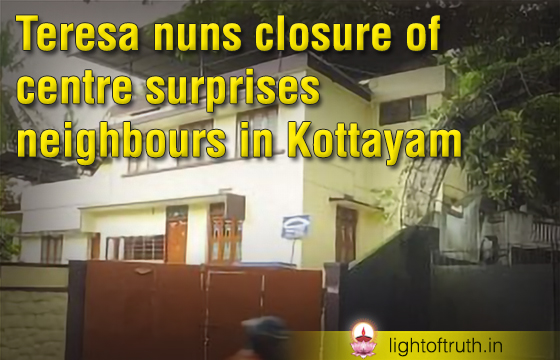
Teresa nuns closure of centre surprises neighbours in Kottayam
Neighbours of Shanti Bhavan (home of peace), a Missionaries of Charity centre in Kerala’s Kottayam town, have expressed surprise at the closure of the centre that had served the poor and destitute for half a century. The centre, opened by Mother Teresa in 1974, was closed June 21.
“We do not know why they closed and left the place,” said Jolly Varghese, a social worker in Kottayam. “Before they left, the sisters transformed their 55 inmates to other centers,” the Catholic layman told Matters India June 23. He said he knew the nuns for 45 years. “I was born and brought up in Kottayam town and have seen them coming to our colonies for charitable works. They wiped the tears of the poor, giving them food and medicine,” Varghese recalled. He said people used to bring people they found lying helpless on the street to the nuns. “The sisters welcomed them with love. We have brought many destitute people here,” he add-ed. He said he was shocked to see the centre’s gate closed when he was “passing by un-expectedly this way. It breaks my heart.” He said the neighbours would have stopped the closure if they were informed early.
His wife Nimmy said they had experienced the nuns’ kindness many times. ”Once we were going to the church in an auto with our two children, when we found a man on the street in a very bad shape. We took him to Shanti Bhavan and requested the sisters to attend to him. They gladly offered to help, and after the Mass we took him to another centre. There are several cases when sisters cooperated with us,” she added. The nuns have apparently given the keys of the centre to the diocese of Vijayapuram.
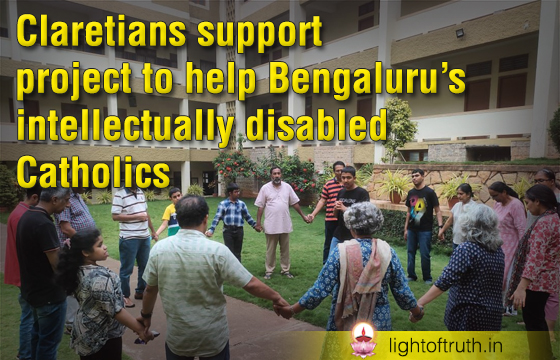
Claretians support project to help Bengaluru’s intellectually disabled Catholics
Catholic parents of some intellectually disabled children in Bengaluru got a boost with the Claretians offering support to an exclusive housing project for their community living. “Since four years, we have been dreaming of this project as we were really worried about our disabled children’s future after our death,” Merly Thomas, one of the parents, told a June 23 meeting at Claretian Seminary in the southern Indian city. Merly, a member of the Bangalore Archdiocesan commission for differently abled, says the Claretian support now helps them build the common living facility where children with intellectual disabilities and their parents can live with dignity. Claretian Father George Kannanthanam, who brought his congregation to the project, says he had seen parents of many differently able children worried about what would happen to their children when they are no more. The priest impressed upon his provincial to allot two acres of land for such families at Gauribidanur, on the outskirts of Bengaluru city. Kannanthanam, who had earlier served as the first secretary to the Bangalore diocesan commission for the disabled, said the Hope Society that functions under the Claretians will give wings to the project. The Archdiocese of Bangalore was first in India to set up a commission to ensure better participation of persons with disabilities in the life of the Church, he recalled.
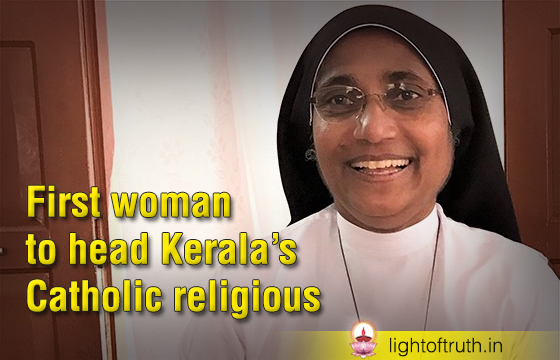
First woman to head Kerala’s Catholic religious
Sister Ardra Kuzhinapurathu is the first woman to head the major superiors of Kerala, the southern Indian state that has produced the largest number of Catholic religious men and women in the country. She became the president on June 7, 2023, at a joint meeting of the Kerala Catholic Bishops’ Council and the religious superiors. The Kerala unit is part of the Conference of Religious India, the national association of the major superiors, with more than 130,000 members, among them 103,000 women. Sister Kuzhinapurathu spoke to Global Sisters Report about various challenges faced by the religious congregations in India – dwindling vocations, aging members and the culture of working together.
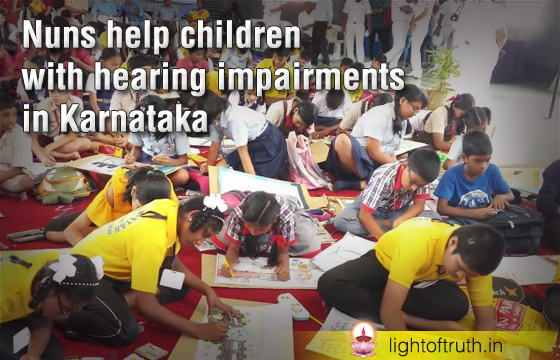
Nuns help children with hearing impairments in Karnataka
Prasad James cannot hear the roar of the sea, but can paint the beauty of the waves. “I have painted the charming Karwar beach, its waves, fishermen with their boats, tourists, and the beautiful sunset,” James told Global Sisters Report in sign language, translated by his teacher, as he showed his works. The sixth grader is among 48 children currently studying in Asha Niketan (House of Hope) Deaf School, a residential school for children who cannot hear or speak managed by the Sisters of the St. Joseph of Chambery, a French congregation, for the Karwar Diocesan Development Council. The center, founded in 1996 near a beach in Karwar on the Goa-Karnataka border, is the first Church-managed school for children with hearing impairments in Karnataka state’s northern region. It now caters even to villagers of Maharashtra, Karnataka’s northern neighbor. “Children seem to enjoy their silent world, but we really struggle to get into that world,” said Sister Tresa Irudayasamy, one of three nuns who live on campus and teach the stu-dents in sign language. The nun, who’s been the hostel warden for four years, has built a good rapport with the children, but said she still struggles in the classroom to teach them. “We use our universal language of love and care mostly, and it works better than our sign language,” she told GSR with a smile.

Elena Beccalli is the new Rector of Milan’s Catholic University of the Sacred Heart
For the first time in the history of the University of the Sacred Heart in Milan, a woman has been appointed Rector. Elena Beccalli will take over on 1 July, after the painful death on 23 May of her predecessor Franco Anelli. Beccalli was a student at the university that she is now preparing to lead for four years, from 2024 to 2028. She was appointed by the Board of Directors who met on 20 June. The decision of the Board of Directors follows the appointment of Professor Elena Beccalli, already serving as Dean of the School of Banking, Finance, and Insurance Sciences, by the University’s 12 Faculty Councils on 22 May, with 636 preferences out of a total of 685, corresponding to around 93% of those voting.
“Università Cattolica del Sacro Cuore is a ‘universal’ academic institution by vocation, where dialogue and confrontation are open, free, interdisciplinary, and oriented towards the creation of networks and strategic alliances. It is a University that can offer with accuracy, creativity, courage a forward-looking approach to contemporary challenges, thanks to the coordinated efforts of its vibrant academic community”, Professor Beccalli said in thanking the academic staff and the Board of Directors.