
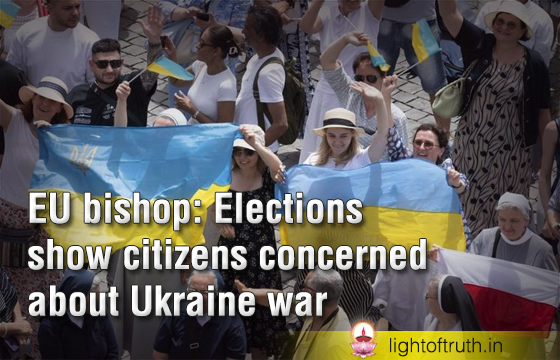
Citizens of the European Uni-on want EU politicians to be more actively engaged in inter-national issues such as the Ukraine war, an Italian bishop said after the EU elections earlier this month.
Bishop Mariano Crociata of Latina, president of the Bishops’ Conferences of the European Union (COMECE), told EWTN News that despite low voter turnout, EU citizens have an expectation that the elected members of the 27 countries’ joint parliament will respond to the problems they are living through, including fear of widespread war in Europe.
“The [election] result denotes …in the citizens of the countries that are part of the European Union, a phase of concern, perhaps one must even say fear,” he said. He explained that there is fear regarding “the presence of a war whose outcome is not foreseen or understood” and voters are looking for greater peace of mind.
EU citizens also have the expectation, he said, that elected officials will “do something, to have their voices heard” and “to have the political strength to become more and more an international subject, a subject that at least operates, is active as much as possible, in the confrontation between the big and medium powers that have responsibilities on so many things and particularly on the war in Ukraine.”
Daily Archives: June 28, 2024
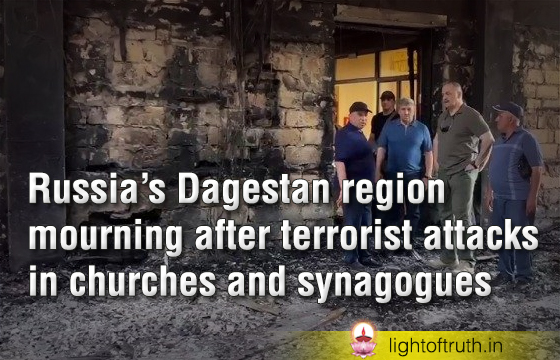
Russia’s Dagestan region mourning after terrorist attacks in churches and synagogues
Panicked-stricken people and police were seen in Russia’s volatile Dagestan region. The area plunged into mourning on June 24 following attacks against houses of worship in the regional capital, Makhachkala and Derbent, with an ancient Jewish community.
The Investigative Committee, the country’s top state criminal investigation agency, said all five attackers were killed after horrific battles. Of the 19 other people killed, 15 were police.
Among the dead was the Reverend Nikolai Kotelnikov, a 66-year-old Russian Orthodox priest at a church in Derbent. Local authorities said the attackers slit his throat before setting fire to the church. The attack came as the Orthodox faithful celebrated their Pentecost, also known as Trinity Sunday.
Shortly after the attacks in Derbent, militants reportedly fired at a police checkpoint in nearby Makhachkala. They attacked a Russian Orthodox Church and a synagogue before being hunted down and killed by special forces. Medical authorities in Dagestan said 16 people, including 13 police, were hospitalized with injuries, including four officers in grave condition. The bloodshed was the latest that officials blamed on Islamic extremists in the predominantly Muslim area in the North Caucasus.
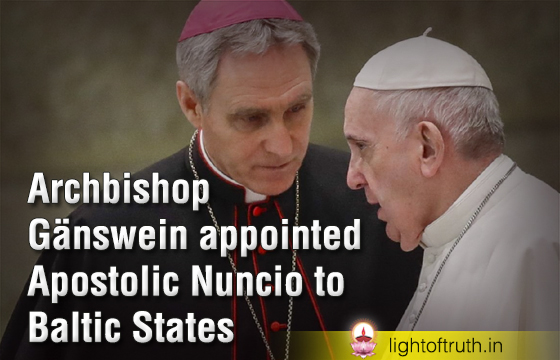
Archbishop Gänswein appointed Apostolic Nuncio to Baltic States
A statement on June 24 released by the Holy See Press Office said Pope Francis has appointed Abp Georg Gänswein, Titular Abp of Urbisaglia, and Prefect Emeritus of the Papal Household, as Apostolic Nuncio to Lithuania, Estonia, and Latvia. Archbishop Gänswein, who is 67, served as Pope Benedict XVI’s private secretary during his entire pontificate and retirement.
In December 2012, Pope Benedict XVI also appointed him Prefect of the Pontifical Household. He was ordained as archbishop in January 2013. He continued to hold both positions after Benedict resigned from the papacy about seven weeks later, in February 2013. For about seven years, Archbishop Gänswein served both Pope Francis and Pope Emeritus Benedict.
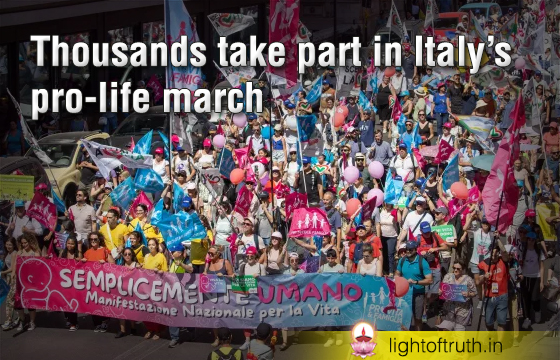
Thousands take part in Italy’s pro-life march
Thousands of people from across Italy braved the summer heat to join the national Demonstration for Life in Rome on the afternoon of June 22. “Let’s Choose Life” was the motto of the annual procession, which began at 2 pm in Rome’s Piazza della Repubblica, close to the city’s main Termini train station. The slow march continued almost one mile down the Via Nazionale before reaching the area of the ancient Imperial Forum, where a rally with speeches and musical performances was held.
“There is no compromise on human life!” Pope Francis said in a message sent to organizers ahead of the march. He thanked participants for their “commitment and public witness in defence of human life from conception to natural death” and urged them to “go forward with courage despite every adversity.” “The stakes, namely the absolute dignity of human life, the gift of God the Creator, are too high to be the object of compromise or mediation,” Francis wrote. The pope also invited families to bear witness to “the beauty of life and of the family that welcomes it” in order to build “a society that rejects the culture of waste at every stage of existence: from the most fragile unborn child to the suffering elderly, passing through the victims of trafficking, slavery, and every war.”
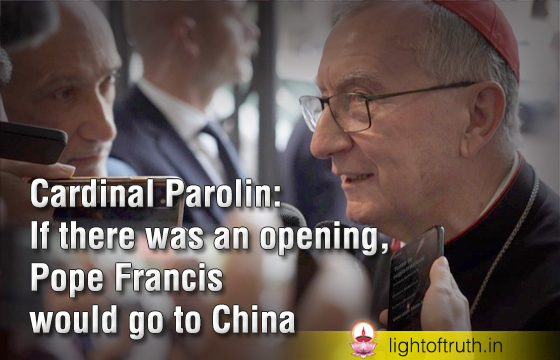
Cardinal Parolin: If there was an opening, Pope Francis would go to China
The timing at the moment seems premature, but “if there were openness on the part of the Chinese, the Pope would also go immediately” to China, a land for which he has always shown great appreciation and esteem for its people, history and its culture. Cardinal Pietro Parolin, Vatican Secretary of State, reiterated Pope Francis’ never-hidden desire to one day visit the great and “noble” Asian country.
The Cardinal’s comments were made on 20 June, at Rome’s Pontifical Urban University at the presentation of the book “Cardinal Celso Costantini and China – Constructor of a ‘bridge’ between the East and West” – The volume was edited by Msgr. Bruno Fabio Pighin, an Italian historian and Episcopal Delegate in the postulation of the cause of beatification and canonisation of Cardinal Celso Costantini (1876-1958), the first Apostolic Delegate to China, and published in Italian by Marcianum Press.
Once again, a month after the conference held at the Urbaniana for the 100th anniversary of the Concilium Sinense, which Cardinal Costantini inspired, promoted and organized, Cardinal Parolin found himself evoking the figure of the First Apostolic Delegate to China who laid the foundations for a dialogue, of which one of the fruits, after decades, can be considered the signing of the Agreement with the Holy See on the appointments of Bishops. That agreement was signed for the first time in 2018 and then renewed twice in 2020 and 2022.
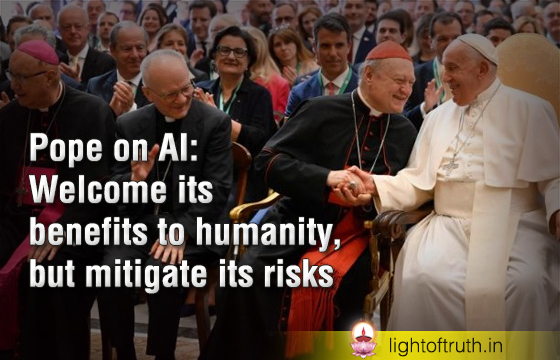
Pope on AI: Welcome its benefits to humanity, but mitigate its risks
Slightly more than a week after Pope Francis addressed the G7 Session in Bari, Italy, on artificial intelligence, the Holy Father is reaffirming that the powerful technological advancement must be used ethically, to serve humanity, and that its inherent risks must be mitigated. The Holy Father’s latest words on AI came during his audience on 22 June in the Vatican with participants in the international convention on ‘Generative Artificial Intelligence and Technocratic Paradigm,’ organized by the Vatican’s Centesimus Annus Pro Pontifice.
In his remarks, the Pope thanked those before him for their commitment to exploring how AI can help promote human dignity and be at the service of the disadvantaged.
“I appreciate,” he expressed, “that the Centesimus Annus has given ample space to this subject, involving scholars and experts from different countries and disciplines, analysing the opportunities and risks related to the development and use of AI.” The Pope likewise warned against the tool acting autonomously, stressing AI “is, and must remain a tool” in human hands. Moreover, the Holy Father warned against artificial intelligence perpetrating a ‘throwaway culture,’ favouring inequality, and making decisions outside of its purview.
As he encouraged them to continue examining the true purpose of AI, he asked: “Does it serve to satisfy the needs of humanity, to improve the well-being and integral development of people?” Or does it, rather, “serve to enrich and increase the already high power of the few technological giants despite the dangers to humanity?”
This, he said, is the basic question. Since the future of humanity will be played out on the front of technological innovation, he stated, “We must not miss the opportunity to think and act in a new way, with mind, heart and hands,” in order to “direct innovation toward a configuration centered on the primacy of human dignity.” This, he underscored, is not up for discussion.