
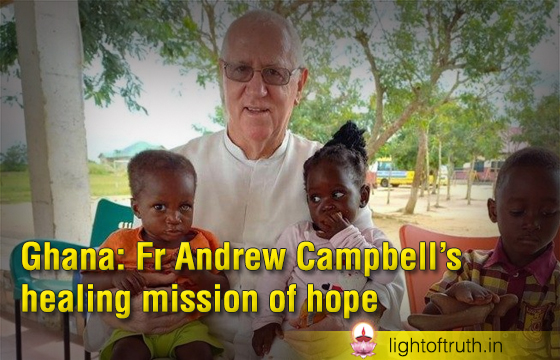
On 27 May 2024, Pope Francis received in private audience the Irish SVD priest, Fr Andrew Campbell, a missionary who has lived and worked in Ghana for the last 53 years. Inspired by Saint Theresa of Kolkata, India, Fr Andrew Campbell has dedicated his life to working with the poor and marginalized of Ghana. He has had great impact, especially working with street children, those suffering from disabilities such as Leprosy, and those generally disadvantaged by society.
“I was working at the age of 13 as a Labourer. So, I know what it is like to go without education. I don’t want anybody to go through what I went through. …there are a hundred thousand street children in the City of Accra living on the streets. They range from little kids onwards…. But with the Lepers, I am actually living with them. I help them, ensuring everything is okay: their health and food. I care for these needs while living with them,” Fr Campbell said.
Speaking to Vatican News after meeting with Pope Francis, Fr Campbell expressed his great joy at the encounter. “I can’t put words to it. It was so wonderful meeting him (Pope Francis). This man has always attracted me with his love for the poor,” Fr Campbel said.
It all started when someone suffering from Leprosy gave Fr. Campbell a bag of Mangoes. He failed to eat them, fearing he could contract the disease himself. Then, his conscience got the better of him. He went to see where those suffering from Leprosy were staying. He was appalled by the conditions and, from there, started an apostolate to Ghana’s marginalised.
Daily Archives: May 31, 2024
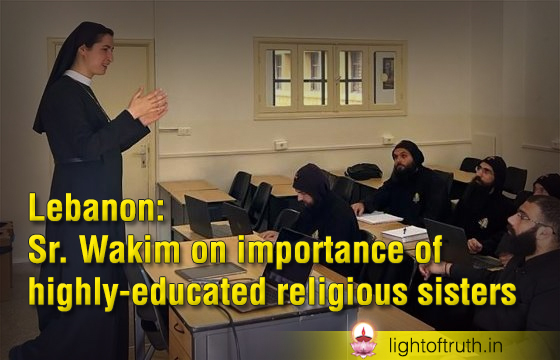
Lebanon: Sr. Wakim on importance of highly-educated religious sisters
Sister Suzanne Wakim is one of many religious sisters who teach in Lebanon’s Catholic universities. She teaches philosophy in four universities, and her students include people of different faiths, among them Muslims. She is an expert in Pope Benedict XVI’s anthropological and philosophical thought, and her work on the topic is the first on the late Pope to be written in Arabic. Sr Wakim began teaching in 2021. She has a sense of mission, and wants to do something good for the Church. She has written four academic publications over the past three years. Among other things, she explores the topic of teaching ethics in universities.
As the religious sister high-lighted, today it is important to read and study, to educate oneself. “I also encourage the younger religious sisters to develop their interests and broaden their horizons; people need educated sisters,” she said. “We cannot focus only on our religious duties; today we are in contact with many educated people, which is why it is important to grow also in our education.” This also changes the congregation’s image. Sr Wakim added that when she was presenting one of her articles for publication, someone asked her who would read it. “Today, we read too little and do not educate ourselves enough, often simply out of laziness,” she added. The religious sister speaks Arabic and English, and she is learning Italian. For work, she has also dabbled in Greek and Syriac. With her family she also speaks Aramaic. “The biggest challenge is finding a balance among all my responsibilities,” she confided.
Sr Suzanne Wakim belongs to the Salvatorian Sisters of Our Lady of the Annunciation. She teaches at Holy Spirit University of Kaslik, Saint Joseph University of Beirut, Antonine University of Baabda, and the Saint Paul Institute of Philosophy and Theology of Harissa, in Lebanon. She also teaches at a school managed by her same religious congregation: the High School Department of Notre Dame de la Délivrance of Hadath.
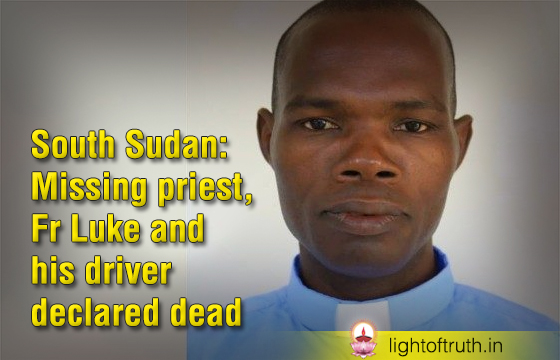
South Sudan: Missing priest, Fr Luke and his driver declared dead
South Sudan’s Diocese of Tombura Yambio has officially declared a mi-ssing priest, Fr Luke Yugue Mbokusa, and his driver, Mr Michael Gbeko, formally dead. “It is with deep sadness and heavy hearts that we inform you of official Funeral Prayers for our priest and colleague, Rev. Father Luke Yugue, and his driver, Michael Gbeko, who went missing on 27 April 2024, when on their way from Nagero County to Tombura County. The funeral prayers will start on Thursday, 23rd– 25th May 2024, and end with a funeral Holy Mass on Saturday (25 May 2024) at St Mary, Mother of God Catholic Parish,” said the local Ordinary. He urged parishes in the diocese to observe the days of the funeral as announced.
Bp Kussala continued, “From that darkest Saturday, 27 April, when Fr Luke Yugue and Michael Gbeko went missing, we have made so many enquiries to find them alive or dead, but sadly to no avail. As we go into this funeral peri-od, our quest for Search, Truth, and Jus-tice will not stop,” he assured. Bp Kussala was quick to appeal for calm and took time to dissuade any unilateral violent acts of revenge. He told the faithful of the diocese, friends and family that despite their pain and loss, they needed to hold fast to the tenets of the Gospel, their faith and let the law take its course.
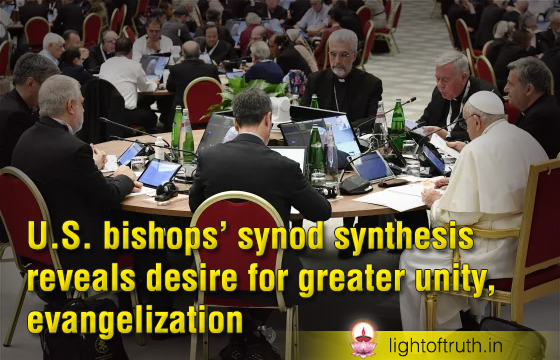
U.S. bishops’ synod synthesis reveals desire for greater unity, evangelization
A synthesis of feedback received from 35,000 U.S. Catholics as part of the ongoing Synod on Synodality reveals that amid political and theological polarization, many lay Catholics desire unity, both among themselves and among the clergy.
“This document reflects the sense that there exists among Catholics in the United States a deep desire to rebuild and strengthen our communion as the body of Christ,” Bishop Daniel Flores of Brownsville, Texas, chairman of the United States Conference of Catholic Bishops’ (USCCB) doctrine committee, wrote in the report’s introduction. “Rebuilding trust where it is frayed involves practicing the humanly graceful art of listening to each other and speaking together. The more we do this, the more we realize that it is the Lord who never fails us. He responds to us and knows well how to accomplish his will through the communion of his imperfect and often wounded servants.”
As synthesized in the May 28 report, many of the reports from the listening sessions expressed a wish for an “increased focus on formation for evangelization… a need for stronger catechesis and formation, focusing specifically on programs for evangelization, Catholic social teaching, and the role of the family.”
Also emphasized was the importance of clerical and lay Catholics working together. “It is important for laypeople to rely on their pastors and help their pastors, and it is important for pastors to rely on their laypeople.”
Participants noted that parishes with “numerous small faith communities, Bible studies, and prayer groups prove most successful in welcoming and integrating people from diverse backgrounds” in a manner “beyond superficial welcoming.” The role of Catholic schools in evangelizing the community was also widely recognized.
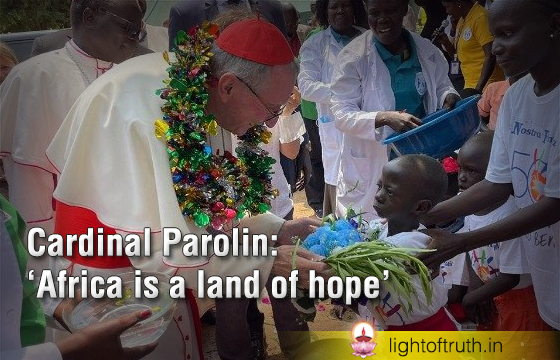
Cardinal Parolin: ‘Africa is a land of hope’
A “moment of joy,” reaffirming the need for our “personal” commitment. This is how Card. Pietro Parolin, Secretary of State, described to Vatican Media the Eucharistic celebration he presided over Monday afternoon, 27 May, in Rome’s Marian Basilica of Santa Maria Maggiore on the occasion of the 61st Africa Day.
In his homily, Card. Parolin cited the words about Africa from Benedict XVI and, before him, St.John Paul II in the post-synodal Apostolic Exhortation Ecclesia in Africa in 1995, highlighting the continent’s challenges, difficulties, and “contrasts” but also its aspects of hope.
“This celebration has a personal aspect for me because I feel close to Africa,” the Cardinal told to Vatican Media on the sidelines of the celebration, recalling, “I have been able to visit several countries over the years and have had contact with both the Church and governments and authorities.” “For me,” he shared, “it is a moment of joy to be here and share in the joy and prayer.”
“I believe,” added the Secretary of State, “that Africa must succeed on its own; it has the strength, it has the resources, it has wealth of all kinds, but it also needs sincere friends from the international community who work for the people, for peace, for reconciliation, and for development.” International community support, Card. Parolin emphasized, is necessary because the continent “finds itself in very difficult situations” amid many “very violent conflicts that cause much suffering to many people.” “Just think of the East of Congo,” he said.
While the Cardinal expressed his conviction “that there is a possibility to emerge,” he recognized that “the principle is always the same: the people and their well-being must be put first.” “If material interests are prioritized, then certainly people are sacrificed, and there is no chance for peace,” he said. “However, if there is justice, if there is access for everyone to even material wealth-and this is the task of both local authorities and the inter-national community,” he added, “then things can improve.”
From its part, Card. Parolin reassured, “The Holy See helps at the level of the African Church because we are one family, and also through the Nunciatures and through the direct interest that the Pope shows towards Africa.” “Where we can,” he insisted, “we try to lend a hand.”
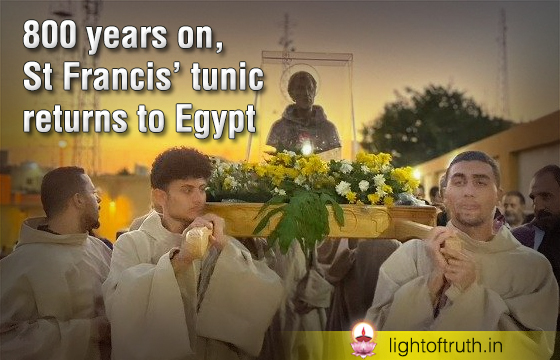
800 years on, St Francis’ tunic returns to Egypt
When Saint Francis made his renowned journey to Egypt in 1219, he was wearing the humble tunic which went on to become characteristic of his followers. Now, 800 years later, that tunic – or part of it – has made a return to the country. A piece of the garment – which counts as a second-class relic of the saint – arrived in Cairo on the 23rd May. It then made its way to Alexandria, and will also visit Minya, Assiut, Qena and Luxor before returning to Italy on the 2nd June.
The relic belongs to Francis-can friars from the Italian region of Tuscany, who are bringing it to various countries in celebration of the 800th anniversary of St. Francis’ stigmata.
Speaking to Vatican News, Anthony Amen, a youth representative for the Egyptian Francis-cans, said that the event aimed to “bring back the spirituality of Saint Francis.” He added that he hoped the encounter with the relics would inspire the Church in Egypt to “follow in St Francis’ steps.”
St.Francis’ visit to Egypt is now best remembered for his encounter with Sultan al-Kamel, who was at the time the ruler of Egypt. In the midst of the Crusades, the saint travelled behind enemy lines to meet with the Muslim leader, and remained with him for several days.
Amen said that the visit of the relic was “always a reminder for us to take the initiative to sustain dialogue between us and the other.” He said that relations between Christians and Muslims in Egypt had taken a “huge step forward” in the past ten years, during the leadership of President al-Sisi. And, he said, much progress had also been made just in the past couple of years precisely because of the 800th anniversary of Francis’ encounter with the Sultan.
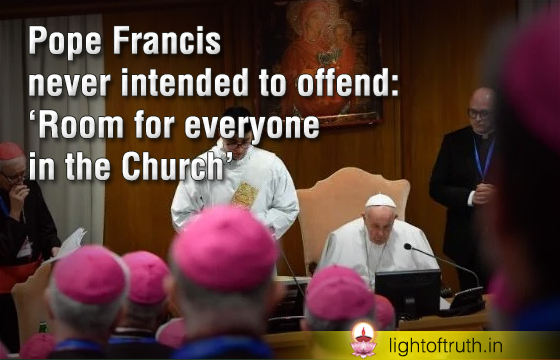
Pope Francis never intended to offend: ‘Room for everyone in the Church’
The Director of the Holy See Press Office, Matteo Bruni, has issued a clarification on May 28 regarding alleged statements made by Pope Francis during a private meeting with the Italian episcopate. The clarification comes in response to reports claiming that the Pope made a definitive «no» to homosexuals in seminaries and used derogatory language in the process.
“Pope Francis is aware of the recent articles regarding a closed-door conversation with the bishops of the CEI [Italian Bishops’ Conference]. As he has stated on many occasions, ‘There is room for everyone in the Church, for everyone! No one is useless; no one is superfluous; there is room for everyone. Just as we are, everyone.’ The Pope never intended to offend or express himself in homophobic terms, and he apologizes to those who felt offended by the use of a term, as reported by others.”
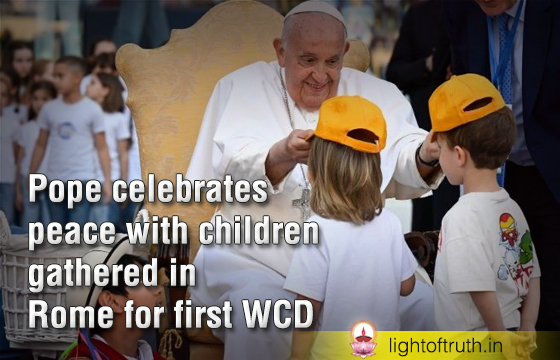
Pope celebrates peace with children gathered in Rome for first WCD
Some 50,000 children hailing from several countries around the globe gathered in Rome’s Olympic Stadium on May 25 to meet Pope Francis and reflect with him on their importance in the world’s future, as part of the first ever World Children’s Day (WCD). Peace was the main theme of the event.
The Pope addressed the young lively audience with a brief introductory speech in which he called for responses from the children. He opened his address by noting that in children “everything speaks of life and the future”, and by reaffirming that the Church, “as a mother”, welcomes them and accompanies them “with tenderness and hope.
He explained that he was inspired to convene the World Children’s Day by the meeting he held with children in the Vatican on November 7 on the theme “Let’s Learn from Boys and Girls.” “I realized that our conversation had to continue and extend to more children and young people,” he said.
The Pope then engaged in a series of questions with the children, starting from the many wars raging in several parts of the world. “Are you sad about the wars?”, “Is war a nice thing?”; “Is peace beautiful?” he asked, inviting the young audience to pray for children who suffer from wars, cannot go to school, are hungry, or neglected.