

Catholic activists have refuted a claim by a leading pro-Hindu party leader that large-scale religious conversions are taking place in an eastern Indian state known for its tribal population.
“I am one hundred percent sure that there has been no religious conversion from Hinduism or any other religions to Christianity,” said Ratan Tirkey, a former member of the tribal advisory committee of eastern Jharkhand state where indigenous people constitute more than 26 percent of the population. We are in touch with the local administration as rules stipulate a prior nod from it to change religion, he said. Hindu groups like the Vishwa Hindu Parishad (world assembly of Hindus) and the Rashtriya Swayamsevak Sangh (RSS), the parent party of the pro-Hindu Bharatiya Janata Party of Prime Minister Narendra Modi, have been accusing Christian missionaries of religious conversions among Jharkhand’s 33 million people. “It is just a claim, there is no truth in it,” said Tirkey, a tribal activist. Jharkhand, currently ruled by the Jharkhand Mukti Morcha, enacted a draconian anti-conversion law in 2017 and joined 11 other Indian states where the sweeping law is in full force. Tribal people, who follow their traditional worship practices, are grouped as Hindus under India’s census, a practice started by colonial British officials for practical administrative purposes. They make up nearly 9 percent of the South Asian nation’s mammoth 1.4 billion population. To prevent conversion among tribal people and the Dalits, the RSS runs a nationwide campaign called Ghar Wapsi (homecoming). While campaigning for polls in Jharkhand on May 22, Himanta Biswa Sarma, chief minister of north-eastern Assam state from Modi’s party, alleged massive conversion by Christian missionaries in Jharkhand. “Missionaries are blamed for interfering in the life of tribal people. But I would say because of missionaries’ tribal people are able to safeguard their culture,” the Christian leader said.
Daily Archives: May 31, 2024
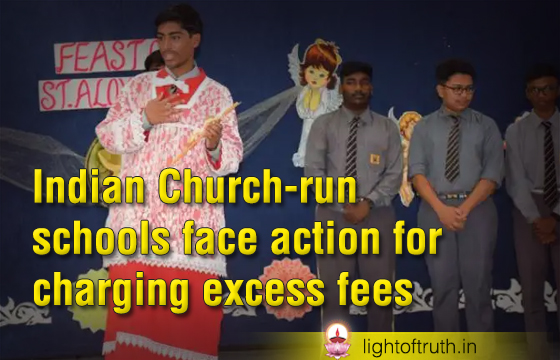
Indian Church-run schools face action for charging excess fees
Twenty persons, including principals of Church-run schools, have been arrested by police in a central Indian state for allegedly charging exorbitant fees to students, in what Christian leaders called a targeted action. The arrested are among the 51 persons connected to 11 private schools charged with flouting the Madhya Pradesh government’s guidelines on fees to be charged by private schools, said Aditya Pratap Singh, superintendent of police in Jabalpur district. According to Singh, the case has been registered against 11 private schools, three of them belonging to the Catholic Church and Church of North India. Five priests from Jabalpur diocese have been named but were not among those arrested on May 27. However, one of the priests was called for interrogation. The arrested persons have been remanded to judicial custody. “The police action is biased and targeted to damage the reputation of Christian schools,” said a priest from Jabalpur diocese who did not want to be named “Jabalpur district has 1,037 private schools that charge much higher fees than Church-run schools. But police found fault with only our schools that charge nominal fees,” the priest told Madhya Pradesh is ruled by the pro-Hindu Bharatiya Janta Party of Prime Minister Narendra Modi and has enacted a sweeping anti-conversion law. The state has witnessed increased harassment of Christians, including attacks on clergy, places of worship and educational institutions.
The collector, the top administrative official in the district, has asked the schools to refund the excess amount within 30 days or face administrative action. The district administration has also imposed a fine on schools. As per the law, an annual fee hike above 10 percent needs the collector’s nod and for a 15 percent hike, the sanction has to come from a state-level committee. However, a private school is free to hike fees up to 5 percent on its own. If the rise exceeds the 5 percent cap, the school must inform the district administration.

Church opposes Indian state diluting liquor laws
Indian Church bodies have opposed the communist-led government’s plan to boost the availability of liquor in IT parks to target youths in southern Kerala state. The Kerala government is planning to allow “unrestricted flow of liquor to benefit the liquor lobby at the cost of public health,” warned Father Antony Vadakkekara, spokesperson of Kerala-based Syro-Malabar Church. When the communist government of Chief Minister Pinarayi Vijayan came to power eight years ago it promised to reduce consumption of liquor. Now it is planning to dilute laws, alleged the Vincentian priest. The pro-posed changes to the liquor policy came to light after an audio clip of a bar owner went viral, hinting at the govern-ment’s alleged willingness to favour bar owners for a bribe to the tune of 200 million Indian rupees (US$24,06,082).
In the clip, he is heard saying that the government was ready to allow liquor shops to function on the first day of every month which is a dry day in the southern state. He further claim-ed the government was willing to allow liquor outlets to remain open after 11 p.m. and open more liquor outlets in IT parks across the state. Kerala, known for its highest literacy among India’s 28 provincial states, has nearly 90 well-known IT parks. Technopark, based in the state capital Thiruvananthapuram, employs around 72,000 professionals and houses a diverse mix of multinational corporations. In the central Ernakulam district, InfoPark employs over 63,600 staff. Kerala is the only Indian state where communists are in power.
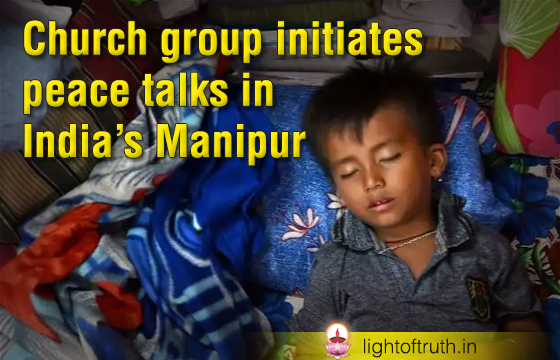
Church group initiates peace talks in India’s Manipur
Led by a Church group, warring tribal Christians and Hindus in India’s northeastern Manipur have met for the first time to end the one-year-old sectarian strife that claimed over 220 lives. “We had seven representatives each” from both the communities, said a Church official associated with the meeting held in the neighboring Assam state on May 17. Over a dozen influential leaders from the Meitei Hindu and Kuki-Zo Christian communities were party to the first-ever meeting held at Bosco Reach Out, a Salesian house, in Guwahati in Assam. Observers say the state administration, led by the pro-Hindu Bharatiya Janata Party of PM Narendra Modi, has failed to end the violence that started on May 3 last year.
“The leaders spent almost a day discussing ways to restore peace after the government failed to make any headway,” a Church official who attended the peace meeting told. He described the meeting as a “significant breakthrough” as the leaders of both sides agreed to reach out to their respective people “with a positive mind.” “Surely, their efforts will yield positive results,” said the Church official who did not want to be named.
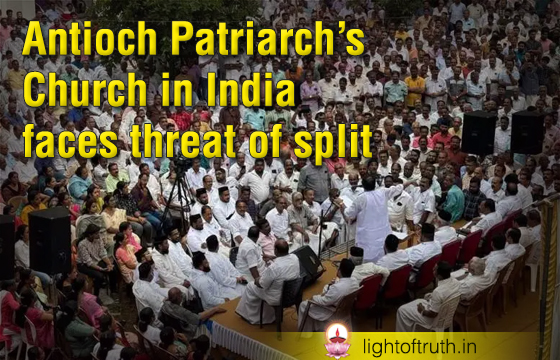
Antioch Patriarch’s Church in India faces threat of split
An India-based Church group under the Patriarch of Antioch, the Malankara Syrian Orthodox Church, faces the threat of a split after the patriarch suspended one of its archbishops for alleged disobedience. Christians in the Church’s archdiocese based in Kottayam district in southern Kerala state are divided after Patriarch of Antioch Ignatius Aprem-II suspended their Archbishop Severios Kuriakose, accused of defying the orders of the patriarch. The suspension order of May 17 has divided around 50,000 Christians of the Malankara Syrian Knanaya Archdiocese at Chingavanam in Kottayam district, according to T. O. Abraham, the archdiocesan Knanaya Association secretary. At a May 21 emergency meeting, the archdiocesan members declared the suspension of their Metro-politan illegal.
“The Patriarch has only spiritual powers and no power to deal with temporal matters, including dismissing our Metropolitan,” said Abraham, secretary of the supreme body that manages the archdiocese’s temporal matters. Some Church leaders told that Kuriakose’s consent to convene a special session of the Knanaya Association to amend their constitution, allegedly to curtail the patriarch’s powers, provoked the suspension.
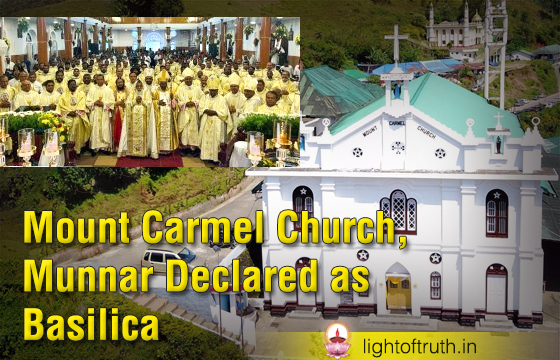
Mount Carmel Church, Munnar Declared as Basilica
Mount Carmel Church in Munnar was elevated to the status of Minor Basilica during the Eucharistic celebration held on Saturday 25 May 2024. The declaration was solemnly announced by Most Rev. Sebastian Thekethecheril, Bishop of Vijayapuram, marking a historic milestone, as the first basilica in the high ranges of Kerala in the Western Ghats. The formal decree of declaration, issued by the Dicastery for Divine Worship and the Discipline of the Sacraments, was read in Latin by Most Rev. Justin Madathiparambil, Auxiliary Bishop of Vijayapuram, with its translation into Malayalam presented by Msgr. Joseph Navaz, the Chancellor of the diocese.

Archbishop Thumma Bala Passes Away
Most Rev Thumma Bala, (80), Archbishop Emeritus of Hyderabad, passed away on Thursday, May 30, 2024, at Karuna Puram, in Warangal, due to old age ailments. He made a visit to his own sister at Karuna Puram and breathed last. He was the Archbishop of Hyderabad (2011–2020) and Bishop of Warangal (1987–2011). He was born on 24 April 1944, in Narimetta, Warangal Diocese. He was ordained priest on 21 December 1970.
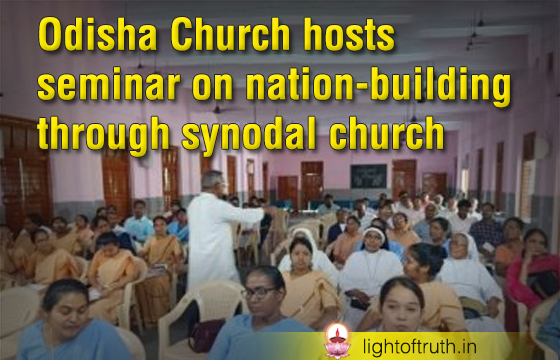
Odisha Church hosts seminar on nation-building through synodal church
A seminar on hope-filled nation-building from a synodal church perspective was held in Bhubaneswar capital of the eastern Indian state of Odisha. The May 18 event was organized by the Odisha Region Catholic Religious of India (CRI) in collabo-ration with church leaders and human rights activists. As many as 85 religious clergy, church leaders, advocates, and human rights activists from various dioceses attended. The seminar started with a keynote address by Sr Helen Saldana, the director of Streevani (the voice of women), Pune. She emphasized the significant role that faith communities can play in nation-building by shaping the moral and ethical framework of society. Sister Saldana’s address set the tone for the day’s discussions, highlighting the intersection of faith, ethics, and civic responsibility. The main resource per-sons for the seminar were Jesuit Fr Prakash Louis and civil and human rights activist Dhirendra Panda.

India plans peace steps in strife-torn northeast
The Indian government has drawn up a plan to bring peace to the volatile northeastern region housing the nation’s only three Christian-majority states after the mammoth national elections end early next month. “Peace in the northeastern states, including Manipur, and end of various conflicts, is a priority,” said an official with India’s internal security ministry. People in Myanmar’s Christian-majority Chin state have family relations with people in the Christian-dominated Indian state of Mizoram. India is planning to seal the Myanmar-India border and end the free movement of people. The Indian government has termed the ethnic violence in Manipur as part of narco-terrorism. However, tribal Christians have accused the pro-Hindu government of Prime Minister Narendra Modi of supporting Hindus. “The government is taking stock of the situation in Manipur and Mizoram,” the official told. “Ethnic clashes cannot be checked by force,” he admitted. On May 17, led by a Church group, warring tribal Christians and Hindus in Manipur met for the first time to end the one-year-old sectarian strife. Over a dozen influential leaders from the Meitei Hindu and Kuki Christian communities attended the first-ever meeting held at Bosco Reach Out, a Salesian house in Guwahati, Assam, the largest northeastern state bordering Bangladesh. According to a senior Mizo-ram government official, a fresh batch of 1,430 refugees from Myanmar have taken shelter in the state since May 17 after fighting between the army and armed rebels escalated in the military-ruled neighboring nation. The cash-starved Mizoram government has sought financial aid from the federal government to settle the migration crisis. In Mizoram, which shares borders between Bangladesh and Myanmar, Christians form close to 90% of the state’s 1.1 million people. Nagaland has witnessed many armed struggles over the years with demands for separation from India. The Naga rebellion reached its zenith in 1956 and the state has reported massacres throughout years of struggle. People in 6 districts of the Christian-majority Nagaland refused to vote in the ongoing national election to stress their demand for a separate state. Christians account for 87% of Nagaland’s 2.2 million people.

Catholic college rector in India says religions should collaborate on reconciliation
A Catholic college president in India spoke about the Buddhist Vesak holiday, which commemorates Gautama Buddha, saying he cherishes a hope “that our multi-cultural, interfaith encounters form communities of awareness and the different religious principles and teachings that should benefit all of humanity.”
This month, Vatican published the message “Christians and Buddhists: Working together for Peace through Reconciliation and Resilience” to mark the holiday, which takes place on May 24. “The noble teachings of our respective traditions, and the exemplary lives lived by those whom we revere, bear witness to the abundant benefits of recon-ciliation and resilience,” said Cardinal Miguel Ángel Ayuso Guixot, the prefect of the Vatican’s Dicastery for Interreligious Dialogue.
“When forgiveness is sought, and broken relationships healed, those who were estranged are reconciled and harmony is restored. Resilience empowers individuals and communities to recover from adversity and trauma,” he continued.
“It fosters courage and hope for a brighter future, since it transforms both victims and the perpetrators and leads to a new life. Reconciliation and resilience unite to form a potent synergy that heals past wounds, forges strong bonds, and makes it possible to meet life’s challenges with fortitude and optimism,” the cardinal added.