

In a pastoral letter from Vatican Arch-bishop Antony Kariyil CMI has asked all the priests and faithful to keep the status quo as regards the orientation of the Holy Mass from November 28 which the date to start to new mode of celebration of the Holy Mass as directed by the Synod, Using the provision of CCEO 1538 he is dispensing the archdiocese from the decision of the Synod on uniform celebration of the Holy Mass. On November 25 and 26 he had audiences with Pope Francis and the Prefect of the Congregation for Oriental churches respectively and had consultation with them. He is using the canonical provisions as directed by the church authorities. “In virtue of your office as Vicar of the Major Archbishop for the Archeparchy of Ernakulam-Angamaly, Your Grace can apply the faculty of dispensation for those cases, which; in your prudential judgment, would result in grave consequences with the entry into force on 28 November 2021 of the Synodal Decisions concerning the Holy Qurbana” Says the letter of the Prefect cardinal Leonardo Sandri of Oriental Congregation.
In 1990 the Syro-Malabar Synod had made a unanimous decision for a uniform celebration of the Holy Mass but could not put the decision into practise because of the opposition from the priests and faithful. At that time Abp Jacob Thoomkuzhy and Abp Varkey Vithayathil used the same provision to dispense with the decision. The law says the local Ordinary can judge “that a dispensation will contribute to the spiritual good of the Christian faithful who are subject to him according to the norm of the law, the eparchial bishop can dispense from both the common law and the particular laws of his own Church sui iuris in a special case…”. Msgr Antony Nariculam followed to assist the Archbishop. Bp Pauly Kannokadan has done the same thing in the diocese of Irinjalakuda.
Daily Archives: December 1, 2021
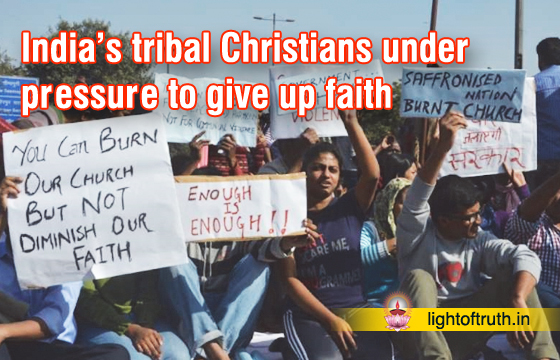
India’s tribal Christians under pressure to give up faith
Indigenous Christians in the central Indian state of Madhya Pradesh say they are under increasing pressure to give up their faith due to mounting pressure from Hindu activists.
“Our people are being forced to give up Christianity and join the Hindu religion,” said Patrick Ganava, a Catholic from the predominantly tribal Jhabua district. He said Hindu activists and organizations were conducting special drives in villages to pressurize Christians, which was a cause for worry.
“There is propaganda against Chri-stians in the district but come what may we will not give up our faith in Jesus,” he told on November 16. The anti-Christian campaign, coupled with police arrests of 10 Christians including six pastors on Nov. 10 for alleged religious conversion, has emboldened right-wing Hindu groups, Ganava said.
“It is unfortunate that we are being portrayed as people working only for converting people to Christianity,” said Father Rocky Shah, public relations officer of Jhabua Catholic Diocese.
The priest said he took the initiative and wrote in local newspapers explaining Christian worship and baptism, trying to clarify common misconceptions. “But nothing changed. The situation is such that our prayer services are being falsely depicted as religious conversion activity,” Father Shah told.
He recounted how a mob of over 1,000 tried to demolish a more than a century old grotto of Mother Mary on Nov. 10 in Thandla in their diocese, but the timely intervention of the police saved it. But the mob persisted with their demand for demolishing the grotto, alleging it was serving as a spot for conversion activities.
“Earlier, in September, they threatened to demolish churches that were built illegally at the district headquarters. They are now moving into the interiors. Timely intervention by the police saved us so far, but we are not sure what will happen tomorrow,” the priest said.
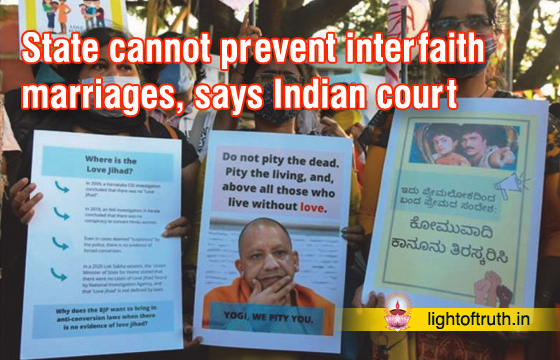
State cannot prevent interfaith marriages, says Indian court
Christians in India have welcomed a recent court order saying interfaith marriages need not wait for the nod from authorities as required under the new anti-conversion law in the northern state of Uttar Pradesh. Allahabad High Court directed that the marriages of 17 interfaith couples in the state be registered without insisting on or waiting for approval from the competent district authority with regard to the couples’ conversion of faith.
The court said the Uttar Pradesh Prohibition of Un-lawful Conversion of Religion Act, 2021, does not prohibit interfaith marriages, but indi-viduals marrying outside their religion “can be subjected to harassment” while dismissing the government’s contention that the couples had not got mandatory approval from the district authorities under the provisions of the law.
The Nov. 18 order, passed by Justice Suneet Kumar in a batch of petitions filed by interfaith couples who had entered wedlock after changing their religion, said that “freedom of religion and belief is a basic human right across civilized states, and the state cannot inquire into or take notice of a person’s religious or moral belief.”
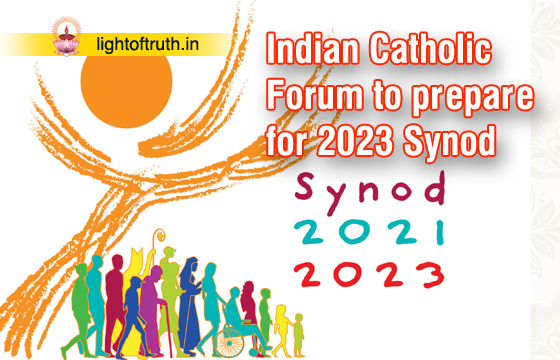
Indian Catholic Forum to prepare for 2023 Synod
The Indian Catholic Forum, a collective of Catho-lics in the country, plans to meet next year to seek the Church’s reform and renewal.
The February 5-6, 2022, program in Bengaluru, known as the Vatican of India, will stress sharing, praying, listening and dialoguing. The two-day deliberations would be recorded and synthesized, says a press note from the forum convener Kanpur-based chho-tebhai.
The meet on “Journeying Together – the Path Ahead” is expected to come up with a 10-page synthesis that would be sent to the Vatican by April 2022, it adds.
The program, the press note says, will have no chief guests, ceremonials or keynote speakers in the spirit of the Synod. “Jesus will be the chief guest and every participant will be a guest of honor,” the press note says.
Pope Francis has called the Synod during 2022-2023.
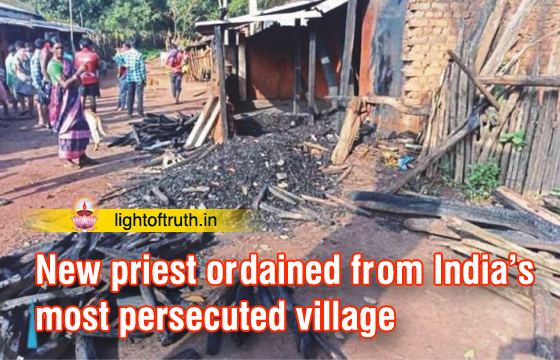
New priest ordained from India’s most persecuted village
Catholics in the eastern Indian state of Odisha are celebrating the ordination of a priest who was a victim of India’s worst anti-Christian violence. Fr Vikash Nayak, 29, who hails from Tiangia village in Kandhamal district, was ordained on November 6 by Archbishop Emeritus William D’Souza of Patna, the apostolic administrator of Buxar Diocese in the neighboring state of Bihar.
He visited his village on Nov. 13 and concelebrated his first Eucharist with local people amid much joy and happiness.
In 2008, Father Nayak’s village witnessed seven casua-lties including a Catholic priest, Father Bernard Digal, during violence that followed the murder of Hindu leader Swami Laxmanananda Saraswati, who was shot dead by Maoist rebels on Aug. 23, the day Janmashtami or the birth of Lord Krishna was being celebrated.
Local Christians including a 13-year-old boy were cornered by irate Hindu mobs, beaten and abandoned at the police station. Then a leader of Vishwa Hindu Parishad (VHP), or World Assembly of Hindus, made public their names and declared them accused in the killing of the Hindu leader.
The murder was declared as a “Christian conspiracy” and violence was unleashed against the minority community.
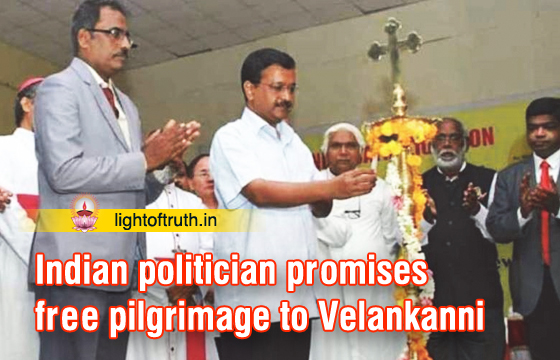
Indian politician promises free pilgrimage to Velankanni
Delhi Chief Minister Arvind Kejriwal has added Velankanni Church in the southern Indian state of Tamil Nadu to his govern-ment’s promised free pilgrimage scheme for senior citizens.
“We were getting requests from our Christian brothers and sisters to include some of their pilgrimage sites to the scheme, so we have decided to include Velankanni Church,” Kejriwal said at a virtual press conference on Nov. 24.
The provincial government of India’s national capital will be launching its free pilgrimage scheme on Dec. 3 with a group of 1,000 senior citizens boarding a train for Ayodhya in Uttar Pradesh, known as the birthplace of Hindu deity Ram. It has also announced free tours to other religious spots like Ajmer Sharif and Shirdi temple.
“India is a secular country where all religions, castes and creeds are respected. If Delhi government is implementing the scheme for other faiths, why not consider Christians too?” Father Savarimuthu Sankar, spokesperson of the Archdiocese of Delhi, told. He, however, cautioned Christians to “be careful about the promises made by politicians” as they may not always come true. “Several states in India are due for assembly elections early next year, hence political party leaders are busy trying to woo voters with such promises,” the priest said.
A.C. Michael, a national coordinator of the United Christian Forum, told that the scheme would benefit over 300,000 Christians, mostly Catholics, in Delhi.
“It will be good if he [Kejriwal] could include pilgrimage centers of other denomination churches too,” he added.
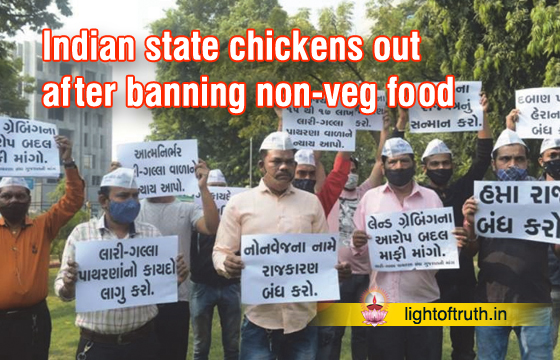
Indian state chickens out after banning non-veg food
The provincial government in the western Indian state of Gujarat was compelled to roll back a ban on serving non-vegetarian food by street vendors after the poultry industry mostly run by Hindus objected to it.
The municipal authorities of four major cities — Ahmedabad, Rajkot, Vadodara and Bhavnagar — had imposed the ban and started evicting street cart ven-dors and roadside stall operators citing “vegetarian sensibilities” of the majority Hindu and Jain religious communities.
The official orders stated that food containing meat, chicken and eggs should not be sold at public places within a 100-meter radius of religious places, gardens, public places, schools and colleges.
They cited complaints from local residents that the “foul smell” of non-vegetarian food was offending their religious sentiments and affecting children.
The authorities were forced to withdraw the order after criticism that it was biased against businesses of minorities, especially Muslims, serving non-vegetarian food. It was clarified that the rollback on Nov. 16 was effected considering the impact it had on the poultry industry at the peak of the winter season when demand for chicken and eggs is high.
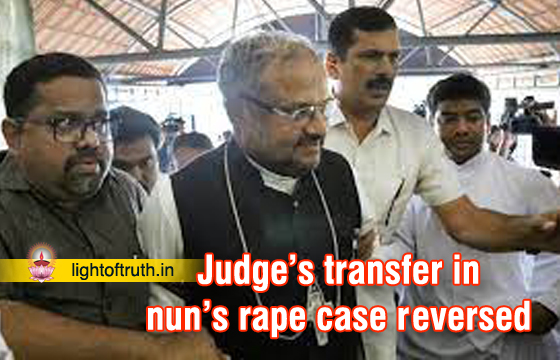
Judge’s transfer in nun’s rape case reversed
After rigorous public charges of foul play and sabotage, Kerala’s High Court in Kochi Nov. 20 overruled a move to transfer the trial judge from the high-profile case against a bishop in the alleged rapes of a nun.
Critics said the transfer of Judge G. Gopakumar, announced Nov. 12, would have stymied the completion of the three-year-old case against Bishop Franco Mulakkal of Jalandhar that oversees the accuser’s convent.
Gopakumar, who heads the district trial court in Kottayam, was the first to reject the bishop’s attempts to dismiss the case against him. Mulakkal’s subsequ-ent appeals to the appellate High Court and the Supreme Court in New Delhi were also denied. For months, trial proceedings have been closed to the public and news coverage is forbidden.
“The trial is in the final stage, and transfer of the judge at this stage is no doubt a body blow to the case. We are happy that the [state’s] top court has considered our demand,” Fr. Augustine Vattoly, said, calling the transfer timing abnormal. Vattoly, a priest in the Ernakulam-Angamaly Archdiocese, is a supporter of the survivor and five nuns who stay with her.
The Kerala government, with High Court approval, directed Gopakumar to take a new post in Thiruvananthapuram, the state capital, 90 miles south of Kottayam. The High Court’s weekend order requires that Gopakumar complete the trial before a transfer can take effect. The rape survivor and both her supporters and Mulakkal’s had urged the court to keep Gopakumar in place to finish the rape trial.
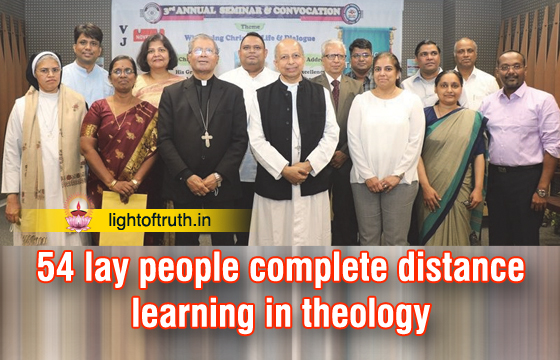
54 lay people complete distance learning in theology
The need for Christians to move from blind faith to mature living of Christ’s values in society was stressed at a function organized by Vidyajyoti theologate in Delhi. The annual convocation and seminar conducted Vidyajyoti’s Distance Education Program in Theology was attended by 54 lay people from Europe and Malaysia, besides India. They awarded certificates for completing the course, Among them 44 attended the November 21 program online.
Archbishop Anil Couto of Delhi, the chief guest, lauded Vidyajyoti for conducting the “meaningful program” to equip the laity. The archbishop, who was a student of Vidyajyoti, stressed the need to bear witness to Jesus in the pluralistic world, through faith, truth and love. He reiterated that the Christians learning theology is part of the baptismal process.

Jesuits get court nod to prove Father Swamy innocent
The Bombay High Court has permitted the Jesuits to initiate separate proceedings to clear Father Stan Swamy’s name from accusation in the Bhima Koregaon Elgar Parishad case.
The Jesuit Adivasi activist died July 5 under police custody at Holy Family hospital in Mumbai, western India. The National Investigation Agency arrested him October 8, 2020 from his residence near Ranchi, the capital of the eastern Indian state of Jharkhand.
Father Swamy was arrested the 16th civil liberties activist to be arrested under the Unlawful Activities Prevention Act for alleged anti-national activities.
The NIA accused 84-year-old Jesuit of being a member of banned Maoist group that conspired to overpower the Indian government.
On November 24, the bench comprising Justices Nitin Jamdar and Sarang Kotwal heard Jesuit Father Frazer Macarenhas’ interim application that sought to clear Father Swamy’s name from the allegations.
The plea from the former principal of Mumbai’s Saint Xavier’s College urged the court also urged the court to order a mandatory judicial inquiry under section 176 (1-A) of the Code of Criminal Procedure into his elderly confrere’s death, reported Live Law, a website that reports legal matters.