

Brett Levanto and his family had never said grace before meals, not regularly, anyway. But what began as a temporary challenge transformed them in small ways.
This year, his daughter decided to start saying grace before dinner during Lent, and he and his wife were encouraging, thinking it would be a nice thing to try out. He was surprised at the effects it had.
“It’s just been lovely. I really dig the way it creates a structure,” says Levanto, 38, who lives in Alexandria, Va., and works for a small lobbying and law firm. “Everyone has to get to the table and be together and not be distracted. We focus on where we are.”
The family sits, holds hands, and takes turns saying a free-form grace. They might say what they’re thankful for, or speak about a sick friend who is in their thoughts. The parents aren’t prescriptive about what a proper grace is supposed to sound like, he says. “If my son’s heart is telling him to thank God for mac and cheese, well, thank God for mac and cheese!”
They all say “amen,” and then dinner is off and running. Although the grace might take less than a minute, it sets a crucial tone. “It creates a grounding feeling — a moment of stillness,” he says. “I feel like our dinners at home are much better now — like, ‘Now we are together, and this is what we’re doing.’ I mean, I’m not going to say we have Rockwellian dinners or any-thing.”
Daily Archives: December 1, 2021
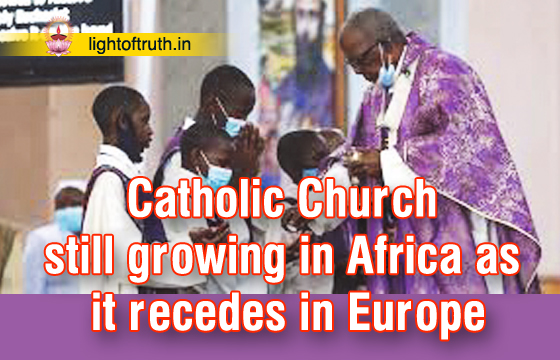
Catholic Church still growing in Africa as it recedes in Europe
According to recent statistics, Africa added more than 8 million Catholics in 2019, the largest area of growth in the world.
In comparison, America added 5.3 million, Asia added 1.9 million and Oceania 118,000. Europe, on the other hand, saw a decrease of almost 300,000 Catholics.
Kinga von Poschinger, who works at the pontifical charity Aid to the Church in Need, said there are many reasons for the growth of the Church in Africa. “The fact that this growth in faith in Africa has only increased in recent decades can be explained on the one hand by the fact that the Christian faith is only now arriving in many regions – there are still many areas where traditional African religions are practiced – and on the other hand by the fact that evangelization today is no longer aimed at mass baptisms and thus mass conversions, but at a real and true encounter with God that comes from the innermost part of the human being. And it is precisely this true encounter with God that makes people shine and be a light for the world,” she told Crux. “On the African continent, this high level of technology does not exist. More than technology, people there rely on nature and on people in their daily lives. It is primarily nature, that provides them with food – not the supermarket, and it is the human being who takes care of them when they are old, sick or suffering – not a machine. Like everywhere else in the world, people in Africa naturally ask for a “sign of God”, in their lives, for answers to their questions – especially in the face of so much hunger and suffering. But at the same time, they are much more open to seeing such signs in their daily lives. In other words, they engage in spiritual experiences, and see in them a proof of God’s existence. The more people have such genuine spiritual experiences, and the more deeply they are convinced of the existence of God, the more their attitude to life changes. This then not only has an influence on their private lives, but also convinces other people of the existence of God – usually without a lot of words.”

Pope: the Beatitudes, proclamation of a new humanity that revolutionizes the world
The Beatitudes “are the prophecy of a new humanity, of a new way of living: to make oneself small and entrust oneself to God, instead of emerging over others; to be meek, instead of trying to impose oneself; to practice mercy, instead of thinking only of oneself; to commit oneself to justice and peace, instead of nourishing, even with connivance, injustice and inequality”.
This Pope Francis- reflection at the Angelus on the day in which the Church marks the liturgical memory of ”All Saints” and in which the liturgy recalls the Beatitudes that “show us the path that leads to the Kingdom of God and to happiness: the path of humility, compassion, meekness, justice and peace”.
The Bishop’s Beatitudes
Blessed is the Bishop who participates in poverty and the sharing of his lifestyle, because by his testimony he is constructing the kingdom of heaven.
Blessed is the Bishop who is not afraid to mark his face with tears until they reflect the sorrows of his people and the difficulties of his priests, finding in embrace with those who suffer the consolation of God.
Blessed is the Bishop who considers his ministry a service and not a power, making meekness his strength, and giving everyone the right of citizenship in his heart to inhabit the land promised to the meek.
Blessed is the Bishop who does not close himself in government buildings, who does not become a bureaucrat more attentive to statistics than to faces, to procedure than to stories, who tries to fight at the side of men for the dream of the justice of God, so that the Lord, met in the silence of daily prayer, will be his nourishment.
Blessed is the Bishop who has a heart for the misery of the world, who is not afraid to get his hands dirty in the mud of the human soul to find the gold of God, who is not scandalized by others’ sin and fragility, because he is aware of his own misery, so that the gaze of the Risen Lord will be for him the seal of infinite pardon.
Blessed is the Bishop who drives away duplicity of the heart, who avoids any ambiguous dynamic, who dreams of good even in the midst of evil, so that he will be able to rejoice in the face of God, finding its reflection in every puddle of the city of men.
Blessed is the Bishop who works for peace, who accompanies the paths of reconciliation, who sows the seed of communion in the heart of the presbytery, who accompanies a divided society on the path of reconciliation, who takes every man and every woman of goodwill by the hand to build fraternity: God will recognize him as his son.
Blessed is the Bishop who is not afraid to go against the tide for the Gospel, making his face “resolute” like that of Christ on his way to Jerusalem, without letting himself be held back by misunderstandings and obstacles because he knows that the Kingdom of God advances in the contradiction of the world.

Escalating Attacks on Poland
Poland’s prime minister is calling on the North Atlantic Treaty Organization (NATO) to help stay the influx of tens of thousands of migrants gathering at Poland’s eastern frontier. Mateusz Morawiecki is also calling on Poland, along with Latvia and Lithuania, to consider invoking Article 4 of the NATO treaty over the deepening crisis on the eastern flank.
Under Article 4 of the NATO treaty, any ally can request consultations “whenever, in the opinion of any of them, their territorial integrity, political independence or security of any of the parties is threatened.”
“It is not enough just for us to publicly express our concern. Now we need concrete steps and the commitment of the entire alliance,” the Polish leader said over the weekend.
Morawiecki pointed out that Poland is protecting the whole EU, not only itself. He added it was clear that the whole bloc should contribute to the funding of an eastern border wall. Morawiecki’s call is triggered by ever-increasing numbers of mostly Middle Eastern and African migrants attempting to gain illegal entry into Poland at various points of its border with Belarus — with the assistance of Belarusian authorities.
Aerial footage provided by the Polish Ministry of Defense shows outnumbered Polish troops at junctures defending the border and illegal immigrants heading from Belarus towards the border accompanied by Belarusian officers. TV crews, including Russian ones, are in tow.
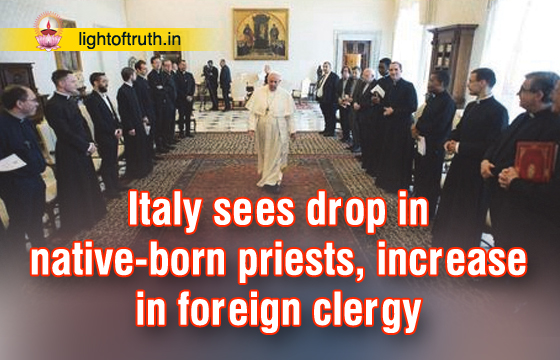
Italy sees drop in native-born priests, increase in foreign clergy
New data released by the Italian church highlights what has been a concerning trend among Catholic leaders in the country for decades: namely, a drop in the number of local priests and an increase in the average age of Italy’s clerics.
However, this data also found that while there are less men joining the priesthood in Italy, the decrease in local vocations has to an extent been offset by a significant increase in foreign priests serving in Italian dioceses.
According to data provided by the Italian bishops’ National Office for the Pastoral Care of Vocations, there has been a 16.5 percent drop in the number of priests in Italy since 1990, with 10%of this drop taking place in just the past decade.
As of 1990, there were a total of 38,209 priests in Italy, which decreased to 36,350 in 2000, and dropped again to 31,793 last year.
Of these 31,793 priests, around 8.3% are foreigners, which is a jump from 6.6% in 2000, and from just 3.4% in 1990.
Last year’s data indicates that the number of foreign priests serving in Italy has increased more than 10x in the past 30 years, jumping from just 204 in 1990, to 2,631 in 2020.
Priests aged under 30 are decreasing, with just 599 recorded in Italy in last year, marking a 60 percent drop since 2000, when there were some 1,708 priests under 30.
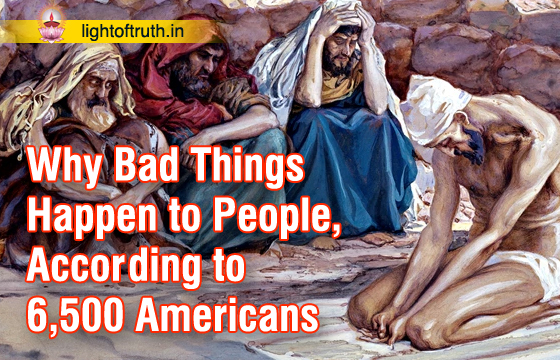
Why Bad Things Happen to People, According to 6,500 Americans
“Job and His Three Friends,” by 19th-century French painter Jacques Joseph (James) Tissot.
Long before Rabbi Harold Kushner’s When Bad Things Happen to Good People got Americans talking about theodicy in the 1980s, these famous thinkers wrestled with explaining why an all-loving, all-knowing, and all-powerful God would allow suffering.
Amid the pandemic and its 5.2 million reported deaths, the Pew Research Centre surveyed 6,485 American adults—including 1,421 evangelicals—in September 2021 about how they philosophically “make sense of suffering and bad things happening to people.” The most common explanation: It happens.
“Americans largely blame random chance—along with people’s own actions and the way society is structured—for human suffering, while relatively few believers blame God or voice doubts about the existence of God for this reason,” concluded Pew researchers in a new study released today.
Yet many Americans do see purpose in pain, as researchers noted: The vast majority of U.S. adults ascribe suffering at least partly to random chance, saying that the phrase “sometimes bad things just happen” describes their views either very well (44%) or somewhat well (42%). Yet it is also quite common for Americans to feel that suffering does not happen in vain. More than half of U.S. adults (61%) think that suffering exists “to provide an opportunity for people to come out stronger.” And, in a separate set of questions about various religious or spiritual beliefs, two-thirds of Americans (68%) say that “everything in life happens for a reason.”