
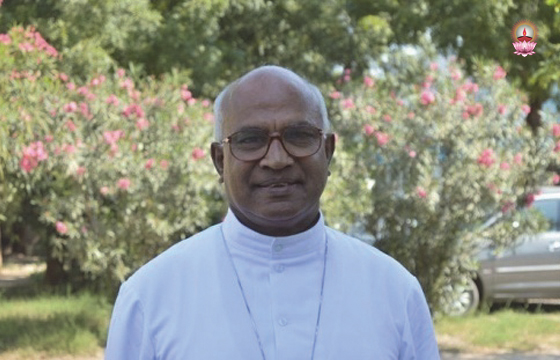
A Catholic priest, who recently assaulted his bishop, has been sus-pended, according to a letter from the victim prelate. In a letter to Father Varghese Palappallil, Bishop Pius Thomas D’Souza of Ajmer cited the second section of Canon law 1370 to inform his priest assaulter that his action has incurred “Latae Sententiae Interdict and suspension” from all priestly duties and priestly ministry.
Father Varghese Peter Palappallil has denied that he has assaulted his superior, Bishop Pius Thomas D’Souza of Ajmer, and accused the vicar general of spreading “baseless and motivated lies” and “imaginary stories.”
Daily Archives: March 19, 2021
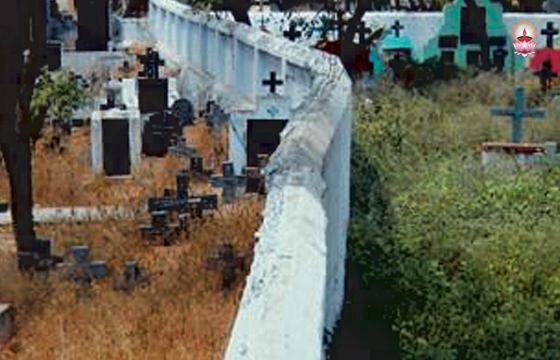
Dalit Christians demand separate Catholic rite
The demand for a separate Rite for Dalit Catholics is gaining momentum with many supporting it as a solution to caste-based discrimination in the Indian Church.
“If this can bring about much needed respect for the Dalit Catholics and wipe out that invisible line of casteism, I am for it. In fact, I will join the movement wholeheartedly and help in attaining the status being demanded,” says AC Michael, a former member of the Delhi Minorities Commission.
Michael shared his thoughts with Matters India March 11, a day after the National Council of Dalit Christians (NCDC) urged Pope Francis to create a Catholic Rite like the Kerala-based Syro-Malabar and Syro-Malankara Churches.
A press release from NCDC coordinator Franklin Caesar Thomas says, “We urge the Pope to recognize the Dalit Catholic Rite like Syro-Malabar and Syro-Malankara Rites with all divine rights and property. According to Thomas, who is also a Supreme Court lawyer, the Rites in the Catholic Church are based on orientation and rituals.
Thomas also points out that Christianity does not have one cultural expression. “It also reflects different faces of the cultures and peoples that received the faith and allowed to take roots “with unwavering fidelity to the Gospel and the Church’s tradition.” If the Pope approves a new separate Dalit Catholic rite, he says it would show to the world that each group of people can pray to the God of Jesus Christ from their cultural riches and expressions without altering the unity of the Catholic faith.”
The new rite will adopt the character and traditions of various Dalit Catholic communities, the NCDC leader asserted.
Dalit Catholics in India are currently spread over Latin, Syro-Malabar and Syro-Malankara Churches in the Catholic fold.
The Catholic Church is comprised of six different liturgical rites, and within them exist 24 particular Churches. These sui iuris (autonomous or self-governing) Churches are all in communion with one another in the Catholic Church and recognize the primacy of the pope.
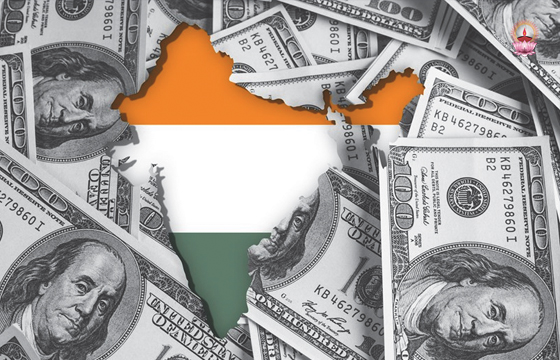
Indian Government Regulation Squeezes Christian Charities
For Christians trying to care for the poor in India, there is always a need for more prayer, more hands, and more money. Much of that money comes from donors in other countries. Recently, though, Prime Minister Narendra Modi’s government has tightened regulations on foreign funding to nonprofits, including Christian groups that feed or-phans, run hospitals, and educate children.
Since Modi took office in 2014, the Indian government has revoked permission for more than 16,000 nongovernmental organizations to receive foreign funding, using the Foreign Contribution Regulation Act (FCRA).
“It is deliberately an assault against the nonprofit sector,” said Vijayesh Lal, the general secretary of the Evangelical Fellow-ship of India, “and that includes the churches.”
In one recent round of revocations, six nonprofits lost the license allowing them to receive money from abroad. Four of those were Christ-ian organizations. A search of the FCRA website reveals more than 450 revocations from 2011-2019 of groups with the word church in their name alone.
While the FCRA is not designed specifically to target Christian groups, experts say its cumbersome regulations have been used by the ruling parties in India to stifle political and religious dissidents since the law’s adoption in 1976.
“It has always been used as a tool,” Lal said. “The thought behind it is very clear. They don’t want to encourage dissent. They don’t want to encourage empowerment.”
The law was first passed in a period of Indian history called “the Emergency.”
“It’s going to be very difficult,” said David Babu, the founder of Sunshine Ministries in Hyderabad. “What can you do with 20 percent?”
Sunshine provides schooling and housing to about 240 students. Eighty percent go on to receive more education after graduating, many of them becoming teachers, police officers, and health care workers.
“These are the kids that are the leaders of tomorrow,” Babu said, “and we believe that when they plant the seed of equality and oneness, things will change.”
Sunshine has 20 staff members, and its main expenditures are salaries and the costs of maintaining buildings and property. The ministry has not yet deter-mined how it can cut administrative costs to maintain its FCRA license.

Kolkata priest joins BJP, Bengal Christians shocked
Father Rodney Borneo, a popular priest of Calcutta arch-diocese, on March 9 joined the Bharatiya Janata Party that heads the federal coalition government, according to a video clip circula-ting in social media platforms.
The video shows Father Borneo coming to a stage where he is given the BJP flag and asked to chant, “Bharat Mata ki jai” (victory to mother India).
The news of a Catholic priest joining the BJP, the political arm of the Hindu nationalists, has sent shock waves among Catholics in West Bengal. The eastern Indian state is all set to elect its legislative assembly through an eight-phased poll starting March 27.
Given below is the reflection of Father Francis Sunil Rosario, a senior priest of the archdiocese of Calcutta, on Father Borneo’s decision.
A competent priest is lost to Calcutta archdiocese
Who should be blamed for the loss of a very competent and promising priest, for whom thirty pieces of silver was more preferable, than to stick to priesthood.
Rodney trained in psychology and counseling, who was a gold medalist in 2016 from Guwahati University, was unable to cope with the pressures and some of the inconveniences created for him to function as the principal of Loyola School, Kidderpore. This is certainly not an isolated case in the ministerial priesthood. There could be others who try hard to survive despite many hardships, inaction and such administrative ‘silence’ and pressures. It could be taken as a case study to understand the issue at a deeper level and thus helping the younger clergy through supervision, counseling and guidance.
Five Christians get bail a month after arrest for conversion in India
Madhya Pradesh High Court in central India has granted bail to five of nine Christians arrest-ed a month ago on charges of violating a law that criminalizes religious conversions.
The court on Feb. 4 granted bail after state police failed to substantiate the charges filed against the five.
“The other four in jail are also expected to get bail this week as they have moved the High Court against a trial court that denied them bail,” said Pastor Patras Savil, who is helping those arrested to secure their legal rights.
Police in Indore city on Jan. 26 charged 11 Christians with violating Madhya Pradesh’s stringent anti-conversion law following complaints from right-wing Hindu activists. They could arrest only nine as two were reported to have absconded.
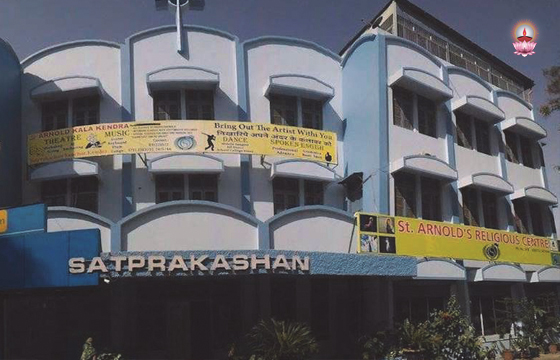
The Hindu activists forced their way into a Protestant prayer service inside Satprakashan Sanchar Kendra, a Catholic media center owned and managed by the Society of Divine Word.
When police arrived, the Hindu activists complained that the Christians were involved in mass religious conversion in violation of the law implemented in January that criminalizes religious conversion through allurement, force, coercion and marriage.
“We are very happy that five got bail. They were falsely implicated in the case and put behind bars for more than a month,” Father Babu Joseph, director of the media center, told.
Commission rejects Indian Christians’ plea to change poll date
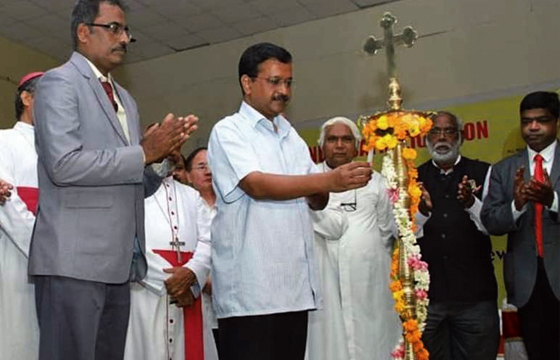
The Election Commission of India has turned down a request to change the election date in West Bengal and Assam from Maundy Thursday. The All India Catholic Union (AICU), the largest laity movement in Asia, submitted a petition asking the commission to reconsider holding polls on April 1, the day before Good Friday, in the eastern and northeastern states. Chandra Bhushan Kumar, deputy election commissioner, rejected the petition on March 1.
Myanmar priest follows nun’s peacemaker act
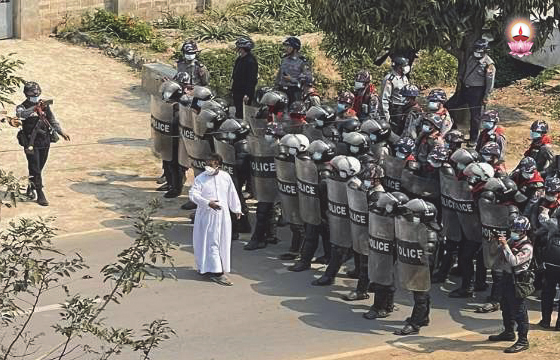
A day after a Kachin nun’s brave act in confronting security forces, a Catholic priest played a mediator role in a Catholic stronghold in northeastern Myanmar.
Wearing a white robe, Father Celso Ba Shwe, apostolic administrator of Loikaw Diocese, walked in front of dozens of security personnel who stood ready to crack down on anti-coup protesters in Loikaw, capital of Kayah state, on March 9.
As police ordered protesters to disperse via a loudspeaker, the priest pleaded with them not to harm unarmed civilians.
“Please, I plead with you not to give harm,” he told one police officer.
The priest’s request, however, was ignored by security personnel and they started to disperse the protesters with rubber bullets and tear gas, causing several injuries.
Father Ba Shwe’s mediation followed the inspiring example of Sister Ann Rose Nu Tawng from Myitkyina, Kachin state, who knelt on the road and begged security forces not to shoot the protesters on Feb. 28 and March 8.
The priest took the role of apostolic administrator of Loikaw on Dec. 21 following Bishop Stephen Tjephe’s death on Dec. 16.
Local Catholics have praised the priest’s brave act and condemned the security forces who ignored his plea.
“I’m proud of being a Catholic as we have priests and nuns who are brave to stand up for the people,” one posted on Facebook.
“Like the priest’s brave act, I wanted to see a cardinal and bishops carrying out the same move in their respective dioceses,” said another comment.
Priests, nuns and seminarians in Loikaw have expressed their solidarity with the people of Myanmar since anti-coup protesters took to the streets nationwide following the Feb. 1 coup. They also rallied to pray for peace in the country by reciting the rosary in early February.
Kayah state is regarded as a stronghold of Catholicism in the Buddhist-majority country and ethnic groups such as the Kayah, Kayan and Kayaw reside in the remote, underdeveloped and mountainous region. About 90,000 Catholics live in a state with a population of 355,000.
Anti-coup protests have continued from urban areas to remote regions including Christian strongholds despite crackdowns bypolice and soldiers.
The military’s brutal approach in recent days has drawn strong condemnation from the United Nations and Western countries including the US and Britain.
On March 9, the 15-member UN Security Council failed to agree on a statement that would have condemned the coup, called for restraint by the military and threatened to consider further measures, according to media reports.
Philippine Jesuit schools call for end to Myanmar violence
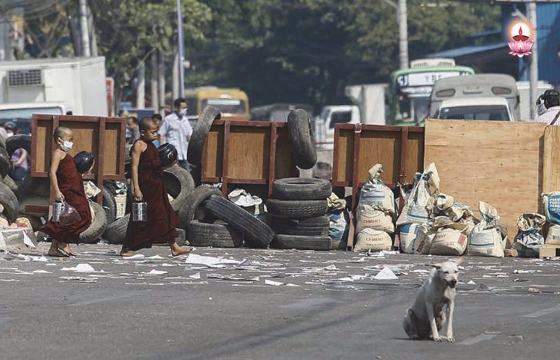
Five Jesuit-run universities in the Philippines have issued a joint statement condemning an ongoing deadly crackdown on street protests against Myanmar’s military coup that has claimed at least 70 lives, according to the United Nations. The military takeover on Feb. 1 and the subsequent repression of pro-democracy protesters was illegal and a gross violation of human rights, the March 10 statement called “One with Myanmar, In the Name of Human Fraternity” said.
The statement was signed by the presidents of Ateneo de Naga University, Ateneo de Manila University, Xavier University — Ateneo de Cagayan, Ateneo de Davao University and Ateneo de Zamboanga University.
Myanmar’s military seized control of the country following a national election in which State Counselor Aung San Suu Ky’s National League for Democracy won easily. The military said the election was flawed, a claim dismissed by the country’s election commission. The coup triggered street protests which the military has sought to crush.
At least 70 people have been killed, according to the UN special rapporteur for Myanmar, Thomas Andrews, who said there was also mounting evidence of crimes against humanity.
“To our brothers and sisters in Myanmar, we are at your side, united in the defense of your freedom. As one family in the Southeast Asia, we are with you in your noble gift to win democracy back,” said the Jesuit-run schools in their statement.
They said that although Asian countries are diverse in culture and history, each nation is called to a spirit of solidarity.
Catholic nun saves young demonstrators: Cardinal Bo wants the country to be “transformed”
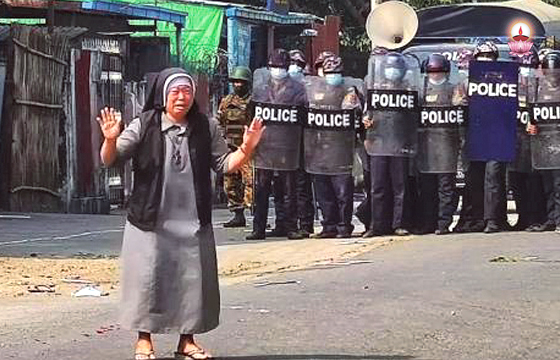
A Catholic religious woman took to the streets in the city of a, the capital of Kachin State in the north of Mynamar, and ask-ed the security forces not to shoot young demonstrators
who are protesting peacefully. Sister Ann Nu Thawng of the Congregation of St Francis Xavier in the diocese of Myitkyina, became the heroine of yesterday, February 28th, which was marked by harsh repression of the Burmese police, who, according to the United Nations, opened fire, killing 18 people and injuring more than 30 nationwide.
“In the Myitkyina area, demonstrations so far have always been peaceful and without incidents. However, yesterday epi-sodes of violence risked precipitating the situation,” said Ca-tholic Joseph Kung Za Hmung, editor of the “Gloria News Journal,” the first Catholic online newspaper in Myanmar. “The action of the nun and the response of the police who, upon seeing the nun’s plea, stopped, surprised many of us. Sister Ann Nu Thawng is today a role model for Church leaders: bishops and priests are called to step out of the their comfort zones and follow her courage as an example.” Many non-Catholics also praised Sister Thawng’s brave efforts, whose entry went viral on social media. “More than 100 demonstrators were able to find shelter in her monastery. It saved them from brutal beatings and arrests by the police,” says the Director.
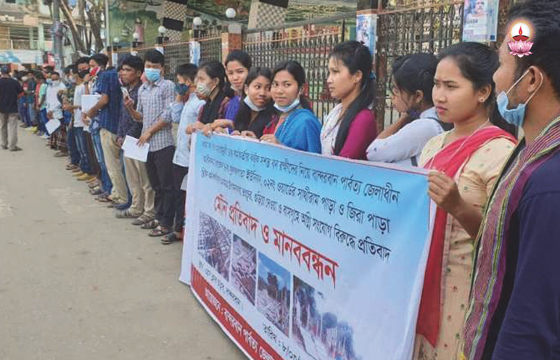
Christians protest after church demolition in Bangladesh
Christians in Bangladesh claim they are being per-secuted after the demolition of a new church building in the remote Chittagong Hill Tracts region.
About 200 Catholics and Protestants formed a human chain and held a silent protest on March 8 against the demolition of the Seventh-day Adventist Church building. A group of about 10 persons including forest officials demolished the under-construction church building in Sathiram Tripura village of Bandarban district on Feb. 25.