
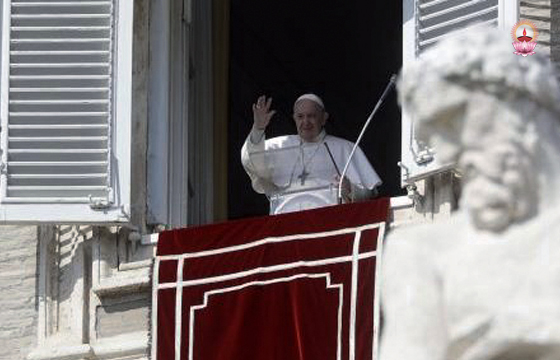
In a candid 2019 interview published Saturday, Pope Francis reveals that he sees himself “dying as pope,” either in active duty or in retirement, and in Rome, because, he said, “I am not going back to Argentina.”
In the interview, published by Argentina’s paper of record, La Nacion, Pope Francis acknowledges that he does think about death, but says he is not afraid of it “at all.”
In context, the pope’s reference to not going back to Argentina appears to mean he won’t return for the end of his life, as many had speculated. However, given his reluctance to make a homecoming trip since his election in 2013, it could be that Francis meant he’s never going back at all.
The fact that Francis didn’t stop in Argentina in 2013, on his way to or from Brazil for World Youth Day, has led to speculation ever since about why the pontiff doesn’t want to go home, and, according to some opinion polls, a loss of support among his fellow Argentines who see the pope’s reluctance as a political choice.
For the past eight years, Francis has crisscrossed Latin America. Beyond the Guianas, the only nations in South America the first pope from the Global South hasn’t yet visited are Uruguay, Venezuela, and, of course, his own country, the land of Evita, Maradona and Che.
Daily Archives: March 19, 2021
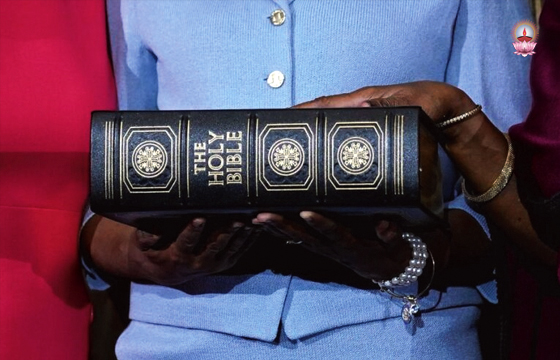
Bible reading boosts mental well-being among Christians, UK survey says
Reading the Bible has had a positive effect on people’s “mental well-being” during the pandemic, according to a Christian Research survey conducted in the United Kingdom. The survey also found that respondents were reading the Bible more and turning to Bible-related videos more during the pandemic.
The survey, carried out on behalf of the Bible Society, posed a number of questions to 1,000 people in the United Kingdom who identified themselves as Christians and who had attended church at least once a month before restrictions aimed at curbing the pandemic. The questions were asked in December, and the results were published online by the Bible Society March 1.
42% of respondents reported that reading the Bible increased a “sense of hope in God during the crisis, rising to nearly half (49%) among 45- to 54-year-olds,” the report by the Bible Society said. “Some 28% said that reading the Bible had increased their confidence in the future,” while 63% said they felt their level of confidence remained the same, rather than dropping, it said.
It said 23% of those surveyed said the Bible “had increased their mental well-being, including 47% of 24- to 34-year-olds,” and 33% of 16- to 24-year-olds reported that reading the Bible had helped them “feel less lonely.” The report said 35% of survey respondents were reading the Bible more during the pandemic with the biggest increase among 25- to 34-year-olds in which “53% were reading the Bible more often.”
“A quarter of those asked, said that they were reading the Bible ‘multiple times a day’ and half said that they were reading the Bible on a daily basis,” the Bible Society said.
It also found that 25% of the 25- to 34-year-olds in the survey said they had begun reading the Bible during the pandemic.
While many continue to turn to print editions of the Bible, 23% reported using “a Bible-reading app, 30% are now listening to the Bible” and 59% of those surveyed said that “they now watched more Bible-related videos or had started watching them.”
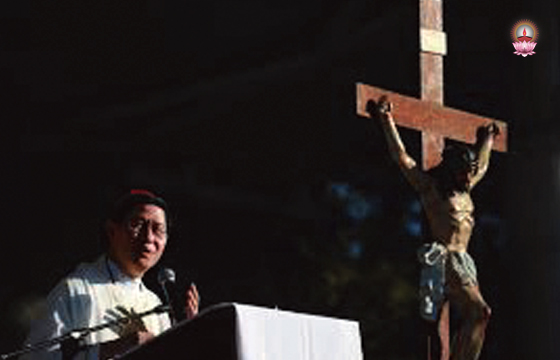
Vatican official concerned by populist leaders ‘hijacking’ religion
Cardinal Luis Antonio Tagle, head of the Vatican’s evangelization congregation, has expressed concern over the “hijacking” of religion by populist leaders who sow division and exploit the anger of those who feel excluded.
Speaking after he delivered the 2021 Trócaire/St Patrick’s College Maynooth annual Lenten lecture March 9 on “Caring for the Human Family and our Common Home,” the Filipino prelate warned, “There is a grow-ing sense in the world today of divisiveness, and unfortunately religion is being used to further division; sometimes even within the same religious affiliation you have divisions.” Referring to the recent rise of populist leaders, Tagle described the phenomenon as “the return of the powerful big-boss-type of people,” some of whom “hijack religion.”
These so-called populist leaders know where the pockets of disgruntled people are, and they present themselves as messiahs, he said. They use religion as a “convenient way” of getting followers, he added.
The president of Caritas Internationalis noted that in the encyclical “Fratelli Tutti,” Pope Francis devoted several paragraphs to the matter of populist leaders who claim that they are defending the people, when in fact they are defending a certain group.
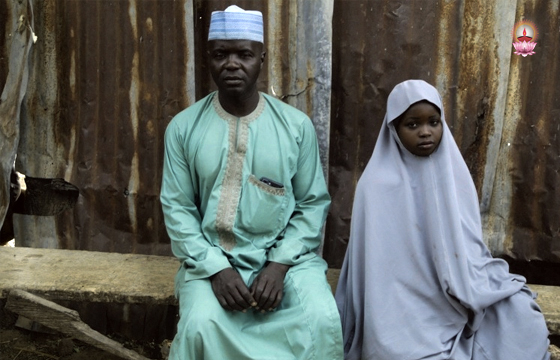
More Nigerian Schoolgirls Kidnapped while a Christian Pastor Pleads for His Life
In the early morning hours of Friday, February 26, CNN reported that hundreds of female students had been kidnapped overnight from their boarding school in Nigeria. “They came on about 20 motorcycles and they marched the abducted girls into the forest,” a source told CNN. “The bandits arrived around 1:45 a.m. and they operated ‘til about 3 a.m.”
This outrageous assault took place less than a week following the 3-year anniversary of the abduction of well-known Nigerian kidnapping victim, Leah Sharibu. In a similar invasion, on February 19, 2018, Leah’s school had been attacked, and she and her classmates were abducted by Boko Haram terrorists.
Boko Haram’s kidnapping of Leah Sharibu and her classmates horrifically demonstrated Boko Haram’s radical Islamist agenda. Her classmates, who were released, were Muslim girls. She, alo-ne, refused to deny her Christian faith and has remained enslaved for three years. Leah has reportedly given birth to the child of one of her captors.
Meanwhile, in a related and tragic story of religiously-based kidnapping, on February 25, Christian Pastor Bulus Yakuru, who was seized during a Christmas Eve attack, stated he will be executed within a week if President Muhammadu Buhari does not meet Boko Haram’s demands for his release. In a new video, Pastor Yakuru identified himself and pleaded with Nige-ria’s president, the Borno State governor, and the Christian Association of Nigeria (CAN), the umbrella body of Christians in the country, to intervene and secure his release.
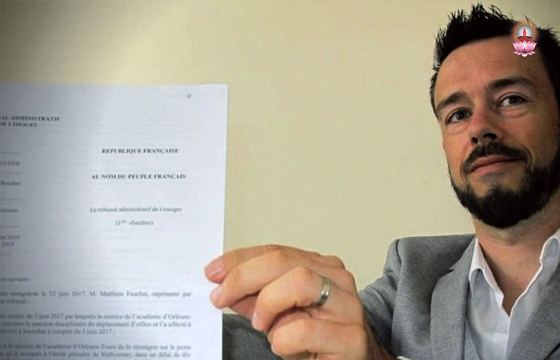
French Court Vindicates Christian History in School
A French public school teacher has been cleared of sanctions for teaching about Christianity.
Matthieu Faucher, an atheist, faced a years-long legal battle after being accused of violating France’s official ”neutrality and secularism” standard by teaching about Christian history.
After school authorities received an anonymous complaint of proselytism, Faucher was suspended — despite parents’ protests. His superiors validated the sanction, and in June 2017, he was assigned to a different school.
Faucher denied failing “in his duty to neutrality and secularism,” and he won a suit against school authorities in a local court. The Ministry of National Edu-cation challenged the court’s decision, which was subsequently validated by an administrative court in Bordeaux on Dec. 22.
While he was happy about the Bordeaux court’s decision, Faucher said that “much bigger things are at play,” including the teaching of the history of religion by secular teachers.
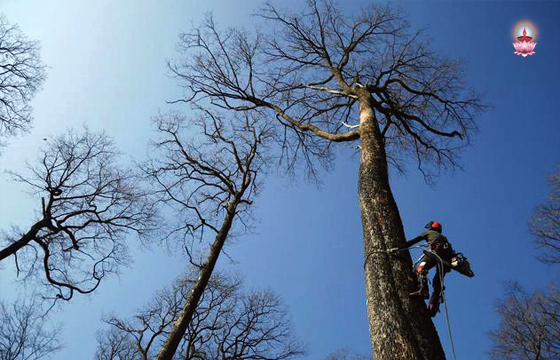
Four oaks, one sacred destiny: Recreating Notre Dame’s spire
Four French oaks that have been standing for hundreds of years in a once-royal forest now have a sacred destiny. Felled Tuesday in the Loire region’s Forest of Berce, they have been selected to reconstruct Notre Dame cathedral’s fallen spire. The 93-metre-high spire, made of wood and clad in lead, became the most potent symbol of the April 2019 blaze when it was seen engulfed in flames, collapsing dramatically into the inferno. Last July amid a public outcry, French President Emmanuel Macron ended speculation that the 19th century peak designed by Eugène Viollet-le-Duc could be rebuilt in a modern style.
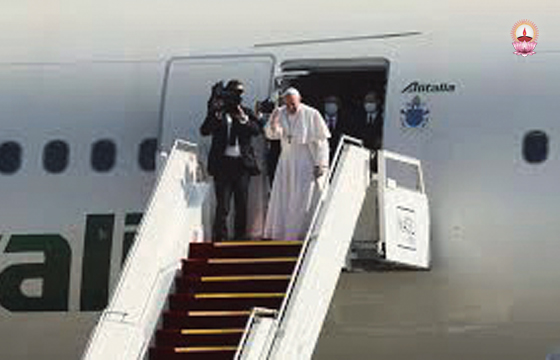
Pope says he’s not afraid of being called ‘heretic’ for outreach to Islam
In his latest in-flight news conference, Pope Francis said Monday he’s not afraid to be called a ‘heretic’ for engaging in dialogue with Muslims; that he felt “imprisoned” during Covid-19 lockdowns; he was “shocked” by the destruction he witnessed in the Iraqi city of Mosul Sunday; and, on inter-national Women’s Day, expressed regret over the exploitation of women, including the practice of genital mutilation.
“Women are more courageous than men, this is true,” he said. “Today, women are humiliated. A woman on the plane [Spanish journalist Eva Fernandez, from Spain’s Radio Cope] made me see the list of prices for women [slaves]” under ISIS.
“I couldn’t believe it. Women are sold. They are enslaved. Also in downtown Rome, the work against trafficking is daily,” the pope said.
Francis also mentioned that there are countries, “primarily in Africa,” that still practice genital “mutilation, mutilation as a rite that needs to be done. But women are still slaves and this is something we have to fight against.”
Women, he continued, are the ones “carrying history,” and this Francis said, is “not an exaggeration. Women carry history forward.”
Human fraternity, the term often used by Francis to describe the aim of interreligious dialogue, is important because men and women are all siblings, the pope said, adding, “We need to move forward with other religions too.”
Francis defined his Saturday meeting with Grand Ayatollah Ali al-Sistani, the highest-ranking Shiite leader of Iraq, as a “second step” in this path towards fraternity after signing a joint declaration with Grand Imam Ahmed el-Tayeb of Al-Azhar, a leading point of reference in Sunni Islam, in 2019.
Without prompting, the pontiff acknow-ledged that when it comes to interreligious dialogue and fostering human fraternity, he takes “risks” because this is “necessary.”
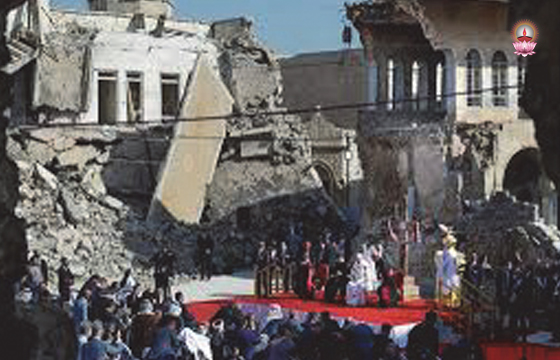
At Mosul Church, Pope Asks Iraq’s Christians to Forgive ISIS and Rebuild
Pope Francis urged Iraq’s Christians this past Sunday to forgive the injustices against them by Muslim extremists and to rebuild as he visited the wrecked shells of churches and met ec-static crowds in the community’s historic heartland, which was nearly erased by the Islamic State group’s horrific reign.
“Fraternity is more durable than fratricide, hope is more powerful than hatred, peace more powerful than war,” the pontiff said during prayers for the dead in the city of Mosul, with the call for tolerance that has been the central message of his four-day visit to Iraq.
At each stop in northern Iraq, the remnants of its Christian population turned out, jubilant, ululating, and decked out in colorful dress. Heavy security prevented Francis from plunging into the crowd as he would normally. Nonetheless, they simply seemed overjoyed that he had come and that they had not been forgotten.
It was a sign of the desperation for support among an ancient community uncertain whether it can hold on. The traditionally Christian towns dotting the Nineveh Plains of the north emptied out in 2014 as Christians—as well as many Muslims—fled the Islamic State group’s onslaught. Only a few have returned to their homes since the defeat of ISIS in Iraq was declared four years ago, and the rest remain scattered else-where in Iraq or abroad.
“It is almost as if we have more churches than people,” Ashur Eskrya, president of Assyrian Aid Society–Iraq, told.
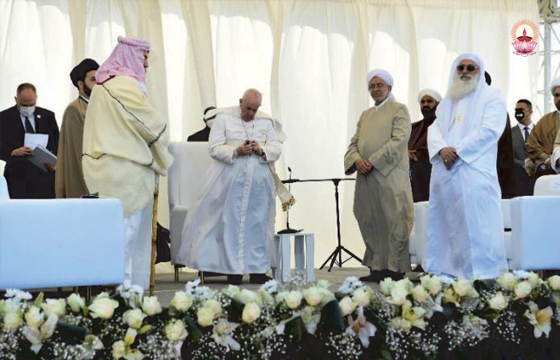
Muslims and Jews: the Pope in Najaf and Ur, the basis for an Iraq of peace and pluralism
The meeting between Pope Francis and Grand Ayatollah
Ali al-Sistani in Najaf and the interfaith prayer in Ur of the Chaldeans are laying the foundations for an Iraq based
on coexistence, pluralism, peace and a multicultural vision.
Analysts and commentators, from Iran to Israel, stress the “historic” significance of this morning’s meeting between the pontiff and the Shia spiritual leader and the dialogue between different faiths in the birthplace of Abraham, father of the three great monotheistic religions.
This “rare and special” event received “an unusually wide media coverage,” said Saad Salloum, journalist and associate professor of political science at Baghdad’s prestigious Al-Mu-stanciriyya University, speaking to AsiaNews about the meeting between Pope Francis and Grand Ayatollah Ali al-Sistani.
Co-founder of the Iraqi Council for Interfaith Dialogue and president of the Masarat Foundation, dedicated to the protection of diversity, Salloum described the meeting as “a symbolic visit between two similar personalities: both with great spirituality but humble; the latter lives in a small house in Najaf, considered the Shia Vatican, while the former resides in a flat in Santa Marta.”
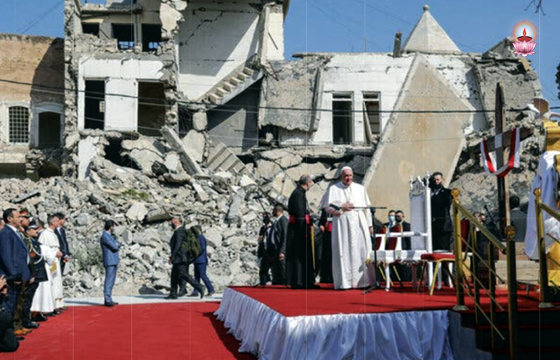
The Pope and restored ruins of Mosul speak to the whole world of hope
An elderly Pope Francis bowing and asking God’s forgiveness for the violence unleashed in the square of the four churches in Mosul; the choral participation of Muslims, Christians, Yazidis and Sabeans, all in traditional costume, survivors of a violent uprooting; the crumbling walls of the churches under reconstruction, where the monument to the martyrs and to those who died under the murderous fury of bloodthirsty hired men is blessed… I was moved to see all these buds of rebirth in a country and especially in a people that risked crumbling away like dust on the wind to disappear.
Iraq, like Iran, influenced by the Zoroastrian tradition, celebrates the new year in spring, on March 21. This year, the new spring came a few weeks earlier, with the pontiff who revealed the resurrection of a people who seemed destined to be swallowed up by terrorism, emigration, division to the eyes of the whole world.
I underline “people” and not “state”: The Iraqi state is still crippled by division, laying mutual blame, yet to rebuild harmony within, but the people show us examples of hope in coexistence and the future. Young Muslims and Christians rebuilding mosques and churches in Mosul is something that has been going on for some time. The Pope highlighted this by showing the power of hope that overcomes oppression; the resurrection that overcomes death.