Taiwan president tells pope of China’s religious persecution

Taiwan’s President Tsai Ingwen has written to Pope Francis to complain about China’s persecution of religion, saying that Beijing aims to threaten its democracy and freedom.

Taiwan has been concerned by the Vatican’s moves to normalize ties with China, especially after a landmark on September 2018 provisional deal on appointing bishops.
Tsai won reelection by a landslide on January 11 after a campaign pledge to protect Taiwan’s sovereignty from Chinese control.

In her letter to the Pope, released by the Presidential Office on Jan. 21, she listed Chinese actions that she said constitute abuses of power, including violence toward Hong Kong protesters and persecution of religious believers seeking to follow their faith.

Responding to a message from Pope Francis for World Day of Peace on Jan. 1, Tsai wrote that Taiwan hopes for a peaceful resolution of its differences with China.

“However, at present dialogue across the Taiwan Strait is filled with difficulties,” she wrote. “The main sticking point is that China has so far been unwilling to let go of its desire to control Taiwan. It continues to threaten Taiwan’s democratic freedoms and human rights by threatening to use force against Taiwan, fake news, cyber attacks and diplomatic means.”


When Chinese Christians adapt Lunar New Year

Chinese-speaking people across the world are busy preparing to celebrate the Lunar New Year, which this year falls on Jan. 25. The festival marks the beginning of the Year of the Rat. Chinese Christians, of course, are part of the celebrations, composing and adapting the parallel sentences of greetings typical of the festival.

The expression “parallel sentences” needs a bit of explanation. Chinese alphabets allow the flexibility of writing sentences from top to bottom or left to right. During the Lunar New Year, the Chinese have a tradition of writing two-sentence greetings on two strips of paper, placed vertically on either side of a statue, picture or door. These couplets of greetings came to be known as parallel sentences.

Christians adapt these greetings and also compose their own. Sometimes they may vary among different denominations. In order to understand these sentences, we must return to the context in which these sentences are written. These greetings of four to 10 characters evoke a story, an affirmation of wisdom, or a blessing, corresponding to each other. Concise and poetic, their form and content are meant to reflect a certain beauty. Each sentence sounds like a maxim that highlights an idea; it translates and transports them. The parallel sentences are found in all regions and religious groups of the Chinese world.

Script by Capuchin priest to hit the big screens

Renowned preacher and author, Father Danny Capuchin is set to make a landmark in south Indian film industry with his story and screenplay in the upcoming Malayalam movie titled Varayan (striped).

According to reports made available to media on the first day of the project, Father Danny narrates the story of a young Capuchin priest who lands up in a remote and scary island and the events thereafter.

The lead role of the priest will be played by South Indian film actor Siju Wilson.

The first look poster of the movie was released on Jan 17 by Manju Warrier who is popularly known as the lady super star of Malayalam cinema. The poster features a firebrand young priest in a Capuchin friar’s habit.

Artists and the production team have high expectations for this movie which is reported to have a storyline that will appeal to the masses.

The scriptwriter himself being a Capuchin priest has created an extra interest to this upcoming movie. As the actor Siju Wilson mentioned in an interview, although he initially expected the story to have a religious theme, he was quite surprised by the serious content and entertainment offered by the story.

Father Danny is known for his unique way of preaching and talks both in India and abroad. He is also popular through several programs on television and radio.

He has authored several books including Daivom Peythirangunnu (God is raining down) – a novel in Malayalam; Prakasathinte Nizhal (shadow of light) – a character analysis, Mounam (silence) – a collection of articles. He is also a well known lyricist in Christian music.

Republic Day: Churches under Calcutta archdiocese to read Preamble

Catholic churches under Calcutta arch-diocese will read out the Preamble to the Constitution after Sunday service on January 26, India’s Republic Day.

Archbishop Thomas D’Souza of Calcutta will send a circular to all 65 parishes in the city and the seven districts, conveying the decision to them. “The Preamble to the Constitution will be read out to uphold and safeguard the Constitution. I think under the present situation, understanding, upholding and being aware of the Constitution is more important than ever.

“We thanked God for the Constitution. We prayed for our country as we always do,” the archbishop said. “This is also an occasion to tell the congregation about the Constitution and many may not be aware of it. It will remind us of the values of liberty, equality and fraternity that the Preamble stands for.”

The Constitution was adopted by the Constituent Assembly on November 26, 1949, and it came into force on January 26, 1950.

The pastors will decide whether to read the Preamble inside the church or outside.

“Since childhood we have pledged to the nation and said ‘all Indians are my brothers and sisters.’ In the current context, it is our own brothers and sisters who are feeling that certain values of the Constitution are under threat. Reading the Preamble in front of God is also to say that it is sacred and cannot be taken lightly and guarding the Constitution is a duty each one of us have,” said Father Rodney Borneo, parish priest of St Ignatius Church in Kolkata. An inter-faith organization has called for the formation of a human chain from Golpark in the south to Shyambazar in the north on Republic Day to “celebrate and uphold the Constitution.”

“I am also asking the congregation to join the human chain wherever possible,” the archbishop said. Churches across the country traditionally celebrate the Republic Day and the Independence Day on August 15 with a variety of programs such as flag hoisting, singing of the National Anthem and talks on patriotism.

Christians faced 1,774 hate crimes in four years

From 2016 to 2019, Indian Christians have faced 1,774 cases of hate crimes across 25 states and 3 Union Territories, says Persecution Relief report.

In other words, India witnessed 59.6 percent rise in hate crimes against Christians during the same period, says Persecution Relief’s much-awaited “Annual Report-2019.

Persecution Relief is an ecumenical forum that records Christian persecution in India. In 2019 alone, the forum documented 527 cases compared to 447 cases in 2018, 440 in 2017 and 330 in 2016.

It was a drastic leap of 179.4 percent.

Uttar Pradesh, India’s most populous state, emerged as the most hostile place for Christians for three consecutive years.

Tamil Nadu continues at the second spot with 75 cases, followed by Karnataka, 32 cases, Maharashtra 4 with 31 cases and Bihar with 30 cases at number 5.

What stands out among the hate crimes in India is that four Christians were murdered in 2019.

In the same year, the forum recorded 199 incidents related to threats, intimidation and harassment against Christians, 104 attacks on churches, 85 incidents of physical violence, 100s of house churches forcefully closed by religious fanatics and the local administration in Uttar Pradesh and Tamil Nadu.

The anti-conversion law was introduced in two states ruled by the Bharatiya Janata Party (BJP) — Jharkhand and Himachal Pradesh making a total of 8 out of 28 states to have passed the same law.

The Persecution Relief started in 2017 a toll-free number 1800-1234-461 to provide comprehensive support to the persecuted.

India listed among top 10 countries of anti-Christian violence

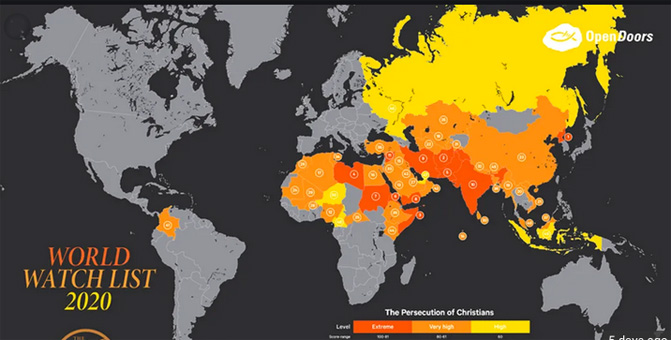
India is among top ten countries where most attacks on Christians were reported in 2019, according to an international persecution watchdog organization.

“Violence against Christians has surged globally, with data showing more than 9,000 attacks on churches in 2019,” reports Open Doors, which claims to be the world’s largest outreach to persecuted Christians in the most high-risk places.

On January 15, the Washington-based organization published its 2020 “world watch list top 10” mentioning North Korea as the worst country for persecution of Christians. India comes at the tenth place and Afghanistan the second. The others are: Somalia 3, Libya 4, Pakistan 5, Erirea 6, Sudan 7, Yemen 8 and Iran 9.

Christians, the organization says, are one of the most persecuted religious groups in the world and are oppressed in at least 60 countries.

“The data found that a startling 14,645 Christians were physically or mentally abused, with the majority of that activity occurring in India, China and sub-Saharan African countries where a myriad of jihadist groups aim to create instability,” the organization noted.

At least 8,500 Christians were raped or sexually abused for reasons related to their faith, a number that should be regarded as the tip of the iceberg, since most sexual harassment happens behind closed doors and is, therefore, more difficult to accurately track, it added.

Pope asks Cardinal Gracias to continue as Bombay archbishop

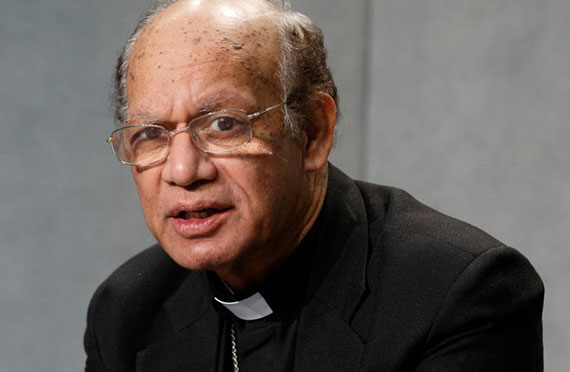
Church leaders in India have welcomed Pope Francis asking Cardinal Oswald Gracias to continue as the Bombay archdiocese. “It is good news. We welcome the cardinal’s extension as the Archbishop of Bombay,” Bishop Allwyn D’Silva told Matters India on January 28, responding to the Pope’s decision.

Cardinal Gracias had on November 30, 2019, submitted to the Pope in person his resignation from the archbishop’s post as he was to complete 75 years on Dec. 24 the same year.

A letter from the Congregation for the Evangelization of Peoples to Cardinal Gracias says the “Holy Father has asked you to continue ‘donec aliter provideatur (until other provision is made).”

The congregation’s on Dec. 6 letter expresses its gratitude to the cardinal for what he is doing for the service of the Church in Mumbai, in India and the Universal Church. “Permit me to add my own personal esteem and affection,” said Cardinal Filoni Fernando, prefect of the Vatican congregation.

Study finds bishops are satisfied with their life and ministry

Catholics may be surprised to learn that many U.S. bishops describe their lives as both all-consuming and satisfying, a priest-researcher said.

“These are guys who generally get up very, very early in the morning, pray about two hours every day and work about 10 hours a day,” said Father Stephen Fichter, a research associate at the Centre for Applied Research in the Apostolate in Washington, which conducted the survey. “(They) just really do some interesting things and there are a lot of difficulties that they’re dealing with all the time.”

A priest of the Archdiocese of Newark, New Jersey, Fichter explained the results of a 2016 survey of active and retired U.S. bishops in a talk at St Mary’s University of Minnesota’s Minneapolis campus on Jan. 15. The survey was the first to look at the lives of bishops since 1989.

The study is the subject of a 2019 book published by Oxford University Press, Catholic Bishops in the United States: Church Leadership in the Third Millennium. Fichter is one of four co-authors of the book.

The researchers wanted to carry out a comprehensive study, develop a profile of bishops and chronicle the experiences of prelates in their ministerial roles, Fichter said.

The average age of active bishop respondents was 66. They are white and theologically moderate or traditional. Some bishops described themselves as moderately progressive.

Of 429 surveys sent, 213 recipients responded. They included bishops ministering in the Latin and Eastern rites. Respondents included bishops who head a diocese or archdiocese; auxiliary bishops; and retired bishops.

The survey, Fichter said, revealed demo-graphic changes among the bishops. Of the 126 Latin-rite bishops heading archdioceses or dioceses who responded, 97percent were born in the United States. Meanwhile, 76% of the 33 Latin-rite auxiliary bishops who responded were U.S. born. (Because of the foreign-based nature of their churches, Eastern-rite bishops are more likely to be born outside of the U.S. than those in the Latin Church).

Bishops ask Kerala state to end anti-Christian policy

The Synod of India’s eastern rite Syro-Malabar Church has appealed to the Kerala State government to end discrimination against Christians in distributing benefits intended for religious minorities.

The Synod’s call came in the concluding statement issued on Jan 15. Of the 64 bishops, 57 attended the Jan. 7-15 assembly at Church headquarters in Kochi, the state’s financial capital.

The bishops’ said 80 per-cent of the federal grants meant for religious minorities “went to one minority community (Muslims), and the remaining 20 percent is divided among the other five minority communities in the state.”

Muslims, Sikhs, Christians, Buddhists, Parsis, and Jains are classified as minorities who together make up 20 percent of India’s 1.3 billion people. Some 80 percent of Indians are Hindus.

The federal government offers individual grants for education, scholarships, and tuition, among other things aiming to improve the socioeconomic development of religious minorities.