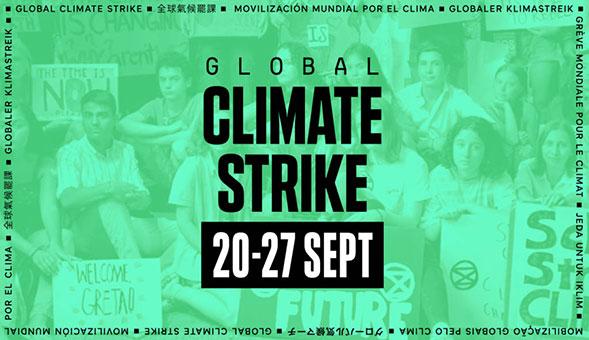
Patna Jesuit college joins Global Climate Strike

Students of St Xavier’s College of Management and Technology, Patna have expressed solidarity with the Global Climate Strike.

They were among millions of students of colleges and schools who on September 27 took to streets at more than 4,500 demonstrations in at least 130 countries to demand politicians to urgently tackle the climate crisis.

The youth climate campaign, started by Swedish teenager Greta Thunberg outside the Swedish parliament a year ago, has grown from a solo protest to a campaign of millions of young people demanding radical action. Adults, businesses and trade unions have also joined the youth climate campaign. Sharan Burrow, general secretary of the International Trade Union Confederation, said its 200 million members in countries from South Africa to Germany, Mozambique to Turkey stood shoulder to shoulder with the students.

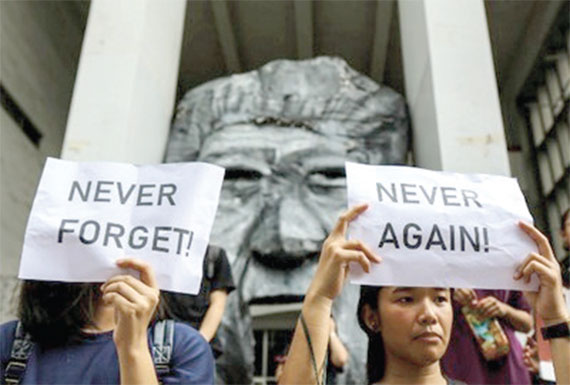
Church leaders warn Filipinos of martial law ‘horrors’

Church leaders have called on Filipinos never to forget the “horrors” of martial law, which was imposed across the country almost half a century ago. The declaration of martial law by late president Ferdinand Marcos resulted in thousands of human rights abuses.

Amnesty International recorded over 100,000 victims, with at least 70,000 people arrested, 34,000 tortured and 3,240 others killed.

Bishop Arturo Bastes of Sorsogon said Filipinos have to be reminded of the atrocities of martial law, adding that there is a “sinister plot… to erase the memory of the darkest period” in Philippine history.

He said “articles should be written… to remind Filipinos, especially the young, of the horrors of martial law imposed by Marcos.”

Retired Bishop Teodoro Bacani of Novaliches said Filipinos should remember how “oppressive and harmful” martial law was to the people. “It bred a culture of subservience and corruption from which we have not recovered,” he said.

India cracks down on foreign donations

Christian leaders in India are complaining that the nation’s pro-Hindu government is placing unfair restrictions on voluntary organizations receiving foreign funding.

The federal home ministry on Sept. 16 announced changes to the Foreign Contribution Regulation Act (FCRA).

The new rules require all chief functionaries of voluntary groups to sign affidavits that they have not been prosecuted or convicted for forced religious conversion or creating communal tensions. There are also declaration requirements in relation to not engaging in what the government defines as “sedition” as well as details about the use of foreign funds.

Until now, only the heads of organizations needed to give such an affidavit. Now all office bearers must sign the affidavit and undertake to report any violation of requirements.

The amended rules apply to new registrations and re-registration of organizations after five-year terms expire.

A.C. Michael, a senior office holder of the Alliance Defending Freedom (ADF) that campaigns for Christian rights, said the onerous provisions are unreasonable and appear to be an attempt to discourage Christian leaders from managing voluntary organizations. “Thousands of these organizations are headed by religious leaders who profess and preach their faith,” he said. “It could be another step towards throttling religious freedom.”

Indian prelate urges dialogue with Hindus over ‘forced conversion’

For almost a decade under St John Paul II and Pope Benedict XVI, then-Monsignor Felix Machado was a primary architect of the Vatican’s inter-religious outreach, including putting together a star-studded 2002 summit of religious leaders in Assisi as a follow-up to John Paul’s historic, and deeply controversial, first such gathering in 1986. Machado, born in Vasai, India, outside what was then Bombay, served as under-secretary of the Vatican’s Pontifical Council for Interreligious Dialogue from 1999 to 2008. There he worked shoulder to shoulder with Michael Fitzgerald, the British prelate whose own passion for inter-faith dialogue will be rewarded Oct. 5 when Pope Francis inducts him into the College of Cardinals.

German ‘synodal way’ is rapid response to abuse scandal, conference says

The bishops of Germany, reacting to an independent study of the extent of clerical sexual abuse in their country and its possible causes, chose to initiate a “synodal” process that was not a Synod or a plenary council. Building on a series of “listening sessions” the bishops held from 2011 to 2015, “we did not choose a Synod because it would take too long,” and the sex abuse study called for a rapid response. So “we have chosen something sui generis: The synodal way,” said Matthias Kopp, spokesman for the conference.

The entire bishops’ conference is to discuss the final plans for the process when the bishops meet on Sept. 23-26 in Fulda.