Almost 300 million Christians persecuted around world

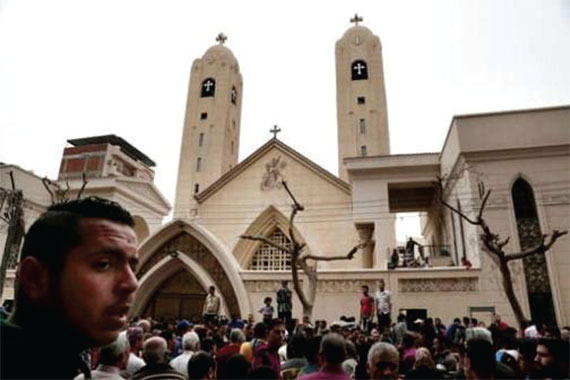
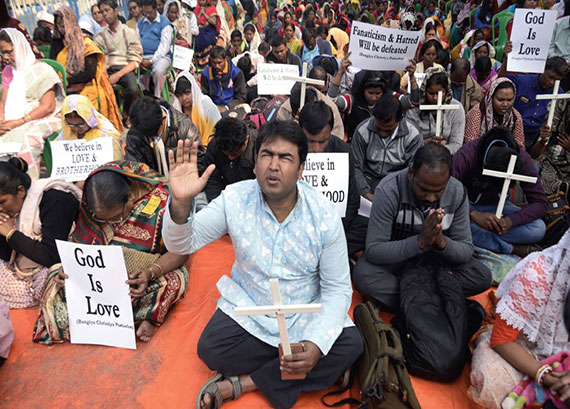
Christians continue to be the most persecuted religious group, according to a report by Aid to the Church in Need (ACN).

Almost 300 million Christians, or one out of seven Christians in the world, live in a country where they face violence, arrest and human rights violations.  Some 61% of the world’s population live in countries where religious freedom is not respected, meaning that six out of every 10 people around the world cannot express their faith with total freedom, Vatican News reported.

These were some of the figures unveiled in the Religious Freedom Report 2018 by ACN, the international pontifical Catholic charity and foundation that helps persecuted Christians worldwide.

The report looks at 196 countries, examining the degree to which the basic right to religious freedom, as defined in the United Nations Universal Declaration of Human Rights, is respected with regard to all the major religious faiths.

The report, which contains data from June 2016 to June 2018, shows grave violations of religious freedom in 38 countries. In 17 of them there is serious discrimination on grounds of religious faith, while in 21 there is outright persecution of religious minorities, in some cases to the point of death. The report reveals that in some of the worst countries for religious freedom, the situation has deteriorated over the past two years. On the global level in general, overall respect for religious freedom has also worsened.

The ACN study shows that in 22 countries the reasons for attacks on religious freedom are rooted in radical Islamism, while in other countries the dominant causes are the authoritarianism of states or governments which pursue policies of “aggressive nationalism.” Among these countries are China, India, North Korea, Myanmar, Vietnam and Kyrgyzstan.

On a more positive note, the report pointed to an improved level of religious freedom for minorities in Syria and Iraq following the military defeat of terrorist group Islamic State.

International group of women’s superiors urge sisters to report abuse

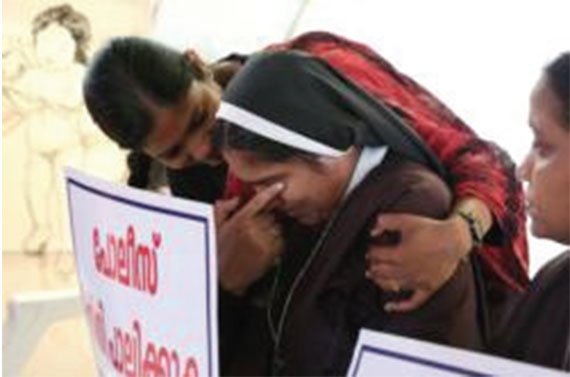
The International Union of Superiors General has called on women religious who have suffered abuse to come forward and report it to their congregations and church and state authorities.

“If the UISG receives a report of abuse, we will be a listening presence and help the person to have the courage to bring the complaint to the appropriate organizations,” it added in a statement published on its website on November 23.

The group – whose members are 2,000 superiors general of congregations of women religious across the world, representing more than 500,000 sisters – said it wished to express “deep sorrow and indignation over the pattern of abuse that is prevalent within the church and society today.”

“Abuse in all forms: sexual, verbal, emotional or any inappropriate use of power within a relationship, diminishes the dignity and healthy development of the person who is victimized,” it added.

“We stand by those courageous women and men who have reported abuse to the authorities. We condemn those who support the culture of silence and secrecy, often under the guise of ‘protection’ of an institution’s reputation or naming it ‘part of one’s culture.'”

“We advocate for transparent civil and criminal reporting of abuse whether within religious congregations, at the parish or diocesan levels, or in any public arena,” it said.

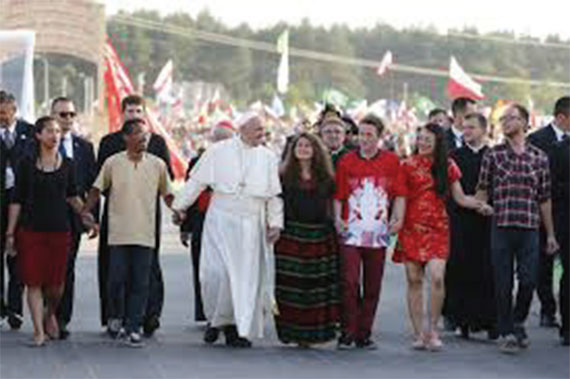
Pope Francis urges young people to lead a ‘revolution of service’

In a video message to young men and women around the world, Pope Francis has called on them to provoke an uprising of change by serving others.

In helping those who are suffering, both young believers and non-believers can find “a strength that can change the world,” the Pope said in a video message to youths for the up-coming World Youth Day in Panama. “It is a revolution that can overturn the powerful forces at work in our world. It is the ‘revolution’ of service,” he said in the message released by the Vatican.

The theme for the World Youth Day celebrations, which will take place on January 22-27, is taken from the Gospel of St Luke, “May it be done to me according to your word.”

In his message, the Pope said those words uttered by Mary during the Annunciation are “the positive reply of one who under-stands the secret of vocation: to go beyond oneself and place oneself at the service of others.”

Life, he said, can only find meaning when serving God and others. Like Mary, young people must engage “in conversation with God with an attitude of listening” so that they may discover their calling either in marriage, consecrated life or the priesthood.

Vatican official: Prohibit ‘killer robots’ now before they become reality

ROME – Fully automated and autonomous lethal weapons systems must be banned now before they become a reality in tomorrow’s wars, a Vatican representative said.

The development of robotic weapons or “killer robots” will provide “the capacity of altering irreversibly the nature of warfare, becoming more detached from human agency, putting in question the humanity of our societies,” Archbishop Ivan Jurkovic told a group of experts at the United Nations in Geneva.

The archbishop, who is the Vatican observer to U.N. agencies in Geneva, spoke Nov. 22 at a meeting of the high contracting parties to the Convention on Prohibitions or Restrictions on the Use of Certain Conventional Weapons Which May Be Deemed to Be Excessively Injurious or to Have Indiscriminate Effects, held in Geneva on November 21-23. The Vatican mission in Geneva released the arch-bishop’s remarks on November 27.

The legal and ethical implications of Lethal Autonomous Weapons Systems (LAWS) have been discussed and on the convention’s agenda for the past five years, the archbishop said in his speech.

The International Committee of the Red Cross has defined LAWS as being “any weapon system with autonomy in its critical functions. That is, a weapon system that can select – i.e. search for or detect, identify, track, select – and attack – i.e. use force against, neutralize, damage or destroy – targets without human intervention.”

34 churches shut in Angola police operation

At least 34 churches have been shut in Angola following an operation dubbed. The national police director for communication, Mr Orlando Bernardo, said 19 churches were shut in Cabinda Province, 11 in Luanda and four in Malanje province for operating illegally. The government said recently that more than 50% of churches operating in Angola were foreign, mainly from the DR Congo, Brazil, Nigeria and Senegal, adding that at least 1,116 of them operated illegally. The police rescue operation started on November 6 and will run until the end of the year. The operation aims at restoring the state authority by instituting order in worship, on the roads, fighting unregulated hawking and illegal migrations, among others.

Ethiopia: Islamists bribing Christians to convert

Young Christians in Ethiopia are being lured to convert to Islam by promises of jobs, education, help to buy houses and other aid, according to a Christian leader. Christians, desperate to escape poverty, are being bribed to join the Muslim religion, Aid to the Church in Need was told by a religious leader who asked to remain anonymous to protect his safety. He said: “The [Muslim employers] are getting the younger ones – with scholarships, promises for jobs, and so on. “Unemployment is at a very high rate in Ethiopia, so this is very attractive to the young people. They are told if you want a job you must live like this – the young people are targeted. You find hundreds or even thousands of young people waiting at the cross roads of towns and villages to see if they can find work.”

Dalit seminar empowers priests, religious to work for Poor

As a follow-up activity earmarked by Catholic Bishops’ Conference of India (CBCI) Office for Dalits and Backward Classes, a three-day national conference of Dalit priests and Religious took place at Arnold Bhavan, Hyderabad, on November 13–15. Above 110 participants different parts of the India joined the program to share, deliberate and strategize so as to empower themselves and their people back in parishes and communities. The conference focused on “Pilgrimage Extension and Training.” Several dignitaries addressed and facilitated the members dealing with topics: media and effective pastoral ministry, creative ministries to empower the Dalit community members, and interpersonal relationship.

Church denies involvement in Mizoram elections

The Church in poll-bound Mizoram has clarified that it has no role to play in elections as it remains apolitical and doesn’t influence voting in any manner. In north-eastern states, particularly in the Christian majoritarian State of Mizoram, Churches are said to cast an influence on the voters and are considered as key centres that can make or break the fortune of any political party or candidate. Voters are said to be largely influenced by the view of the Church before going for voting. The Church, however, has clarified that it doesn’t interfere in any manner in the election process, adding that it is solely upon the people of the state to decide the fate of political parties through voting.

Church calendar stirs controversy

Featuring the photo of Bishop Franco Mulakkal of Jalandhar on the official calendar of Trichur archdiocese for 2019 is seen as the prelate’s clout in his home State of Kerala.

Bishop Mulakkal, who is accused of raping a 44-year-old member of the Missionaries of Jesus congregation under his authority, is now out on bail. The court has forbidden the prelate from entering Kerala except to appear before the investigating officer once in two weeks.

The calendar, which is published by the Catholicasabha, the mouthpiece of the archdiocese, features pictures of all bishops hailing from the archdiocese. Bishop Mulakkal’s photo appears in his birth month of March.

The move has not surprised those supporting the survivor since it is in line with the patronage the Church has extended to Bishop Mulakkal. It had allegedly tried to cover up the crime and shield the accused when the nun complained to the Church authorities.

Political leaders are overwhelmed by the open support extended to the bishop by the Church and its various organizations. The Church continued the support even after the police found him prima facie guilty and arrested him.

While bishops and priests made a beeline to the jail where he was lodged after the arrest, special prayers for the accused were organised in many churches across the state.

Protecting Aasia Bibi is state’s duty, says top judge

Chief justice of Pakistan (CJP) Mian Saqib Nisar has said blasphemy accused Aasia Bibi ‘was trapped’ without any proofs and that sending her abroad for protection would be tantamount to failure of the state. The CJP, who is currently in London, expressed these views on November 22 while visiting the British Parliament where he was welcomed by British lawmakers of Pakistani origin – Afzal Khan and Faisal Rasheed.

According to a TV channel, the CJP said Aasia Bibi – who was absolved of blasphemy charges by the apex court on October 31 – should get full protection in Pakistan rather than abroad.

“Providing her security is responsibility of the government; it is responsibility of the state of Pakistan to protect life and property of every citizen. If Aasia Bibi is sent abroad or given asylum in any other country it will be failure of the government and the state,” he said.

The CJP, who headed the bench that set the Christian woman free, said every possible effort should be done to provide Bibi more and more protection in Pakistan. “If we set such an example, the chain will continue,” he added.

To a question about putting her name on the Exit Control List (ECL), he said it is not a suitable time to express his thoughts on this question as the case could be brought to his court. “I assure you, however, that our law has no such provision. The judiciary will not give any illegal judgement about it,” he added.

When asked as to why the Supreme Court did not take notice of the recent sit-ins and protest that erupted in the wake of its October 31 verdict in Aasia Bibi case, he said: “Just wait for a few days and you will get the answer to this question.”