Jalandhar priests question Bishop Mulakkal’s congregation

Among the various controversies dogging Bishop Franco Mulakkal of Jalandhar is the formation of a new congregation by him – Franciscan Missionaries of Jesus (FMJ).

Many priests in the northern Indian diocese have voiced concern over the congregation’s structure and speed of growth, besides the seemingly ‘luxurious’ life its members lead.

Priests have not been forth-coming in discussing matters of the diocese since the rape charge surfaced against Bp Mulakkal, and later the mysterious death of a witness against him, Father Kuriakose Kattuthara, at Dasuya.

The students of the new congregation are housed in a palatial building on a huge property that was bought for several millions of rupees at Malupota village on the Phagwara-Nawanshahr highway near Banga. It is an air-conditioned building that was earlier the Sanskar International School set up by a Delhi-based group.

Currently, the seminary has some 80 students from Kerala. The seminary also plans to set up a regular school also on the premises.

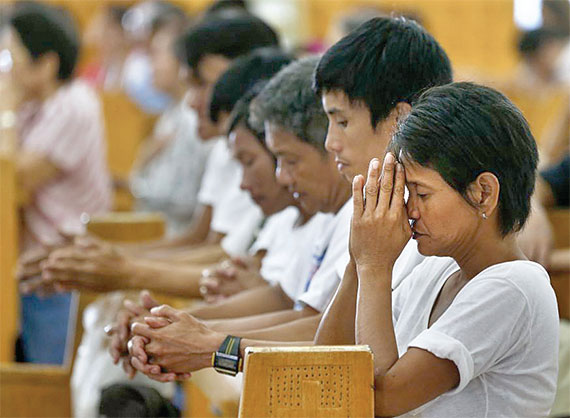
In dispute with Catholic leaders, Duterte tells Filipinos to quit church

Philippine President Rodrigo Duterte renewed his attacks on Catholic leaders and urged Filipinos to stop going to church altogether.

The president, who earlier this year called God “stupid,” suggested in a Nov. 26 speech that people should instead build their own chapels where they can pray.

“You don’t have to go to Church to pay for these idiots,” said Duterte referring to bishops who have condemned the wave of drug-related killings in the country.

Duterte’s tirade against church leaders came days after he accused Bishop Pablo Virgilio David of Kalookan of giving church donations to his family. He offered no supporting evidence for his accusation.

“You, David, you be quiet. You go on asking for contributions. …Where does the people’s money go?” the president said on November 22.

“You know, the truth is, I tell you, the offerings, the pineapple, avocado, bananas, where do they go? You want to know? I will show you. To his family,” Duterte said.

“The fool just keeps on asking — there is even a second collection,” he added.

In a statement, David, a vocal critic of drug-related killings in the Philippines, said “people who are sick sometimes do not know what they are talking about.”

Earlier this month, the bishop asked the public to pray for Duterte because he is a “very sick man.” He made the statement after the president called saints “fools” and “drunkards.”

David’s pronouncement seemed to anger the president. Duterte said on Nov. 26 that he thought that the bishop might be into drugs. “I’m telling you, David. I wonder why he goes around in the evening. I suspect that he might be into drugs,” he said.

Four Finns arrested on Langkawi Island for handing out pamphlets related to Christianity

Four Finnish citizens were arrested on Langkawi Island, a well-known tourist destination in Kedah State, for allegedly distributing pamphlets related to Christianity, local police reported. If convicted, they could get two to five years in prison.

On Langkawi, the largest island in the eponymous archipelago, Police Chief Mohamad Iqbal Ibrahim said that his officers arrested two men and two women after members of the public complained.

The Finns, aged between 27 and 60, were arrested at a hotel and the police seized their pens, notebooks and a bag. They are accused of breaking laws that ban disturbing religious harmony.

Religion is a very sensitive issue in Malaysia, where over 60% of the population is Muslim. Critics argue that, in recent years, religious conservatism has grown undermining the religious tolerance that once characterised Islam in the country.

According to official statistics, 9 percent of the Malaysian population is Christian, half of them Catholic. The government however does not differentiate the various Churches.

Card Charles Maung Bo is the new president of Asia’s bishops

Card Charles Maung Bo will be the new president of the Federation of Asian Bishops’ Conferences (FABC) On 1st January 2019. The archbishop of Yangon (Myanmar) was elect- ed in Bangkok (Thailand), at a meeting of the FABC Central Committee.

The Myanmar cardinal replaces Card Oswald Gracias, archbishop of Bombay (India), who will end his second term as FABC head on 31 December. Gracias was also FABC general secretary between January and December 2012.

A member of the Salesian Society of St John Bosco, Card Bo was born on 29 October 1948 in Monhla, a village in the Archdiocese of Mandalay.

After studying at the Nazareth Aspirantate in Anisakan, Pyin Oo Lwin, from 1962 to 1976, he made his temporary vows on 24 May 1970, followed by perpetual vows on 10 March 1976.

He was ordained as a Salesian priest in Lashio (Shan State) on 9 April 1976. He served as pastor in Loihkam (1976-1981) and Lashio (1981-1983). From 1983 to 1985, he taught in the seminary of Anisakan.

Protecting Aasia Bibi is state’s duty, says top judge

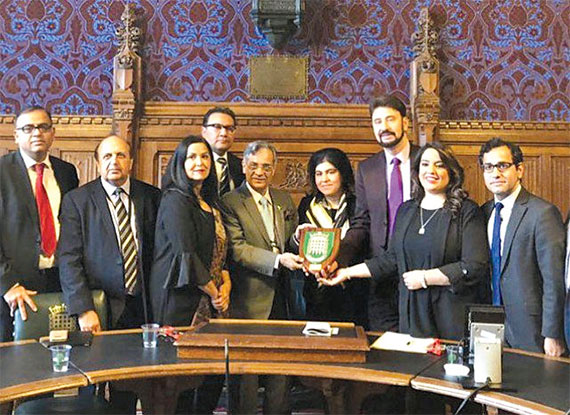
Chief justice of Pakistan (CJP) Mian Saqib Nisar has said blasphemy accused Aasia Bibi ‘was trapped’ without any proofs and that sending her abroad for protection would be tantamount to failure of the state. The CJP, who is currently in London, expressed these views on November 22 while visiting the British Parliament where he was welcomed by British lawmakers of Pakistani origin – Afzal Khan and Faisal Rasheed.

According to a TV channel, the CJP said Aasia Bibi – who was absolved of blasphemy charges by the apex court on October 31 – should get full protection in Pakistan rather than abroad.

“Providing her security is responsibility of the government; it is responsibility of the state of Pakistan to protect life and property of every citizen. If Aasia Bibi is sent abroad or given asylum in any other country it will be failure of the government and the state,” he said.

The CJP, who headed the bench that set the Christian woman free, said every possible effort should be done to provide Bibi more and more protection in Pakistan. “If we set such an example, the chain will continue,” he added.

To a question about putting her name on the Exit Control List (ECL), he said it is not a suitable time to express his thoughts on this question as the case could be brought to his court. “I assure you, however, that our law has no such provision. The judiciary will not give any illegal judgement about it,” he added.

When asked as to why the Supreme Court did not take notice of the recent sit-ins and protest that erupted in the wake of its October 31 verdict in Aasia Bibi case, he said: “Just wait for a few days and you will get the answer to this question.”

Saudi school textbooks teach violence, anti-Semitism, ADL report says

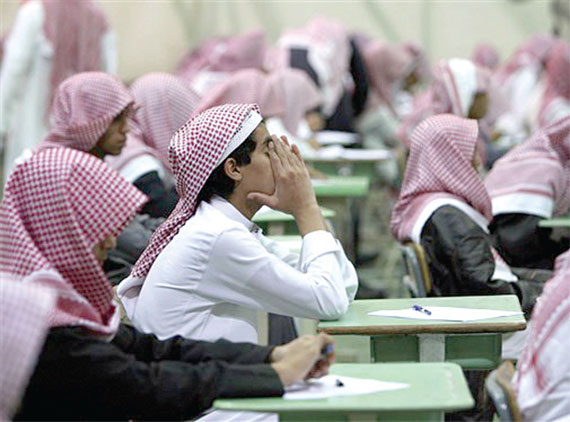
Textbooks for high school  students in Saudi Arabia promote hatred against Jews, Christians, women, homosexual men and other Muslim sects despite repeated promises to return the country to a more moderate form of Islam, according to a report released.

The Anti-Defamation League highlighted that some text books include anti-Semitic stereotypes.

Among the goals of Zionism is a “global Jewish government to control the entire world,” one excerpt states.

Another example reads: “The hour will not come until Muslims fight the Jews, so that the Muslims kill them, until the Jew hides behind rock and tree, so the rock or the tree says: ‘Oh Muslim, oh servant of God, this Jew is behind me, so kill him.’”

A third passage suggests that “beating [women] is permitted when necessary.”

Saudi Arabia is the birthplace of Islam and for decades has exported a strict Wahhabi form of Sunni Islam that views Shiite Muslims as heretics.

Intolerance in the kingdom came under particular scrutiny after the Sept. 11, 2001, attacks when it emerged that 15 out of the 19 hijackers were Saudi.

Pope: the bishop must be an ‘administrator of God’, not of goods, of power

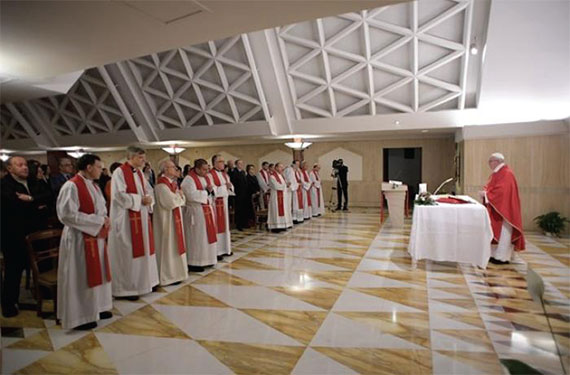
The bishop must be an ‘administrator of God,’ not of goods, of power, “humble, meek, servant, not prince.” Only in this way can we put order in the Church which “ has never been born perfectly in order,” Pope Francis said at Mass this morning at Casa Santa Marta, inspired by the passage from Paul’s letter to Titus.

Fervor and disorder are the two words used by Francis to recount how the Church was born, also remembering the “admirable things” accomplished. “There is always confusion – he said – the power of the Spirit, chaos, yet we must not be afraid,” because in reality “it is a beautiful sign.” Jorge Mario Bergoglio assures us that “the Church was never born all organized, all in place, without problems, without confusion, never. She was always born that way.” And the confusion, “this disorder, must be fixed. It’s true, because things must be put in order; let’s think, for example, of the first Council of Jerusalem: there was the struggle between the Judaizing and the non-Judaizing… Let’s think about it well: they do the Council and fix things.”

For this reason – continued the Pope – Paul left Titus in Crete to put things in order, reminding him that “faith comes first.” At the same time, he provides some criteria and instructions on the figure of the bishop “as administrator of God.” “The definition he gives is “administrator of God,” not of goods, of power, of lobbies, no: of God. He always has to correct himself and ask himself, “Am I an administrator of God or am I a business-man?” The bishop is the administrator of God. So he is called to be ”blameless: this is the same word that God asked Abraham: “Walk in my presence and be blameless.” It is the founding word of a leader.”

Helping the poor is not a papal fad but a duty, says pope

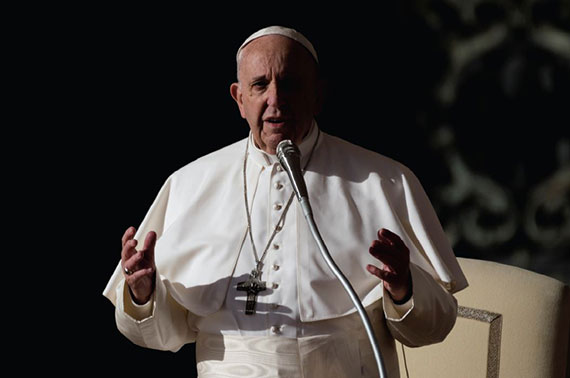
As the rich get richer, the increasing misery and cries of the poor are ignored every day, Pope Francis said. Christians cannot stand with arms “folded in indifference” or thrown up in the air in helpless resignation, he said in his homily on Nov. 18, the World Day of the Poor.

“As believers, we must stretch out our hands as Jesus does with us,” freely and lovingly offering help to the poor and all those in need, the Pope said at the Mass in St Peter’s Basilica. About 6,000 poor people attended the Mass as special guests; they were joined by volunteers and others who assist disadvantaged communities.

After the Mass and Angelus, the Pope joined some 1,500 poor people in the Vatican’s audience hall for a multi-course lunch. Many parishes, schools and volunteer groups across Rome also offered a number of services and meals for the poor that day.

God always hears the cries of those in need, the Pope said in his homily at the Mass, but what about us? “Do we have eyes to see, ears to hear, hands outstretched to offer help?”

May people hear the cry of the abandoned elderly, those who lack any support, refugees and “entire peoples deprived even of the great natural resources at their disposal,” he said.

Pope’s abuse summit opens new chapter on abuse

Pope Francis is convinced that the scourge of abuse is a problem that does not pertain just to a single country.

Pope Francis’ crunch summit on child protection in February is poised to open a new chapter in the Church’s response to the clerical sexual abuse scandal, ending what has been a haphazard and inconsistent approach to child protection.

The Vatican on November 23 released details about the unprecedented 21-24 February 2019 global gathering of bishops underlining Francis’ desire for a collective, centralised and coordinated response to preventing abuse in the Church.

The Pope has asked clerical sex abuse victims and his child protection commission to help prepare for the meeting which will be attended by 180 participants, the vast majority of these presidents of bishops conferences from across the world.

On the organising committee, two of the most credible Church anti-abuse experts have been appointed. These include the Archbishop of Malta, Charles Scicluna, a longtime Church prosecutor who is now the Pope’s point man in handling abuse cases, and Fr Hans Zollner, the Jesuit priest who runs the Centre for Child Protection at the Pontifical Gregorian University in Rome.

‘His father is Boko Haram, but he is still my child’

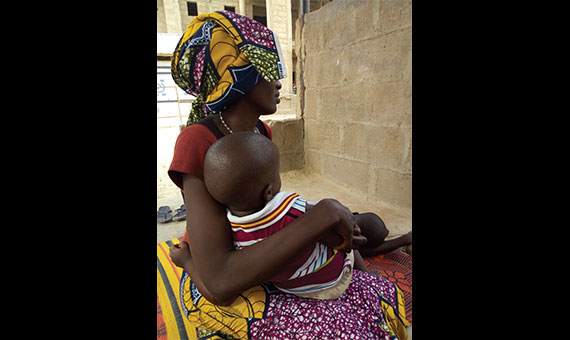
“The evening of August 21, 2014 I was relaxing with my two children–Zachariah (5) and Jonathan (18 months), in front of our house in Baga, Borno State. I was pregnant at the time. We suddenly heard gunshots and explosions.

“We all knew immediately that it was Boko Haram, and ran in different directions. They killed people, burned houses and churches. In no time, they surrounded us and kept us hostage for three weeks.

“We were later moved to Chad and eventually, Sambisa, back in Nigeria. They picked wives from among us. Those who refused marriage were killed and their children enslaved.

“I refused to convert to Islam but they still named me Maryam. When I refused, marriage, they picked up Jonathan and flung him into a river. He soon drowned, screaming and crying, ‘mama.’ I helplessly, watched him die.

“I was told I would be married to someone who could impregnate me to replace my dead son. If I didn’t want that, then I would work as a sex slave or they would kill my remaining child. I became a sex slave.

“Daily, for almost two years, I was with more than one man. I was scared of being infected. Many times, I felt like ripping my skin off whenever they called on me. I was flogged, beaten, imprisoned with no food or water.

“I had a miscarriage in the process but got pregnant afterwards and gave birth to a son they named Ibrahim. It was very difficult to love this child. His father is Boko Haram, but he is still my son.

“I worried a lot about my husband. I wondered how I would face him if we eventually reunited. I wondered how I would cope with this current situation which had become a part of life’s story.

“I hadn’t seen or heard any news about him as we had gone in separate directions during the attack.

“One fateful day, soldiers attacked the camp and many of us escaped during the chaos. Another group of soldiers brought us to Maiduguri. As we journeyed, I felt like flinging the baby out of the truck. But it seemed like the soldiers anticipated my thoughts and began counselling me against it.

“While I was struggling with this reality of having a Boko Haram baby, I was also worried about how my husband would accept that I was a sex slave while in captivity and had also come back with a child fathered by one of the insurgents. “They asked me if I had anyone in Maiduguri and I told them I had the Catholic Church. That’s how they brought me to St Patrick’s Cathedral.