Minorities Commission objects to school circular to recite ‘Gayatri mantra’

The Delhi Minorities Commission has issued a notice to the North civic body over a circular issued by it for recital of ‘Gayatri Mantra’ in schools run by its education department. Chairman of Delhi Minorities Commission(DMC) Zafarul Islam Khan said the notice was recently issued to the education department of North Delhi Municipal Corporation (NDMC).

The education department of NDMC has been asked to explain “why a circular has been issued to its schools to make students recite Gayatri Mantra in morning assemblies.

“Is this not against our secular policy and will this not cause division in the ranks of students and teachers as many belong to minority communities who may not like to recite mantras of religious nature,” the notice asks.

NDMC authorities have defended the move, saying recital of ‘Gayatri Mantra’ at schools run by the civic body was not mandatory.

The civic body runs 765 primary schools where around 2.2 lakh students are enrolled.

Chairman of Education committee of the BJP-ruled municipal corporation, Ritu Goel said she had no information about the notice issued by the minorities panel on ‘Gayatri Mantra’ but added its recital was not mandatory.

“We have already clarified, its not mandatory in our schools,” she said.

Pakistani Islamists issue warning over Asia Bibi


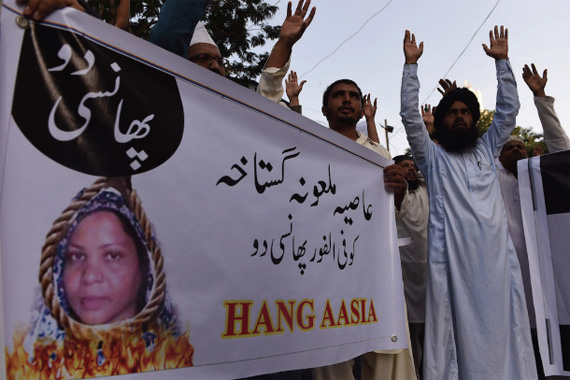
A hard-line Islamic group known for supporting Pakistan’s tough blasphemy law has warned against any release on bail of jailed Catholic woman Asia Bibi.

The nation’s Supreme Court earlier announced that it would consider the issue of bail pending hearing of an appeal by the Catholic mother of five against a death sentenced imposed by a trial court in 2010.

She was found guilty of making derogatory remarks about Prophet Mohammed during an argument with a Muslim woman while working in a field.

In 2014, the High Court in Lahore, capital of Punjab province, upheld the death penalty.

Two high-profile politicians, then Punjab governor Salmaan Taseer and minorities minister Shahbaz Bhatti, were assassinated in 2011 after calling for reforms to the blasphemy law.

According to a media release issued by the Supreme Court of Pakistan on October 5, a three-member bench headed by Chief Justice Mian Saqib Nisar and comprising Justice Asif Saeed Khosa and Justice Mazhar Alam Khan Miankhe, would begin hearing Asia Bibi’s appeal this week.

If her appeal is rejected by the Supreme Court, she is expected to ask the nation’s president for clemency.


Update: Pakistan court rules on Catholic’s blasphemy charge, defers announcement

A court in Pakistan has reached a decision on whether a Catholic woman will become the first person to hang to death under the country’s controversial blasphemy laws.

A special bench of the Supreme Court, sitting in Islamabad, reached a verdict on October 8 on the fate of Asia Bibi, but publication has been deferred until a later, unspecified date, according to the British Pakistani Christian Association. In an Oct. 8 news release sent by email to Catholic News Service, Mehwish Bhatti, an officer of the BPCA who was in the courthouse during the proceedings, said the three judges “have come to a decision, but it has been reserved.”

Christians in Pakistan are conscious of the threat of an outbreak of rioting by Muslim mobs if Bibi is acquitted by the court, the BPCA said in an Oct. 7 press release, even though they are praying ardently for her release. Bibi has been held in solitary confinement since November 2010, when she was sentenced to hang for insulting Muhammad, the founder of Islam.

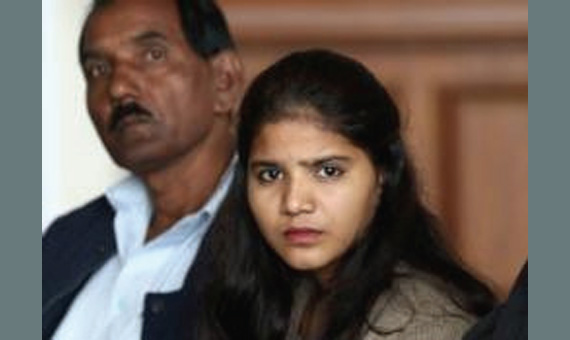
Ashiq Masih, her husband, told Catholic News Service in an Oct. 5 interview that if Bibi is released she and her family will immediately seek sanctuary in one of several countries that have offered them exile, because it was too dangerous for them to remain in Pakistan.

They said when they visited Bibi in Multan Prison on Oct. 1 that she was in good health, contrary to speculation that she was developing dementia. During the interview at St Columba’s Church, Ashiq said Bibi was praying constantly and that she deeply believed she would win her freedom.

“She is psychologically, physically and spiritually strong,” Ashiq told CNS. “Having a very strong faith, she is ready and willing to die for Christ. She will never convert to Islam.

“She also wanted to deliver a message to the international community that they must remember her in their prayers. These prayers will open the door of the prison, and she will be released very soon,” he said.

The Orthodox Church is on the brink of a new Great Schism

For centuries, the archbishops of Constantinople could credibly claim to be the “Ecumenical Patriarch”. Their see was the “New Rome”, centre of the oikoumenç, the “inhabited world”. Today, their successor, Patriarch Bartholomew, looks beleaguered. The guards around his residence in the Phanar quarter of Istanbul reveal his threatened position in an increasingly Islamified Turkey. But now he seems poised to gain other powerful enemies, this time within the Orthodox Church itself, by unilaterally recognising a Ukrainian Orthodox Church independent of Moscow.

The renascent Church of Russia, thought to comprise more faithful than all the other Orthodox Churches combined, covets Constantinople’s leadership role. Styled “the Third Rome” since Tsarist times, Moscow believes geopolitical reality should give it more weight than Bartholomew’s aura of the Byzantine past.

Moscow has long sought to expose Bartholomew’s weakness, as when it tried to wreck the Pan-Orthodox Great and Holy Synod of 2016. The Russians and other Churches under their influence stayed away, greatly reducing the impact of the long-planned assembly where Constantinople had hoped to bolster its prestige.

But perhaps Bartholomew now has an opportunity to strike back. Since Ukraine gained independence in 1991 two distinct groups have separated from the Moscow patriarchate, seeking to establish a distinctively Ukrainian Church. One of these groups has established a patriarchate based in Kiev, while the other group, older but much smaller, makes the less radical claim of being the autocephalous (self-governing) Church of Ukraine. So far, neither has received recognition from any other canonically recognised Orthodox Church. But conflict with Russia since the 2014 revolution has reportedly enhanced the standing of these groups with patriotic Ukrainians.

Bartholomew has announced his intention to recognise an autocephalous Ukrainian Church, uniting these groups – and anyone else who will join them – into a single jurisdiction looking to Constantinople rather than Moscow as the Mother Church.

Pope: Eastern-rite priests’ families offer unique example

The families of Eastern-rite Catholic priests give an important witness to what is healthy and wonderful about family life, Pope Francis said.

Speaking to laypeople, clergy and religious of the Slovak Catholic Church – a Byzantine-rite Church that has maintained its tradition of ordaining both celibate and married men – the Pope said, “the families of priests live a unique mission today.”

“When the very model of the family is called into question, if not attacked outright, you offer a healthy and exemplary testimony of life,” he said in his talk on October 6.

The Pope encouraged the small Slovak Catholic Church, which also has a diocese in Canada – the Eparchy of Sts Cyril and Methodius of Toronto – to safeguard its Byzantine tradition, “which I, too, came to know and love when I was younger.”

“Rediscover it and live it to the full just as the Second Vatican Council taught,” he said.

“The European continent, both east and west, needs to rediscover its roots and vocation; and from Christian roots, only solid trees can grow which bear the fruits of full respect for the dignity of the human person in every condition and every phase of life,” the Pope said.

Pope Francis calls for a youth synod ‘anointed by hope’


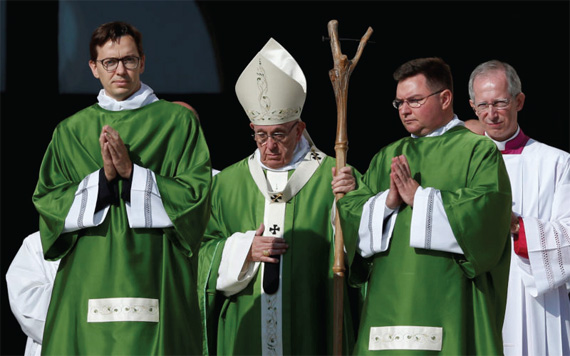
Pope Francis began the Synod on young people Oct. 3 with a homily call-ing for the Holy Spirit to renew hope and dynamism in the Church.

Hope can “broaden our horizons, expand our hearts and transform those frames of mind that today paralyze, separate and alienate us from young people,” said Pope Francis. The Synod of Bishops commenced its fifteenth ordinary general session with Pope Francis asking to begin the assembly “anointed by hope.” “Hope challenges us, moves us and shatters that conformism which says, ‘it’s always been done like this,’” he continued.

In a historic first, two bishops from mainland China are participating in the Synod of Bishops due to the Holy See’s provisional agreement with China on the appointment of bishops in September. One of the bishops at the Synod, Bishop Giuseppe Guo Jincai of Chengde, was among the seven bishops recognized by the Vatican on Sept. 22.

“The communion of the entire Episcopate with the Successor of Peter is yet more visible thanks to their presence,” the Pope said as he welcomed the delegates from China.

“Hope asks us to get up and look directly into the eyes of young people and see their situations,” said Pope Francis, “This same hope asks us to make efforts to reverse situations of uncertainty, exclusion and violence, to which our young people are exposed.”

More than 300 participants are gathered in Rome, including clerics and religious, as well as 49 auditors, among them 36 young people from five continents.

Cardinal Marx calls for ‘fundamental, systemic change’ to confront abuse crisis

The German prelate who serves on Pope Francis’ advisory body of cardinals has called for the Catholic Church to adopt “fundamental, systemic change” in order to address the continuing clergy sexual abuse crisis. Cardinal Reinhard Marx, one of nine members on the Council of Cardinals, suggested discussions about such change could focus on three areas: adoption of “good governance” practices, compliance with safeguarding norms, and a focus on creating a “higher degree of accountability” for church leaders. “There can be no restoration of the church’s credibility without fundamental, systemic change,” Marx told participants of an Oct. 5 event at the Pontifical Gregorian University for the inauguration of the institution’s new graduate-level degree in safeguarding.

The cardinal also praised survivors of clergy abuse for coming forward.

“We must be grateful to the public pressure, the criticisms and the voice of the survivors… which help us to improve,” he said. Marx, the archbishop of Munich and Freising, also serves as the president of the German bishops’ conference, which recently released a report indicating there had been an estimated 3,700 sexual abuse cases in the country over the past seven decades.

At the Sept. 25 press conference releasing that report, the cardinal apologized for the abuse, saying it had been “covered up for far too long.”

During his address at the inauguration of the new degree program at the Gregorian, being offered by the university’s Centre for Child Protection, Marx said the abuse scandals “have plunged the church into one of its most serious crises worldwide, raising many questions and challenges for the future.” “This is challenging, exhausting, but at the same time without alternative,” said the cardinal. “We must help together to promote a variety of constructive initiatives and create synergies.”

“Leadership must be learned and practiced,” said the cardinal, adding that it is “absolutely unacceptable to say” that those who are ordained become leaders “simply by being ordained.”

Archbishop apologizes for Church scandals, justifies nuns’ protest

A Catholic prelate on October 2 apologized for recent scandals involving Church leaders around the world and justified some Indian nuns coming to the street for justice.

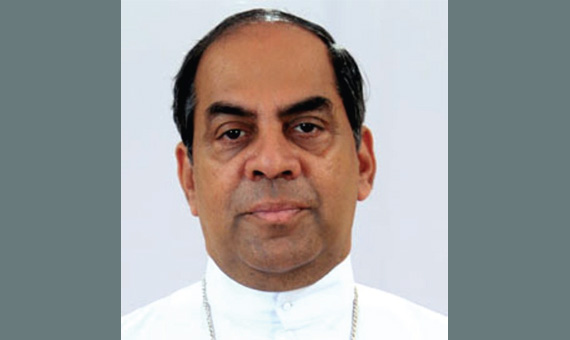
“We are in the land of Mahatma Gandhi, promoter of Satyagraha and the only condition is that our strikes should be of ahimsa and not of violence,” Arch-bishop Kuriakose Bharanikulangara of Faridabad told more than 10,000 people attending a Bible convention in Thyagaraja Stadium in New Delhi.

The remarks of the prelate, a former Vatican diplomat, came in the backdrop of a sit-in by five members of the Missionaries of Jesus in Kerala to demand justice for a nun who was allegedly abused by Bishop Franco Mulakkal of Jalandhar.

The nuns and their supporters led by the “Save Our Sisters” movement ended their 14-day demonstration on September 22, a day after the Kerala police arrested Bishop Mulakkal.

Archbishop Bharanikulangara recalled that it was not the first time that the Church has gone to the street for its causes.

He recalled the late Arch-bishop Joseph Kundukulam of Trichur calling for a rally to protest a controversial drama that depicted Christ in poor light. Recently several bishops joined a sit-in the national capital seeking the release of Salesian Father Tom Uzhunnalil, who was kidnapped by Islamic militants in Yemen.

He, however, admitted that the arrest of a brother priest and the nuns protest have shaken the faith many ordinary Catholics in India. These events have also affected the credibility of the Church systems and the clergy, he added.

He listed several scandals that hit the Church in the past one year such as the “land deal affair” in the archdiocese of Ernakulam-Angamaly in Kerala and the breaking of confession seal by an Orthodox priest and subsequent abuse of a woman by several priests.

Other scandals that have caused “a great turmoil and tumult” among Catholics and others are punishment of an American cardinal, resignation of some Chilean bishops, and the recent sexual abuse report of the German bishops’ conference have, Archbishop Bharanikulangara added.

“I regret that these things happened. I publicly apologize for the scandals caused by the Church leaders to the common Catholic faithful,” he added.

Assam Christian forum condemns vandalism of Don Bosco statue

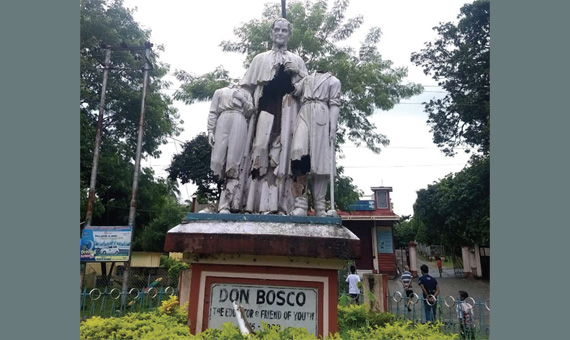
The Assam Christian Forum has condemned the vandalism of a statue of St John Bosco kept in front of the Bishop’s House in Tezpur, the cultural capital of the north-eastern Indian state.

This is another incident of increasing intolerance in Assam and it has “put us all in anxiety,” says Allen Brooks, spokesperson of the forum.

The Catholic lay leader said that “anti-social elements” vandalized the statue on September 29 night. The statue depicted the founder of Salesian congregations with two boys, but the miscreants broke the heads of the boys and made a gaping hole in the saint’s torso.

“It is shocking that such an incident has happened in Tezpur, which is considered the cultural capital of Assam,” Brooks told Matters India on October 2.

He said a First Information Report has been registered with the police. He also expressed the Christian community’s hope that the police would book the culprits soon and restore their faith and security.

Brooks recalled a similar incident in August 2015 when the saint’s statue was desecrated in Guwahati.

Assam is currently ruled by the coalition headed by the pro-Hindu Bharatiya Janata Party, the political arm of Hindu radical groups. Tezpur (city of blood), some 175 km northeast of the state’s commercial hub of Guwahati, is an urban agglomeration in Sonitpur district. It is the largest of the north bank towns of Assam.

Youth in India gather for ‘Synodgy’ as a sign of solidarity with bishops in Rome

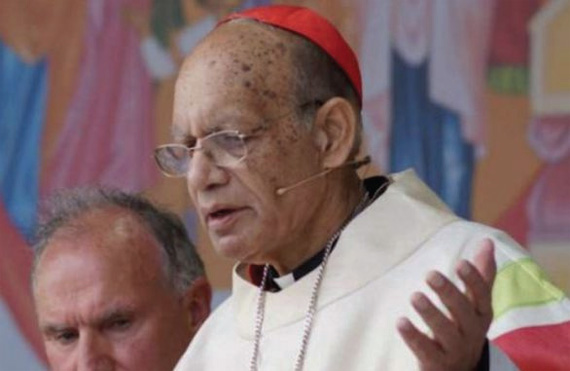
A group of young people gathered in Mumbai on October 7  to celebrate Synodgy 2018, an event to help the young people of India participate spiritually in the Synod of Bishops meeting on the youth taking place this month in Rome. “Synodgy is celebrating this Universal event on the home ground,” said Cardinal Oswald Gracias, the Archbishop of Bombay. The cardinal is in Rome for the synod and sent his remarks in a video message.

“Stay high and excited in our faith in Jesus Christ. Synodgy is here to ignite you and inspire you to work together youthfully and faithfully even as we commit to listen to you, accompany you so that you make your choices and decisions which will bring you inner contentment, reveal the beauty and meaning of life and the Christian life,” Gracias said.

The event was taking place at St. Andrew’s College in the Bandra neighborhood, a center of Catholicism in Mumbai.

The event included a video presentation consisting of interviews with young people, who spoke about the relevance of the Church today and what they would do if they were made pope for a day.