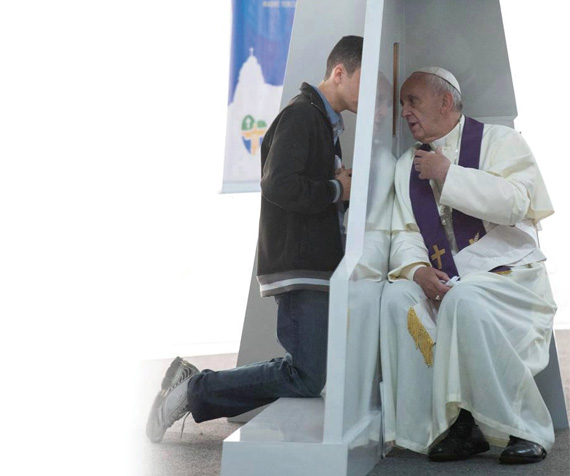
AUSTRALIAN BISHOPS, RELIGIOUS SAY SEAL OF CONFESSION IS SACRED

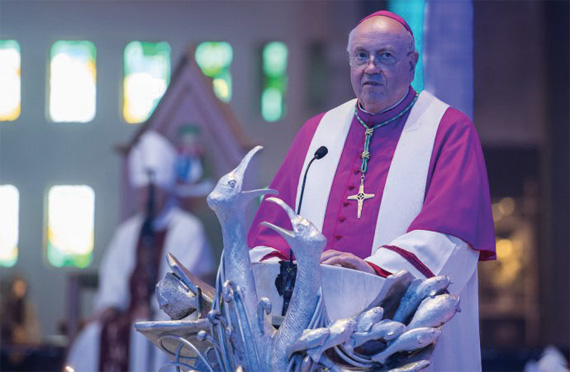
Australia’s Catholic bishops and religious orders, responding to recommendations from the Royal Commission Into Institutional Responses to Child Sexual Abuse, accepted 98 percentage of its suggestions, but said they could not accept recommendations that would violate the seal of confession.

Support independent Catholic journalism. Become an NCR For- ward member for $5 a month.

“We are committed to the safe-
guarding of children and vulnerable
people while maintaining the seal.
We do not see safeguarding and the
seal as mutually exclusive,” said the preamble to a 57-response to dozens of recommendations concerning child safety, formation of priest and religious workers, on-going training in child safety and even out-of-home care service providers.

The response, published Aug. 31, came eight- and-a-half months after the Royal Commission released its 17-volume report on child sexual abuse. The report was based on five years of hearings, nearly 26,000 emails, and more than 42,000 phone calls from concerned Australians. In February 2017,

Australian Church leaders spent three weeks testifying before the commission.

In a statement published with their response, Josephite Sister Monica Cavanagh, president of Catholic Religious Australia, and Archbishop Mark Coleridge of Brisbane, president of the Australia Catholic Bishops’ Conference, ex- pressed “their deep sorrow that vulnerable children were abused, weren’t believed and weren’t supported when seeking justice.”

Cavanagh said, “The process is already underway to reform the church’s practices to ensure that safeguarding is integral in all that we do as part of our ministry and outreach in the community.”
The statement said Coleridge acknowledge that the church’s response to the abuse scandal had been “too slow and too timid.”

“Many bishops failed to listen, failed to believe, and failed to act,” he was quoted as saying. “Those failures allowed some abusers to offend again and again, with tragic and sometimes fatal consequences.”

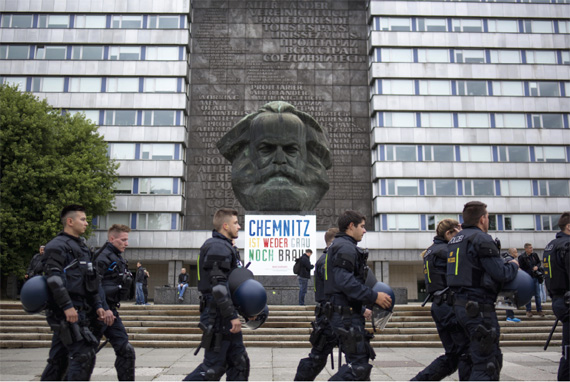
GERMAN CHURCH LEADERS CONDEMN RACISM AND ‘MIGRANT-BASHING’ IN CHEMNITZ

The clashes between right- wing demonstrators and antifascist protesters in the eastern German city of Chemnitz in Saxony, where a German with Cuban roots was stabbed to death by an Iraqi and a Syrian on 27 August, have been sharply condemned by church leaders in Germany.

The Catholic Church would always “clearly reject” racism and “migrant bashing,” Father Karl Jüsten, head of the “Katholisches Büro” in Berlin, the German bishops’ conference’s liaison office with the German government, underlined in an interview with ‘domradio.de.’

“It really is terribly depressing to see that many people have obviously rejected the democratic consensus and no longer allow the constitutional state to do its work,” Jursten said. “This time, the police were very quick to act but for a certain group of people that was not enough. It is simply not acceptable that such a group should think they are above the law, should take the law into their own hands and even to declare how the state should behave. I am not accusing all those who joined in the rioting of being Nazis. In Berlin, we have similar problems with left-wing protesters. As a church we must ask ourselves how we can reach those who have rejected the democratic consensus.”

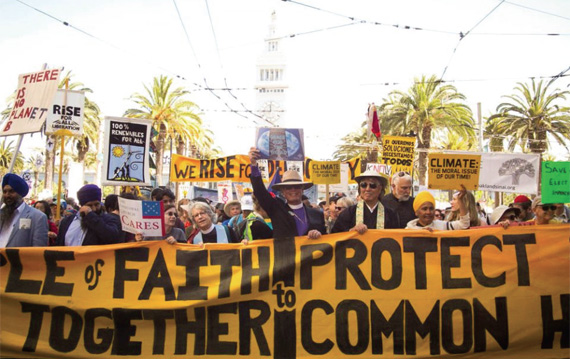
WORLD LEADERS, FAITH GROUPS GATHER FOR GLOBAL CLIMATE ACTION SUMMIT

In an effort to move beyond promises and pledges, leaders from around the world have joined the faith community and others in San Francisco to put on display actions under way to address the global threat of climate change, and to mobilize even more.

The three-day Global Climate Action Summit officially opened Sept. 12, and is expected to draw more than 4,000 delegates to the Bay Area. Its primary focus is show- casing the steps taken so far toward fulfilling the goals of the 2015 Paris Agreement. Under that accord, 195 nations committed to limit average global temperature rise “well below” 2 degrees Celsius (3.6 degrees Fahrenheit), and as low as 1.5 C (2.7 F).

While the summit, hosted by California Gov. Jerry Brown, will highlight achievements to date in implementing the Paris Agreement — announcements of progress and new commitments to reduce greenhouse gas emissions by cities, regions, organizations and companies are expected throughout the three days — it also aims to push the global community to “take ambition to the next level,” the gathering’s theme. Scientists have estimated the planet has already warmed 1 C since the late 19th century and that the initial national pledges under the Paris accord will yield an overall temperature rise of 3 C by the end of the century. In addition, few countries are on track to meet their commitments, and funding for the Green Climate Fund, to assist developing nations in implementing climate mitigation efforts, has been slow to materialize.

The next round of United Nations climate talks, in Katowice, Poland, in December, will serve as the first official stock take of global progress. “Climate change is the defining issue of our time, and we are at a defining moment,” António Guterres, U.N. Secretary General, said in a speech at U.N. headquarters in New York. He added that if the world doesn’t change course by 2020, “we risk missing the point where we can avoid runaway climate change.”

“God has made the earth green and beautiful. And there is no greater threat to our ‘green and beautiful’ earth than the more frequent and intense droughts, floods, storms and wildfire brought by climate change, which knows no barrier,” said Nana Firman, co-founder of the Global Muslim Climate Network.

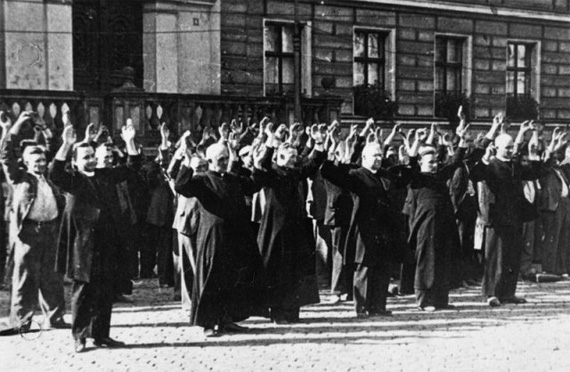
SPOKESMAN OF THE EPISCOPATE: EVERY FIFTH DIOCESAN PRIEST IN POLAND MURDERED DURING WORLD WAR II

Every fifth diocesan priest
was murdered in Poland occupied by the Germans and Russians.
Four Polish bishops were killed
in the concentration camps, and
nearly half of the Roman Catholic dioceses were deprived of
diocesan bishops. It was also a
war with religion – said the spokesman of the Polish Bishops’ Conference, Fr Pawe B Rytel- Andrianik, on the 79th anniversary of the outbreak of World War II. The spokesman of the Episcopate reminded that during the World War II in Poland there was massive persecution of the clergy. “Priests, monks, nuns were shot, sent to concentration camps, imprisoned and tortured. The Germans confiscated the Church’s goods and closed the churches. Nevertheless, the faith of the Church in Poland survived this dark period of German Nazi terror” – he added.

Fr. Rytel-Andrianik pointed to the tragic data from World War II. “According to scientific research, for about 10,000 diocesan priests (in 1939) German Nazis murdered about 2,000 priests, that is every fifth priest. Among about 8,000 monks (in 1939), 370 were murdered. Among about 17,000 nuns, the Nazis murdered about 280 sisters. Additionally, during World War II about 4,000 priests and monks and about 1,100 nuns were imprisoned in German concentration camps. Those who were at large were also repressed” – said the spokesman of the Polish Episcopate. During the World War II, almost half of the Polish dioceses were deprived of diocesan bishops. In twenty-one Roman Catholic dioceses in Poland, nine were without bishops who were interned or forced to emigrate, and one of the diocesan bishops was murdered.

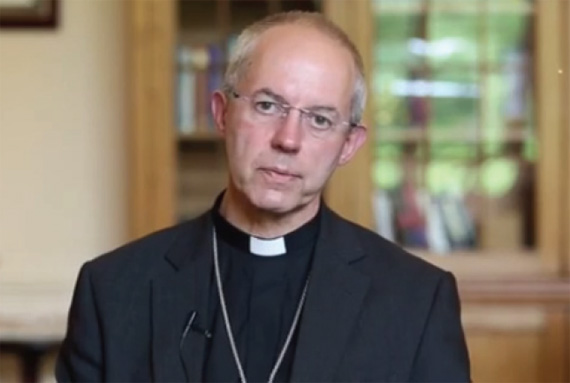
ARCHBISHOP OF CANTERBURY CALLS FOR “FUNDAMENTAL REFORM” OF BRITAIN’S ECONOMY


A major research paper, co- authored by the Archbishop of Canterbury Justin Welby, says that Britain’s economy “is not working for millions of people and needs fundamental reform.” The report, Prosperity and Justice, argues that “a fair economy is a strong economy” and says that “prosperity and justice can, and must, go hand- in-hand.” The report includes a 10-part plan for “a new vision of the economy and a rebalancing of economic power” and more than 70 recommendations for “the most significant change in economic policy in a generation.”

The Report was published by the Institute for Public Policy Research’s Commission on Economic Justice, which was established in autumn 2016 following the decision by Britain to leave the European Union.

To coincide with today’s launch of the report today, Archbishop Justin wrote an article in the Daily Mail news- paper setting out a case to tax wealth more. He said there was much in the economy for which Britain can be proud, including being the fifth largest economy, world-leading businesses, and low unemployment.

“Yet despite these strengths, it is evident that for many people, the economy is not working,” he said. “It no longer fulfils the promise of rising living standards. For more than a decade, most people have seen no improvement in their pay, even while the economy as a whole has continued to grow.”

ENGLISH ARCHBISHOP: SCANDALS AND COVER- UPS MEAN CATHOLICS MUST ‘SHOUT LOUDER’

Christians must still proclaim the Gospel, even in the face of the current scandals and cover- ups, according to the Archbishop of Liverpool.

Archbishop Malcolm McMahon was preaching in Liverpool’s Metropolitan Cathedral at the concluding Mass of the Adoremus Eucharistic Congress, which took place in the city on August 7-9.

“As a Christian community we may say that we can no longer hold our heads high because of the current scandals and cover- ups, so let us keep our heads bowed in penance but stand erect nonetheless,” McMahon said.

“Maybe our words won’t carry the same authority as before, but we still have a gospel to proclaim, and let us continue to do that by our actions as well as words so that others may see Jesus in us.”

The archbishop said that “even though we may be humiliated as members of Christ’s Body at this moment in time,” he told Christians that the Church belongs to Christ.

McMahon recounted a visit to the Holy Land, where he saw firsthand the Greco-Roman cities and pagan temples that had existed in Christ’s time, and said it made clear that Jesus was preaching in an area that wasn’t just made up of Jewish believers, but also gentiles and pagans.

“The parallel is obvious: Our society is deaf to the word of God too. When Jesus preached and healed in these cities it would have been in an alien culture. Well, I think that our society is more ‘hard of hearing’ than deaf. We have to learn to shout louder,” the archbishop said.

He said the Church of today is “lost in the crowd in what is a secular age where Christianity and its ideals linger but are no longer the common basis of our society.”

CHURCH PROJECT HELPS INDIAN VILLAGERS ENJOY DRINKING WATER

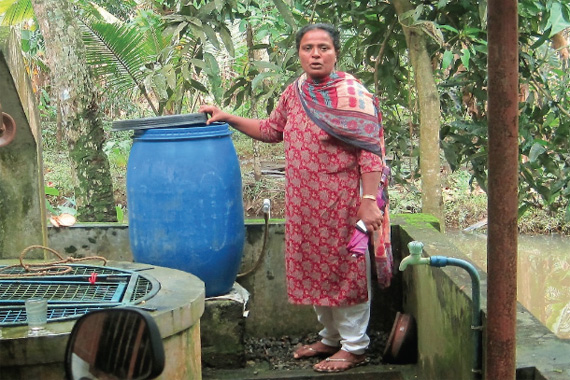
Despite being surrounded by water, Varghese Mollykutty used to row a boat four kilometres along a narrow canal to a public water source to fetch a few pots of drinkable water for her family.

She and her husband and two children live on a tiny island village, Kuttanad, a unique marshy delta in India’s southern State of Kerala that lies below sea level. Recently floods in the southern Indian state killed more than 350 people since June, peaking in August with 37% excess rainfall in just two-and-a- half months.

Kuttanad, although ringed by water flowing from four perennial rivers, is one of the thirstiest areas in India. Its water is loaded with heavy microbial elements such as coliform bacteria and so is unusable for drinking or any domestic chores.

Most houses in Kuttanad have wells but the water is unusable because it is acidic with mineral content, brackish or unsafe with bacteria.

But Mollykutty now has a method to filter well water to make it suitable for drinking or any household chores.

“It has come as a big boon to us. We don’t have to go kilometres for water anymore. We can get it any time we want by opening a tap. We have only to fill the filtering chamber with water from our well,” she says.

INDIAN INNOVATOR SHOWS ‘ENDLESS POSSIBILITIES’ FOR CHANGE

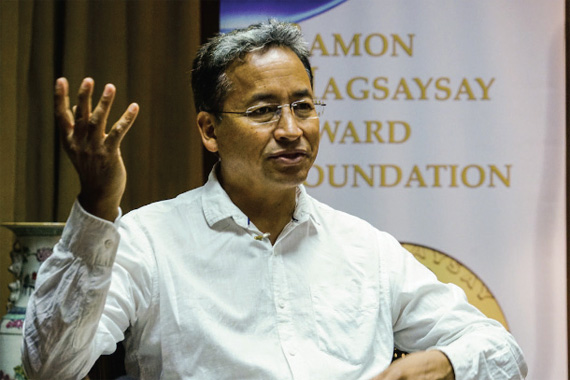
He was born in the mountains, up in the northern Indian State of Jammu and Kashmir, where the air was then still fresh and the trees were green.

Up there, in the small,
remote village of Ulaytokpo
in Ladakh, Sonam Wangchuk
went to school with other tribal children.

Education was difficult, he recalled, because minorities were discriminated against, and schools were lacking and poorly-equipped.

Teaching standards were abysmal during those days and what was written in textbooks was irrelevant to the lives of mountain people.

“I had a very rough education in the mountains,” Wangchuk told ucanews.com during an interview in Manila. “Not much with what you got from the textbooks made sense,” he said.

He was then too young to understand, but when he got older and was confronted with financial difficulties to continue his own education, he opened his eyes.

“I had to teach other students to support myself,” he said.

“It did not make much sense, even to people in New Delhi, and even in London,” he said with a smile.

He stressed the need for spiritual and religious leaders who should preach about “a new form of non-violence and peace with air, water and all living beings on this planet.”
“We need to update our religion,” Wangchuk told ucanews.com.
“Our religion is somewhat outdated from the time when people were killing with guns and daggers, our leaders are still talking about peace of that kind whereas the current problem is not the peace of guns and daggers,” he said.

Wangchuk said the “main causes of violence and deaths these days are environmental in nature [and] lifestyle related.”

He said he looks forward to “new ways of seeing religion” where Hindus and Muslims, for instance, would not only say that they would not eat this or that kind of meat but would say that “we don’t use plastic bottles, we don’t use cars for no reason, we use public transport, we use steps rather than escalators.”

UNIFORM CIVIL CODE UNDESIRABLE: LAW COMMISSION

The Law Commission has suggested certain changes in marriage and
divorce laws that should be uniformly
accepted in the personal laws of all
religions, while holding that the
uniform civil code “is neither necessary
nor desirable at this stage” in the
country. The Commission, headed by
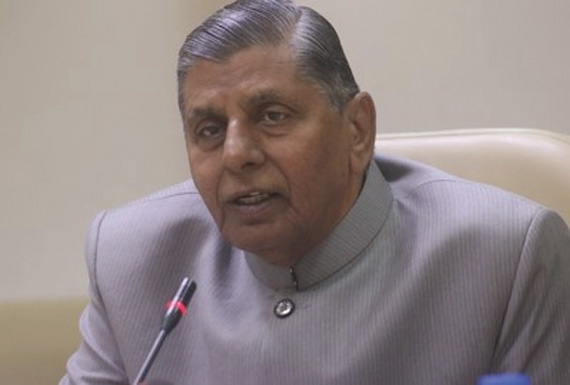
former Supreme Court judge Justice B.S. Chauhan whose tenure ended on August 31, has come out with a 185-page consultation paper on “Family Law Reforms’ said a unified nation does not necessarily need to have “uniformity.”

It said the best way forward was to preserve diversity of personal laws even while ensuring they did not contradict fundamental rights guaranteed under the Constitution.

Saying, secularism cannot contradict the plurality prevalent in the country, the Commission said in the paper that: “Cultural diversity cannot be compromised to the extent that our urge for uniformity itself becomes a reason for threat to the territorial integrity of the nation.”

RANCHI JESUIT CALLS TREASON CHARGE ‘FABRICATED’

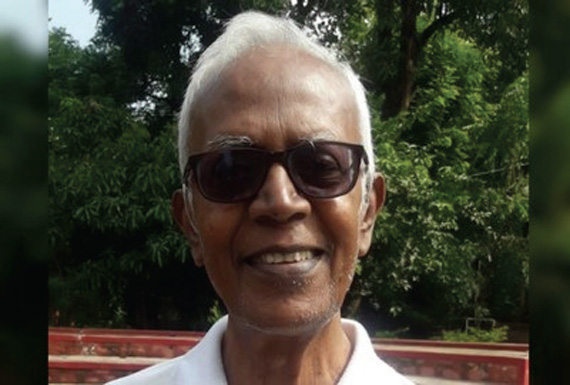
Indian Jesuit Father Stanislaus Lourdusamy says a treason charge linking him with militant Maoists is a fabrication being used to discredit his work for prisoners and tribal people.

The 82-year-old Jesuit, popularly known as Stan Swamy, was charged along with eight other rights activists on Aug. 28 for alleged links to a banned Maoist group in the western State of Maharashtra.

Police have also linked the activists with violence between Dalit and upper-caste Maratha people in the state earlier this year. “It is nothing but a complete concoction and absolute falsehood that is being propagated by Maharashtra police,” Father Swamy said in a Sept. 3 statement.

Father Swamy said he has been convener of an organization called Persecuted Prisoners Solidarity Committee (PPSC) which assists under- trial prisoners.