Child trafficking: India orders inspections for all of Mother Teresa’s orphanages

The Indian government has ordered the inspection of all the orphanages and children’s care homes run by the order founded by Mother Teresa, after a nun was arrested on charges of trafficking in newborn babies.

In a statement released recently, Women and Child Development Minister Maneka Gandhi said that all state governments have been asked “to get child care homes run by Missionaries of Charity all over the country inspected immediately.”

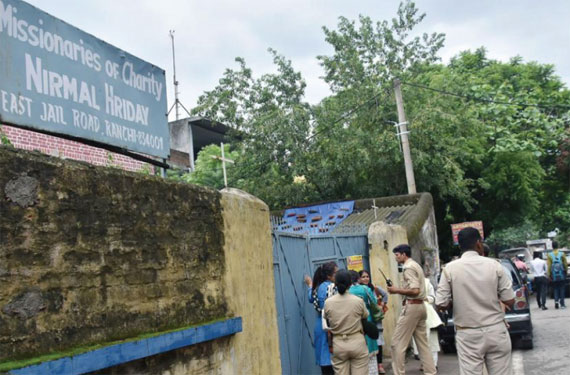
Early this month, police in Ranchi (Jharkhand) arrested Sister Koshleniea, who ran a children’s home, and an employee of the facility, Anima Indwar, who “sold” a newborn to a family in Uttar Pradesh for 120,000 rupees (US$ 1,750).

Minister Maneka Gandhi’s move appears to be an attempt to stop child trafficking and illegal adoptions that see more than 100,000 children disappear in India. Gandhi also asked that all childcare institutions should register and be linked to a central office for adoption within a month. According to government figures, 2,300 institutions have already registered with another 4,000 still pending.

Sister Mary Prema, superior general of the Missionaries of Charity, has already stated that the congregation would investigate something that “goes against our moral convictions,” and that they would take steps to prevent anything like this happening in the future.

The Catholic Bishops’ Conference of India, however, expressed doubts about the case involving the Sisters of Mother Teresa in Jharkhand, that it is being purposefully blown out or proportion by “some people” trying to frame the organisation founded by Mother Teresa. West Bengal Chief minister, Mamata Banerjee, who is great admirer of the saint of Calcutta, spoke in defence of the order founded by Mother Teresa.

Demand for ban on confession shocks Cardinal Gracias

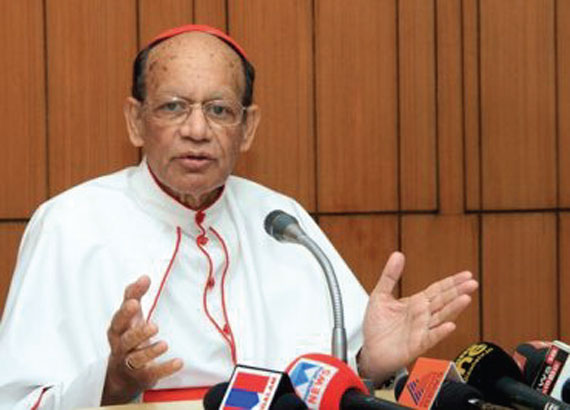
The head of the Catholic Church in India on July 27 expressed shock at the National Commission for Women’s demand for a ban on the Christian practice of confession. “This demand by the commission betrays a total lack of understanding of the nature, meaning, sanctity and importance of this Sacrament for our people; and also an ignorance of the strict laws of the Church to prevent any abuse,” Cardinal Oswald Gracias, president of the Catholic Bishops’ Conference of India, said in a press release.

The 73-year-old prelate, one of the eight cardinal advisers of Pope Francis, said such a ban will directly infringe on “our freedom of religion guaranteed by the Indian Constitution.”

According to him, millions of people from all over the world, over the centuries, have testified to the spiritual benefit of this Sacrament and to the grace, pardon and peace they have experienced as a result of receiving this Sacrament. “I am confident the government will totally ignore this absurd demand from the commission,” he added.

The cardinal was reacting to commission chairperson Rekha Sharma’s recommendation to Prime Minister Narendra Modi and some of his cabinet colleagues to take steps to abolish the practice of confession in Christian Churches. The commission, a statutory body concerned with advising the Indian government on policy matters affecting women, reportedly recommended confession’s abolition alleging that the practice could lead to blackmailing of women.

Sharma on July 26 said priests pressured women into telling their secrets. “We have one such case in front of us, there must be many more such cases and what we have right now is just a tip of the iceberg,” she said.

The recommendations come in the backdrop of a rape case against four priests of Malankara Orthodox Syrian Church accused of sexually exploiting a married woman belonging to their church.

The issue came to the fore after the victim’s husband wrote to the Church, alleging that the priests blackmailed and abused his wife, a school teacher.

Spanish priest a good shepherd for ex-Khmer Rouge

Within weeks of the collapse of the final remnants of the Khmer Rouge in late 1998, Father Enri-que Figaredo, also known as “Kike” or “The Bishop of the Wheelchair,” went to visit some of the movement’s last-standing cadres after hearing they needed assistance.

During the decades-long civil war, many had lost limbs to land-mines and were struggling after the group’s ultra-Communist leadership had defected, died or been arrested.

While many people would have been apprehensive to say the least about entering an area that until recently had been controlled by one of the most feared revolutionary movements of the 20th century, Father Figaredo saw it as his calling. “I remember going to one of the furthest corners of Cambodia,” he said from within the grounds of Battambang Catholic Church, or Pet Yiey Chee as it is known by locals.

“They asked for my support. I went to see them and gave them chickens so they could have eggs and meat. I also gave them small loans,” most of which are still being put to use today, he said.

Beijing, raid on Christian churches: ‘Our rights are being violated, enough!’

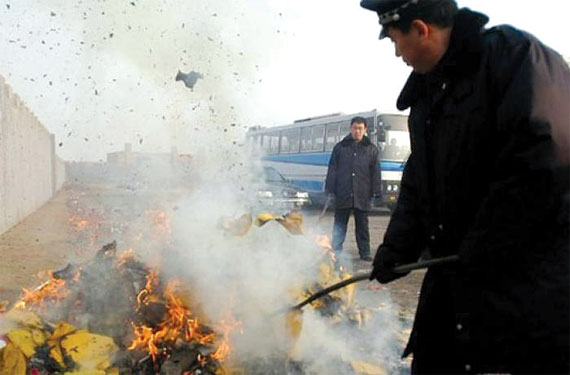
A group of Protestant congregations writes a courageous appeal to the government: “You consider us a threat, an error to be corrected. But wrong, we want to contribute to the well-being of the nation like everyone else.” The capital orders a catalog of unregistered places of worship. Among the churches affected, one is Catholic.

Chinese Christians “are not a force in disagreement, an error to be managed or rectified, the chosen objective of veiled or direct attacks. Thinking this way is wrong, it’s a fundamental mistake. The Christian churches, even the domestic ones, are animated by the desire for dialogue to achieve the best possible relations with the government of this new era, to achieve socialism with Chinese characteristics “of which President Xi Jinping speaks. This is the courageous appeal launched by dozens of domestic Protestant churches, struck by yet another round of restrictions on their religious freedom.

The text, signed by 34 unofficial churches, underlines how recent revisions to religious regulations adopted by the government have broken the rights of the faithful: “The normal life of a believer has been violated and hindered, and this has caused enormous emotional damage. The sense of patriotism that animates Christians has also been affected, opening the possibility to social conflicts. The situation seems to worsen day by day.”

To overcome this impasse, Christian leaders write, “the authorities must respect the religious freedom protected by the Constitution of China. That text contains many rights that in reality the single-party state does not respect. The churches have a real desire for dialogue.”

The Chinese State Council approved in 2016 a new package of regulations on religious activity termed as “draconian.” The declared aim is to eliminate the unregistered Christian cult, that of the so-called “domestic churches.” The new rules came into force on 7 October 2016, effectively prohibiting religious preaching or Christian events online or in schools.

Cardinal Tagle laments deaths of innocent people

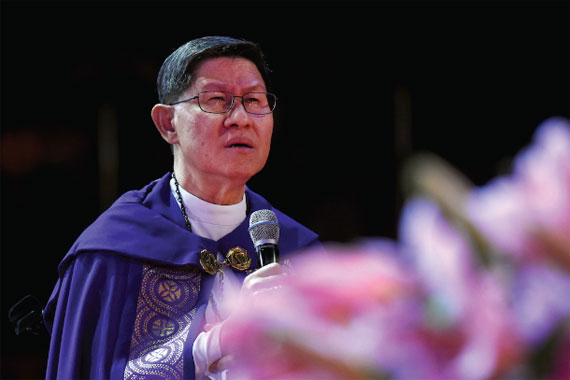
A teary-eyed Cardinal Luis Antonio Tagle of Manila has lamented the deaths of innocent people killed since Philippine President Rodrigo Duterte’s assumed office during the last day of a summit on new evangelization on July 22.

Addressing a crowd of priests, nuns, religious and lay people, the prelate asked if people were happy with all the deaths around them.

“Do you rejoice at the deaths of the innocent?” Cardinal Tagle asked in the wake of a statement released by the country’s Catholic bishops condemning a wave of killings across the country.
In his prayer, the Manila archbishop spoke to God about many innocent people dying.

“We want to believe that you do not rejoice in their death. But there are so many of them,” said the prelate. Police have reported more than 23,000 killings over the past two years, which human rights groups said were likely linked to the government’s war against narcotics.

The cardinal included in his prayer a 36-year-old migrant worker who was killed in Slovakia for defending two women from being attacked.

“Where do we see your face? Where do we hear your word? Some people are asking, where are you?” asked the cardinal.

The cardinal told about 8,000 participants at the Fifth Philippine Conference on New Evangelization to become “bread” for others amid the hunger in the world.

Philippine President apologizes for calling God ‘stupid’

Philippine President Rodrigo Duterte apologized to the “all forgiving God” after being heavily criticized for calling God “stupid” in a controversial televised speech last month. Duterte, 73, made the apology during a two-hour meeting with religious leaders at the Malago Clubhouse, but clarified that he was not saying sorry to any church or religious leader.

“I only apologize to God and nobody else,” he told Jesus Is Lord founder Eduardo Villanueva in a video posted on Facebook. “If I wronged God, then he would be happy to listen to my apology. Why? Because my God is all-forgiving. He does not remember past hurts. Why? Because God created me to be good, not bad.”

The Filipino leader reminded the religious leaders about the separation of church and state, saying they should not use God’s name to attack him or his administration.

“Remember that there is a division between church and state. You can criticize anything at all— from the garbage collector to generals and even to vice president and senator,” Duterte said. “But never, never use the name of God as a front to attack government because that is not the proper way to do it. There is a separation of state and church. Do not use God to attack me. That is not proper and I’m sure that is not what God wants.”

Duterte met with the religious leaders to improve his strained relations with Asia’s largest Catholic Church after Philippine Catholic bishops called for fasting and prayer.

Humanae Vitae at 50: Help people to live out the teaching of Pope Paul VI, says Commission head

The Church should stop arguing over the rights and wrongs of artificial contraception but instead find ways to help people live out the teaching of Pope Paul VI, according to the leader of a commission set up by Pope Francis to study Humanae Vitae.

MgrGilfredo Marengo, who coordinated a research group examining material in the Vatican secret archives on the compiling of Paul VI’s controversial encyclical, said there was an urgent need for pastoral work because “objectively what Humanae Vitae says” is “very distant” to many people.

“Today we have a difficulty in accompanying families pastorally on the path marked out by Humanae Vitae. Perhaps if all those years we had invested more energy on this pastoral path instead of debating, in a strict way, if Humanae Vitae is right or Humanae Vitae is wrong, maybe today we would be in a better place,” Msgr Marengo said.

Today marks exactly half a century since Paul VI released one of the most controversial encyclicals of recent times, reaffirming the Church’s opposition to artificial contraception. Its release was met with fierce criticism from inside the Church and, fifty years on, the evidence suggests it is a teaching largely ignored by Catholic laity.

According to a 2014 poll by Univision 79% of Catholics across the world favour the use of contraception, a figure that rises to more than 90 percent in the Pope’s home continent of Latin America.

At the same time there have been a growing number of voices inside the Church defending the encyclical, in particular where it argues that contraception is “intrinsically wrong” and should be “absolutely excluded” in all cases. Last month 500 priests in England signed a letter stating their full support for Humanae Vitae.

When the Pope asked Msgr Marengo and a commission to look at the Vatican’s secret archives into the compiling of Humanae Vitae, it was met with alarm in traditional Catholic quarters that Francis was trying to covertly undermine – or re-write – Paul VI’s teaching.

But Mgr Marengo and his body conducted a solidly historical analysis of Humanae Vitae which has now been presented in a book “The Birth of an Encyclical,” currently only available in Italian. Then there was a commission of experts, set up by Pope John XXIII, with a majority of them arguing for contraception to be allowed in some circumstances. In 1967, this commission’s report was leaked to and published by The Tablet, The National Catholic Reporter and Le Monde.

Yet it was the divisions within that expert commission – four of its 72 members were opposed to any change in teaching – that led Paul VI to disregard its advice.

Terrorism is not Christian-Islam clash: Cameron

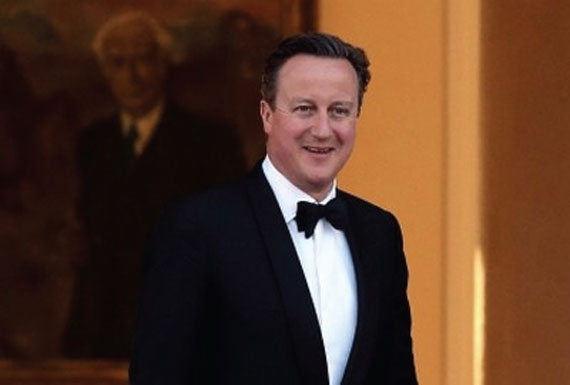
Former British Prime Minister David Cameron on July 25 said terrorism should not be seen as a battle between the Christian countries of the West and the Islamic countries in the Middle East. It is all about identifying and wiping out a small section that believes in extremism. Criticizing US President Donald Trump’s view on terrorism, he said it is more of an intellectual battle against those who believe in the “perverted view” of the Islamic religion.

“When at times I listen to President Trump, it seems he thinks of terrorism like a clash of civilizations between the Christian West and the religion of Islam, which I think is completely wrong,” said Cameron, also the former Conservative Party chief.

“What’s happening now-a-days is a civil war in the Islamic states between a vast majority willing to practice their religion peacefully and a very small minority that have taken up a radicalized and perverted view of the religion and turned it into a kind of belief.

“What we have to do is recognize those who are involved in this,” he pointed out while addressing the Annual General Meeting of the Indian Chamber of Commerce here.

Cameron said the terrorist problems have surfaced not just in the Middle East but also in Afghanistan, Pakistan, India and Britain in recent times, which shows “we are involved in a big intellectual fight.”

He said that in order to discourage the spread of radicalism among people, the success of multi ethnic nations like India and Britain should be celebrated.

“We should try to celebrate the multi-cultural, multi-religious, multi-ethnic countries like India and Britain. We should also help those countries in wiping out the perverted practice of radicalism in the name of religion,” he said.

Talking about the spread of Islamic State in Iraq and Syria, he said such forces need to be fought with fire to eliminate the extremists. “Iraq is a state that has been finding support for the Islamic State that actively sends terrorists to other countries. Sometimes people are trained in Iraq and sent to the European countries while at other times they are just radicalized through social media.

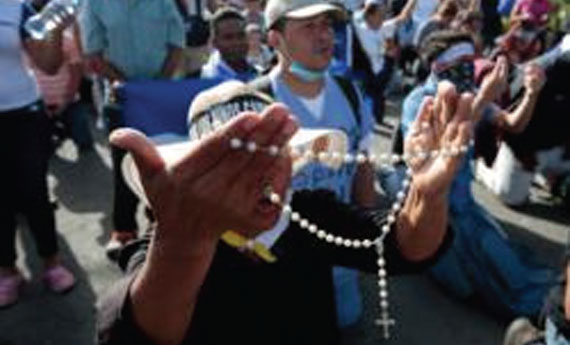
Nicaraguan bishops to pray for exorcism as violence continues

As attacks on Catholic clergy continue and anti-government protesters are besieged by Nicaraguan police and paramilitaries, the bishops said they would pray an exorcism prayer.

The bishops said July 20 would be a day of prayer and fasting “as an act of atonement for the profanation carried out in recent months against God.” On that day, “We will pray the prayer of exorcism to St Michael Arch-angel.” On July 15, the vehicle of Bishop Juan Mata Guevara of Esteli was shot as he traveled to the city of Nindiri, where he had hoped to stop an attack by police and paramilitaries. The bishop escaped unharmed but the vehicle’s tires were shot out and windows broken, said Father Victor Rivas, executive secretary of the Nicaraguan bishops’ conference.

An attack on July 14 at the nearby National Autonomous University of Nicaragua campus in Managua left two students dead and injured 15 more. Some of the fleeing protesters sought shelter in Divine Mercy Church, where the injured were being treated, but armed assailants stopped ambulances from reaching the church.

A Catholic analyst in Nicaragua, who preferred not to be named for security reasons, said the dialogue has been interpreted as an attempt by Ortega and his wife, Vice President Rosario Murillo, to buy time. The bishops also run the risk of being blamed for the collapse of the talks if they withdraw as mediators, the analyst said.

EU population up to nearly 513 million

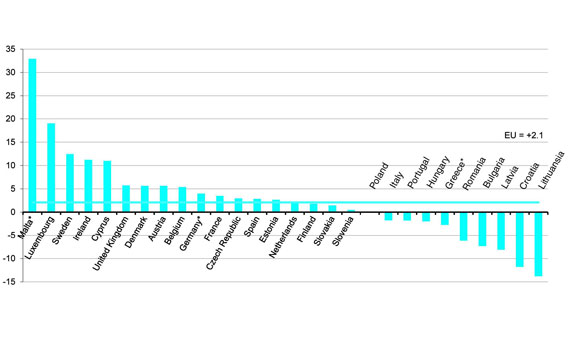
On 1st January 2018, the population of the European Union (EU) was estimated at 512.6 million, compared with 511.5 million on 1st January 2017. During the year 2017, more deaths than births were recorded in the EU (5.3 million deaths and 5.1 million births), meaning that the natural change of the EU population was negative. The population change (positive, with 1.1 million more inhabitants) was therefore due to net migration.

With 82.9 million residents (or 16.2% of the total EU population on 1st January 2018), Germany is the most populated EU Member State, ahead of France (67.2 million, or 13.1%), the United Kingdom (66.2 million, or 12.9%), Italy (60.5 million, or 11.8%), Spain (46.7 million, or 9.1%) and Poland (38.0 million, or 7.4%). For the remaining Member States, nine have a share of between 1.5% and 4% of the EU population and thirteen a share below 1.5%.