Clergy are ‘main obstacle’ to Pope Francis’ agenda: Vatican newspaper

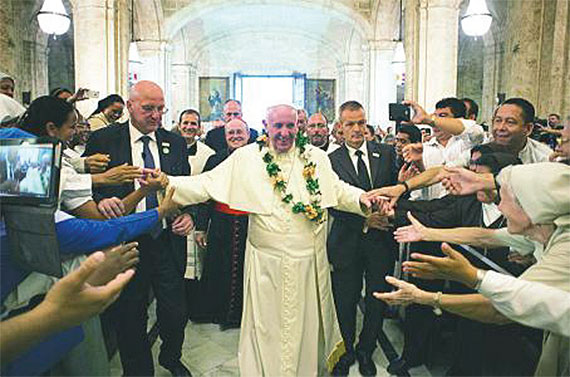
The “main obstacle” Pope Francis faces in implementing his agenda for the Church comes from “closure, if not hostility” from “a good part of the clergy, at levels both high and low,” stated an article in the Vatican’s semi-official newspaper L’Osservatore Romano on the weekend of the end July.

Giulio Cirignano, an Italian priest and Scripture scholar at the Theological Faculty of Central Italy, accused all levels of clergy — priests, bishops, and cardinals — of opposing the Pope’s agenda because of being attached to traditional ways of thinking and practices.

“The main obstacle that stands in the way of the conversion that Pope Francis wants to bring to the Church is constituted, in some measure, by the attitude of a good part of the clergy, at levels high and low … an attitude, at times, of closure if not hostility,” he said.

Cirignano argued that average pew-sitters, not the clergy, are the ones who are recognizing that now is the “favourable moment” for the “conversion” of the Church championed by Pope Francis.
“Most of the faithful have understood, despite everything, the favourable moment, the Kairos, which the Lord is giving to His community. For the most part, they’re celebrating,” he said.

“Despite that, the portion [of the community] closest to little-illuminated pastors is maintained behind an old horizon, the horizon of habitual practices, of language out of fashion, of repetitive thinking without vitality,” he said.

Cirignano outlined several factors that he said explains why much of the clergy is not behind the Pope’s agenda for the Church. This includes, he said, many having a “modest culture level,” an unacceptable image of what it means to be a priest, and theological confusion when it comes to God and religion.

Many clergy who oppose Pope Francis, he said, operate from an old theology, associated with the Counter-Reformation. Such a theology, he said, is “without a soul.” It is responsible for transforming the “impassioned and mysterious adventure of believing” into “religion” that does not reach the level of a real “faith.”

Germany: 162,000 Catholics left Church, 537 parishes closed in 2016

162,093 Catholics left the Church in Germany during 2016—down from 181,925 in 2015, according to statistics released by the bishops’ conference on July 21. 28.5% of Germans are Catholic and the Catholic population stands at 23,582,000, down from 27,533,000 in 1996.

537 parishes closed in 2016. Over the past two decades, over 3,000 parishes have closed, with the number declining from 13,329 to 10,280.

There are now 13,856 priests in Germany, down from 14,087 the previous year. The Sunday Mass attendance rate was 10.2% in 2016, down from 10.4% in 2015.

Some other statistics:
The number of baptisms declined from 259,313 in 1996 to 171,531 in 2016. However, the number of baptisms has risen for two consecutive years.

The number of adult converts fell from 3,860 in 1996 to 2,574 in 2016, and the number of adults who returned to the Church fell from 6,981 to 6,461.

First Communions declined by over 100,000, from 291,317 in 1996 to 176,297 in 2016.

Catholic weddings fell from 79,453 to 43,610. The number of Catholic funerals declined from 286,772 to 243,323.

Nun celebrates Catholic wedding in Canada

Cindy and David had their religious wedding on Saturday, July 22, celebrated by… a woman. The exceptional ceremony took place in a Catholic Church at Lorrainville, 650 km west of Montreal in Canada.

In the rural diocese of Rouyn-Norand in the Abitibi-Témiscamingue region, the lack of priests is such that the bishop called on the assistance of Sr Pierrette Thiffault of the Sisters of Providence.
Why Sr Pierrette?

“You need to ask my bishop,” she smiles, explaining that in this zone several priests are responsible for up to seven or eight different parishes each.

“I was happy and proud to be able to provide this service for my diocese,” she says.

Although rare, such an event is in fact authorized by canon law.

“Where there is a lack of priests and deacons, the diocesan bishop can delegate lay persons to assist at marriages, with the previous favourable vote of the conference of bishops and after he has obtained the permission of the Holy See,” says Canon 1112.

“A suitable lay person is to be selected, who is capable of giving instruction to those preparing to be married and able to perform the matrimonial liturgy properly.”

Hence, on May 23, Sr Pierrette received the necessary mandate in the form of an authorization from Rome after her name was proposed by the Congregation of Divine Worship and for the Discipline of Sacraments.

A member of the Sisters of Providence the past 55 years, Sr Pierrette is a pastoral worker in the parish of Moffett, which neighbours Lorrainville, where the wedding took place on July 22.
In fact, it was as a catechist that she came to know David, the husband when he was a high school student.

Feminist group claims responsibility for Mexico bishops bombing

An internet statement claiming to be from a feminist movement says the group was behind July 25 bombing at Mexico’s Catholic Council of Bishops. The homemade device caused little damage.

A statement signed by the “Informal Feminist Command for Anti-Authoritarian Action” was posted on Contra Info. The international website says it is maintained by “anarchists, anti-authoritarians and libertarians.”

The statement says Feminist Command was responsible for the bomb made of “dynamite, LP gas and butane.” It then says: “For every torture and murder in the name of your God! For every child defiled by paedophiles!”

Contra Info has previously published seven stories on Feminist Command actions in Mexico, although The Associated Press could not confirm the existence of the group. Mexican authorities were not immediately available to comment.

Tutsis and Hutus practise the multiplication of love and fishes

When Sr. Mary Rose Mukuki-bogo first approached women in Gisagara, southern Rwanda, about starting an agricultural associa-tion, they were furious. It was 1997, three years after the 100-day genocide in 1994 that killed more than a million people during the fighting and the chaos afterwards. Mukukibogo, a member of Les Soeurs Auxiliatrices (Helpers of the Holy Souls), remembers walking from house to house in the district near the southern city of Butare, asking them if they’d like to join a farming cooperative. “They said to me, ‘I don’t understand how you can ask us to stand up,’ “ said Mukukibogo. “We have lost everyone. How can you ask us to stand?” In 1994, Rwanda lost 13%  of its population in the course of a single season, the result of a civil uprising between the Hutu, a peasant majority, and the Tutsi, the minority ruling class. After the genocide, infra-structure lay in ruins. The rural farmers, who had barely eked out a living before the killing, found themselves thrust deeper into poverty. Most men of working age had been killed, were imprisoned or fled to neighboring states as refugees, making economic recovery even more challenging. “It was very difficult for them to do any type of activity, because their spirit was so low,” recalled Mukuki-bogo, a genocide victim herself who lost multiple siblings in the genocide. “I started to accompany them to have hope in life.” Rwanda is a communal society, and farming associations have been a part of community life for hundreds of years, through “Ubudehe,” or mutual field cultivation. Slowly, Mukukibogo built a group of genocide victims, all of whom had lost their husbands, to start farming together.

An Unwanted Shepherd: The Bitter Dispute In Nigeria’s Ahiara Diocese Is About More Than Tribal Politics

On 10 July, the seminarians in a house of formation in the Ahiara diocese woke as usual; but their morning prayer was anything but routine. The atmosphere was like a graveyard. The deadline given by Pope Francis for all the priests of the diocese to pledge obedience to him and apologise for their rejection of the appointment of Peter Okpalaeke as their bishop had passed the previous day.

The 40 or so seminarians had one prayer intention that morning: that the situation in the diocese be resolved quickly, so that they could finally be ordained, five years after some of them had completed their formation. Exactly two weeks after the 30-day papal ultimatum to all Ahiara Catholic priests to apologise and accept Peter Okpalaeke as their bishop, the 529-member Ahiara Diocese Worldwide Laity Council has written another letter to Pope Francis, praying for justice and protection from a “rapacious predator.” The latest letter dated Sunday, July 23, 2017, was signed by 529 members of a global network of Catholics with roots and or relationships traceable to the Ahiara Presbyterium, of Nigeria, constituted to promote the social and pastoral health of members and the Diocese, using all resources available to them globally. Entitled: “We pray to you for justice, for a Bishop Incardinated in our Presbyterium—We Have Been Taken Advantage of, as Orphans,” the letter openly accused Emeritus Francis Cardinal Arinze of being behind the oppression of “orphan diocese,” and passionately pleaded with the Catholic Pontiff to deliver them from miscarriage of justice. According to the signatories, “it is against this background, that we collectively raise our clenched fists in prayer to you, to give us justice, to protect your ‘orphan diocese’ from the rapacious predator who, like a proverbial king of the world, would stump at an ant to deny it microscopic crumbs.

Vatican shuts down fountains as Rome deals with drought

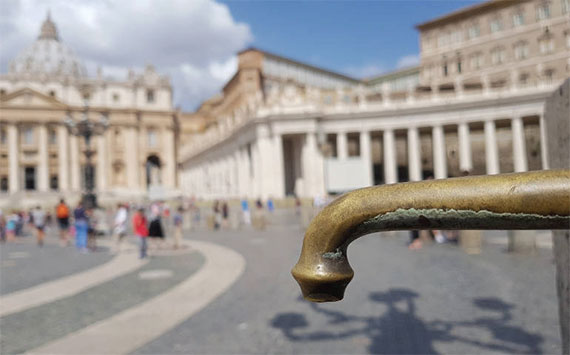
While Rome reels from one of its worst droughts in decades, the Vatican is doing its part to conserve water by shutting down the city-state’s 100 fountains. The office governing Vatican City State announced July 25 that the drought has “led the Holy See to take measures aimed at saving water” by shutting down fountains in St. Peter’s Square, throughout the Vatican Gardens and in the territory of the state.

Benedict XVI: On the dictatorship of the Xeitgeist, deceased cardinal had faith in Church

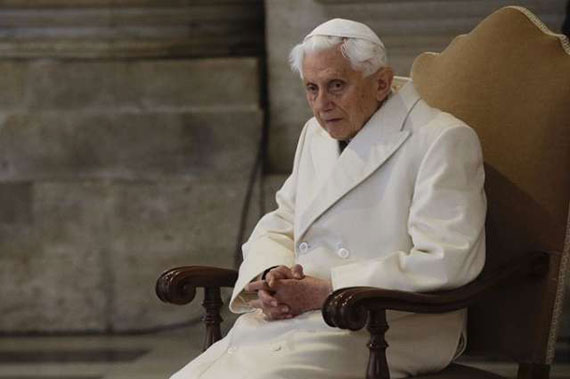
In a tribute to the late Cardinal Joachim Meisner, Pope-emeritus Benedict XVI praised the German prelate for his “conviction that the Lord does not leave His Church, even if at times the ship is almost filled to the point of shipwreck.”

The message from the retired Pontiff, which was read out at Cardinal Meisner’s funeral by Archbishop Georg Ganswein, suggested that Benedict saw the Church as enduring a time of crisis.
In a candid passage of his message, Benedict wrote:

“What struck me particularly in the last conversations with the Cardinal, now gone home, was the natural cheerfulness, the inner peace and the assurance he had found. We know that it was hard for him, the passionate shepherd and pastor of souls, to leave his office, and this precisely at a time when the Church had a pressing need for shepherds who would oppose the dictatorship of the zeitgeist, fully resolved to act and think from a faith standpoint. Yet I have been all the more impressed that in this last period of his life he learned to let go, and live increasingly from the conviction that the Lord does not leave his Church, even if at times the ship is almost filled to the point of shipwreck.

Venezuelan Church condemns ‘morally unacceptable’ government

The Venezuelan Church has announced that it will no longer participate in the “national dialogue” between the pro-Chavez government of Nicolas Maduro and the opposition.

“There are obvious issues that were brought to the table from the beginning of the discussions in October 2016 but these issues have never been addressed,” explained Cardinal Baltazar Enrique Porras of Mérida in the northwest of Venezuela.

Until now, the Church has tried to maintain a dialogue at all costs in order to prevent the country from tipping over into violence.

Central African Republic: Muslims take refuge in Catholic cathedral

More than 2,000 Muslims have sought refuge in the Catholic cathedral in Bangassou, in the Central African Republic, to escape sectarian violence.

The Muslim refugees have fled from attacks by the anti-Balaka militia group. An estimated 100,000 people have been driven from their homes in the conflict that has plagued the Central African Republic for several years. The anti-Balaka forces—composed primarily of Christians, but repudiated by Church leaders—have been condemned for multiple human-rights viola-tions.