300 people pledge to donate their eyes in Bangaluru

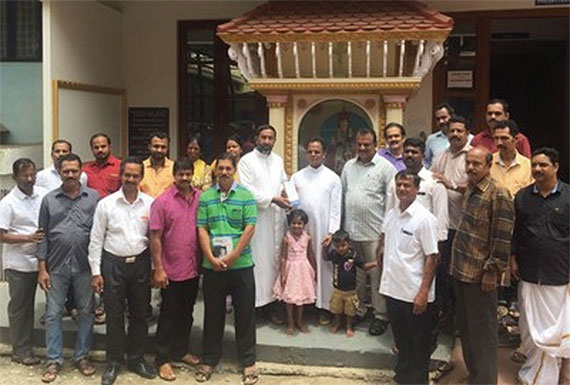
About 300 people from two parishes at Dasarahalli in Bangaluru pledged to donate their eyes. The parishioners belonging to St Claret and St Joseph Church on July 16 pledged to donate their eyes with Project Vision, an organization working for the cause in the city.

So far more than 60,000 people have pledged to donate their eyes with Project Vision. Already 100 people have received sight through the donations done through this organisation in various parts of the country. According to Project Vision, in 2016, only about 26,000 people donated their eyes in India, though there were about 85 lakh deaths reported.

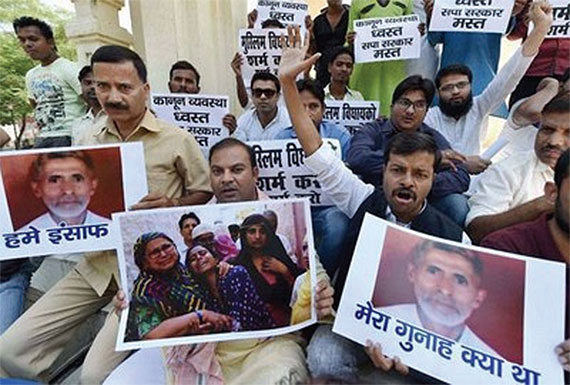
Indian Americans hold protests against mob lynchings in India

Indian Americans, spanning various communities, held protests in three US cities, to express their outrage over lynching of minorities by mobs in India and the Narendra Modi government’s policies which are “emboldening such forces.”

The protests here as well as San Diego and San Jose were organised by The Alliance for Justice and Accountability (AJA), an umbrella coalition of progressive organisations across the US, and other groups. A fourth protest is scheduled to be held in New York City on July 23, said a press release from AJA.

These protests are similar to the “Not In My Name” protests that have been held across various cities in India. Besides the AJA, the protests in San Jose were jointly organised with the “Multifaith Voices for Peace and Justice,” while the South Asia Solidarity Initiative (SASI), will be part of the protests in New York City.

Protesters slammed the “brutal killings of mostly Muslims and Dalits in the name of cow protection,” alleging these were orchestrated by “Hindu supremacist groups ideologically aligned” with the BJP-led central government and “drawing inspiration” from the beef ban imposed by the governments in various states.

“The reign of terror unleashed by Hindu supremacist cow vigilantes is clearly targeted at browbeating the nation’s religious minorities into the status of second class citizens,” said Suhail Syed, one of the organisers of the protests in Washington DC.

Protesters in San Jose carried signs, such as “India – Hostage to Hindutva?” and “Beef Ban is Cultural Fascism.”

The AJA has pledged to work with people of all faiths to defend India from the onslaught of hate and divisiveness.

Nun offers lifeline to refugees who fled Timor Leste

Rostiana Bareto, 49, experienced tough living conditions as a refugee when she and her family settled in Atambua, western Timor, on the border with Indonesia. Despite the fundamental challenge of making ends meet, she and her husband decided to stay and avoid the political instability back home.

More than 250,000 people fled Timor Leste or were forcibly transferred west following violence that escalated around an independence referendum, Aug. 30, 1999. The initial attacks on civilians by anti-independence militants expanded to general violence throughout the country.

Many returned to Timor Leste after the declaration of independence in 2002. But some 100,000 people chose to continue their lives in East Nusa Tenggara province, including 60,000 people in Belu regency.

Since her arrival, Bareto, now widowed, has not received any assistance from the government, causing great frustration for her family and many others living in similar conditions.

Their lives began to change when they met Holy Spirit Sister Sesilia Ketut, 59. Seven years ago the nun gave Bareto some money to start her own cloth-weaving business. Working in a group of widows she learned to weave and cook, and make bags, rosaries, flowers and wallets, which were then sold to markets.

“Every day our job was weaving and we never stopped, although the products were sold at a cheap price,” said the mother of six.

Now, more than 300 widows — whose husbands either died before or after the 1999 conflict — are receiving help from the nun.

Catholic woman rises to top govt post in Bangladesh

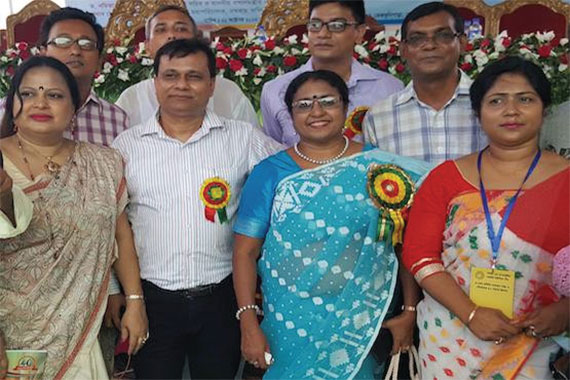
A Catholic woman has been appointed to one of Bangladesh’s top bureaucratic posts, drawing praise from the country’s minority Christian community.

Nomita Halder from Shelabunia Church in Khulna Diocese was appointed acting secretary of the Expatriate Welfare and Overseas Employment Ministry.

She is the first Christian in Bangladesh to hold such a high post in the civil service since independence from Pakistan in 1971. Halder had served as a personal secretary to Prime Minister Sheikh Hasina since 2014.

Cardinal Patrick D’Rozario of Dhaka hailed the appointment.

“Nomita Halder’s appoint-ment is a matter of joy and honour to minority Christians in Bangla-desh. She has been very helpful to the church in times of need, and hopefully her new post will broaden the scope of her support to the community further,” Cardinal D’Rozario said.

Nirmol Rozario, president of Bangladesh Christian Association described Halder’s appointment as an “inspiration” to the Christian community. “She has been appointed to the post deservedly.

She has proved the notion that minorities can’t get top govern-ment posts is wrong. We had a state minister from the Christian community and now we have a secretary. It is not just a matter of joy but also a great source of inspiration,” Rozario told ucanews.com.

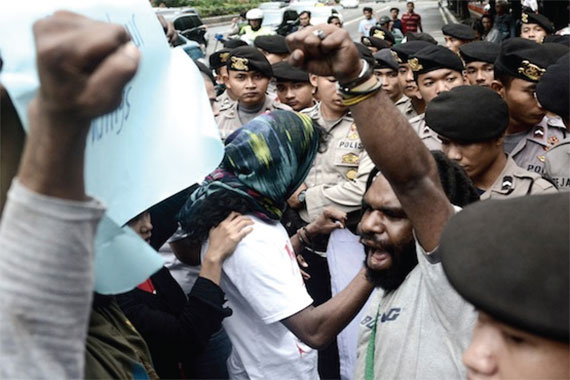
The church and West Papua’s struggle for self-determination

As in Papuan society, so also in churches, there are members who opine that the western part of New Guinea has the right to be an independent state. There are also members who consider this region a province of Indonesia.

But what is the attitude of church leaders? Seen from a theological perspective, it is the duty of the ecclesiastical hierarchy to unify people. That’s why bishops and pastors think they are not allowed to take sides.

Vietnamese officials meet Benedictines over land dispute

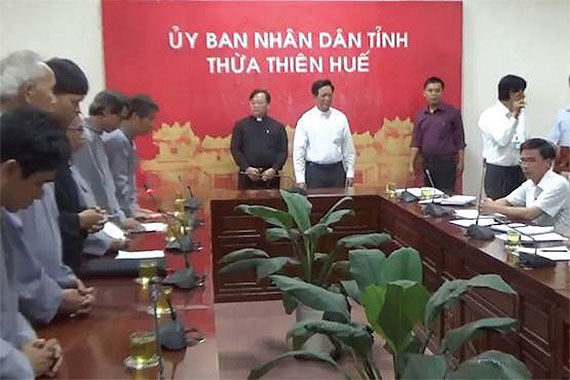
Government authorities in central Vietnam offered no gesture of goodwill in dealing with a long-standing land dispute with Benedictines at a meeting between both sides, the monks have said. Twelve Benedictines led by Father Anthony Nguyen Van Duc, superior of Thien An Monastery, met 15 officials of Thua Thien Hue Province at the headquarters of the People’s Committee of the province on July 12.

Also present at the meeting were Fathers Anthony Duong Quynh and George Nguyen Thanh Phuong representing the Hue Archbishop’s House.

“The meeting lasted three and half hours but had no successful result because government officials showed no positive sign of openly having dialogue with us to resolve the dispute,” Father Peter Khoa Cao Duc Loi, who attended the meeting, told ucanews.com.

Former cathedral now part of China’s World Heritage island

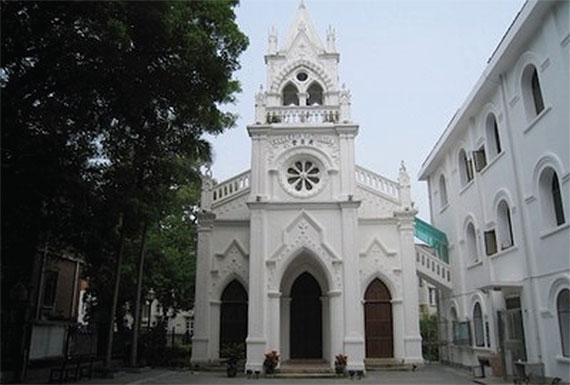
A Catholic Church building is part of a Chinese island’s inclusion on the UNESCO World Heritage list which is being seen by local Catholics as an opportunity for more people to learn about their faith. The former Catholic cathedral of Xiamen Diocese on Gulangyu Island of eastern Fujian province was included by the 41st session of the World Heritage Committee held in Krakow, Poland, on July 8.

The decision in recognizing the Christ the King Church as one of the 51 notable sites on the island comes as the church celebrates its 100th anniversary.

“The renovation of the church has almost come to an end,” Bishop Joseph Cai Bingrui of Xiamen told ucanews.com. “There is a tour guide service to introduce the church. It is a good chance to let more people feel the religious culture on the island,” said the bishop.

The church is located at the centre of the heritage area so “priests and laypeople in the church are very happy and excited,” said Joseph Chen, a full time worker of the church.
The Christ the King Church was built by Spanish Dominican Bishop Mamaunel Prat in 1917.

Pakistani Catholic family flees following blasphemy allegation

A Catholic family in Pakistan has fled their home fearing attack by local Islamists after their eldest son was arrested on blasphemy charges on July 13.

“We left the city same evening the clerics captured him,” Shfaaqt Masih told ucanews.com. “I switched off my phone fearing they will trace my family.”

Shfaaqt, whose name Masih is not a surname but identifies him as a Christian male, said that local police station will not tell them where 16-year-old Shahzad is currently being held.

“My relatives even visited the jail but he is not there. We don’t know what to do,” he said.

The father of four has been hiding since Shahzad was taken into custody for allegedly insulting the Prophet Mohammed, a crime that carries a mandatory death sentence in Pakistan.

Shfaaqt, a builder, is liaising with his parish priest in the hope to somehow resolve the situation. “We are poor people and I am out of work now. The clerics did not listen to our please; they will kill my son,” he said.

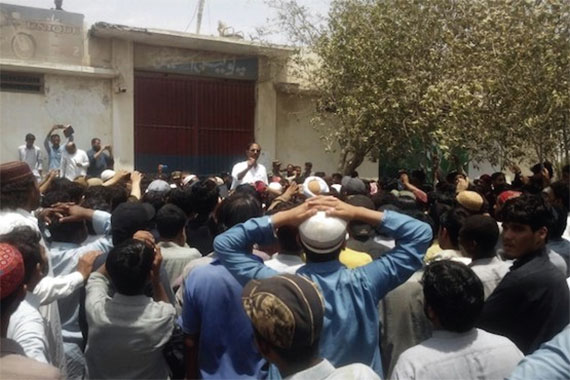
Shahzad worked as a sweeper in a hospital of Dinga City, Punjab province, where a Muslim shopkeeper accused him of blasphemy. He was later taken to a madrassa by activists from the Islamist party Tehreek-e-Tuhafaz Islam Pakistan and was then arrested by the police.

More than 50 party activists later protested in front of the police station.

Dinga has a population of about 80,000 people of whom 150 are Christians who live in a Christian colony near the city’s railway station.

In response to the allegations, an X-marked photo of Shahzad is now being shared on social media captioned laanat (shame).

Raja Nadeem Ahmad, the main complainant of the blasphemy allegation, said Shahzad said abusive things about the Prophet Mohammed.

“We brought him to my shop and he repeated the same insulting remarks … he has hurt our feelings and tried to disrupt the peace in the area,” stated Ahmad in the first information report made with the police.

Ghazi Saqib Shakeel Jalali, from Tehreek-e-Tuhafaz Islam Pakistan said, “We will not forgive even if the court releases him. We are not cowards.”

Census 2016: Drop in religious affiliation no surprise for Archbishop Coleridge

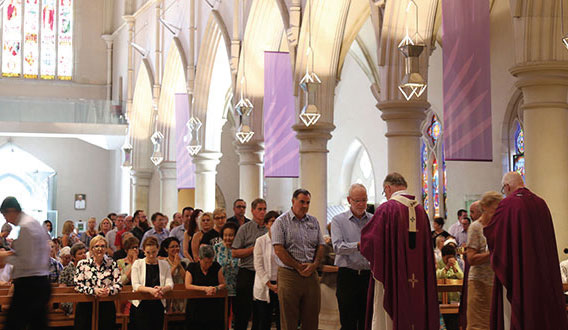
Archbishop Mark Coleridge believes the latest census data showing a drop in religious affiliation suggests “the young are more interested in unorganised spirituality than organised religion, and that they aren’t as interested in denominations as their forebears were.”

Catholicism remains by far the most dominant religion in Australia with more than 5.2 million followers, however the 2016 census data shows a decline in religious affiliation, particularly amongst the young.

In 2016, 22.6% of Australia’s 23.4 million population listed Catholicism under religious affiliation, compared to 25.3% in 2011. However the 2016 census shows that the number of people who listed “no religion” had risen to about 30%, almost double the figure in the 2001 census.

About 13% of Aus-tralians listed “Angli-can” as their religious affiliation (second behi-nd the Catholic Church), com-pared to 17.1% in 2011. For Archbishop Coleridge, who is leading the plans for a plenary council to discuss the future of the Church, the census data is nothing new.

Archbishop Coleridge said the Church should consider the advice of a famous psychologist and consider the facts as “friendly.”

The census shows that 44.7% of families were couples with children, while 37.8% were couples without children. Another 15.8% were one parent families, and 1.7% were listed as “other family types.” This data has barely changed since 2011.

Turin Shroud is stained with blood of torture victim, research reveals

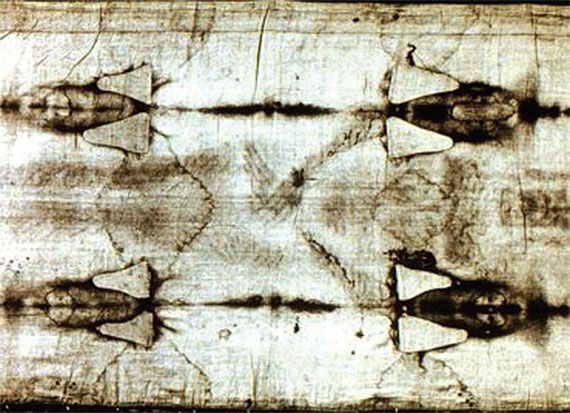
New research claims the Shroud of Turin is stained with the blood of a torture victim, supporting the theory that it was used to bury Jesus. The Shroud of Turin in a linen cloth, three meters in length, that bears an image of a man some believe to be Jesus Christ. The cloth is thought by many to have been used to wrap Christ’s body after His crucifixion.

The new research, carried out by various institutions under Italy’s National Research Council and published in the US scientific journal Plos One, contradicts the theory that Jesus’ face was painted onto the cloth by forgers in medieval times.

Elvio Carlino, who led the research at the Institute of Crystallography in Bari, Italy, says the cloth contains nanoparticles of creatinine bounded with small nanoparticles of iron oxide, which indicate severe trauma rather than paint.