Muslim refugees to US are declining as Christians overtake them

Christians made up the majority of refugees admitted to the U.S. in the first five full months of the Trump administration, reversing a trend that saw Muslims entering the country at higher numbers under President Obama, a new Pew Research report shows.

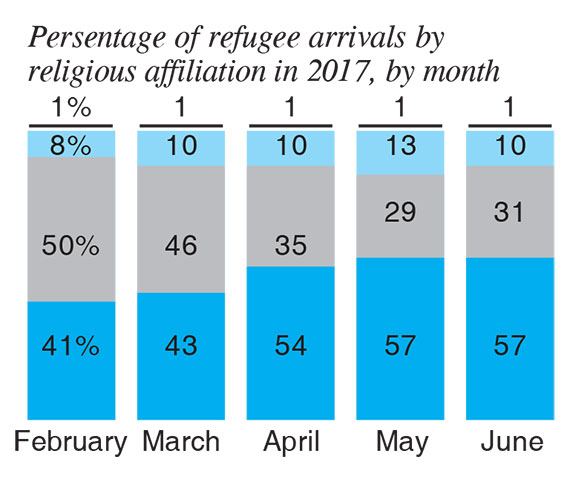
Out of all the refugees who arrived between President Trump’s inauguration and June 30, about half were Christians and 38% were Muslims, according to data released July 12.

But when monthly figures are viewed, the data (originally from the U.S. State Department) reveals a steady decline for Muslims, from about 50% of refugees in February to 31% in June.

This comes at a time when the origin of most of the world’s refugees continues to be Muslim-majority countries. According to the U.N. Refugee Agency, Syria continues to account for a significant proportion of newly displaced refugees, with more than half of all new refugees worldwide fleeing the conflict in that country. Afghanistan and Somalia also top the list.

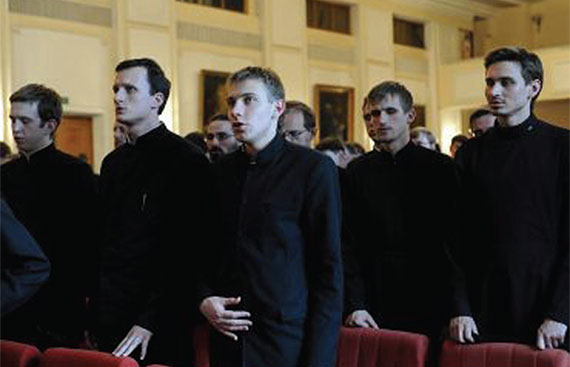
Russian Orthodox Church sees sharp rise in seminary admissions

Russia’s Orthodox church has reported a sharp rise in seminary admissions, with the highest numbers ever recorded now training for the priesthood in its 261 eparchies, or dioceses.

The Interfax news agency said 1593 ordinands were expected to begin studies this summer, a 19 percent increase from 2016, while a further 827 young men would also join the church’s preparatory course, or propaedeuticum, a quarter more than last year. It added that a total of 5877 semi-narians were now preparing for ordination, a figure comparable to that of Poland’s Catholic Church in its peak years 1985-7.

The Russian church was savagely persecuted under Soviet rule in 1917-1991, but is now by far the largest of the world’s 14 Orthodox denominations, claiming 144 million members, with 368 bishops and around 40,000 priests and deacons. The church, which has 926 functioning monasteries and convents, is estimated to have opened three places of worship daily over the past three decades, bringing the total to 36,000 compared to just 6000 at the end of communist rule.

Protestant churches embrace gluten-free bread for Communion as Vatican reaffirms ban

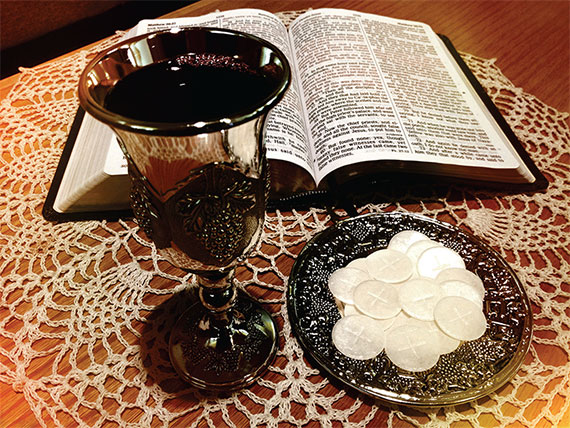
While the Roman Catholic world digests a Vatican letter confirming the church’s prohi-bition on gluten-free wafers, Protestant churches continue to place orders for a Eucharist that won’t bother the gluten-intolerant. Gluten or no gluten — the difference is theological. Protes-tant churches generally do not subscribe to the doctrine of transubstantiation, which holds that during the Communion service, the bread and wine turn into the actual body and blood of Jesus.

The Catholic Church, which affirms transubstantiation, wants to hew as closely as possible to the elements of the first-ever Communion — the bread and wine that Christians believe Jesus ate and drank during the Last Supper.

But Protestants consider Communion a symbolic act, and generally give themselves more leeway on the elements.

Wine can be grape juice. Bread does not necessarily have to be made out of wheat.

The Vatican letter released on July 8 reaffirmed that Communion wafers must contain at least some gluten. But the rule is not new, just a restating of an earlier teaching.

“ … bread made from another substance, even if it is grain, or if it is mixed with another substance different from wheat to such an extent that it would not commonly be considered wheat bread, does not constitute valid matter for confecting the Sacrifice and the Eucharistic Sacrament,” the letter reads.

And it makes clear: “Hosts that are completely gluten-free are invalid matter for the celebration of the Eucharist.”

Low-gluten wafers, however, are deemed acceptable by the church.

Those who suffer from celiac disease — about 1 in 100 people worldwide, according to the Celiac Disease Foundation — must stay away from gluten to avoid painful symptoms and serious health consequences.

‘For every person baptized, the U.S. Church loses six Catholics’

He may be at the helm of one of the most dynamic Roman Catholic parishes in Florida, with the 3,000 families present each weekend at one of the seven masses at Saint Peter’s Church in Deland, but Father Thomas Connery is still worried.

“We have many retirees in Florida, so the churches are full but take them away and it’s a catastrophe,” says Father Connery. “We’re not managing to reach the young generations.”

“For every person baptized, the American church loses six Catholics,” he laments. “We don’t dare talk about it among priests, doubtless because we do not know what to do, but it is past time to break this taboo.

“Imagine a company facing such a problem. It would immediately launch an emergency plan! What about us?”

U.S. bishops do not yet have an emergency plan, but they have organized a unique gathering. For the first time in a hundred years, priests, laymen, monks, nuns and other heads of services and movements from all over the United States have come together at a meeting in Orlando, Florida from 1 to 4 July.

Their purpose is to reflect on how to be the best “missionary disciples,” in the words of Pope Francis in his Evangelii Gaudium.

Catholics represent the largest denomin-ation in the United States, with 77.4 million believers (22% of the total population), but fewer people have actually been attending church. The number of people taking the sacraments, except baptism, is also dropping.

From 2013 to 2016, the number of children who had their first communion decreased by 50,000 or 7%. Catholic schools registered a loss of 250,000 students over the same period.

If the Roman Catholic Church is losing ground in the United States, this also has to do with the rampant secularization of U.S. society in general. Americans who define themselves as not belonging to any religion, the “nones,” make up close to 25% of the population, up from 6% in 1991.

Joaquín Navarro-Valls has died

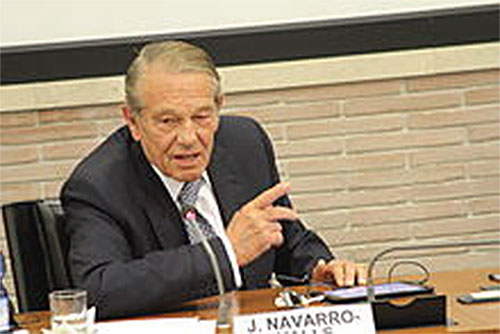
The former Director of the Press Office of the Holy See, Joaquín Navarro-Valls,  on  5 July 2017, after a battle with pancreatic cancer. He was 80 years old. Navarro trained as a medical doctor with a specialization in psychiatry, as well as in journalism, moving to Rome in the early 1970’s, becoming a foreign correspondent and eventually being elected president of the foreign press association in the city.

How Facebook is like church, according to founder Mark Zuckerberg

Its members gather to comfort and encourage one another. They check in on the sick and struggling. They wish each other a happy birthday. Founder and CEO Mark Zuckerberg said in Chicago at the first Facebook Communities Summit that the two are similar in the way they create community and bring people together.

“As I’ve travelled around and learned about different places, one theme is clear: Every great community has great leaders,” he said. “Think about it. A church doesn’t just come together. It has a pastor who cares for the well-being of their congregation, makes sure they have food and shelter. A Little League team has a coach who motivates the kids and helps them hit better. Leaders set the culture, inspire us, give us a safety net and look out for us.”

Cameroon’s bishops insist Bishop Balla was murder victim, not suicide

The Catholic bishops of Cameroon insist that Bishop Jean-Marie Benoit Balla of Bafia was “brutally assassinated,” rejected the conclusions of an autopsy that found “no trace of violence.”

At a July 7 press conference, Archbishop Samuel Kleda of Doula, the president of the nation’s episcopal conference, rejected the results of the autopsy that had been performed by German doctors. Government officials had stressed that the autopsy was performed independ-ently under international super-vision. The bishops’ rejection of the results points to the deep level of suspicion between the Catholic hierarchy and the government leadership. Some observers questioned whether the bishops feared that the government had provided another body for the autopsy. At his July 7 press conference, Archbishop Kleda decli-ned to give a direct answer to the question of whether the bishops had received Bishop Balla’s body for burial.

While investigation of Bishop Balla’s death continues, government officials now suggest that it was a suicide.

Embezzlement charges against two former officials of Vatican-run hospital

The Vatican has indicted two former officials of the Bambino Gesu Hospital on embezzlement charges. The indictment is the first brought by Vatican prosecutors under new rules designed to promote transparency and accountability in Vatican financial transactions. The Vatican has been under pressure from European banking authorities to prosecute violations of these rules.

Giuseppe Profiti and Massimo Spina—who were the president and treasurer, respectively, of the Bambino Gesu Foundation— were summoned to appear before a Vatican tribunal for a July 18 hearing on the charges. Although the summons was issued on June 16, the indictment was announced on July 13. The two former officials of the foundation connected with the Vatican-owned Bambino Gesu Hospital are charged with improperly spending more than €400,000 in foundation funds on the renovation of an apartment owned by Cardinal Tarcisio Bertone. In the past, Profiti has said that the expenses were justified because the cardinal’s apartment was used for the foundation’s fundraising events.

Indian minister criticized for demonizing Goan Catholics

A federal minister in India has come under fire for indirectly accusing Catholics and environ-mentalists in Goa for blocking development in the former Portuguese colony which they say harms the environment and local culture. Road Transport, High-ways and Shipping Minister, Nitin Gadkari, said that “a microscopic minority” has been blocking major projects worth more than US$150 million in the name of protecting the environ-ment.

The projects include plans to widen main roads, expand ports and to develop water transport via the state’s two major rivers — Mandovi and Zurari.

“There is opposition among a few groups,” the minister told an annual meeting of the Goa Chamber of Commerce and Industry.

Conflict with ISIS ally is not a religious conflict, Philippine bishops insist

The Philippine bishops said that the conflict with Maute, an ISIS-affiliated group, is not a conflict with Islam. In May, Maute attacked the city of Marawi, setting fire to Christian buildings and taking hostages at the cathedral. “We believe that the war in Marawi is not religious,” the bishops said in a July 10 statement. “We have heard and read truly stunning stories of how Muslims have protected and helped Christians to escape from almost certain death.” The bishops added: Even now Christians are assisting thousands of Muslims who have fled from Marawi for safety. These are indisputable signs that there is no religious war … As Catholic religious leaders we condemn in the strongest terms possible, as did Islamic religious scholars in Mindanao, the violent extremist Maute group in Marawi. Its leaders and members have pledged allegiance to ISIS. They have contradicted the fundamental tenets of Islam by abducting and hostaging, maiming and killing the innocent.