Christians refuse $10 million grant in Meghalaya

Christian leaders have rejected an offer from India’s tourism ministry of a US $10 million grant for the facelift and main-tenance of churches in the Christian-majority State of Meghalaya.

Catholic leaders in the state told that they will not apply for or accept the funding of 613 million rupees for illuminations, landscaping, construction of parking lots and toilets among other infrastructure work at 37 churches.

Federal tourism minister K.J. Alphons announced the grant on Jan. 8, just 10 days ahead of India’s Election Commission declaring Feb. 27 as the date of provincial elections in the northeastern state.

The minister, a member of the pro-Hindu Bharatiya Janata Party (BJP), has also announced another 86 million rupees for similar projects involving temples, mosques and important sites for 11 other religious groups including indigenous Khasi, Jaintia and Garo believers.

Catholic support is seen as crucial for an election victory in the state, where Christians account for about 80 percent of the three million people. The BJP holds only two seats in the 60-state house.

Alphons, a churchgoing Catholic from southern Kerala state, was made tourism minister on Sept. 3 last year, and four days later he was named the party’s election chief in Meghalaya state.

However, Alphons’ allotment ahead of the election has not enthused Christian leaders.

“First of all, we were never consulted on our needs, nor informed about the project. All these days after the announce-ment, no one from the government had contacted us on this, so there is no question of taking money from the government,” Bishop Victor Lyngdoh of Jowai Diocese told.

Bishop Lyngdoh said the church leadership “cannot take financial help now because it will give the wrong message to our people during this election time. It can create confusion,” he said.

Church decorated with Tagore motif inaugurated

A church decorated with the style and motifs used by Rabindranath Tagore in his works was inaugurated on January 18.

The Infant Jesus Church at Makrampur here was formally inaugurated by Bishop Cyprian Monis of Asansol.

“We have incorporated local traditions of Santiniketan while trying to integrate the church decor with the artistic style of Tagore and popular traditions like open air classrooms which the poet had started,” an official of the Kolkata-based organisation that designed the Infant Jesus Church said.

The centre-piece in the church’s sanctuary is an imposing banyan tree under which Jesus is seated in lotus position imparting his teaching and blessings to all.

Above the banyan tree is the depiction of the Spirit of Wisdom and Enlightenment.

On the right side of banyan tree is the tabernacle enshrined in the traditional winnowing fan decorated with bamboo background and surrounded by conch shells. On the left side of the tree is Infant Jesus – the patron of the church.

The inside back wall of the church has a 40 feet mural depicting Jesus sitting under a huge banyan tree and holding a child.

Mizo Christians in India offer cash for babies

A Baptist Church in India’s north-eastern Mizoram State has announced incenti-ves to encourage couples to have more babies in an effort to check their dwindling numbers, disregarding a natio-nal policy to control the population.

The church in remote Lunglei town said it will pay families a one-time cash assistance of 4,000 rupees (US$ 63) for a fourth child and an additional 1,000 rupees for each new child.

Influential youth organization Young Mizo Association endorsed the move. “What the church has done is worth emulating. We Mizos are facing a serious challenge of dwindling numbers. We need to arrest the trend and if possible to reverse it,” president Vanlalruata (only one name) told.

The Christian-majority Mizoram has about 1.1 million people, 88 percent of them Christians. Mizoram is among the least populous states in the country of 1.3 billion people. India, currently the world’s second most populous nation after China, implements a national policy to check population growth.

Leading investigative journalist wins India’s “Booker Prize”

Josy Joseph, a leading investigative journalist, was among the winners of this year’s Crossword Book Awards, an Indian version of international literary wards. The Crossword Book Awards are considered as the Indian version of the Man Booker Prize and Commonwealth Writers’ Prize. It is currently in its 15th edition. This year the winners of both jury and popular choice awards for 10 categories were announced on January 18 at the Royal Opera House in Mumbai.

Jammu-Kashmir Christians attacked over forced conversion

Hindus have burned down a church and shops belonging to Christians in India’s Jammu and Kashmir State after a Hindu family alleged that their dau-ghter was killed by her husband after she had been forced to convert to Christianity.

The violence is unusual in the Muslim-dominated state, where Christians have not faced any hostility from Hindus.

Tension is high in the Raj-ouri district bordering Pakistan following the Jan. 16 incident, with police on alert to prevent further violence.

Police said a 25-year-old Hindu woman, Seema Devi, married a local Hindu man, Rinku Kumar, two years ago. The man took his wife to the northern Punjab State, where he was working in a private firm.

However, Devi died recen-tly in Punjab and her body was taken by her husband to his home village in Kashmir for burial with Christian rituals.

It is the first incident of Hindu violence against Christians in the state, although there has been some tension after Muslims accused Christ-ians of converting their people.

Pope Francis is top world leader, who in India the Christian leader?

In the latest survey of world leaders done by Gallop international, which is usually about politicians in the secular world, the wonder of wonder is this: The highest placed person on the list isn’t a political leader, but a religious person: Pope Francis who has a 58% rating.

Then comes German Chancellor Angela Merkel with 49%, as the top politician in the secular domain, followed by French president Emmanuel Macron with 45% approval. The US President Trump with 31% support could get only the third place in the secular domain. What is significant is, India’s PM Modi comes immediately after Trump as in the fourth secular leader with 30% support. Only then comes Chinese and Russian presidents and British PM followed by many others.

What is significant to note are two things: 1. Even in a secularized world people at large give top priority to religion and moral values. 2. Both among religious and secular leaders of the world Pope Francis, as the head of the Catholic Church, though he is the head also of Vatican, the smallest State in the world, is looked up to as the towering, shining personality, both among religious and political leaders. Among Christians and multiplicity of Churches in India is there any one spiritual person looked up to by the entire country? Since Pope Francis happens to be the head of the Catholic world, acceptable to all irrespective of differing religions persuasions, what about the Catholic Churches in India made up of Latin, Syro-Malabar and Syro-Malankara Rites?

Knanaya diocese declines Vatican directive to end endogamy

In a possible confrontation with the Catholic Church, the Knanaya Church has refused to put an end to the practice of endogamy, where members of the same ethnic background marry one another.

Those who don’t follow the custom are excommunicated.

Dismissing the demand of the Oriental Congregation in Rome to get rid of the practice, the Kottayam archdiocese has declined to allow those who were excommunicated back into the Church. The archdiocese is planning to approach the Pope and also legally challenge the direction. In a recent order sent to the bishop of the diocese of Chicago, Jacob Angadiath, the congrega-tion had asked him to take back those who were excommunicated.

Calling the demand of the congregation as unacceptable, Stephen George, president of the Knanaya Catholic Congress said, “We will challenge the direction both legally and at the hierarchy of the Church.”

The congregation had issued the direction on the basis of a report by Canadian Bishop Michael Mulhal of Pembroke diocese, who was entrusted by Rome to study the issue and present a report in 2015.

The bishop filed the report after visiting the State of Chicago and had recommended that the practice be ended.

Pakistan reopens churches after outcry

Pakistan’s north-western Khyber Pakhtunkhwa province has allowed six Christian churches to reopen, some two weeks after their forced closure over alleged security threats, minority representatives said. The home-based churches are in Abbottabad, the city where Al Qaeda chief Osama bin Laden was found and killed in a raid by U.S. Navy Seal commandos in 2011.

The surprise ban, which came shortly after the U.S. placed Pakistan on a special watch list for severe violation of religious freedom, angered minority leaders and rights activists who called the move discriminatory.

The ban was overturned by Khyber Pakhtunkhwa Speaker Asad Qaiser when the matter was taken up by opposition law-makers in the provincial assembly.

“All churches have got verbal permission to reopen and worship according to their religious faith and beliefs. We are expecting to get a written order soon,” Pastor Christopher Shakar said in a statement.

“We are grateful to everyone for being with us when we were facing difficulties to worship our Lord. God has proven once again He is always with us.”

According to the pastor, Sunday Mass was also held at the churches.

Basharat Khokhar, a minority rights activist, had condemned the Khyber Pakhtunkhwa government for its prejudicial behaviour toward religious minorities.

“On one hand, the government wants to pay billions of rupees to Muslim clerics, while on the other hand it is shutting down Christian worship places,” Khokhar said.

On Jan. 18, Khyber Pakhtunkhwa Chief Minister Pervez Khattak approved a plan to provide a monthly stipend of 10,000 rupees (US$100) to thousands of Muslim prayer leaders in a scheme that will cost 3 billion rupees.

Kachin bishops meet Myanmar military chief

Four Kachin bishops have met Myanmar’s military chief Min Aung Hlaing to talk prospects for peace in the country’s north, where fighting between the military and armed ethnic groups has intensified. Retired Abp Paul Zinghtung Grawng of Mandalay and Bishops Philip Lasap Za Hawng of Lashio, Francis Daw Tang of Myitkyina and Raymond Sumlut Gam of Banmaw attended a meeting at Bayintnaung Parlor in Naypyidaw on Jan. 16.

For one hour and 45 minutes, the bishops and Min Aung Hlaing discussed the situation in Kachin and Shan states, where intense fighting has erupted in recent months between ethnic armed groups and Myanmar’s military.

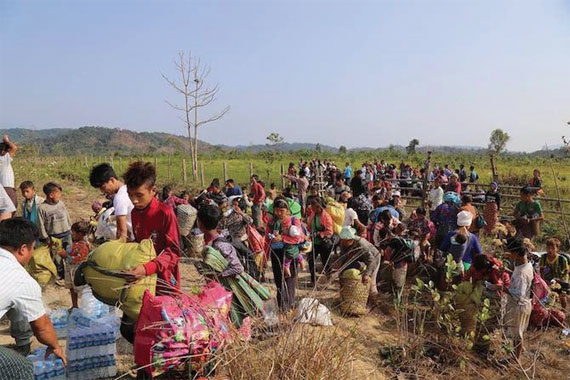
Since late last year, the military has conducted an offensive using airstrikes and heavy artillery, resulting in thousands of internally displaced persons fleeing their camps.

“We conveyed the message on the Catholic Church’s stance of getting a durable peace through dialogue instead of arms, and the church stands ready to take part in nation building in collabora-tion with all stakeholders,” he told ucanews.com.

Bishop Gam said the military chief reaffirmed its commitment to ending civil wars in Myanmar while opening the door to all armed ethnic groups to negotiate.

Since the situation deteriora-ted in 2011, more than 100,000 people have been displaced. Most of the state’s 1.7 million Kachins are Christians, including 116,000 Catholics.

Pakistan religious minorities face discrimination at work

Parmala Ravi Shankar quit working for a multinational company in Pakistan after four days when a manager asked her not to use the same eating utensils as Muslim colleagues. She was told to instead bring her own from home.

“I was wondering what is going on — am I not a human being?” Shankar recalls.

What happened to her is by no means unique.

Other well-known cases include that of a woman who was sentenced to death for blasphemy after an argument over her drinking water from the same glass used by Muslims.

The Human Rights Commi-ssion of Pakistan, in collaboration with organizations such as the Catholic Bishops’ Conference, has conducted case studies in Karachi and Hyderabad of Sindh province.

Moazzam Ali, a project coordinator, said a primary aim was to highlight impacts on people’s lives. A survey posed 22 questions related to consti-tutional guarantees such as the outlawing of discriminatory employment practices.

Father Saleh Diego, director of the National Commission for Justice and Peace (NCJP) of the Catholic Bishops’ Conference, said some people had a discri-minatory mindset.

Official Website

Exit mobile version