
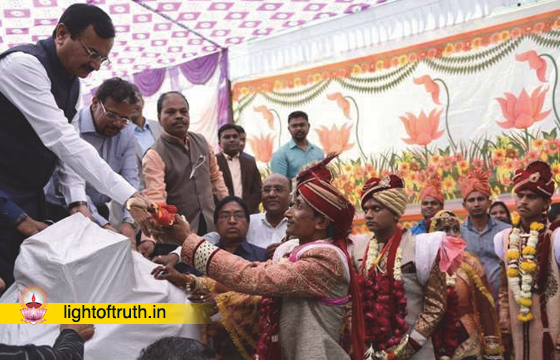
They say marriages are made in heaven but in the western Indian state of Gujarat, a dubious syndicate of paid agents is playing matchmaker for the mostly jobless boys from the prosperous Patel community and young girls from the indigenous Adivasi communities. The consequences are evidently disturbing and causing much pain and loss to the poor tribal people, who are highly protective of their girls like any class or caste community in India.
Bharatiya Tribal Party leader Raj Vasava says this has been a common practice among the Hindu Patel men to buy tribal women for marriage. But now it is being resented by the tribal communities. “It is a cultural assault and cannot be allowed,” he said.
The Patels, who are socially, economically and politically the most influential community in Gujarat, have no other way to deal with their skewed sex ratio of 700 girls for every 1,000 boys.
The state has some 10 million tribal people among its 62 million population. The state also has some 350,000 Christians, an estimated half of them are tribal people. While selecting brides, the Patels do not distinguish between Christian and Hindu tribal people, a Petel leader said.
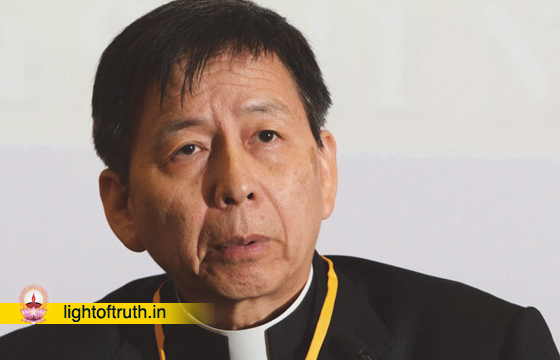
Chinese abp: Three stages to ‘drama’ involving church, communists
The ongoing “drama” between Chinese Catholics and the nation’s communist leaders has three stages, said Chinese Archbishop Savio Hon Tai-Fai, the Vatican’s nuncio to Greece.
The current stage in the drama, in effect since 2013, is one of “shrinking and getting confused,” Hon said.
“As a result of the drama, people feel so disoriented, disconnected,” Hon said in his recent keynote address to the 28th international conference of the U.S.-China Catholic Association, held at Jesuit-run Santa Clara University.
Hon cited three major players in each stage of the drama: the communist regime, the church in China and the Vatican. At this time, the Vatican was “trying to normalize the diplomatic relationship” with China, he noted. “The Holy See encouraged the Catholics to remain faithful, stating that an ‘independent church’ cannot be the ‘Catholic Church,’” Hon added.
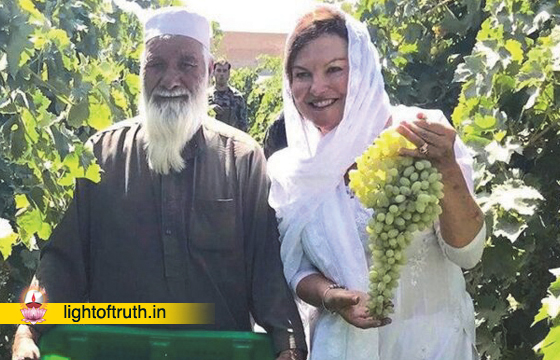
Roots of Peace founder fears for her nearly 400 employees in Afghanistan
Roots of Peace founder Heidi Kuhn is on a dead-line-driven, life-or-death mission to get her nearly 400 employees out of Afghanistan by Aug. 31.
The Taliban took over the organization’s com-pound in Kabul Aug. 15.
President Joe Biden vowed Aug. 24 in a statement with G7 leaders to stick to the end-of-the-month deadline he set to complete evacuation of “Americans, third-country nationals and Afghans who were allies in the war.”
In an Aug. 25 news conference, the Taliban announced that Afghans will no longer be able to leave the country.
Kuhn, a Catholic mother of four from San Rafael, California, launched rootsofpeace.org in 1997 to clear war-scarred fields in Afghani-stan and other countries of land mines and convert them into life-sustaining farmland.
In Afghanistan alone, Roots of Peace has helped plant over 5 million trees, created over 100,000 full-time jobs and facilitated exports of fruits, nuts and spices to new markets that by 2020 valued $1.4 billion. The Taliban’s attack on the Roots of Peace compound in mid-August occurred as local workers began the year’s harvest of grapes and other fruits of the vine.
In addition to working to secure the safety of her Afghan workers in Kabul, Kuhn and her organization are helping rural farmers throughout the country bring the harvest to market without interruption. The loss of the ready crops and resulting income would further devastate the country and its people, Kuhn said.
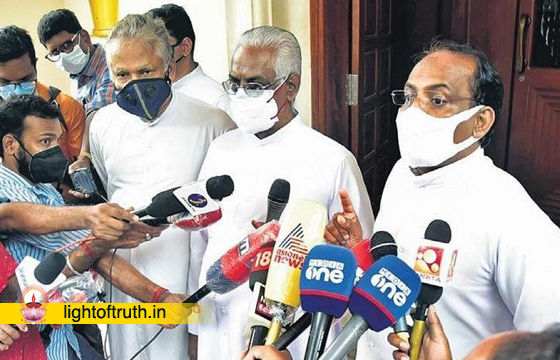
Priests appeal Pope against uniform mode of Mass celebration
All the 456 priests of the Arch-diocese of Ernakulam-Angamaly have written to Pope Francis saying they want to continue to offer Mass facing people, a practice that the Syro-Malabar eparchy has followed for the past 50 years. The memorandum was sent to the prefect of the Oriental Congregation in Rome and the apostolic nuncio in India on August 10, as the Syro-Malabar Synod prepared to discuss Pope Francis’ letter on the controversial issue of liturgy.
The memorandum was also signed by some priests of religious congregations working in the Syro-Malabar archdiocese.
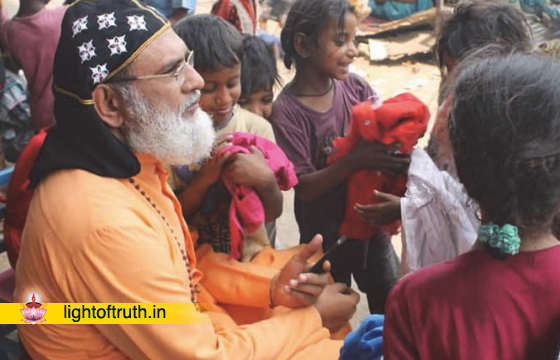
India loses fifth Catholic bishop to Covid-19
Bishop Jacob Barnabas of Gurgaon died of post Covid-19 complications at noon on August 26 in a private hospital in New Delhi. He was 60.
Bishop Bernabas is the fifth Catholic prelate in India to die of Covid-19 and its complications.
The other bishops who died of Covid-19 were Paul Alois Lakra of Gumla in Jharkhand on June 16, retired Archbishop Antony Anandara-yar of Pondicherry-Cuddalore on May 5, and Basil Bhuriya of Jhabua in the central Indian state of Madhya Pradesh, the next day. Retired Bishop Joseph Pastor Neelankavil of Sagar Syro-Malabar diocese died on February 17.
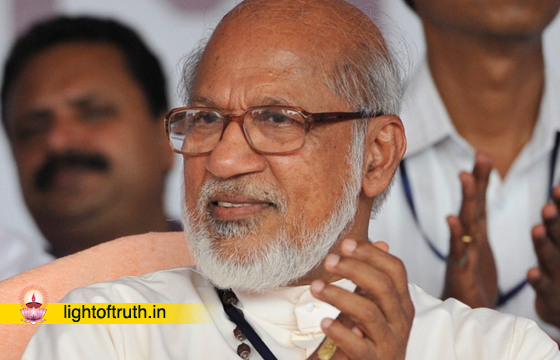
Cardinal Alencherry asked to face trial in land deal case
The Kerala High Court on August 12 said that Cardinal George Alencherry must face trial in the land deal case. The court upheld the verdict of a district sessions court that on August 24, 2019, asked the cardinal and two others to stand trial in the case. The court has dismissed six petitions submitted by Cardinal Alencherry.
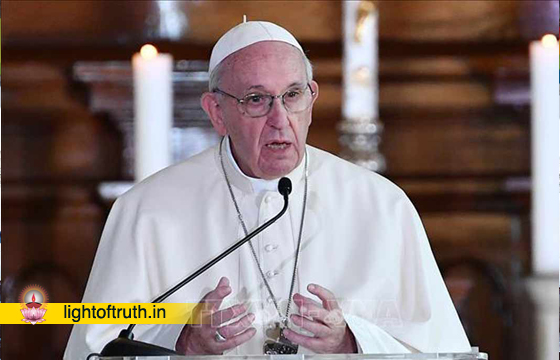
COVID-19: Pope donates 100,000 euros to Vietnam
The Vatican Dicastery for Promoting Integral Human Development announced on 24 August that the pontiff is sending 100,000 euros in emergency aid to the people of Vietnam, which is in a state of dire crisis due to the socio-economic fallout from the pandemic.
In Vietnam, the pope’s act of solidarity joins the Catholic Church’s action in favour of COVID-19 victims, which continues with unreserved dedication.

Bishops say Spain trying to ‘dismantle the Christian worldview’
Spain’s Catholic bishops warned of growing division and tension in their country over government attempts to “deconstruct and dismantle the Christian worldview.”
“We are in a difficult moment, not only because of COVID-19, but because we are convulsed by a deep institutional crisis, with some groups seeking to open a new constitutional phase and replace a political framework that has given Spain great stability,” the bishops’ conference said.
“Legislative initiatives by the coalition government on education, euthanasia, abortion, democratic memory and the judiciary reflect a global deconstruction project, whose development puts freedom at risk and impedes essential unity.”
The warning was contained in a 95-page statement, published July 28, setting out pastoral guidelines for the Spanish church from now until 2025.
The bishops said an attempt was underway to “erase distinctions between truth and falsehood, reality and fiction, good and evil.”
“With its prophetic mission, the church is obliged to denounce these attacks on freedom and justice, to act as a channel of encounter and reconciliation,” the bishops said. They added that “Spaniards are no longer living in a culture inspired by the Christian faith. For many, Christian truths have become incomprehensible, as moral standards flowing from the Gospel also become unacceptable.”
The statement was released two days after Spain’s co-governing Socialist Party confirmed plans to review a series of 1979 accords with the Vatican and adopt a “statute of secularism,” enforcing “strict separation between politics and religion, law and morality, crime and sin.”
The bishops said society was full of distrust and confrontation, as digitization, artificial intelligence and surveillance technologies fuelled “spiritual impoverish-ment.” They warned of a type of capitalism that does not just regulate production and consumption, “but also imposes values and lifestyles.”
New report says anti-Christian violence in Nigeria highest level for years
At least 3,462 Christians, including ten priests or pastors, were murdered in Nigeria in the first 200 days of 2021. The number, just 68 deaths short to the estimated total for 2020, is aligned with the warnings from human rights organizations that focus on anti-Christian persecution regarding the rise of religious-motivated violence in Nigeria, and a nation where the Christian and Muslim populations are widely considered as more or less evenly split.
According to a recent report coming from Nigeria itself produced by the International Society for Civil Liberties and Rule of Law, the number of unarmed Christians who were murdered by members of the Islamic terrorist organization Boko Haram or other Jihadist groups between Jan. 1 to July 18, 2021, is barely lower to the one estimated by Open Door’s International for 2020.
Breaking it down, the number means that 17 Christians a day were murdered for reasons related to their faith the first half of 2020, the second highest daily average since 2014, when over 5,000 Christian deaths were recorded in the hands of Boko Haram and jihadist Fulani herdsmen.
In addition to the Christians who’ve been killed in the first 200 days of 2021, some 3,000 Christians, many of them young girls and women, have been kidnapped by Islamic terrorists and their whereabouts remains unknown. The people behind the report estimate, extrapolating from previous cases, that at least three out of every ten kidnapped Christians have been killed.
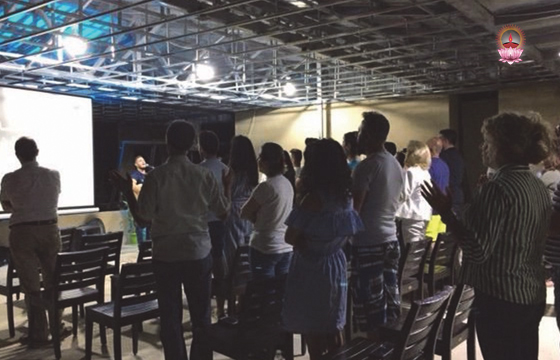
Christians in Lebanese border town say they’re having spiritual revival
Young adults and families say they are experiencing a spiritual revival in this town near the Syrian border even as Lebanon is pummeled by multiple crises: an economic meltdown, mass unemployment, a fresh wave of coronavirus infections, and shortages of fuel and electricity — all made worse by the ongoing political paralysis and an unresolved probe into the devastating Beirut blast.
“Every week we intercede for Lebanon. We know that God is going to speak life over this country, because many times Jesus showed us that this is in his hands,” a 31-year-old Lebanese Catholic named Nesrine told the Catholic News Service one balmy summer night.
“We feel that God is allowing what is happening in Lebanon. His heart is for salvation. Yes, many are now poor, others are battling coronavirus, but we see many Lebanese seeking the Lord, because he is the very last shelter they have,” said the petite, raven-haired woman who was a civil servant and owned her own successful media business before entering lay ministry.
Both Nesrine and her husband, Elie, once an atheist, have experienced dramatic spiritual conversions. And so, apparently, have many others among the 200-plus attendees at the prayer meeting at The Land.