
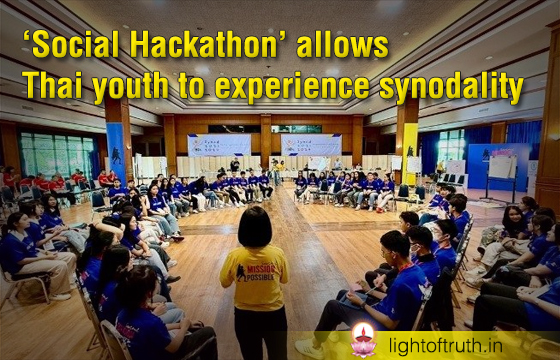
Students from Catholic schools throughout Thailand are taking part in a “Youth Social Hackathon” that provides them with opportunities and support to create a better world following a synodal dynamic. Organized by the Catholic Education Council of Thailand with the support of partners including the Archdiocese of Bangkok and the General Secretariat of the Synod, the four-day event invites teams from 12 Catholic schools across the country to investigate issues raised by the Synod that are found in their own communities and then propose creative solutions to those problems.
The event is inspired by startup tech “hackathon weekends”, says Dr Peter Monthienvichienchai, director of LiCAS News, the Archdiocese of Bangkok’s English-language news outlet. In the tech world, “hackathons weekends” allow hackers “to develop a product that they would go and pitch for funding to venture capitalists,” he explains. “What we’re doing here at the socialhackathon is that we use a similar format, but we ask the children here to try to solve issues in their community that matter to them.”
Instead of producing a tech product, Monthienvichienchai says, the students will “take a synodal journey with the people on the fringe of society, especially in their local community, listening to what their challenges, what their sufferings are, and come to together and attack the problem; come up with a solution; and pitch for funding.” At the conclusion of hackathon, judges will award funding to the most outstanding pitches “to make their solutions come true.”
The whole point, though, says Monthienvichienchai, “is to engage youth in a way that uses their language. It uses their energy.” At the same time, “for us, it’s an exercise that we’re listening to them. It’s showing them that we trust them to not only solve a problem, but to identify the problem that matters. And then the funding is really to empower the youth to take action and make their solution a reality.”
Five years of disrupted schooling in Ukraine has led to ‘emotional instability in children’
For five consecutive years, children in Ukraine have not have any form of “normal” schooling. From COVID19 to the ongoing war in the country, the Ukrainian Ministry of Education and Science reported that some 4.6 million children in Ukraine face barriers to education and 2 million of them have seen their school close down. In an interview with Vatican News’ Marie Duhamel, Laura Frigenti, the Director-General of the Global Partnership for Education—the largest global fund dedicated to education—spoke about the effects of the war in Ukraine on children’s education.
Frigenti highlighted there are two main consequences of the war on the educational system. The first is “that half of the infrastructure was destroyed, and so the children had to stop going to school and start remote education,” she explained. The children’s rights NGO Plan International reported that about 30% of Ukraine’s educational buildings have been damaged and over 365 schools completely destroyed since 2022. Despite moving online, constant, quality education remains difficult for children to receive as power outages and limited internet access create barriers.
This physical consequence of the war on education has also led to “an emotional instability in many children, which prevents them from fully achieving the objectives that they could achieve under normal circumstances,” as Frigenti described. She pointed out that the children as a result need psycho-emotional support “to make sure that they can compensate the crisis that they are experiencing in their life.” Thus, whenever possible, Frigenti said they try to bring children together physically to help them learn about each other and improve their social skills. However, this is not always possible due to the bombings.
A survey of 1,000 fifteen- to twenty-four-year-olds conducted by Plan International in February 2025 showed that one in five have missed between one and two years of education as a result of the war.
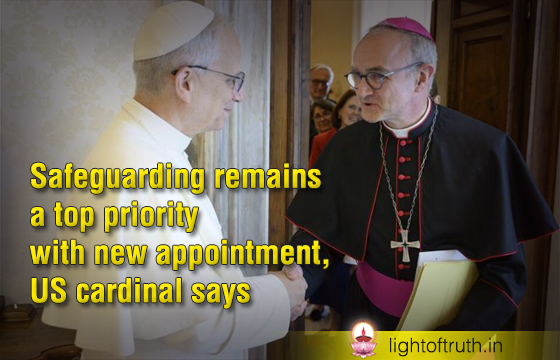
Safeguarding remains a top priority with new appointment, US cardinal says
Pope Leo XIV’s appointment of the new president of the Pontifical Commission for the Protection of Minors shows that safeguarding remains a top priority, its former president said.
“Our Holy Father Pope Leo XIV has affirmed the continued priority of the commission’s work for the universal church in his thoughtful appointment” of Archbishop Thibault Verny of Chambéry, France, as the new president of the commission, said Cardinal Seán O’Malley.
“The Holy Father’s words and deeds in these early months of his pontificate assure the world that the church will not grow complacent in her efforts to as best possible ensure the protection of children, vulnerable adults, and all people in our communities,” he said in a written statement released July 5, the day the Vatican announced the new appointment.
Verny, 58, has served as a member of the papal commission since 2022. “In addition to important contributions to the work of the commission, the archbishop has years of in-depth experience working with law enforcement, other civil authorities, and church leadership to ensure accountability for the serious failures of the church in France,” where he served as auxiliary bishop of Paris before joining the commission, O’Malley wrote.
“He has been at the forefront in seeking healing and reconciliation with survivors,” the cardinal said, and he “played an important role in the development and implementation of substantive policies and procedures, with cultural specificity, for the prevention of any recurrence of abuse.”
“With deep humility and profound gratitude, I thank the Holy Father, Pope Leo XIV,
for my appointment,” Verny said in a written statement. “I am honoured by the trust he has placed in me, fully aware of the grave and sacred task entrusted to the commission: to help the church become ever more vigilant, accountable, and compassionate in her mission to protect the most vulnerable among us,” he wrote.
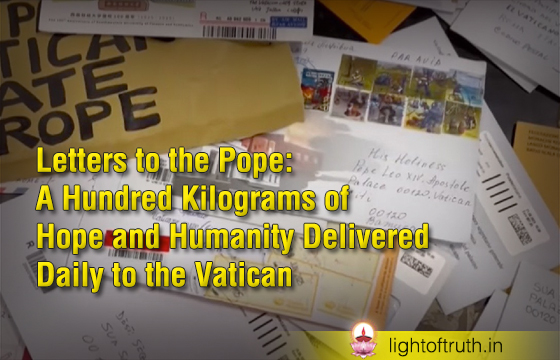
Letters to the Pope: A Hundred Kilograms of Hope and Humanity Delivered Daily to the Vatican
In a small but determined ritual repeated each day in Italy, postal workers sort through handwritten envelopes, illustrated postcards, and carefully wrapped packages—all marked with a curious address: simply, “To His Holiness the Pope.” No street name. No postal code. No country needed. Yet, somehow, they always arrive. According to Poste Italiane, Italy’s national postal service, an astonishing 100 kilograms of mail are delivered to the Vatican daily, addressed to Pope Leo XIV. Since his election on May 8, 2025, the influx has become a steady stream of paper prayers, heartfelt confessions, and appeals for guidance. And no matter how vague the sender’s scrawl—”The Pope, Rome” or “Vatican, Italy”—the system finds its way.
Antonello Chidichimo, director of Poste Italiane’s main sorting facility in Fiumicino, just outside Rome, says this has become the norm. “It’s truly global,” he explains. “Today, letters came from the United States, Kosovo, and India. Tomorrow it will be a different trio. There’s no way to pinpoint the most devoted country. They all write.”
After a stop in Fiumicino, each item undergoes security checks before being scanned, weighed, and forwarded to the Vatican’s nearest distribution centre. From there, the missives continue their journey into the heart of the world’s smallest state—and into the papal household. While the mechanics are routine, the meaning is not. Many letters bear the marks of deep emotion. A shaky hand hints at the elderly seeking a final blessing. A drawing of a dove or a sun might reveal a child’s innocence and trust. Others contain questions, thanks, or tears transcribed into ink. For the Vatican mail handlers, the work goes beyond logistics—it’s a ministry of presence.
Though the content remains confidential, the nature of the correspondence is unmistakable: these are not just letters; they are fragments of lives, stitched together by faith and hope. They carry grief, love, longing, and sometimes joy—each sender, anonymous or not, casting their message into a spiritual bottle and sending it toward Rome.
Inside the Vatican, while it’s not possible for Pope Leo XIV to read every word himself, the significance of this global chorus is not lost. It reflects the papacy not only as an office of leadership, but as a listening post for the world. Whether mailed from a bustling American city or a remote Indian village, each envelope crosses borders not only of geography but of human vulnerability. Poste Italiane knows that, and delivers accordingly—not just to an address, but to a presence.
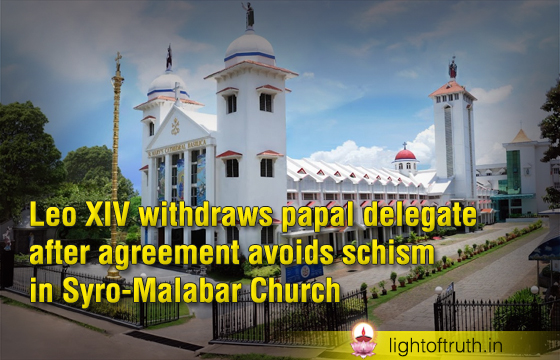
Leo XIV withdraws papal delegate after agreement avoids schism in Syro-Malabar Church
The specter of schism has hovered in recent years over the Metropolitan Archeparchy of Ernakulam-Angamaly of the Syro-Malabar Church in India—one of the 24 Eastern Churches in full communion with the Catholic Church. Parts of the clergy and faithful of Ernakulam-Angamaly, the largest Indian episcopal see in terms of the number of priests as well as the see presided over by the bishop in charge of the entire Syro-Malabar Church, did not accept the 1999 reform of the liturgical rite, which was later confirmed at the 2021 Synod of the Syro-Malabar Church.
Pope Leo XIV appears to have resolved the controversy by terminating the 2023 appointment of Archbishop Cyril Vasil’ as papal delegate to the Syro-Malabar Church to mediate the dispute. According to Vatican News, the official Vatican website, this decision by the pope “concludes the Holy See’s mediation work among the Syro-Malabars.”
Martin Bräuer, an expert at the Ecumenical Research Institute in Bensheim, Germany, told ACI Prensa, CNA’s Spanish-language news partner, that “Rome now considers the conflict over and therefore no longer needs a papal representative. Secondly, the agreement reached within the [Syro-Malabar] Church without the direct mediation of Archbishop Vasil’ is recognized.”
Indeed, the news comes after new measures to implement the liturgical reform approved by the 2021 Synod came into effect on July 3, the feast of St. Thomas the Apostle—patron saint of the Syro-Malabar Church. The compromise now reached allows the parishes of Ernakulam-Angamaly to celebrate the liturgy with the priest facing the faithful (versus populum), adhering to the practice of the Roman Rite, provided that at least one Sunday or feast day Mass is celebrated according to the traditional form, that is, with the priest facing the altar (ad orientem) during the consecration. According to the 2021 reform of the rite, during Mass the priest was required to address the people during the first part of the celebration, but the liturgy of the Eucharist was celebrated facing the altar.
This case has been, according to the expert, an acid test of the delicate balance between papal authority and the autonomy of the Eastern Churches. It was St. John Paul II who, in 1998, gave the Syro-Malabar bishops authority to resolve liturgical conflicts.
According to Bräuer, “the Syro-Malabar Church first attempted to resolve the conflict internally. When that failed, Rome intervened, but that too was unsuccessful.” The papal delegate, Archbishop Vasil’, who belongs to the Byzantine rite and had worked in the Dicastery for the Eastern Churches, was widely criticized for his authoritarian style. “He didn’t know how to find the right tone with the parties in conflict,” Bräuer commented.
In this regard, it was the metropolitan vicar, Archbishop Joseph Pamplany, successor to the apostolic administrator Bishop Bosco Puthur, who managed to move toward a solution thanks to a strategy of open communication and active listening.
Asked about the value of this experience for other liturgical conflicts in the Church, Bräuer said that the liturgy is “prayed dogma,” that is, an “expression of the Church’s faith” that can take many forms, as seen in the Catholic Church: for example, “in the West, with the ancient Mozarabic rite, and also with inculturated forms of the Mass in the Congo, Australia, or Mexico.” “Liturgical diversity enriches the Church, but fidelity to tradition does not mean stubbornly clinging to the past, but rather accepting change with discernment,” he stated.

Six million visitors to Notre Dame Cathedral in six months
Five years after a fire destroyed the famed Parisian Cathedral of Notre Dame, its doors opened for pilgrims and visitors to once again marvel at its French Gothic architecture. Now, six months since the reopening on December 7, 2024, a total of 6,015,000 people have gone through the Cathedral’s doors, as of June 30, 2025. On July 6, the French newspaper, La Tribune Dimanche, reported that, on average, 35,000 people visit the Cathedral of Notre Dame each day.
If the numbers continue on this path, attendance could reach 12 million by the end of 2025, which means it would knock the Eiffel Tower out of the top spot for most visited monuments in France. This figure would also exceed the pre-fire numbers when 11 million people visited the Cathedral each year.
However, work on the Cathedral is far from complete. Prior to the fire, restoration was scheduled for the chevet, the flying buttresses, and the Viollet-le-Duc’s sacristy. Plans for new stained-glass windows to be installed are set for 2026 and the Cathedral’s forecourt, green spaces, and front walkway are all slated for renovation, which will be finished in 2027.
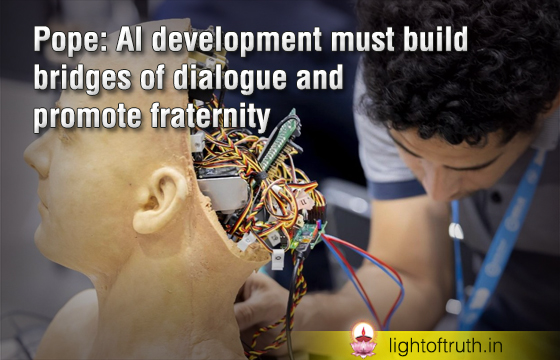
Pope: AI development must build bridges of dialogue and promote fraternity
Pope Leo XIV encouraged nations to establish frameworks and regulations on AI so that it can be developed and used according to the common good, in a message sent on July 10 to the participants of the AI for Good Summit, taking place in Geneva, Switzerland, from July 8 to 11.
“I would like to take this opportunity to encourage you to seek ethical clarity and to establish a coordinated local and global governance of AI, based on the shared recognition of the inherent dignity and fundamental freedoms of the human person”, the message, signed by the Secretary of State, Cardinal Pietro Parolin, said.
The summit is organized by the United Nations’ International Telecommunication Union (ITU) and is co-hosted by the Swiss government. The event sees the participation of governments, tech leaders, academics and others who are interested and work with AI.
In this “era of profound innovation” where many are reflecting on “what it means to be human”, the world “is at crossroads, facing the immense potential generated by the digital revolution driven by Artificial Intelligence”, the Pope highlighted in his message.
“As AI becomes capable of adapting autonomously to many situations by making purely technical algorithmic choices, it is crucial to consider its anthropological and ethical implications, the values at stake and the duties and regulatory frameworks required to uphold those values”, the Pope underlined in his message.
He emphasized that the “responsibility for the ethical use of AI systems begins with those who develop, manage and oversee them” but users also need to share this mission. AI “requires proper ethical management and regulatory frameworks centered on the human person, and which goes beyond the mere criteria of utility or efficiency,” the Pope insisted.
Citing St. Augustine’s concept of the “tranquility of order”, Pope Leo highlighted that this should be the common goal and thus AI should foster “more human order of social relations” and “peaceful and just societies in the service of integral human development and the good of the human family”.
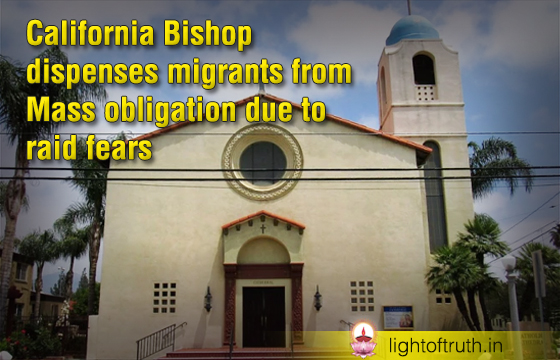
California Bishop dispenses migrants from Mass obligation due to raid fears
The Bishop of San Bernardino, California, Bishop Alberto Rojas, issued a decree on July 8, 2025, dispensing immigrant faithful from the obligation to attend Sunday Mass until further notice, in light of the “genuine fear” of potential immigration enforcement actions. “There is a real fear gripping many in our parish communities that if they venture out into any kind of public setting, they will be arrested by immigration officers. Sadly, that includes attending Mass,” Bishop Rojas said in a media statement accompanying the decree released on July 10. “I want our immigrant communities to know that their Church stands with them and walks with them through this trying time.”
On June 20, diocesan officials stated ICE agents entered two Catholic parish properties in Montclair and Highland, and detained multiple people in the parking lot of St. Adelaide Church in Highland, California. The director of communications for the Diocese of San Bernardino, John Andrews, said at the time that one male parishioner was taken into custody, adding the others detained were neither parishioners nor worked for the parishes.
These events have “only intensified” the fear of many migrant faithful, the Bishop explained in his recent message. He had already written a letter on June 23 in which he asked “political leaders and decision-makers to “reconsider and cease” immediately these tactics, in favour of an approach that “respects human rights and human dignity.”
The Bishop of San Bernardino, the sixth-largest Catholic diocese in the United States, emphasized that his decree seeks to alleviate the “burden” people may feel due to not being able to fulfil the Catholic obligation of Sunday Mass, considering “all the worry and anxiety” these individuals are experiencing. Bishop Rojas also underlined in the decree that pastors and other Church members “are to provide compassionate support to those affected” and ensure “that they feel welcomed and safe in communities.”
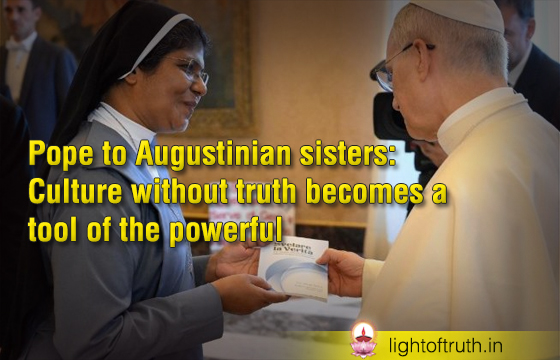
Pope to Augustinian sisters: Culture without truth becomes a tool of the powerful
“A culture without truth becomes a tool of the powerful”. Pope Leo XIV gave this consideration during a meeting with the Augustinian Sisters Servants of Jesus and Mary in the Apostolic Palace on July 5. He explained that “instead of freeing consciences, it confuses and distracts them according to the interests of the market, trends or worldly success”.
“You will be persevering in the following of Christ, who is ‘the way, the truth and the life’ and therefore the criterion of all our cultural initiatives”, the Pope emphasized.
The Augustinian Sisters Servants of Jesus and Mary were founded in 1827 by the Venerable Maria Teresa Spinelli, an Italian Augustinian sister who dedicated her life to teaching and helping young people. Today, the members of this religious order are present in nine countries spanning from the Philippines to Brazil. They follow in their foundress’ footsteps with educational projects, by assisting marginalized young people and women, and offering medical assistance.
Other than allowing Christ to be the guiding element for their mission, the Pope also offered the sisters two other suggestions in order for them to imitate their foundress in their work. You will “be patient in tribulations, because it is precisely in our trials that the Lord confirms his faithfulness; you will be brave in your mission, so that the educational work to which you dedicate yourselves may form wise minds and hearts capable of listening and to feel passion for humanity”, he explained. The Pope in fact urged the sisters to read St. Augustine’s text ‘De Magistro’, where he highlights “that outward teaching must always lead to an encounter with the inner Teacher, who is Jesus”.
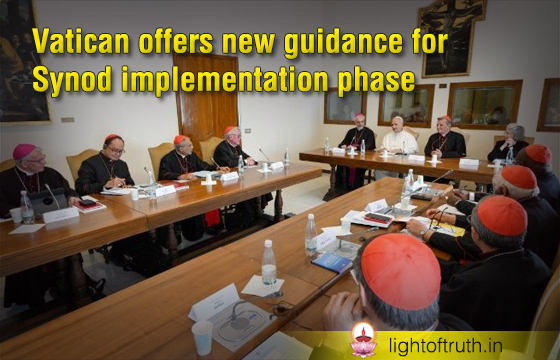
Vatican offers new guidance for Synod implementation phase
The General Secretariat of the Synod released “Pathways for the Implementation of the Synod”, which provides “an interpretive key for understanding the implementation phase of the Synod on Synodality.” Released on July 07, Pathways for the Implementation Phase of the Synod offers “local Churches throughout the world the world a shared framework that will make it easier to walk together” and promotes “the dialogue that will lead the whole Church to the Ecclesial Assembly,” set for October 2028 that will mark the culmination of the synodal process begun by Pope Francis in 2020.
Opening Pathways, Cardinal Mario Grech, the Secretary General of the Synod, notes that “the synodal form of the Church is at the service of its mission… it is the urgency of this mission that drives us to implement the Synod, a task for which all the baptized share responsibility.” He says that the General Secretariat of the Synod, which prepared the new document, is at the service of the local Churches, ready “to listen to them, support their efforts, and, above all, contribute to animating the dialogue and exchange of gifts between the Churches.”
Pathways opens with an explanation of the implementation phase and its objectives, and goes on to describe the participants of the implementation phase, along with their tasks and responsibilities; to suggest how to engage with the Synod’s Final Document, the main point of reference for this phase of the Synod journey; and to offer advice on methods and tools that “can help shape our path during the implementation phase.”
“We convey” these pathways, says Cardinal Grech, “to the entire People of God, who are the subjects of the synodal journey, and in particular to the Bishops and Eparchs, to the members of the synodal teams, and to all those who are involved in various ways in the implementation phase.” The aim, he adds, “is of making them feel our support and continuing the dialogue that has characterized the entire synodal journey.”