Goa still a ‘battery’ of Catholicism for Asia

Goa, a former Portuguese colony that now ranks as having one of the most famous beaches in India, is continuing to promote Christianity in Asia as part of its colonial legacy, according to former Archbishop Raul Gonsalves.

The 91-year-old retiree believes Jesuit missionaries, who have been based in his homeland on the subcontinent’s southwest coast since the 16th century, are still having a ripple effect across the entire continent, despite alleged attempts to “ethnically cleanse” the area of Catholics in the past. Archbishop Gonsalves said Goa has produced bishops for a number of countries due to the strong sense of faith instilled in so many families in the region.

This tiny Indian state, covered by the dioceses of Goa and Daman, has churned out some 60 bishops and cardinals for India, Pakistan and Africa, according to Father Joaquim Loiola Pereira, secretary to the current Archbishop of Goa Filipe Neri Ferrao.

Goa Diocese was created in 1533, 23 years after the Portuguese conquered the state by defeating its then Muslim ruler Ismail Adil Shah.

About 500,000 of Goa’s 1.8-million population identify as Catholic while in nearby Kerala about 5 million of its 36 million people are Catholics, and another 1 million are from other Christian denominations.

Vietnamese court imprisons peaceful demonstrators

A court in southern Vietnam has jailed 15 protesters includ-ing Catholics who joined nat-ionwide protests against a new cybersecurity law and a draft law on special economic zones.

On July 30, the People’s Court in Bien Hoa city sentenced Tran Nguyen Duy Quang, 35, and Pham Ngoc Hanh, a 45-year-old Catholic mother of five, to 18 months and 16 months in prison respectively, Dong Nai newspaper reported.

The newspaper said 13 other defendants were jailed for 8-10 months, while five others were given 12-14 months’ probation as they need to take care of their children. Many of the defendants are Catholics from Xuan Loc, the country’s largest diocese in terms of population. The court also confiscated 10 motorbikes belonging to defendants.

All defendants were convicted of causing public disorder, holding up banners, shouting slogans, inciting others to protest and blocking traffic for hours on June 10 at the protest in Bien Hoa, the capital of Dong Nai province.

Religion a punchbag for Indian poll

India’s secular ethos is being eroded by the politicization of religion ahead of a general election due in May next year.

Opposition parties during the latest session of parliament accused the federal government led by the pro-Hindu nationalist Bharatiya Janata Party (BJP) of trying to manipulate religious sensitivities. The Congress Party said Prime Minister Narendra Modi is copying divide-and-rule tactics used by British colonial rulers to foment antagonism between Hindus and Muslims. This included BJP leaders branding Congress as a “Muslim party.”

Thousands March in Support of Nicaraguan Bishops

The streets of Nicaragua were filled July 28 by thousands of demonstrators supporting the country’s bishops and priests after repeated attacks by para-militaries with ties to the government.

The march was organized by the “Outcry for Nicaragua” movement and the Civic Alliance for Justice and Democracy. Its theme was “Pilgrimage for Our bishops, Defenders of Truth and Justice.” The Nicaraguan Bishops’ Conference did not participate in the event.

The march, which concluded at the Managua cathedral, took place after President Daniel Ortega accused the bishops of being “part of the plan with those plotting a coup,” after they proposed that he hold early presidential elections to alleviate tensions in the country and not run for office again.

Participants in the demonstration carried banners with phrases such as “Thank you, courageous bishops, for being with your people” and “The bishops, heroes of pea-ce.” They chanted, “Bishop, friend, the people are with you.”

Study says practical reasons, not lack of faith, keep people out of church

Pope Francis insists that attending Sunday Mass isn’t just an obligation of the faith, saying last year that “only with the grace of Jesus, with his presence alive in us and among us, can we put into practise his commandment and be his credible witnesses.” Yet, according to a new study from the Pew Research Centre, many Americans choose not to attend religious services because of practical or personal reasons – not because of a lack of faith.

“Why Americans Go (and Don’t Go) to Religious Services” aims to make sense of the decline in regular attendance at mass, synagogue, mosque, or some other house of worship. The study finds that the primary reason for attendance is straight forward: People want to be closer to God.

It’s making sense of why they don’t go that is more complicated.

While 81% of respondents said they attend services regularly to grow closer to God, 69% said they do so in order that their children will have a moral foundation, 68% said they do so in hopes of becoming a better person, and 66% said it’s an important comfort in times of grief or sorrow.

Latin-rite bishop appointed to administer Eastern-rite diocese following legal dispute

Latin-rite Bishop Thomas Olmsted of Phoenix has been appointed apostolic administrator of a Byzantine Ruthenian eparchy also based in Phoenix in USA, following a legal dispute among Eastern Catholics. Archbishop Christophe Pierre, Vatican nuncio to the United States, announced the appointment of Bishop Olmsted to the Holy Protection of Mary Byzantine Catholic Eparch on August 1. Bishop Olmsted, who remains the head of the Phoenix Diocese, said that the current head of the eparchy, Bishop John Pazak, remains in place.

Child trafficking: India orders inspections for all of Mother Teresa’s orphanages

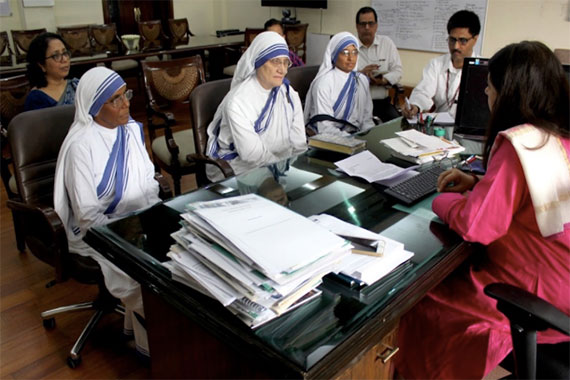
The Indian government has ordered the inspection of all the orphanages and children’s care homes run by the order founded by Mother Teresa, after a nun was arrested on charges of trafficking in newborn babies.

In a statement released recently, Women and Child Development Minister Maneka Gandhi said that all state governments have been asked “to get child care homes run by Missionaries of Charity all over the country inspected immediately.”

Early this month, police in Ranchi (Jharkhand) arrested Sister Koshleniea, who ran a children’s home, and an employee of the facility, Anima Indwar, who “sold” a newborn to a family in Uttar Pradesh for 120,000 rupees (US$ 1,750).

Minister Maneka Gandhi’s move appears to be an attempt to stop child trafficking and illegal adoptions that see more than 100,000 children disappear in India. Gandhi also asked that all childcare institutions should register and be linked to a central office for adoption within a month. According to government figures, 2,300 institutions have already registered with another 4,000 still pending.

Sister Mary Prema, superior general of the Missionaries of Charity, has already stated that the congregation would investigate something that “goes against our moral convictions,” and that they would take steps to prevent anything like this happening in the future.

The Catholic Bishops’ Conference of India, however, expressed doubts about the case involving the Sisters of Mother Teresa in Jharkhand, that it is being purposefully blown out or proportion by “some people” trying to frame the organisation founded by Mother Teresa. West Bengal Chief minister, Mamata Banerjee, who is great admirer of the saint of Calcutta, spoke in defence of the order founded by Mother Teresa.

Demand for ban on confession shocks Cardinal Gracias

The head of the Catholic Church in India on July 27 expressed shock at the National Commission for Women’s demand for a ban on the Christian practice of confession. “This demand by the commission betrays a total lack of understanding of the nature, meaning, sanctity and importance of this Sacrament for our people; and also an ignorance of the strict laws of the Church to prevent any abuse,” Cardinal Oswald Gracias, president of the Catholic Bishops’ Conference of India, said in a press release.

The 73-year-old prelate, one of the eight cardinal advisers of Pope Francis, said such a ban will directly infringe on “our freedom of religion guaranteed by the Indian Constitution.”

According to him, millions of people from all over the world, over the centuries, have testified to the spiritual benefit of this Sacrament and to the grace, pardon and peace they have experienced as a result of receiving this Sacrament. “I am confident the government will totally ignore this absurd demand from the commission,” he added.

The cardinal was reacting to commission chairperson Rekha Sharma’s recommendation to Prime Minister Narendra Modi and some of his cabinet colleagues to take steps to abolish the practice of confession in Christian Churches. The commission, a statutory body concerned with advising the Indian government on policy matters affecting women, reportedly recommended confession’s abolition alleging that the practice could lead to blackmailing of women.

Sharma on July 26 said priests pressured women into telling their secrets. “We have one such case in front of us, there must be many more such cases and what we have right now is just a tip of the iceberg,” she said.

The recommendations come in the backdrop of a rape case against four priests of Malankara Orthodox Syrian Church accused of sexually exploiting a married woman belonging to their church.

The issue came to the fore after the victim’s husband wrote to the Church, alleging that the priests blackmailed and abused his wife, a school teacher.

Spanish priest a good shepherd for ex-Khmer Rouge

Within weeks of the collapse of the final remnants of the Khmer Rouge in late 1998, Father Enri-que Figaredo, also known as “Kike” or “The Bishop of the Wheelchair,” went to visit some of the movement’s last-standing cadres after hearing they needed assistance.

During the decades-long civil war, many had lost limbs to land-mines and were struggling after the group’s ultra-Communist leadership had defected, died or been arrested.

While many people would have been apprehensive to say the least about entering an area that until recently had been controlled by one of the most feared revolutionary movements of the 20th century, Father Figaredo saw it as his calling. “I remember going to one of the furthest corners of Cambodia,” he said from within the grounds of Battambang Catholic Church, or Pet Yiey Chee as it is known by locals.

“They asked for my support. I went to see them and gave them chickens so they could have eggs and meat. I also gave them small loans,” most of which are still being put to use today, he said.

Beijing, raid on Christian churches: ‘Our rights are being violated, enough!’

A group of Protestant congregations writes a courageous appeal to the government: “You consider us a threat, an error to be corrected. But wrong, we want to contribute to the well-being of the nation like everyone else.” The capital orders a catalog of unregistered places of worship. Among the churches affected, one is Catholic.

Chinese Christians “are not a force in disagreement, an error to be managed or rectified, the chosen objective of veiled or direct attacks. Thinking this way is wrong, it’s a fundamental mistake. The Christian churches, even the domestic ones, are animated by the desire for dialogue to achieve the best possible relations with the government of this new era, to achieve socialism with Chinese characteristics “of which President Xi Jinping speaks. This is the courageous appeal launched by dozens of domestic Protestant churches, struck by yet another round of restrictions on their religious freedom.

The text, signed by 34 unofficial churches, underlines how recent revisions to religious regulations adopted by the government have broken the rights of the faithful: “The normal life of a believer has been violated and hindered, and this has caused enormous emotional damage. The sense of patriotism that animates Christians has also been affected, opening the possibility to social conflicts. The situation seems to worsen day by day.”

To overcome this impasse, Christian leaders write, “the authorities must respect the religious freedom protected by the Constitution of China. That text contains many rights that in reality the single-party state does not respect. The churches have a real desire for dialogue.”

The Chinese State Council approved in 2016 a new package of regulations on religious activity termed as “draconian.” The declared aim is to eliminate the unregistered Christian cult, that of the so-called “domestic churches.” The new rules came into force on 7 October 2016, effectively prohibiting religious preaching or Christian events online or in schools.

Official Website

Exit mobile version