Rights group condemns repeated raids on Jesuit activist

A human rights group in Jharkhand, eastern India, has condemned what it called repeated raids on Jesuit social activist Father Stan Swamy.

“The raids and arrests are part of the government’s growing attempts to stifle dissent and intimidate those who are fighting for justice,” the Jharkhand Janadhikar Mahasabha (Grand council of people’s rights in Jharkhand) said on June 12 soon after the police raid.

An eight-member team of the Maharashtra police raided the Bagaicha campus, the 83-year-old priest’s residence at Namkum near Ranchi, the Jharkhand State Capital. The raid that started at 7:15 am continued for 3.5 hours.

The Maharashtra police had earlier raided the priest’s residence on August 28, 2018.

In the latest raid, the police searched the priest’s belongings and took his computer hard disk and internet modem and forced him to give his email and Facebook passwords. Thereafter, they changed the passwords and seized these accounts.

“The Jharkhand Janadhikar Mahasabha condemns repeated raids on Stan Swamy and arrests of other human rights activists,” the statement said.

Archbishop Machado mourns Karnad’s death

Archbishop Peter Machado of Bangalore on June 11 expressed deep sorrow over the passing away of Girish Karnad, a legendary playwright, actor and social activist.

“We have lost a legend in field of literature and arts. Truly our cultural world is poorer today,” Archbishop said in his condolence message.

The archdiocese later stated that the Catholic bishops of Karnataka with the entire Christian community, priests, religious and lay faithful joined the archbishop in conveying heartfelt condolences to the bereaved family.

Karnad was a man of multi-dimensional talented in nature. Theatre was his vocation. He was a prolific writer, thinker, actor, social activist, non-corrupt and fearless speaker. He also left an indelible impression on cinema, Archbishop Machado noted.

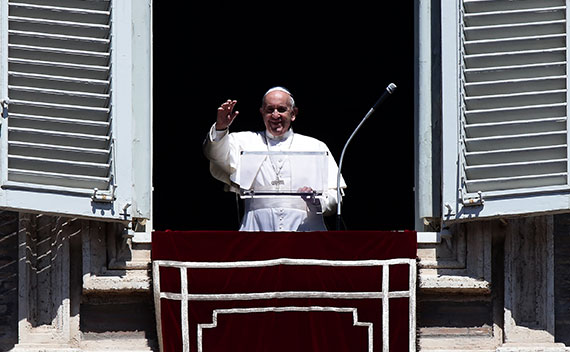
Pope Francis was right to approve the new translation of the Lord’s Prayer

Does God lead people into temptation? Not anymore, at least if you’re a Catholic in France, Spain, or – as of – Italy, where the Bishops’ Conference has approved (with Pope Francis’ blessing) a translation of the Our Father that wrestles the blame for sin away from God, and into the world. The subtle change – from “lead us not” into “do not let us fall” – is an exegetical sleight of hand that has caused theological uproar, bringing on bewilderment in the broadsheets and forging an unlikely alliance between Traditionalist Catholics and Protestant literalists.

Bishop’s body exhumed on court order

The body of Bishop Thomas Thennatt of Gwalior was on June 10 exhumed following a complaint from a Catholic woman who suspected foul play in his accidental death seven months ago.

“The police team took the body for medical examination and brought it back to the graveyard where it will be buried again,” Father Maria Stephen, the public relation officer of the Catholic Church in Madhya Pradesh, told Matters India.

“The body will be buried only after getting permission from the government authori-ties,” he added.

At the time of filing the report, the Church officials were waiting for permission from the government authorities for burial.

On May 11, Judicial Magistrate First Class Nidhi Neelesh Shrivastava, Pohari, district Shivpuri directed the police to investigate the circumstances that led to the prelate’ death and submit its report within a month.

The court order came following Dolly Theresa, a laywoman, approached the court saying she suspected foul play in the bishop’s death.

The woman alleged the diocesan authorities have restrained her from receiving Holy Communion from all churches in the diocese after she filed the petition.

“I had complained to the nuncio and the archbishop of Bhopal about the restriction imposed on me from the diocese, but to no avail,” she told Matters India.

Myanmar Bishops demand shut down of Myitsone dam

In a rare move the Catholic bishops of India’s neighbour Myanmar have jointly demanded the complete shutdown of the China-backed Myitsone Dam on Irrawaddy river.

Charles Cardinal Maung Bo of Yangon and 18 bishops from 16 dioceses of Myanmar signed the statement after a biannual meeting held in Yangon.

In a statement released on 8 June 2019, they affirmed their constant effort to “engage in constructive dialogue with the government and all the stakeholders, firmly holding the belief that peace is possible and peace is the only way to effective nation building.”

The bishops pleaded for all dam stakeholders “to review the Myitsone Dam project in Kachin State and stop it permanently” for the sake of the country’s people.

“The River Irrawaddy runs through the heart of our nation nourishing millions of our people, flora and fauna with water for livelihood and life,” the statement said.

They also stressed people’s sentiments stating, “To the people of Myanmar, the history of River Irrawaddy is intertwined with our joys and our sorrows.”

The bishops feared the resumption of the mega dam would further displace thousands of people.

The bishops further claim that “Scientists have identified serious fault lines below the rivers’ course and building a dam might expose the lines to greater pressure and consequent mega disasters.”

They fear, “The promised economic benefits that are thought to come from the dam are no match for the social and ecological disturbances that will certainly come.”

The US$ 3.8 billion dam project on the Irrawaddy, Myanmar’s premier waterway, was being built to provide hydro-electricity that would be used almost exclusively in neighbouring China.

Indian nun receives honorary doctorate for her work with UN

Spalding University, USA, has conferred an honorary doctorate on Indian nun, Sister Teresa Kotturan of Nazareth,  at the United Nations  for the Sisters of Charity Federation, on June 3.

Sister Teresa, a member of the Sisters of Charity of Nazareth, Kentucky, serves as the main representative for the Sisters of Charity Federation NGO at the UN.

In this role, Sister Teresa’s primary objective is to take to the global stage of the UN, the concerns of the 3,400 members of the Charity Federation and all those with whom and to whom they minister in 28 countries.

Agra archdiocesan priest appointed Gwalior bishop

Pope Francis on May 31 appointed Father Joseph Thykkattil of the Arch-diocese of Agra as the bishop of Gwalior in Madhya Pradesh.

Father Thykattil is currently the parish priest of St Peter’s Church in Rajasthan State’s Bharatpur.

This was announced at noon in Rome, corresponding to 3:30 pm in India, according to a press release from the Catholic Bishops’ Conference of India headquarters in New Delhi.

Modi visits blast-hit church during Lanka trip

Indian Prime Minister Narendra Modi plans visited St Anthony’s Church, venue of the first bomb blast site in Colombo, during his official visit to the island nation on June 9. The Indian premier’s Sri Lanka visit was announced by Sri Lankan President Maithripala Sirisena on May 31, a day after he attended Modi’s swearing-in ceremony in New Delhi.

Modi will go to Sri Lanka after completing a trip to the Maldives, the Sri Lankan president told reporters.

“Prime Minister Modi’s visit is very important to us. We are neighbours and friends… We are eagerly awaiting his arrival,” Sirisena told a news conference on May 31 after his meeting with the Indian premier at Hyderabad House.

Sirisena also said that his country is eagerly waiting to welcome the Indian leader.

Earlier, India’s Ministry of External Affairs said in a statement that Modi warmly thanked Sirisena for his gesture of attending the ceremony and for his good wishes. “He conveyed his government’s continued commitment to further foster friendly bilateral ties with Sri Lanka,” it added.

Modi’s Sri Lanka visit would highlight that for India “neighborhood first policy” is paramount.

Sirisena also said that the visit will further strengthen bilateral ties between the two countries, particularly in areas of trade and commerce. India is currently cooperating with Colombo in the investigations being carried out on the Easter Sunday terrorist attack bombers and ISIS presence. New Delhi has also sent a team from its National Investigation Agency to Colombo to further assist them with the investigations and their findings.

Modi is expected to visit Maldives on June 7-8 which will be his first bilateral visit after becoming the Prime Minister for a second term. However there is no official statement regarding the matter.

Tight control for Chinese underground bishop’s funeral

The funeral of a Chinese underground bishop was held under strict government control and underground priests were only allowed to attend part of it.

Bishop Stephen Li Side of Tianjin died at the age of 92 on June 8 after suffering a stroke in mid-May and being admitted to a hospital in Ji County.

Underground Coadjutor Bishop Shi Hongzhen, who will eventually succeed Bishop Li, was not allowed to attend his funeral on June 10. A source said Bishop Shi had been under 24-hour surveillance by local authorities who had restricted his movement.

State-sanctioned Tianjin Catholic Patriotic Association was put in charge of the funeral. When underground priests asked officials to allow Bishop Shi to hold the ceremony, the request was rejected because Bishop Li and Bishop Shi were not recognized by the government.

However, underground priests were allowed to organize a requiem Mass held by senior underground priest Father Yang Wanyuan at a funeral home, but laypeople and the taking of photographs were banned.

Tiananmen massacre 30 years on: Modern China remains Orwellian

Thirty years ago, China’s Communist Party regime revealed, yet again, its true character when it turned its guns on the people and sent in its tanks to crush peaceful pro-democracy protests in Tiananmen Square.

The People’s Liberation Army turned out to be neither on the side of the people nor for liberation as it slaughtered thou-sands who were simply seeking freedom. “We didn’t commit any crimes,” says Bob Fu, an exiled dissident and president of China Aid, who had joined the protests but left the square three days before the massacre. “We were just holding a peaceful protest.”

Three decades later, China, under President Xi Jinping, is undergoing the worst crackdown on human rights since the Tiananmen massacre. Hopes that China would gradually liberalize politically as it opened up economically have been dashed.

And the crackdown is on every form of freedom, from expression to religious belief, and in every corner of China’s territory, from Xinjiang to Hong Kong, and has taken on an unprecedented extraterritorial aggression, resulting in critics abroad being harassed, intimidated, threatened and, in the worst cases, kidnapped.

Furthermore, the Chinese regime has done everything possible to bury the truth of what happened in Tiananmen Square on June 4, 1989.

Official Website

Exit mobile version