Nigeria accounts for 72% of Christian killings worldwide, new report finds

More Christians were killed in Nigeria last year than any-where else in the world combined, a new report has found, placing the country at the centre of a growing global persecution crisis. Of the 4,849 Christians killed for their faith worldwide, 3,490 were in Nigeria, according to Open Doors’ World Watch List 2026.

Open Doors is a Netherlands-based international Christian mission that tracks global perse-cution and supports persecuted Christians worldwide. The orga-nization’s annual World Watch List ranks 50 countries by the severity of persecution faced by active Christians.

The new report also shows a global increase of 8 million Christians facing high levels of persecution and discrimination between October 2024 and September 2025, bringing the total to 388 million.

Speaking at the report’s launch, Henrietta Blyth, CEO at Open Doors UK & Ireland, said: “Nigeria is in sub-Saharan Africa, a region that represents a death trap for Christians,” while expre-ssing relief that people are finally talking about what’s going on in the country.

In recent months the situation in Nigeria has been back in the spotlight after U.S. President Donald Trump threatened to go “guns a-blazing” into the country and subsequently launched strikes on militants linked to the Islamic State group in the northwest of the country.

While both the U.S. and Nigerian governments cooperated on the strikes, Trump has accused the Nigerian government of failing to protect Christians from jihadist attacks, with some allies and campaign figures describing the situation as a “genocide.”

The Nigerian government is reluctant to address the religious aspect for fear of being designated a “country of particular concern,” which could “enable the Trump administration and other international governments to take measures including an embargo,” according to John Samuel, an expert on sub-Saharan Africa for Open Doors.

Pope Leo XIV addressed the Nigeria crisis in November 2025, acknowledging that “Christians and Muslims have been slaughtered” in the country. He told journalists at Castel Gandolfo that “many Christians have died” and called on the government to “promote authentic religious freedom.” The pope’s comments came after Trump designated Nigeria a country of particular concern for religious freedom violations.

Lack of faith, especially among youth, should spur evangelization, pope says

The increasing number of people who do not see the Gospel as a fundamental resource for their life should inspire — not discourage — Catholics in rediscovering the joy of evangelization, Pope Leo XIV said. The transmission of the faith is “a topic of great urgency,” the pope said in remarks to members and officials of the Dicastery for the Doctrine of the Faith and others participating in its plenary session at the Vatican Jan. 27-29.

Meeting with the group at the Vatican Jan. 29, Leo praised the dicastery for its “valuable service” of helping the pope and the world’s bishops proclaim the Gospel by promoting and safeguarding the integrity of Catholic teaching on faith and morals. “It does this by drawing upon the deposit of faith and seeking an ever deeper understanding of it in the face of new questions,” he said, citing Pope Francis’ apostolic constitution on the reform of the Roman Curia, Praedicate Evangelium (“Preach the Gospel”).

Of great importance today, he said, is the “transmission of the faith,” a topic discussed during the dicastery’s plenary. “We cannot ignore the fact that, in recent decades, there has been a breakdown in the way Catholics pass down the Christian faith” from generation to generation, he said, and that “there is an increasing number of people who no longer perceive the Gospel as a fundamental resource for their life, especially among the younger generations.”

In fact, he added, many young men and women “live without any reference to God and the Church, and while this causes us believers pain, it must also lead us to rediscover the ‘delightful and comforting joy of evangelizing,’ which is at the very heart of the life and mission” of the Catholic Church.

Reiterating his appeal during his extraordinary consistory with the College of Cardinals in early January, Leo said, the Catholic Church wants to be a missionary Church “that looks beyond itself, at others” and that proclaims the Gospel, “above all through the power of attraction,” reminding them that “it is not the Church that attracts, but Christ.”

Korean activists, religious groups oppose nuclear power plants

Civil society and religious groups in South Korea have continued their strong opposition to two proposed nuclear power plants, accusing the government of moving ahead hastily without sufficient access to information, deliberation, or consent. During a press conference on Jan. 27, the Citizens’ Action for Nuclear Phase-out, a coalition of 43 environmental, advocacy, and religious groups, slammed the government for its planned nuclear plants, according to a report by the advocacy group People’s Solidarity for Participatory Democracy.

“We strongly condemn the forced push for the hastily pursued new nuclear power plant construction plan,” said Esther Yoo, an executive committee member of the Nuclear-Free Citizens’ Action group. Yoo also demanded that South Korean President Lee Jae-myung “dismiss Minister Kim Sung-hwan and personally explain the [purpose of the] new nuclear power plants.”

On Jan. 26, Kim, the Minister of Climate, Energy and Environment, stated that the government would proceed with the construction of two new nuclear power plants, the Asia Business Daily reported. Kim hinted at the possibility that the proposal for additional nuclear power plants remains open in the 12th Basic Electricity Plan, which will be prepared this year.

A public opinion survey found that more than 80 percent of respondents said nuclear power is necessary, and over 60 percent agreed that the new nuclear power plants were essential, according to the government.

Park Hang-joo, a specialist committee member of Green Korea United, condemned the survey as “ridiculous.” He pointed out that the survey methodology was flawed and the questions “failed to verify the consistency of the entire survey and responses for policy decision-making.”

Lee Heon-seok, a policy committee member of Energy Justice Action, warned about the risk of nuclear power plants clustered together near cities. “In the event of an accident, the risk is enormous, and evacuation is completely impossible due to the dense concentration of major cities nearby,” Lee warned.

Cambodian faiths unite against scourge of plastic pollution

Cambodia is drowning in a flood of plastic waste — almost literally in some cases — fueled by rapidly growing consumption and economic growth, poor to non-existent rubbish collection, almost no recycling, and a lack of public awareness. The kingdom produces 32 kilograms of waste per person — 33 percent more than other countries around the world at a similar stage of development, according to the government’s Plastic Action Roadmap released on Jan. 20, which sets out a 14-year strategy drawn up in partnership with the United Nations Development Programme (UNDP).

Underlining the issue: Phnom Penh, a city of barely 2.5 million people, uses 10 million plastic bags a day, most of which are thrown away the same day. The Environment Ministry says the volume of waste in the capital alone more than trebled from 343,657 tons in 2007 to 1,058,500 tons in 2019. About 20 percent is single-use plastics such as plastic bags, straws, PET bottles and cups. “In 2022… only five percent of Cambodia’s plastic waste was properly managed, with less than two percent properly recycled. The remaining 95 percent is mismanaged, ending up in dumpsites, being openly burned, or leaking into the environment,” the Roadmap said. “Without urgent intervention, this crisis will continue to escalate, seriously threatening Cambodia’s ecosystems and public health.” The Roadmap plans to increase recycling by 52 percent and cut mismanagement — basically, improper disposal or treatment —  by 74 percent by 2040.

Cambodia’s interfaith youth alliance has made this a priority and is working with local communities and organizations to promote awareness, conduct workshops, and help change the use and waste of plastic. The alliance of Buddhist, Christian and Muslim youth sees country’s waste crisis as a deadly legacy for future generations.

“We need to change the concept of using plastic,” says alliance leader Nhib Kimheang. “It is too easy to use and too easy to throw away without thinking of the effect,” she told UCA News. “It threatens the environment. And when people burn it, it pollutes the air and people choke. If Cambodia cannot cut its plastic waste, there will be a huge problem for the next generation. It is harming the ecosystem, reducing agricultural productivity, and harming food security and public health.” “It will also cost the country a lot of money if we don’t deal with the waste problem now.”

Thai Bishops call Catholics to act as ‘moral force’ in upcoming polls

The Catholic Bishops of Thailand have reminded the faithful that they have a vital role to play as a “moral force” and “social conscience” in safeguarding a truthful and just electoral process. In a message addressed to parishioners nationwide and released on January 27, Archbishop Francis Xavier Vira Arpondratana, president of the CBCT, stressed that voting is not merely a civic right but a moral responsibility rooted in the Church’s social teaching.

“The Church invites all Christians to recognize that voting is a moral obligation for the common good,” Archbishop Vira said. “Exercising the right to vote is not simply a legal duty, but a moral requirement that citizens must collectively fulfill for the good of society.”

Citing the Catechism of the Catholic Church, the Archbishop recalled that citizens are called to contribute to the common good through concrete actions such as paying taxes, defending the country, and participating in public life through voting. Neglecting to vote, he noted, constitutes a failure to participate responsibly in society.

The pastoral letter offers guidance to Catholic voters as the campaign period intensifies ahead of the election, which will determine all 500 seats in Thailand’s House of Representatives, whose members will nominate the new prime minister.

According to the CBCT, authentic democratic participation does not end at the polling booth. “Participation includes monitoring, scrutinizing, and upholding moral truth at every stage of the electoral process,” the statement said, adding that abstaining from voting may be morally permissible only in exceptional cases where no candidate meets minimum ethical standards.

The Bishops also warned against reducing democracy to procedural rules alone. “True democracy is not merely the result of laws and regulations,” Archbishop Vira said, “but arises from the acceptance of fundamental values such as human dignity, human rights, and the common good.” Without these values, he cautioned, democracy risks becoming a “disguised dictatorship” that ultimately oppresses the people, citing the Compendium of the Social Doctrine of the Church (No. 408).

Cardinal Tagle celebrates 80th anniversary of Hong Kong diocese

To mark the 80th anniversary of the establishment of the Diocese of Hong Kong, a celebration with prayer, song, and music brought people together from across the diocese. “May the Holy Face of Jesus always shine upon Hong Kong”, Cardinal Luis Antonio Gokin Tagle said, at the event at the Charter Garden in Hong Kong on January 18. The Cardinal Pro-Prefect of the Dicastery for Evangelization explained the Biblical origin and nature of the Christian practice of blessing. Following the explanation, he blessed everyone present and the entire city—together with the Jesuit Cardinal Stephen Chow Sau-yan, Bishop of Hong Kong.

According to the Vatican’sFides news agency, the Pro-Prefect specifically drew inspiration from the blessing found in the Book of Numbers (“The Lord let his face shine upon you and give you peace”). He offered it as “the blessing that God desires to give us”—that His face shine upon men and women throughout all ages. “The blessing that God gives us and to Hong Kong is His Holy Face in Jesus Christ”, Cardinal Tagle noted. It is a face that is both “fully divine and fully human”. He also explained that it is also possible to encounter the Face of Jesus through the face of a child as they “are always a blessing for society”. The Pro-Prefect stressed that “no child or young person is a ‘problem’”. The true blessing for Hong Kong, therefore, is “the face of God that shines upon it”. Cardinal Tagle expressed his hope that the face of Jesus will always shine on Hong Kong and that Hong Kong may always rejoice in His face. In this spirit, people will be encouraged to “bring hope to society”, becoming “courageous witnesses of the Lord”.

In his address, the Pro-Prefect encouraged everyone in Hong Kong to foster these “blessings”, acknowledging that all have the ability to become “a blessing to others”.

At the ceremony, people and groups from various nationalities and backgrounds prayed for Hong Kong in different languages: Cantonese, Filipino, French, Mandarin, Korean, and Vietnamese. Of the more than 7.4 million permanent residents in Hong Kong, over 400,000 are Catholic.

Cardinal Sako: Domestic instability and winds of war bring fear to Baghdad (and Tehran)

Cardinal Louis Raphael Sako, the Chaldean Patriarch of Baghdad, spoke to AsiaNews about recent events in Iraq, and more generally in the region, scene of a new escalation between Iran and the United States (and Israel). “Sadness, great concern, and a climate of fear” are pushing many government officials and religious leaders to remain silent, relegated to the margins while the country risks sinking back into a spiral of tension and violence, fuelled by new winds of war that are “blowing in the Middle East,” in addition to an “internal instability” that has already proven to be a decisive factor in plunging Iraq into chaos.

Amid a broad conspiracy of silence, fear, and silence that resonate louder than words, “several politicians have in recent days asked me to intervene, to make the voice of a religious authority heard,” said the cardinal by telephone at the end of a three-day retreat and prayer. Fear and anxiety are fed by internal instability in a country waiting for the new president to be elected after repeated postponements. Once he is named, he will have to name a prime minister charged with forming a new government.

“Not only in Iraq, but throughout the region, from Syria to Lebanon, people are very worried,” Cardinal Sako said. “The same goes for Christians, who have already paid a very high price in terms of exodus, and who certainly cannot live without security and stability.” Above all, “They fear for their children and their future,” he explained.

“Last but not least, there is also the problem of an economy that is 90 per cent dependent on oil revenues, plus other critical factors,” including a resurging threat from the Islamic State and other jihadist groups.

The Chaldean patriarch has also joined the chorus of criticism and concern over the United States’ decision to send Islamic State detainees from Syria, just over a hundred for now, but they number in the thousands, to neighbouring Iraq.

Instability and fear are also reflected in “the weakness of international institutions, starting with the United Nations, which is no longer capable of ensuring global order. The only superpower today seems to be the United States, which does what it wants,” especially since Trump’s return to the White House.

Young Doctor Returns to Serve Poor Communities in Odisha

After completing his medical studies at a top medical college in Bengaluru, 30-year-old Dr. Akshya Montry chose to return to his home district of Gajapati in Odisha, one of India’s most remote and underdeveloped regions. Raised in a poor village family, he says his own life struggles helped him understand the suffering of the people he now serves.

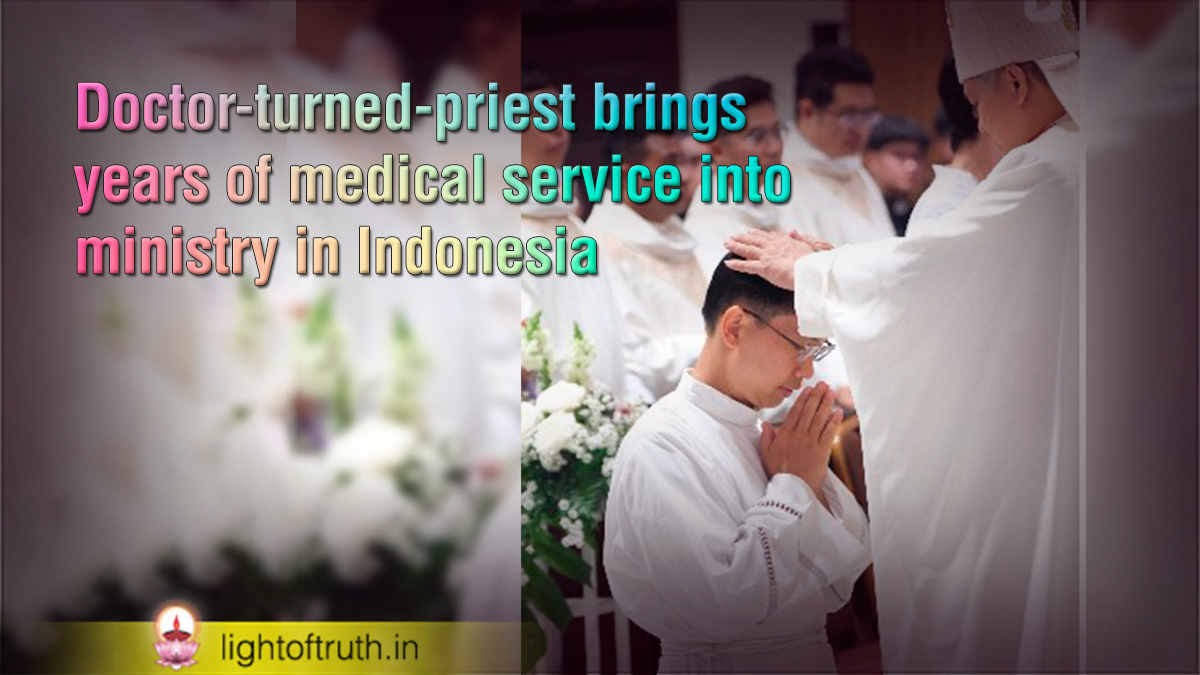
Dr. Montry works at the Kashinagar Community Health Center, a government hospital that mainly serves tribal and Dalit communities. Starting his day early, he treats 50 to 100 patients daily, handling common illnesses, emergencies, and accident cases. He considers his work a blessing and tries to treat every patient with care and respect.

Dr. Montry says he owes his medical education to the support of the Catholic Church. When his family could not afford the high admission fees, Church leaders and benefactors stepped in to help him through scholarships, donations, and fee concessions. This support continued throughout his studies, making it possible for him to complete his degree.

Now, Dr. Montry wants to specialize further while also helping poor students achieve their dreams. Odisha faces a serious shortage of doctors, especially in rural areas. Government reports show that many medical posts remain vacant, affecting healthcare delivery in tribal districts.

Church leaders say such achievements are remarkable, especially after the anti-Christian violence that affected Odisha in 2007–2008, disrupting education for many families. Today, there are dozens of Catholic doctors and nurses from poor backgrounds serving across the state.

Dr. Montry believes education restores dignity and hope. By serving his own people, he hopes to give back to society and inspire other young students to serve the poor with compassion and commitment.

Catholic Nuns Bring Hope and Healing Behind Prison Walls in India

The heavy iron gates of a central prison in Bengaluru opened recently for an 85-year-old Catholic nun, Sister Adele Korah. A guard saluted her and said, “Your people have been waiting for you.” Smiling, she replied that she too was eager to see them. For more than 20 years, Sister Korah has been visiting prisons as a volunteer, bringing hope, comfort, and faith to inmates.

In October 2025, Sister Korah and several other nuns published books sharing their experiences with prisoners across India. Her book, My Journey With Brethren Behind Bars, tells stories of 27 prisoners whose lives were renewed through encouragement and inner change. Other nuns wrote similar books, sharing stories of repentance, healing, and second chances from prisons in Bhopal, Pune, and Bengaluru.

The books were released during a national prison ministry convention in Kerala, where the ministry began over four decades ago. Today, the prison ministry has about 8,000 volunteers, nearly half of them Catholic religious, mostly nuns. They offer spiritual guidance, counseling, legal help, education, and skill training to prisoners.

Many nuns described prison ministry as the deepest expression of their vocation. Some help prisoners get bail or learn new skills, while others use music, prayer, and simple presence to heal wounded hearts. Several also continue supporting former prisoners after their release.

Church leaders say the dedication of these women has transformed prisons into places of renewal and hope. Through quiet service, prayer, and sacrifice, the nuns help prisoners rediscover dignity, faith, and the courage to begin again—even behind locked gates.

Republic Day Celebrations Raise Questions on Constitution’s Promise

Every year on January 26, India celebrates Republic Day with grand parades, cultural performances, and patriotic displays. In 2026, the country will mark 77 years since the Constitution came into force, turning India into a sovereign, secular republic. Across the nation, schools hold flag-hoisting ceremonies, families share sweets, and millions watch the parade from New Delhi.

The Constitution, adopted on January 26, 1950, promised equality, freedom, and justice for all citizens, regardless of caste, religion, or gender. It was shaped by leaders like B.R. Ambedkar, who warned that democracy would survive only if social and economic equality were achieved along with political freedom.

However, many observers note a growing gap between constitutional ideals and present realities. In recent years, concerns have been raised over arrests of political leaders, pressure on journalists, and legal action against students for protests. Critics say these actions challenge the Constitution’s guarantee of free speech and political rights.

Minority communities, especially Muslims, have also expressed fear and insecurity, pointing to laws and actions they feel undermine equality before the law. At the same time, economic inequality remains severe, with millions struggling in poverty despite constitutional promises of social justice. Dalits and tribal communities continue to face discrimination and displacement, while farmers’ protests highlight ongoing distress in rural areas.

The judiciary, seen as the guardian of the Constitution, has also faced criticism for delays in justice and weak enforcement of rights. Despite these challenges, India continues to hold regular elections, and civil society groups keep raising their voices.

Official Website

Exit mobile version